
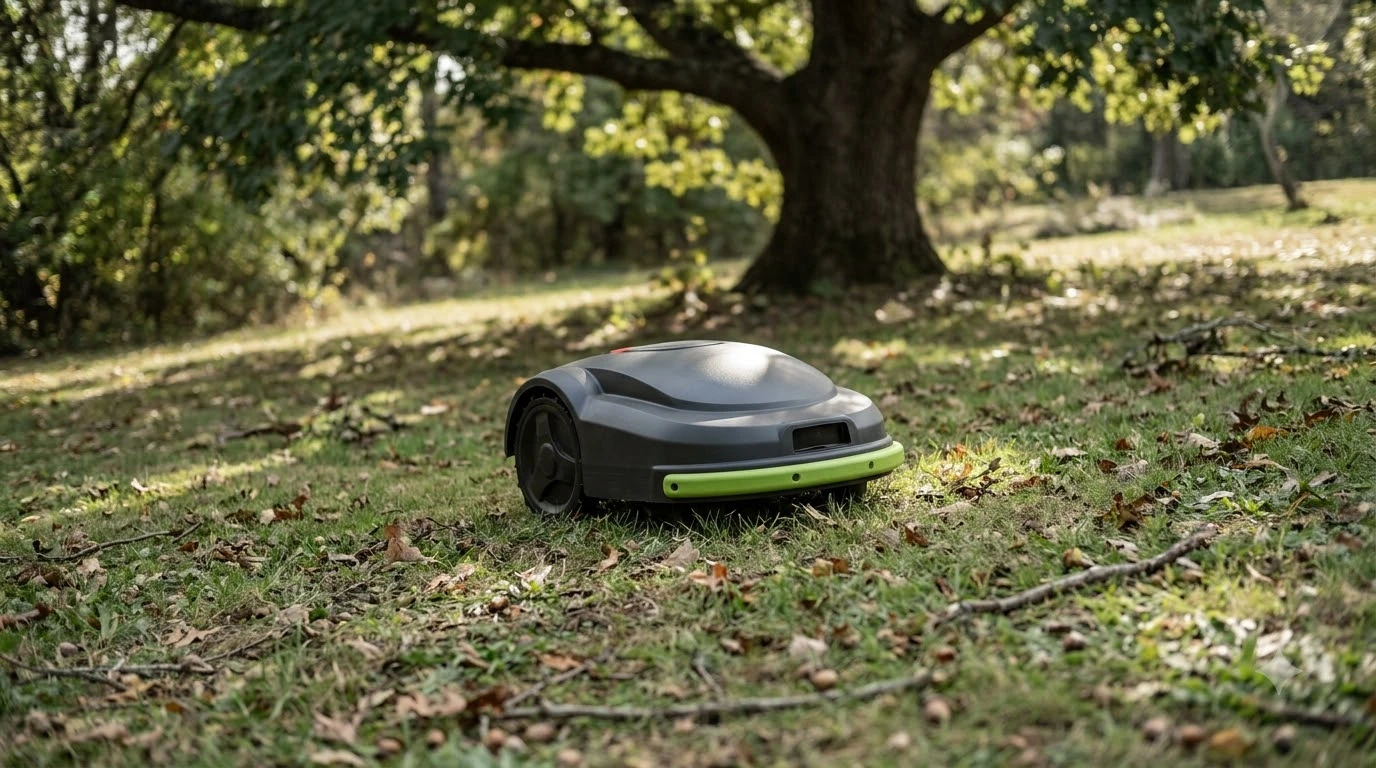

The best robot mower for yard with lots of trees is one that can keep its position when satellite signal is blocked. A mower that depends only on RTK GPS can lose its fix under dense canopy, so look for a model that adds vision, LiDAR or an inertial sensor as a fallback. Wire-free models are fine under trees, but you should test the shadiest corners before you trust a virtual boundary.
The short answer
- Positioning: choose RTK combined with vision or LiDAR over RTK alone.
- Boundary: a perimeter wire is the safest choice for tight corridors and dense shade.
- Obstacles: the mower needs reliable detection of trunks, low branches and roots.
- Grass: shaded turf needs a higher cutting height, so check the mower’s height range.
- Test first: walk the boundary, look up, and mark the zones where trees block most of the sky.
Why trees make robot mowing harder
Trees cause two separate problems. The first is signal. RTK GPS needs a clear view of the sky, and canopy can block satellite signals or reflect them, which makes the position less accurate. RTKdata’s guide says that a mower under partial canopy will get “occasional fix and float transitions,” while under dense canopy “RTK may not hold a fix.” Depending on its fail-safe logic, the mower may slow down, pause or wander. The same guide says RTK generally needs a clear sky above roughly 15 degrees from the horizon, so a single tall oak can be enough to cause trouble along one edge of the lawn. Dense planting is the main factor here, and the guide to mowing under tree canopy explains the basic limits. Trunks are picked up by the mower’s sensors and bumpers, as tree handling by sensors explains for dense plantings.
The second problem is the grass itself. Shade is hard on turf. The University of Florida’s IFAS extension notes that shaded grass stretches its leaf blades and stems, which depletes stored carbohydrates, thins the lawn and invites weeds. Mississippi State Extension adds that shaded turf near trees often needs extra water because tree roots compete for moisture, and that foot traffic stresses it further. A robot mower does not change either of these facts, so the mower you pick has to fit the lawn you have.
Best robot mower for yard with lots of trees: positioning comes first
Under trees, the positioning system decides whether the mower stays in its zone. The options below are the most common ones, and the trade-offs are real. Vendor claims are not independent tests, so treat them as starting points. Leaves can block satellites, and GPS signal under tree cover describes how mowers cope.
| Positioning type | Strength under trees | Weak point |
|---|---|---|
| RTK GPS only | Accurate in open sky | Fix can drop under dense canopy; no fallback described in many models |
| RTK plus vision | Vision bridges short gaps when the fix drops | Camera performance drops in low light, fog, heavy rain or on a dirty lens |
| RTK plus LiDAR | LiDAR is not affected by satellite signal | Needs a clear line of sight to the sensor; check the mower’s maximum slope and obstacle rules |
| Perimeter wire | Boundary does not depend on satellites | Installation takes time, and the wire must be routed around every trunk and bed |
Lymow, for example, says its vision system takes over under dense cover for up to 10 minutes, a claim worth checking against the manufacturer’s manual for the exact model. The practical rule is simple: if a mower has no described fallback for signal loss, plan a wire in any corridor where the canopy is dense. Our reading is that a hybrid system gives the most room for error when you shop for the best robot mower for yard with lots of trees, while a wire gives the most predictable boundary.


Plan the yard before you buy
Before you choose a model for a treed yard, walk the perimeter and look up. Note the stretches where branches close over the lawn, the narrow passages between trunks, and any spots where the mower would have to pass under low limbs. RTKdata recommends marking these dense canopy zones and expecting more fix drops there. Open Robotics forum users who have tested under canopy suggest running the mower repeatedly in the shadiest area and checking the results, because a fixed signal flag does not prove that the position is right. Surface roots can trap wheels or tilt the body, as root zone stuck risk explains for lawns under mature trees. The way a mower treats exposed roots across the lawn is covered in tree root handling, with notes on wheel clearance.
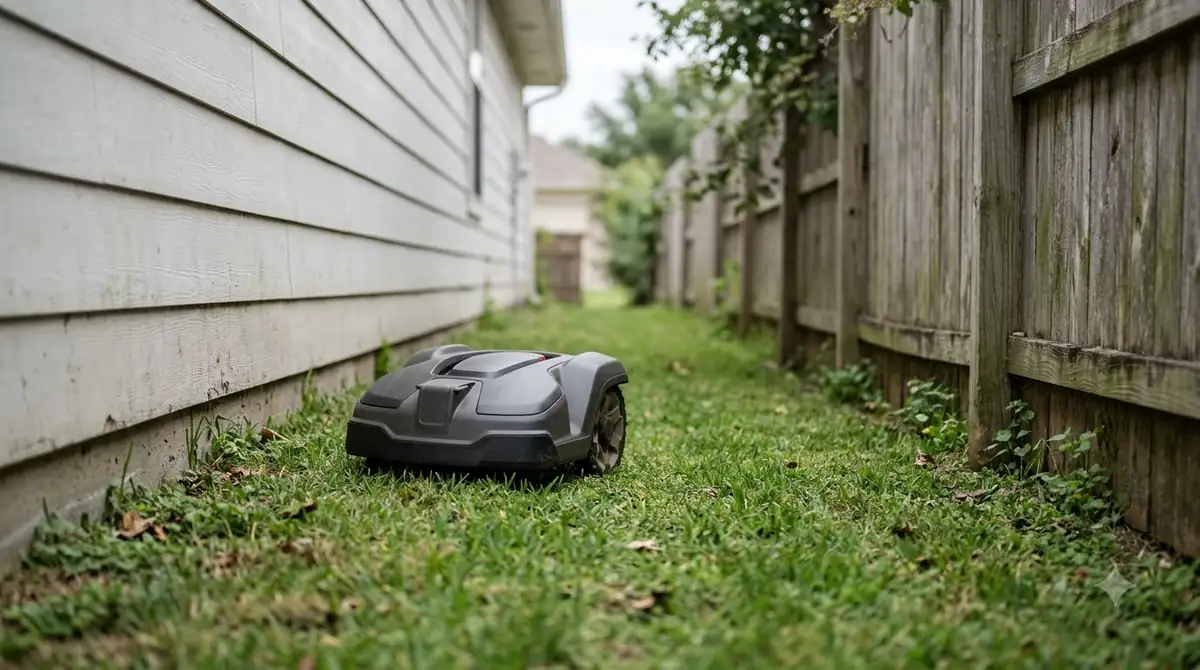
Also measure the lawn’s shape. Long, narrow strips between trees are the places where a wire-free boundary is most likely to be tested. A wide open section with a few isolated trees is much easier. If your yard has both, a mower with a hybrid system and a wire at the narrow points is a common setup.
Mowing height and shaded grass
The mower’s cutting height matters more under trees than in an open lawn. UF/IFAS advises mowing shaded turf at the highest recommended height for the grass type, because more leaf area absorbs more light and taller grass roots more deeply. Robot mowers that cut very low, or that cut on a fixed schedule, can stress thin shaded turf. Check that the model’s height range reaches the top of the range your grass needs, and plan a higher cut for lawns that are mostly shade. Grass beneath trees is often thin, and mowers for deep shade compares options.
Shaded lawns also need less fertilizer, and that matters when the mower is your main tool for keeping a treed yard tidy, and the slow-release kind is usually better. Keep the mower’s blades sharp so that the grass is cut cleanly, and expect to rake or blow leaves off the lawn in autumn, since a mower cannot cut through a thick layer of leaves.
What to check before you buy
- Fallback behavior: ask what the mower does when satellite signal drops, and whether it pauses, slows or keeps going.
- Obstacle detection: confirm the mower detects trunks, low branches and roots without hitting them.
- Wire option: check whether the model can be installed with a perimeter wire for the tight corridors.
- Height range: make sure it cuts at the top of the range your grass type needs.
- Slope and wet grass: shade keeps grass wet longer, so check traction and slope ratings too.
Related reads: Branches on the lawn can stop a mower, as fallen branch handling explains. A common tree type is covered in maple tree lidar and vision.
Frequently asked questions
Can a robot mower work in a yard with lots of trees?
Yes, many do, but the positioning system decides how well. RTK-only mowers can lose their fix under dense canopy and may slow down or pause. Models that add vision, LiDAR or a perimeter wire handle treed yards more reliably.
Do I need a boundary wire under trees?
Not always. A wire is the most predictable boundary, so it is worth considering for narrow corridors and any spot where the canopy is dense. For open areas with a few trees, a wire-free system with a good fallback can be enough.
Why is my robot mower pausing near the trees?
The most common cause is a weak satellite fix under the canopy. Check the mower’s app for the positioning status, and look for a pattern in the places where it stops. If the stops repeat in the same zone, that zone is probably a dense canopy area.
What cutting height is best for shaded grass under trees?
UF/IFAS advises the highest recommended height for your grass type, since taller leaves capture more light. Shaded turf is weaker than sunny turf, so avoid cutting very low. Check your grass species and the mower’s height range before setting it.
Sources
- Wire-free Robot Mower RTK Accuracy Guide (RTKdata, vendor blog, Jan 2026): canopy effects on RTK, fallback behavior, sky-angle guidance, test method.
- UF/IFAS EP072 (University of Florida IFAS Extension): shaded turf stress, mowing height and fertilizer for shade.
- Selecting and Managing Turfgrass for Shade (Mississippi State Extension): root competition and extra water for shaded turf, foot traffic.
 Up next6 min readBy YardBest Robot Mower for a Yard with Maple Trees: What to CheckUpdated Nov 14, 2026
 8 min readBy YardBest Robot Mower for a Yard With Tree Roots: What to CheckUpdated Nov 13, 2026
 8 min readBy YardWhere to Place RTK Antenna in a Yard With TreesUpdated Nov 11, 2026
 8 min readBy YardRobot Mower for Yard With Heavy Tree Canopy: What to CheckUpdated Nov 11, 2026
 6 min readBy YardBest Robot Mower for a Half Acre Suburban LotUpdated Nov 13, 2026
 6 min readBy YardRobot Mower for a Corner Lot With a SidewalkUpdated Nov 11, 2026