
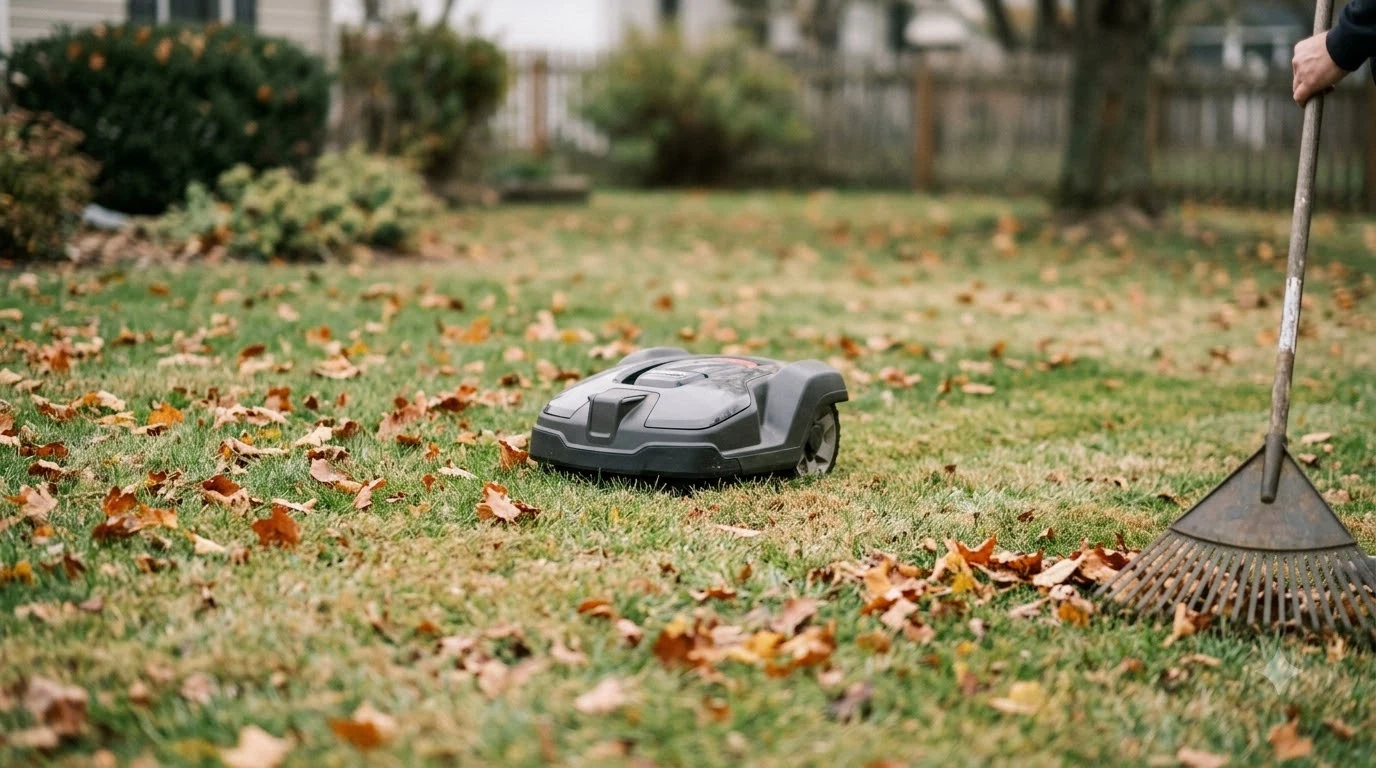

How does a robot mower handle fallen branches? Mainly by blade type: star blades usually shred small branches and fallen fruit, while disc blades struggle with small branches, according to Robomow’s own guidance. Sensors and floating decks lower the risk, but debris can still wedge under the mower and stop it.
The short answer
- Star blades: usually shred small branches and fallen fruit, and only larger branches are a problem.
- Disc blades: small branches are problematic, and fallen fruit can be nicked.
- Sensors: bump sensors and optional obstacle avoidance help, but they are not a guarantee.
- Jams: debris can wedge under the mower and bring it to a standstill.
- Before mowing: walk the lawn and remove limbs, debris and stones.
How does a robot mower handle fallen branches, by blade type?
Blade type is the first thing to check, because a star blade and a disc blade react to debris in different ways, and the same split applies to twigs and sticks. Robomow describes two designs: disc blades, which have individual blades attached to a disc, and star blades, which have three or four prongs and are described as significantly more robust. The same guidance says that with star blades only larger branches pose a problem, while with disc blades small branches are the trouble spot.
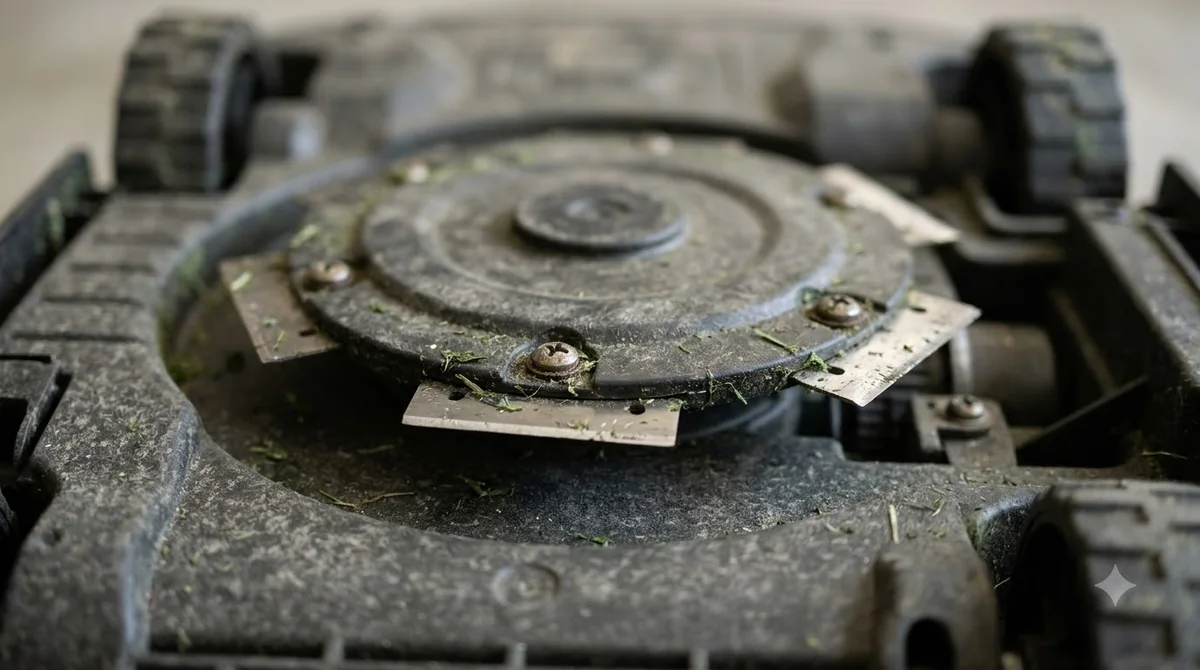
Acorns and pine cones are a related case, covered in how a robot mower handles acorns and pine cones. The table below summarizes what Robomow’s guidance says for each blade type. The source does not give a branch diameter or a size limit, so the table uses general terms rather than numbers.
| Blade type | Small branches | Fallen fruit | Larger branches |
|---|---|---|---|
| Star blades | Usually shredded | Chopped up | Pose a problem |
| Disc blades | Problematic | Nicked | Not described in this source |
Robomow also notes that star blades usually shred debris, but it adds that debris can still jam the mower. Its uneven-ground guidance says star blades easily chop up small hindrances, while disc blades tend to break off or become jammed by nuts or twigs. In our reading, blade type is a better guide to a lawn with frequent small debris than any size number, because the sources do not give one. For a lawn with many trees and fruit, a star blade model is the safer pick, since Robomow describes star blades as significantly more robust than disc blades. Tree-heavy yards bring other limits too, covered in how a robot mower handles trees.
How does a robot mower handle fallen branches with sensors and floating decks?
Bump sensors, optional obstacle avoidance and floating decks help a robot mower react to branches, but the manufacturer descriptions present them as aids rather than guarantees. Feature sets differ between models, so the spec sheet decides which of these you get. For the wider picture, see how robot mowers avoid obstacles.
- Bump sensor: Worx says the mower stops when it hits an obstacle and then retreats, though it calls repeated bumping inefficient and potentially damaging.
- Obstacle avoidance: Worx describes its ACS module, an option, as steering the mower around obstacles.
- Floating deck: the cutting disk adapts its height to the roughness of the terrain, which Worx says helps prevent the blade from hitting fallen branches or other low obstacles.
None of these features is described as clearing debris. They change how the mower reacts when it meets something in its path, which is why a walk-through before mowing still matters.
Low objects are a separate gap. Eufy’s guidance says sprinkler heads, hose fittings, wire pegs, solar-light bases and trampoline feet may sit below a mower’s normal obstacle-detection height. It recommends marking fixed low hazards as no-go zones where the model supports them. The page gives no height figure, so check your model’s manual for its detection range.
How does a robot mower handle fallen branches when they jam the blades?
Debris stops a robot mower in two main ways: it wedges under the body, or it jams the blades. Robomow says cones and other debris can wedge under the robot and bring it to a standstill. Its guidance on objects such as toys says the blades usually stop and a manual restart is needed.
- Wedged debris: cones and other debris can get under the robot and stop it completely.
- Blade stop: objects caught in the blades stop them, and a person must restart the mower by hand.
- Uneven ground: uneven surfaces and holes can interfere with smooth operation, according to Robomow.
If the mower keeps stopping in one place, see what to do when a robot mower gets stuck in the same spot. Robomow also gives a layout figure: it recommends a passage with a minimum width of one meter. Eufy adds a safety step for any jam. Turn the mower off and wait for the blades to stop before you clear branches, toys, stones or compacted grass by hand.
What to clear before the mower runs
Walk the lawn and remove limbs, debris and obstructions before each mow. Texas A&M AgriLife Extension’s lawn safety guide advises a walk-through of the yard before mowing and recommends removing “debris and obstructions including toys, limbs, rocks, wire, or glass.” That guidance was written for walk-behind mowers, so our reading applies it to robot mowers as well.
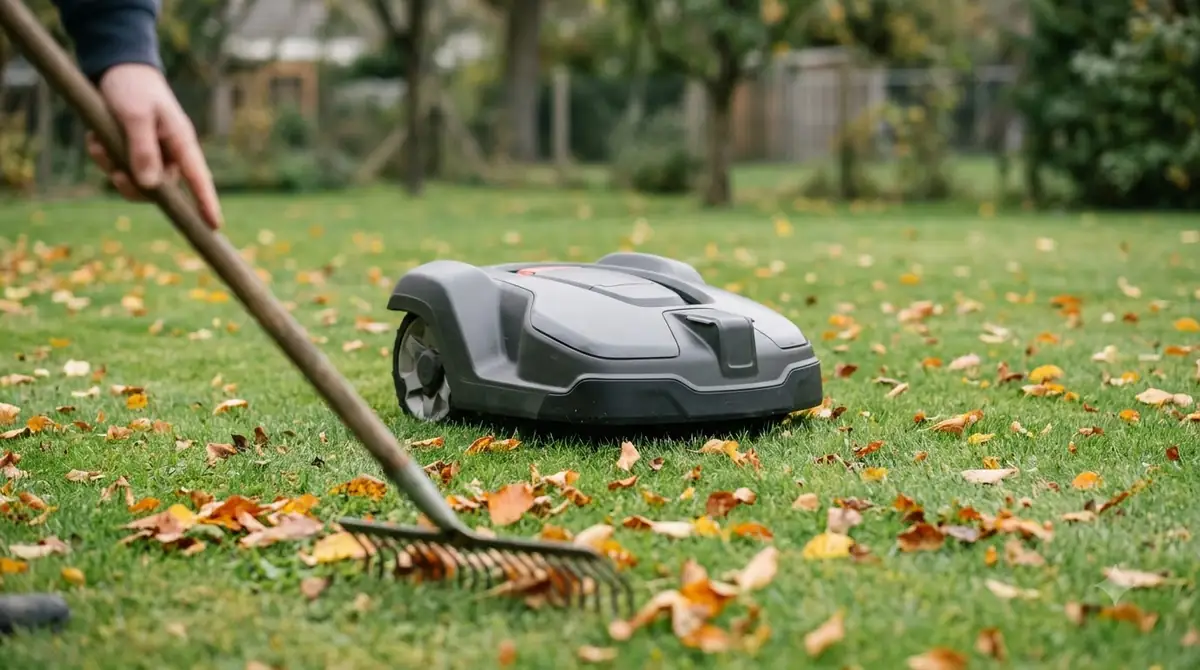
- Walk the lawn. Look for limbs, twigs, cones, fruit and stones before each run.
- Clear large leaf piles. Worx advises clearing large piles of fallen leaves first, gathering them with a rake or leaf blower.
- Remove stones. Robomow says stones can cause serious damage to the blades and the housing, so check under leaves as well.
- Keep the leaf layer thin. Robomow says scattered leaves do not harm the mower, but a continuous layer can interfere with cutting and traction. Eufy warns that a thick layer of wet leaves can reduce wheel traction and hide small obstacles, so clear heavy build-up before mowing.
Leaves are the easiest debris to overlook, because a thin layer hides the sticks and stones underneath it. Check the ground under any heavy leaf cover before you start the mower, and see using a robot mower during fall leaf drop for the wider autumn routine.
So how does a robot mower handle fallen branches in practice? Our reading: small debris is manageable with star blades, large limbs are a job for you, and the walk-through matters more than any sensor. It takes only a few minutes and catches the items that sensors may miss.
Frequently asked questions
Can a robot mower run over a small stick?
It depends on the blade. Robomow says small branches are problematic for disc blades, while star blades usually shred them. The sources do not give a stick diameter that is safe, so clear anything you would not want the mower to chew on.
Do fallen leaves damage a robot mower?
Scattered leaves do not harm the mower, according to Robomow. A continuous layer of leaves can interfere with cutting and traction, so rake or blow up large piles before mowing.
Will a robot mower get stuck on a branch?
It can. Robomow says debris can wedge under the robot and bring it to a standstill, and some objects stop the blades until a person restarts the mower by hand.
How does a robot mower handle fallen branches if it has sensors?
Sensors and floating decks help the mower react to obstacles, but manufacturers describe them as aids rather than guarantees. Low objects can sit below the detection height, and Texas A&M’s safety guidance still advises walking the yard before mowing.
Sources
- How does the robotic lawnmower deal with fallen fruit and the like? (Robomow): blade types, fallen fruit and small branches.
- Can a robotic lawnmower get stuck? (Robomow): debris wedging, blade stops and passage width.
- Can a robotic lawnmower mow well on uneven, difficult surfaces? (Robomow): star and disc blades with twigs and nuts.
- What does a robotic lawnmower do with leaves (Robomow): leaves, stones and blade damage.
- Robot mowers and complex lawns (Worx): bump sensor, obstacle avoidance and floating deck.
- Mower drills into bushes (Worx support): clearing large piles of fallen leaves.
- Robot lawn mower stuck: causes and fixes (eufy): low objects, clearing debris safely, wet leaves.
- Lawn Maintenance Safety (Texas A&M AgriLife Extension, Extension Safety Program): walk-through and debris removal before mowing.
 Up next9 min readBy YardHow Does a Robot Mower Handle Garden Furniture?Updated Nov 11, 2026
 8 min readBy YardHow Does a Robot Mower Handle a Trampoline?Updated Nov 11, 2026
 8 min readBy YardHow Does a Robot Mower Handle a Pond?Updated Nov 11, 2026
 9 min readBy YardHow Does a Robot Mower Handle Sprinkler Heads?Updated Nov 11, 2026
 9 min readBy YardHow Does a Robot Mower Handle a Playset?Updated Nov 11, 2026
 8 min readBy YardHow Does a Robot Mower Handle Trees?Updated Nov 11, 2026