

How does a robot mower handle a pond? It stays out of the water. Wired models use a boundary wire that acts as a stop line, and wire-free models rely on cameras and sensors to see water and obstacles. The pond itself is not meant to be cut, so the real work is setting the margin around the edge and checking the slope above it. The guidance below comes from manufacturer manuals and product pages, not from our own trials.
The short answer
- Keep a margin. Robomow’s guidance uses a distance of about 35 cm from the pond to the boundary wire.
- Add barriers. The same guidance says extra obstacles are needed to stop the mower from falling in.
- Check the sensors. Segway says its camera-based Navimow spots water and goes around a puddle, but this is a manufacturer example.
- Watch slopes. Eufy warns that a mower slipping on a slope could slide into a pond.
Why a pond is a hazard for a robot mower
A wired robot mower follows a boundary wire, and it has no way of knowing a pond is there unless the wire keeps it away. The danger is that a pond often sits at the bottom of a bank, where the lawn is sloped and the edge is soft. Eufy’s wet grass guidance puts the risk plainly: “A mower that slips on a slope could potentially slide into a garden bed, a pond, or against the edge of a verandah.” That warning applies to any yard where grass runs down to water.
Wet grass makes the problem harder. Eufy says cutting wet grass is generally discouraged, mainly because the cut is uneven and wet clumps build up under the deck. Our reading is that damp ground near a pond is also the spot where a wheel is most likely to lose grip, so a pond with a wet bank deserves a bigger margin than a dry one. Our guide to running a robot mower on wet grass covers the grip and cut-quality side.
A pond is also a different hazard from a flower bed. A bed can be marked with a wire or a short fence, but for a pond the water has to be a hard stop, not an area the mower will simply slow down in.
Boundary wire sets a stop line about 35 cm from the water
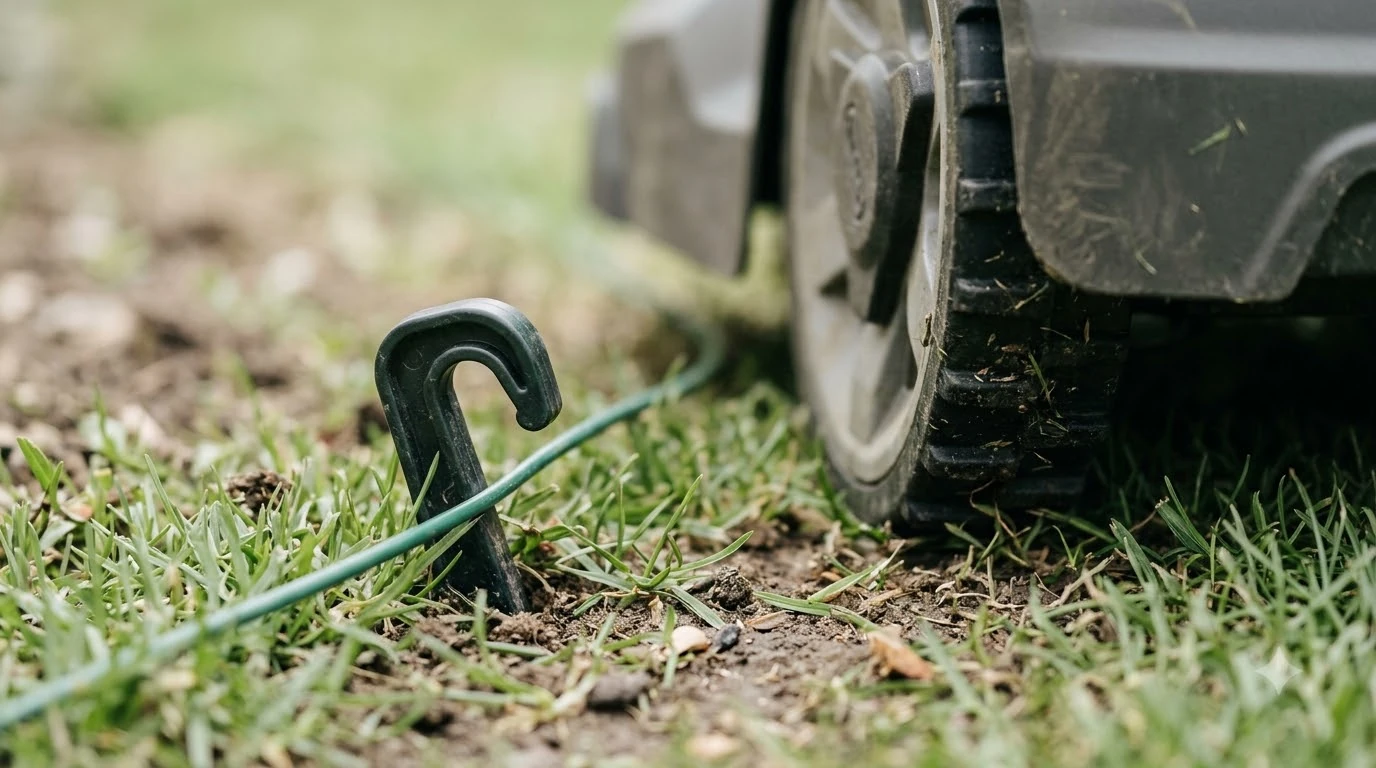
So how does a robot mower handle a pond? For wired models, the boundary wire is the main way to keep the mower away from a pond. Robomow’s guide to laying the wire describes the signal as a stop sign that helps prevent the robot from driving over the cable, mowing unwanted areas, or accidentally landing in a garden pond. The same guide gives a guide value of approximately 35 cm between the wire and the pond, with additional obstacles to prevent the robot from falling in.
The wire itself also has a depth rule. Robomow says a laying depth of 4 to 5 cm is optimal, and that the mower can receive the signal at a depth of up to 7 cm. Those numbers are for the wire in general, not for a pond specifically, so they show how the signal is meant to be laid rather than a rule for water.
The honest answer to “how does a robot mower handle a pond” is that the manual decides the details. Manufacturer installation instructions always take precedence over a general figure. Check the manual for your model before you lay the wire, because a setback that works for one brand may not match another model’s sensors or turning radius. Our reading is that the 35 cm figure is a useful minimum to plan around, not a distance to stretch. For the routing itself, see laying boundary wire around trees and obstacles.
Cameras and sensors can spot water, but only on some models
Wire-free models use cameras and sensors instead of a boundary wire, so how does a robot mower handle a pond depends on the vision system. Segway’s VisionFence page says the system uses “an AI camera see and make sense of its environment.” It adds that the i-series “can recognise 150 types of obstacles,” which covers more than a pond edge alone.
Segway also gives a practical example. In its account, an H-series mower found a large puddle that was not marked as an exclusion zone, and “spots the water and avoids the puddle, and mows around it instead of right through it.” The mower returned a couple of days later to mow the grass that had been under water once the puddle dried. The app shows that area as an object avoided during that cycle.
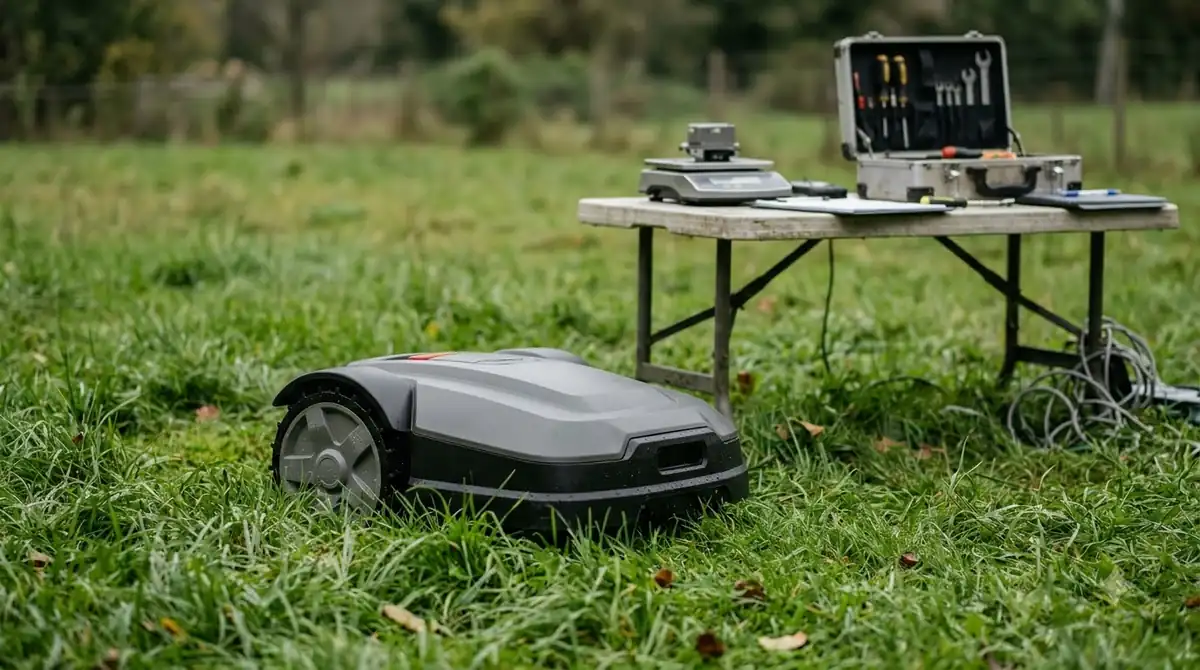
This is a manufacturer example, not an independent test, so treat it as a claim to verify on the model you are considering. A puddle is also much smaller than a pond with a steep bank. Our reading is that camera detection helps with the water itself, but it does not replace a physical margin at the edge.
How does a robot mower handle a pond on a slope?
A pond on a slope is the hardest case for any robot mower, because a mower that loses traction can slide toward the water even when it starts well back from the edge. Eufy’s warning about slopes names a garden bed, a pond and a verandah as places a slipping mower could end up, so the slope itself is the risk, not only the line on the lawn. If the bank is steep, how steep a hill a robot mower can handle is worth reading first.
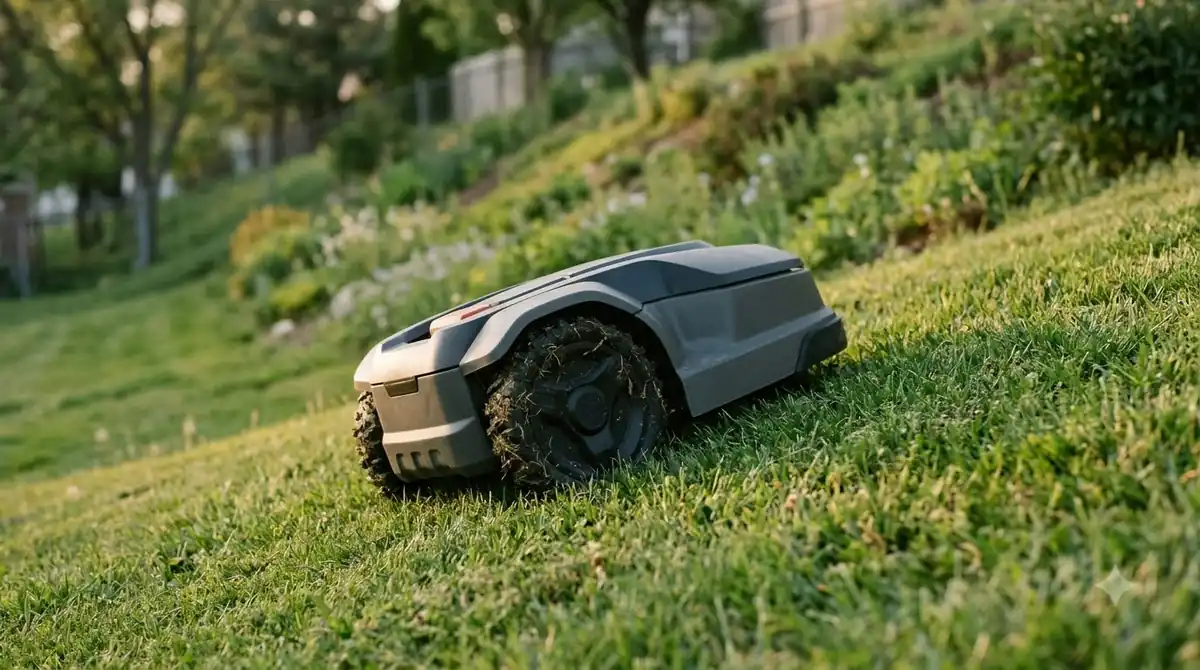
The safest approach is to widen the margin wherever the ground drops toward the water. A wider gap gives the mower room to turn before it reaches a bank, and it gives a slipping wheel less distance to travel toward the water. Our reading is that a sloped pond bank calls for more margin than the flat-ground figure, even when the manual gives a single number.
Check the slope rating in the manual before buying, because a mower that copes with a pond on a gentle lawn may not be safe on a steep bank. A model rated for a gentler incline should not be placed above a steep pond bank, and a wet slope is worse than a dry one for the reasons Eufy gives about uneven cutting and grip.
What to check before you buy or install
Start with the navigation method, because it decides how does a robot mower handle a pond in your yard. A wired model depends on the wire and the obstacles you add, while a camera model depends on how well it sees water and edges. Then work through the list below before you put the mower on a lawn with water.
- Confirm the navigation type. Decide whether the model uses a boundary wire or cameras and sensors, since that changes how you protect the pond.
- Read the pond setback in the manual. Robomow’s guide uses about 35 cm, but your model may specify something different.
- Measure the slope. Note any drop between the lawn and the water, and compare it with the maximum slope rating in the manual. Measuring your yard slope shows how.
- Add physical barriers. Robomow says extra obstacles are needed to keep the robot from falling in, so plan fencing or another visible barrier at the edge.
- Plan hand trimming at the edge. Our reading is that a mower should not be relied on to cut right up to a pond bank, so budget time for trimming by hand.
Frequently asked questions
Can a robot mower drive into a pond?
A robot mower can drive into a pond if nothing stops it. Robomow’s guidance says the boundary wire acts as a stop sign to keep the robot from landing in a garden pond, and it also says extra obstacles are needed to prevent a fall. A pond with no wire, no barrier and no camera detection is a real hazard, so plan the protection before the first mow.
How far should the boundary wire be from a pond?
Robomow’s installation guide gives a guide value of approximately 35 cm between the pond and the wire. Manufacturer installation instructions take precedence over any general figure, so check the manual for your specific model before you lay the wire.
Do camera-based mowers avoid water?
Segway says its camera-based Navimow spots water and goes around a puddle in one of its examples. This is a manufacturer example rather than an independent test. Check the model’s own specifications and manual for water and edge detection before you rely on it near a pond.
Is a slope next to a pond a problem?
Yes. Eufy warns that a mower that slips on a slope could potentially slide into a pond. A wider margin and a check of the slope rating in the manual are the usual precautions, and a wet bank adds to the risk.
Sources
- Laying the lawn boundary wire (Robomow): pond distance of approximately 35 cm, wire laying depth of 4 to 5 cm, and the stop-signal role.
- Robot lawn mower wet grass (Eufy): the slope warning about sliding into a pond, and the guidance that cutting wet grass is generally discouraged.
- Navimow: a practical example of the benefit of VisionFence (Segway Navimow): the AI camera, the 150 obstacle types for the i-series, and the puddle example.
 Up next9 min readBy YardHow Does a Robot Mower Handle Sprinkler Heads?Updated Nov 11, 2026
 9 min readBy YardHow Does a Robot Mower Handle a Playset?Updated Nov 11, 2026
 8 min readBy YardHow Does a Robot Mower Handle a Trampoline?Updated Nov 11, 2026
 9 min readBy YardHow Does a Robot Mower Handle Garden Furniture?Updated Nov 11, 2026
 7 min readBy YardHow Does a Robot Mower Handle Fallen Branches?Updated Nov 11, 2026
 8 min readBy YardHow Does a Robot Mower Handle Trees?Updated Nov 11, 2026