


MOVA LiDAX Ultra 2000 vs Segway Navimow X3: the two mowers locate themselves and avoid obstacles in different ways. MOVA’s published specs describe LiDAR and AI vision with no RTK setup, while Segway’s X3 series is built around dual RTK positioning and a camera and time-of-flight obstacle fence. The two listings also differ on coverage, slope rating, cutting height and battery, so the better fit depends on your yard and what you can set up.
The short answer
- Navigation: MOVA says the 2000 needs no boundary wire or RTK base station and uses 360-degree 3D LiDAR with AI vision. Segway lists dual RTK with EFLS 3.0 for the X3 series.
- Coverage: the 2000 is rated for lawns up to 0.5 acre. The X3 series lists four models from 1,500 to 10,000 square meters, about 0.37 to 2.47 acres by our conversion.
- Slope: the 2000 is rated to a 45% grade. The X3 is rated to 50% (26.5 degrees), a manufacturer claim.
- Cutting height: 30 to 99 mm for the 2000 and 20 to 70 mm for the X3 series.
- Runtime: one reviewer reports about 2 hours for the X315 in normal mode. The MOVA pages we read list no runtime.
MOVA LiDAX Ultra 2000 vs Segway Navimow X3: how the navigation differs
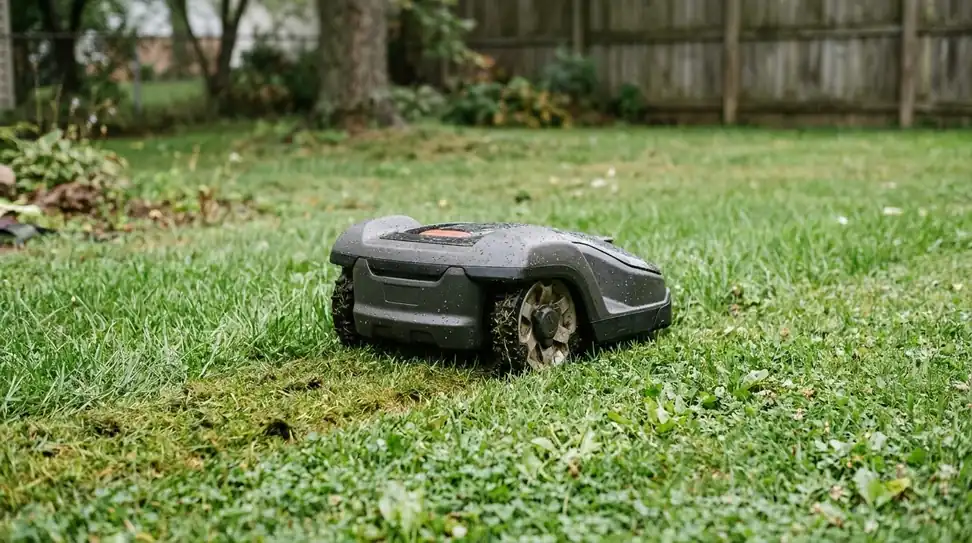
In the MOVA LiDAX Ultra 2000 vs Segway Navimow X3 matchup, the two mowers rely on different positioning methods, and that difference matters most on yards with heavy tree cover or buildings close to the lawn. Segway’s Australian product page describes EFLS 3.0 and dual RTK, with Network RTK listed as standard (availability depends on location). MOVA’s comparison blog and retailer listings describe 360-degree 3D LiDAR with AI vision, and say no boundary wire or RTK antenna is needed. Neither source includes an independent accuracy test, so the table below shows what each maker or listing claims.
Segway’s support pages add a practical detail for the RTK side. A flashing yellow light signals weak GPS, and the advice is to move the antenna and charger to a more open area. The MOVA pages we read do not describe a comparable placement step, which is one reason the two systems are hard to compare on setup alone. If an X3 owner loses signal, the guide to Segway Navimow positioning lost explains the usual causes.
Side-by-side specs from the published listings
The table lists each claim with its source type. Where a figure comes from a third-party review rather than the maker, the table says so. Where a page did not state a number, the cell says “not listed” rather than guessing.
| Spec | MOVA LiDAX Ultra 2000 | Segway Navimow X3 series |
|---|---|---|
| Navigation | 360-degree 3D LiDAR and AI vision, no RTK (MOVA claim) | Dual RTK with EFLS 3.0, Network RTK standard (Segway page) |
| Obstacle sensing | AI avoidance for more than 300 obstacle types (retailer page) | VisionFence: ToF 0.1 to 2 m, three cameras, 300-degree view (Segway page) |
| Coverage | Up to 0.5 acre | X315 1,500 m2, X330 3,000 m2, X350 5,000 m2, X390 10,000 m2 (Segway page) |
| Maximum slope | 45% grade (retailer page) | 50% or 26.5 degrees, manufacturer claim (review data sheet) |
| Cutting height | 30 to 99 mm, 1.2 to 3.9 in (retailer pages) | 20 to 70 mm (review data sheet) |
| Cutting width | Not listed | 23.7 cm (review data sheet) |
| Battery | 5 Ah, no voltage or watt-hours | 6, 8, 10 or 12.8 Ah by model (review data sheet) |
| Weight | 30.4 lb | 19.6 to 19.9 kg, about 43 to 44 lb (review data sheet) |
| Water rating | IPX6 | IP66 (review data sheet) |
| Drive | 2WD (retailer page) | Not stated on the pages we read |
| Runtime | Not listed | About 2 hours for the X315 in normal mode (one review) |
| Warranty | Not listed | Not listed on the pages we read |
This MOVA LiDAX Ultra 2000 vs Segway Navimow X3 table mixes units, so here are our conversions: 1 acre is about 4,047 square meters, so the X315 to X390 coverage figures come to about 0.37, 0.74, 1.24 and 2.47 acres. The 2000’s 0.5 acre rating is about 2,023 square meters. The X3 weight converts to about 43 to 44 pounds.
Cutting height and slope ratings
The two cutting height ranges overlap only partly. The 2000 reaches higher, up to 99 mm, while the X3 series goes lower, down to 20 mm. Our reading is that a low minimum helps when you want a close trim, and a high maximum helps when the grass has been left long. Which range matters more depends on how you plan to maintain the lawn.
Both slope figures are ceilings rather than targets. Husqvarna’s support guide defines slope percent as the vertical rise divided by the horizontal distance, times 100. A 26.5-degree slope works out to about a 50% grade by our calculation, so the X3’s 50% and 26.5-degree claims are the same figure stated two ways. The 2000’s 45% rating is lower on paper. Eufy’s guidance says the maximum slope is an absolute limit, and that running at the top of the range strains the motor and drains the battery.
Heads up
Wet grass can reduce tire grip, so a slope inside either rating can still cause a slide. Measure your steepest area and check it against the rating, especially if the lawn stays damp for long periods.
Obstacle sensing and missed areas
Both makers claim systems that detect obstacles before contact, but they use different sensors. Segway’s VisionFence uses time-of-flight sensors at 0.1 to 2 meters and three cameras with a 300-degree view. Segway says it recognizes more than 180 yard objects, and that it can detect a person at 3 meters and slow the mower to 0.2 meters per second. MOVA’s listings describe AI avoidance for more than 300 obstacle types, along with a 1.6-inch obstacle climb and corridors as narrow as 23.6 inches. Both of those figures come from MOVA’s own blog, with no independent test data.
Segway’s support pages list the most common causes of a missed area: VisionFence-off zones, narrow passages and blocked GPS. The MOVA pages we read do not describe a comparable list of missed-area causes, so the two sets of support information are not directly comparable.
- X3 support: the mower can show “Mower Disconnected” when power, Wi-Fi or the 4G setting fails, and Segway’s guide lists those three checks. Owner-reported issues are collected in our Segway Navimow X3 problems and complaints guide.
- 2000 support: the pages we read did not include a troubleshooting guide.
Who each option suits
Choosing between the MOVA LiDAX Ultra 2000 vs Segway Navimow X3 comes down to lawn size, slope and sky view. For each model on its own, see the MOVA LiDAX Ultra 2000 review and the Segway Navimow X3 review. Our reading is that the 2000 suits a yard up to 0.5 acre with moderate slopes, where the buyer wants to avoid an RTK antenna and a boundary wire. It is a weaker fit for larger lawns or for buyers who need a listed runtime or warranty before they buy.
The X3 series suits buyers who want a choice of four coverage sizes, from about 0.37 to 2.47 acres, and who can place the RTK antenna and charger where the sky is open. It is a weaker fit for shaded or tree-heavy yards, where the RTK signal may be less reliable, and for buyers who need the drive layout or warranty confirmed.
- Choose the 2000 if: your lawn is near or under 0.5 acre, your slopes stay below 45%, and you prefer a system without an RTK antenna.
- Choose the X3 series if: your lawn is larger, you can place an antenna in open sky, and you want the choice of four sizes.
- Check either model first: the steepest area of your yard, your sky view, and the runtime and warranty figures, which neither listing set confirms in full.
Frequently asked questions
In the MOVA LiDAX Ultra 2000 vs Segway Navimow X3 comparison, does the MOVA need RTK?
According to MOVA, no. The 2000 navigates with 360-degree 3D LiDAR and AI vision and needs no boundary wire or RTK base station. Segway’s X3 series is built around dual RTK positioning. Both are manufacturer or listing claims, so check how each system behaves on your own yard.
Which model has the larger listed coverage?
It depends on the X3 model. The X315 is listed at 1,500 square meters, which is less than the 2000’s 0.5 acre rating. The X330 at 3,000 square meters and the larger X3 models list more coverage. Pick the model whose coverage matches your lawn’s measured area, not the nearest name.
Which has the steeper slope rating?
On paper, the X3 series is rated higher, at 50% against the 2000’s 45%. Both figures are manufacturer or listing claims, and running near the top of either range strains the motor and drains the battery. Wet grass reduces grip at any rating.
Which specs are missing from the listings?
For the MOVA 2000, the pages we read do not list runtime, cutting width, warranty or dimensions. For the Navimow X3 series, they do not state the drive layout or the warranty. Check the maker’s current product page for those figures before you compare the two models in detail.
Sources
- Segway Navimow X3 product page (manufacturer, Australian site): coverage by model, dual RTK and EFLS 3.0, VisionFence sensors.
- Notebookcheck review of the Navimow X3 (third-party review): cutting height, cutting width, speed, slope claim, battery, weight, IP66 and the reported runtime.
- Navimow X3 missed-area support article (manufacturer): causes of missed areas.
- Navimow X3 “Mower Disconnected” support article (manufacturer): power, Wi-Fi and 4G checks.
- MOVA comparison blog (manufacturer): no boundary wire or RTK claim, obstacle climb and corridor figures.
- Freshly Charged product page (retailer): area, incline, cutting height, battery, weight, navigation and drive.
- RoboticGizmos product write-up (retailer): cutting height, clearing path and IPX6 rating.
- Husqvarna steep-slope guide (manufacturer): slope formula and steep-area rules.
 Up next8 min readReviews & CompareMOVA LiDAX Ultra 2000 vs Dreame A2: Published Specs ComparedUpdated Nov 13, 2026
 7 min readReviews & CompareMammotion LUBA 3 AWD vs MOVA LiDAX Ultra 2000: What the Published Specs ShowUpdated Nov 13, 2026
 7 min readReviews & CompareMOVA LiDAX Ultra 2000 Review: Specs, Slope and LimitsUpdated Nov 12, 2026
 7 min readReviews & CompareMOVA LiDAX Ultra 2000 Problems and Complaints: What Is VerifiedUpdated Nov 14, 2026
 7 min readReviews & CompareMOVA Lidax Ultra 2000 Pros and ConsUpdated Nov 18, 2026
 8 min readReviews & CompareMOVA LiDAX Ultra 3000 AWD Review: Specs and Slope LimitsUpdated Nov 16, 2026