
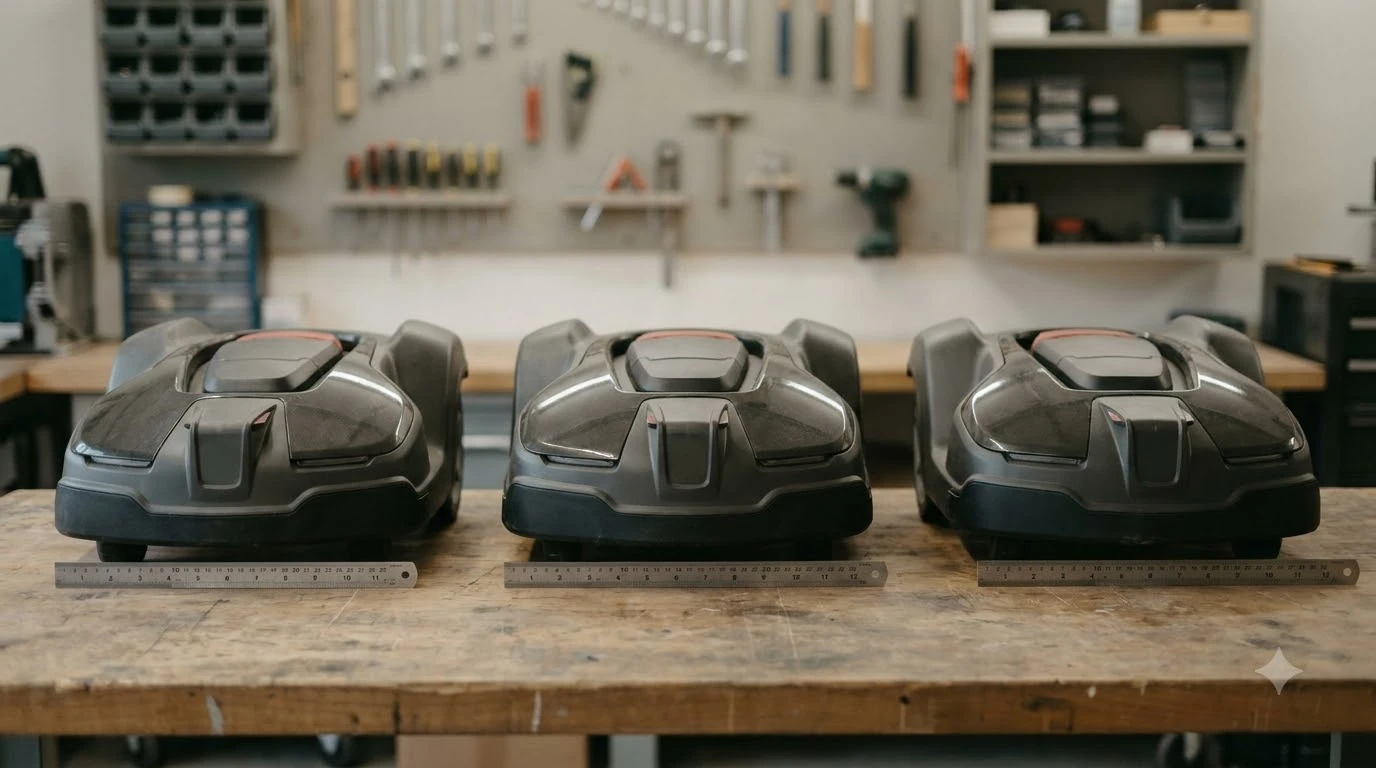

What size robot mower do I need for 1.5 acres? Plan on a model rated for about 2 acres. A 1.5-acre property is about 65,340 square feet, but a robot mower’s rated area is a ceiling set under ideal conditions, not a promise for every yard. Real lawns lose coverage to trees, beds, slopes and the hours the mower can actually run.
The short answer
- Lawn size first. Count only the grass, which is often less than the full 1.5 acres.
- Rating with margin. One manufacturer advises buying 1.3 to 1.5 times your actual acreage.
- Check the assumptions. Makers rate their mowers on different hour bases, so compare like with like.
- Check slope and obstacles. Both cut the usable area, sometimes sharply.
What 1.5 acres means in square feet
One acre is 43,560 square feet, so 1.5 acres is 65,340 square feet. In metric terms, that is about 6,070 square meters. Those are the numbers to compare against a mower’s rated maximum area, because most rating tables use square meters or square feet rather than acres.
The conversion is simple arithmetic, but the rating is not. A mower rated at 6,000 square meters on paper may cover less than that on a real 1.5-acre lot, and the reasons are below.
Measure the grass, not the property
Answering what size robot mower do I need for 1.5 acres starts with the grass, not the deed. Only the grass the mower cuts counts toward its rating. The house, driveway, patio, garden beds and planting areas all come out of the total. Dreame’s guide gives a useful example: a 4,000 square meter property, which is about one acre, often has only about 2,800 square meters of actual lawn. That is roughly 70 percent of the total. Dreame’s large-lawn guide makes the same point about lot size and lawn size.
Our reading is that if your 1.5-acre lot follows a similar ratio, the lawn itself may be closer to one acre. Measure before you shop, because what size robot mower do I need for 1.5 acres depends on the lawn number, not the deed number, when you compare ratings.
Why the rating is a ceiling
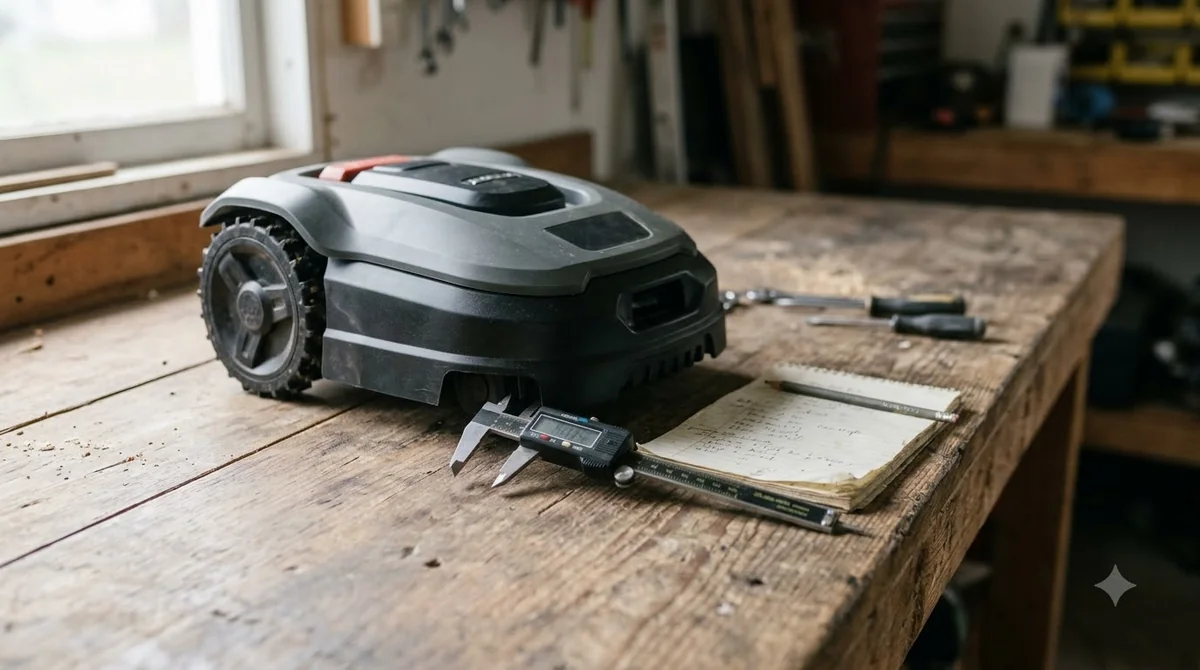
A maximum area rating (how robot mower coverage ratings work) describes what a mower can handle under ideal conditions. Robomow says a manufacturer’s maximum figure applies only under “truly perfect conditions,” and that real-world factors can cut that figure by up to 30 percent. Robomow’s sizing article also gives a formula for working out the rating you need:
Lawn size divided by the mowing hours you want per week, multiplied by the operating hours the manufacturer rates, gives the required rating. Robomow’s example is 1,000 square meters, mowed for 40 hours a week, against a 120-hour rating. That works out to a 3,000 square meter rating.
The catch is that makers do not all count the same way, so the answer to what size robot mower do I need for 1.5 acres changes with each model’s hour basis. Robomow notes that some manufacturers assume round-the-clock operation, while others limit mowing to 12 hours a day in the software. A figure that looks large may depend on a 24-hour basis that your yard will never use. For a 1.5-acre lawn, run the same formula with each model’s own hours before you compare ratings.
What size robot mower do I need for 1.5 acres with a margin
Dreame advises buying a mower rated for 1.3 to 1.5 times your actual acreage. For 1.5 acres, that points to a rating between about 2 and 2.25 acres. Elsewhere the same guide uses a multiplier of 1.3, so treat the range as a guide rather than a rule.
Obstacles are the main reason for the margin. Dreame estimates that a 1-acre yard with mature trees and complex landscaping loses 20 to 30 percent of its rated coverage to obstacle navigation. Our reading is that a 1.5-acre yard with the same features would lose a similar share of its rated area.
- Trees and beds add turns, which slow the mower in our reading.
- Fast spring growth means more hours per week. Our reading is that a near-maximum rating leaves little room for that.
- Charge cycles add time, since large lawns need several of them to finish one mow, according to Dreame (how long a robot mower takes to mow one acre).
Dreame also states that no single residential robot mower handles lawns of 6,000 to 8,000 square meters, which is 1.5 to 2 acres, in one cycle. Large lawns need several charge cycles to finish one mow. Our reading is that a 1.5-acre yard is a multi-session job for any model, so plan the schedule around that. If the lawn has separate sections, how multi-zone robot mowers work is worth reading. For a bigger lawn, see what size robot mower you need for 2 acres.

Slope, passages and shape
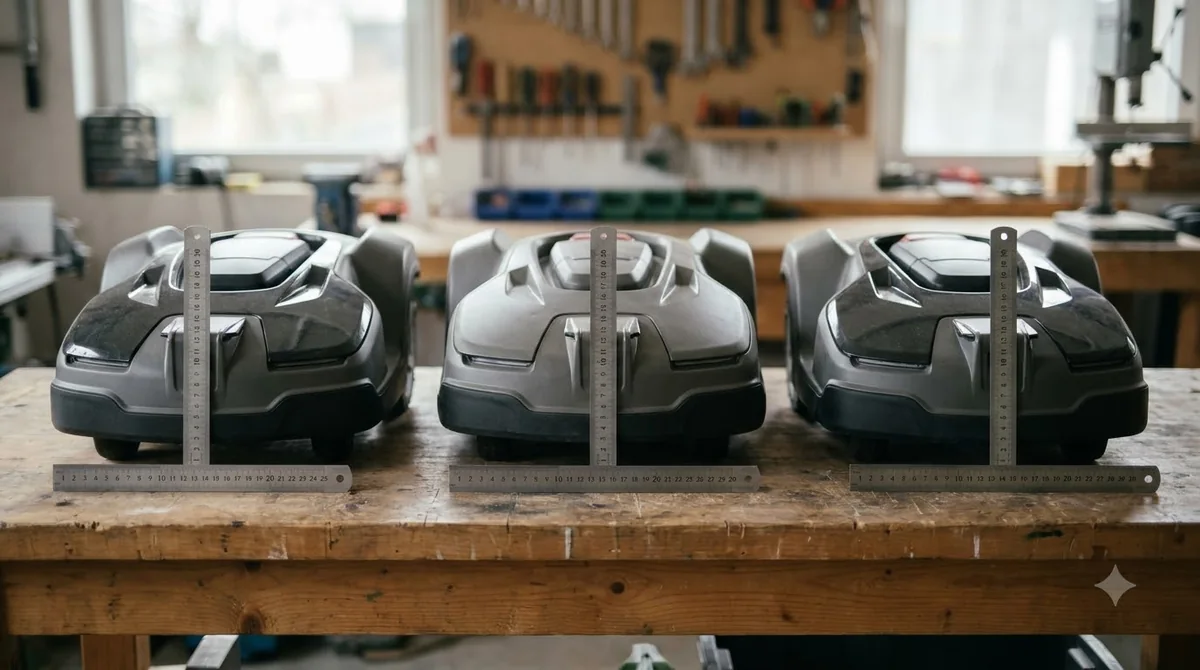
If you are asking what size robot mower do I need for 1.5 acres on a hillside, slope is the first filter. Slope tolerance varies widely between models. Robomow says cheap models are often designed only for slopes of 20 to 25 percent, while higher-quality robot mowers can handle slopes of up to 45 percent and more. If your 1.5 acres has a hillside, check the steepest part of the lawn with a level or a phone app, as how to measure yard slope explains, and compare that figure with the mower’s rated slope, not the headline number.
Shape changes the usable area too. Our reading is that a long, narrow lot has more edge work and more turns than a near-square lot of the same size, so it takes longer to mow. Narrow passages between a shed and a fence can also limit which model fits.
How to measure a 1.5-acre lawn
Clemson Cooperative Extension gives the basic formulas for lawn area in square feet. Its factsheet was published February 28, 2018, and shows no later update date, so confirm local guidance if you need current figures. The main formulas are:
- Rectangle: length times width.
- Triangle: base times height, divided by 2.
- Circle: 3.14 times the radius squared.
- Oval: length times width, times 0.8.
For irregular shapes, the offset method works well. Add the lengths of all the offset lines you measure across the lawn, then multiply by the distance between those lines. Subtract any beds, patios or pools you measured the same way. Keep a sketch with the numbers, because the same sketch helps when you talk to a dealer or support team about your yard.
What to check before you buy
Use this order when you compare models for what size robot mower do I need for 1.5 acres. Start with the grass area, then the margin, then the conditions the mower must handle.
| Check | What to look for | Why it matters for 1.5 acres |
|---|---|---|
| Rated maximum area | Rating near or above 2 acres, in the same units you measured | Leaves room for trees, beds and spring growth |
| Hours assumed | Whether the rating uses 24 hours or 12 hours a day | Changes the real capacity for your schedule |
| Slope rating | The maximum slope on the steepest part of your lawn | Cheap models are often limited to 20 to 25 percent |
| Obstacle load | Trees, beds and the number of boundary wire turns | Dreame estimates a 20 to 30 percent coverage loss on complex yards |
| Charge cycles | Whether one charge finishes a session or the mower returns to dock | Large lawns need several cycles to finish |
Look at the manufacturer’s sizing article and its specification sheet before you decide. Where a guide gives a buffer, a formula and an hour basis, you can check the numbers yourself.
Frequently asked questions
Is a 1.5-acre lawn too big for one robot mower?
Not always, but Dreame says no single residential robot mower handles 1.5 to 2 acres in one cycle. Expect the mower to work in several sessions and to return to its dock during each one.
Can a mower rated for 1.5 acres cover a 1.5-acre property?
Only if the grass is less than the full property and the rating has margin. Subtract the house, driveway and beds first, then compare the lawn figure with the rating.
Does the shape of my lot matter?
Yes. A long, narrow lot has more edge work and turns than a near-square lot of the same area, so it takes longer to mow even at the same size.
What if my yard has a lot of trees?
Dreame estimates that a 1-acre yard with mature trees and complex landscaping can lose 20 to 30 percent of its rated coverage to obstacle navigation. Choose a model with extra margin if your yard is heavily landscaped.
Sources
- Measuring the Area of a Home Lawn (Clemson Cooperative Extension, HGIC): lawn area formulas, the 0.8 oval shortcut and the offset method, published February 28, 2018.
- Which robotic lawnmower is suitable for which lawn size? (Robomow): rating meaning, the 30 percent real-world reduction, the sizing formula and slope figures.
- Best Robot Mowers for Large Lawns (2026 Buyer’s Guide) (Dreame): 1.3 to 1.5 times buffer, obstacle loss, single-cycle limit and the 4,000 square meter example.
 Up next8 min readBest Robot MowersWhat Size Robot Mower Do I Need for 1/4 Acre?Updated Nov 11, 2026
 8 min readBest Robot MowersBest Robot Lawn Mower for 1/2 Acre: How to Choose by Lawn SizeUpdated Nov 11, 2026
 7 min readBest Robot MowersWhat Size Robot Mower Do You Need for 2 Acres?Updated Nov 11, 2026
 9 min readBest Robot MowersWhat Is the Best Robot Lawn Mower for a 1/2 Acre With SlopesUpdated Nov 11, 2026
 7 min readBest Robot MowersBest Wireless Robot Mower for 1/3 Acre Lawn: What to CheckUpdated Nov 11, 2026
 8 min readBest Robot MowersBest Robot Lawn Mower for 3/4 Acre: How to Choose the Right SizeUpdated Nov 11, 2026