
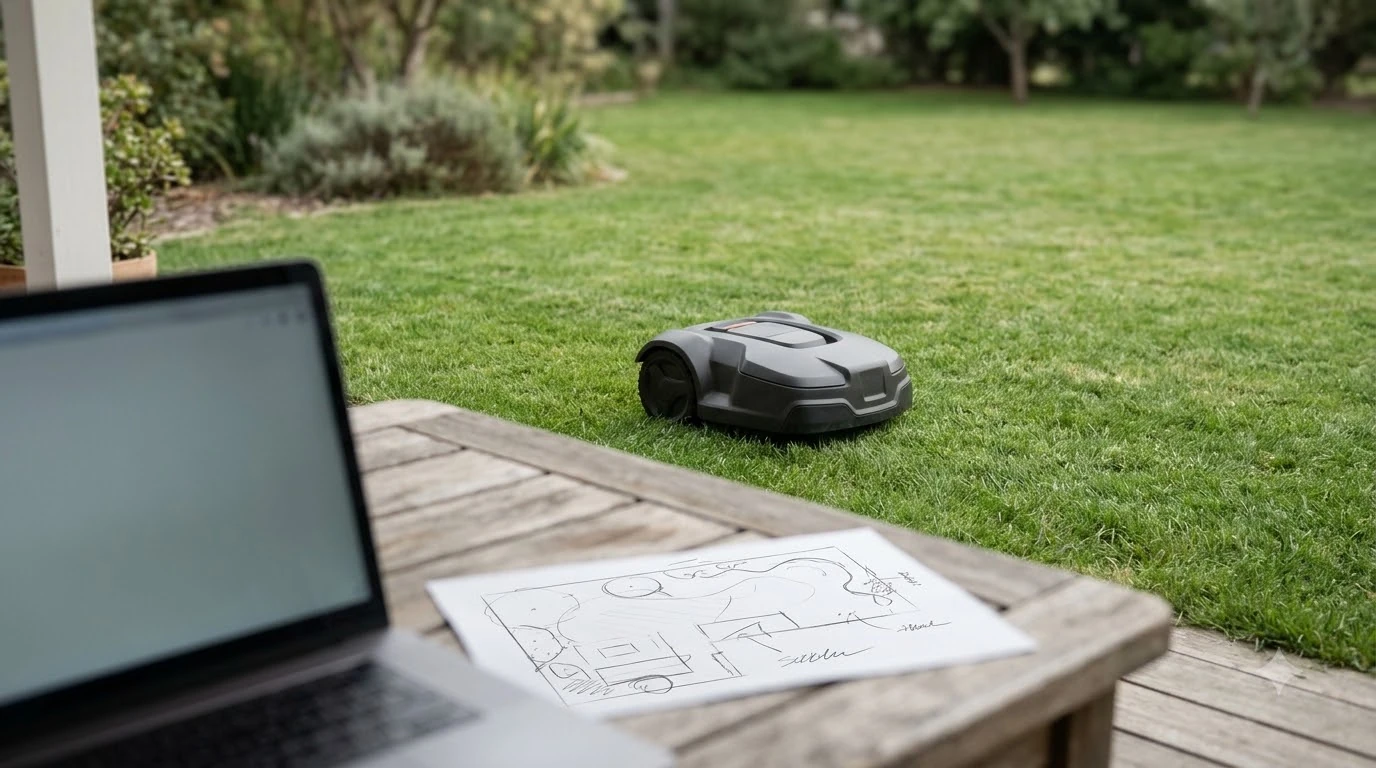

Can a robot mower mow around a wildflower patch? Yes, but only if you map the patch as a no-go or stay-out zone. Without that zone, the mower treats the flowers as ordinary lawn and cuts them. Setup steps differ by brand, and the details below are as of 2026-11-12.
The short answer
- Map the patch: a robot mower can mow around a wildflower patch only when it is drawn as a no-go zone in the app, because a fence or row of stakes does not stop the mower by itself.
- Zone size: Husqvarna’s wire-free system requires at least 30 x 30 cm (1 x 1 ft) for a stay-out zone.
- Keep clear: the zone must not cover the charging station, the guide wire or a passage the mower needs.
- Rest of the lawn: Iowa State and Colorado State both suggest a mowing height of about 3.5 inches.
- Cut the patch later: UMaine Extension advises mowing pollinator habitat after the first hard frost.
Can a robot mower mow around a wildflower patch without a zone?
Not reliably. A robot mower cuts whatever sits inside its mapped lawn, so a flower patch is safe only when the map excludes it. Mammotion’s support documentation lists flowerbeds, trees, roots and ditches as obstructions that get no-go zones, and says the robot avoids mowing inside them. A patch you have not mapped gets no such protection.
The reason to protect it is ecological. Colorado State Extension notes that lawns generally are not abundant or diverse resources for pollinators, and that dedicated pollinator habitat provides floral resources all season long. A small uncut patch inside a mown lawn is one simple way to add that habitat, and the robot mower can keep the rest of the lawn tidy around it.
Draw the patch as a no-go zone
The direct question, can a robot mower mow around a wildflower patch, has a practical answer once the zone exists. Most current apps create the zone on the map, then ask you to walk or draw its edge. Mammotion’s steps are to tap Create, then No-go zone on the Map page, guide the robot to the zone’s edge, tap the play icon to start mapping, drive the perimeter back to the start point and press save.
Husqvarna’s boundary-wire models use a stay-out zone instead, and the app lets you move waypoints until they cover the area you want. Husqvarna’s own example for these zones is newly sown grass or spring flowers, which is the same situation as a wildflower patch. Its wire-free EPOS system has a minimum stay-out size of 30 x 30 cm.
Husqvarna’s EPOS guide also recommends stay-out zones around all obstacles, such as trees, roots and stones. A patch that sits among tree roots or rocks therefore fits the same logic, and the zone protects the flowers while keeping the mower off the hazard.
Once the zone is saved, a robot mower can mow around a wildflower patch without touching the flowers, which is the setup most readers need. Our reading is to draw the zone slightly wider than the visible blooms. Flowers spread and seedlings appear at the edge, so a tight outline leaves the most exposed plants unprotected. Re-check the zone after the first few mowing runs, since you can add or change zones in the app at any time. Our walkthrough of how to set up no-go zones on a robot mower covers the general steps.
Keep the zone clear of the charging station and passages
Before you draw anything, check the layout, because the zone only works if the dock stays reachable. A stay-out zone must not cover the charging station or the guide wire, and it must not block a passage the mower needs to use. Husqvarna’s rule is that a zone covering the charging station will stop the mower from operating at all.
- Charging station: Husqvarna’s EPOS guide asks for at least 6 metres (20 feet) of free space in front of the charging station.
- Guide wire: do not let the zone cover any part of it.
- Passages: if the mower has to pass through a gap to reach the rest of the lawn, leave that gap open.
- Boundary wire: Husqvarna advises including as long a stretch of the boundary wire as possible inside the zone.
Husqvarna’s wire-free guidance also warns against zones that create unreachable areas, including narrow passages the mower cannot get through. A zone must not cut off part of a work area either. Its warning is direct: a stay-out zone across a transport path will prevent the mower from reaching its destination, so our reading is to draw the patch as a compact shape rather than a long strip that splits the lawn. If the patch sits among trees, how to lay boundary wire around trees and obstacles shows the wire side of the same problem.
These placement rules apply to boundary-wire installations. Wire-free systems use their own setup, so check the manual for your model before you draw anything near the dock. For dock placement itself, see where to put a robot mower charging station.
Set the mowing height for the rest of the lawn
Set the mower to about 3.5 inches for the lawn around the patch, which Iowa State and Colorado State both recommend. Both sources also say to remove no more than one-third of the grass height in a single mowing.
| Source | Height advice | Cut when grass reaches |
|---|---|---|
| Iowa State Extension | 3.5 inches, or a little higher in May | Not stated |
| Colorado State Extension | 3.5 inches, or 4 inches if the mower allows | About 5.25 inches at a 3.5-inch setting |
The one-third rule matters more than the exact number. Iowa State says ideally you remove only one-third of the total leaf blade in a single mowing, and it suggests stretching the time between cuts from every 7 days to every 10 to 14 days. A robot mower runs often, so the rule is easier to meet with a higher deck and a longer interval. For general settings, see the best mowing height for a robot mowed lawn.
Colorado State adds that mowing more than one-third of the grass height stresses the grass. The advice is for a general lawn, so a regional extension office can refine the height for your grass type.
When to cut the patch itself
Timing is the other half of the answer. Readers often ask when they can cut the patch, and the short version is that the cut waits until late in the season. For a pollinator patch, UMaine Extension says mowing is generally done after the first hard frost of the season. Waiting that long allows seed dispersal or collection, and it gives perennial plants the longest possible season to store energy for overwintering.
The UK Royal Horticultural Society describes a different schedule for managed wildflower meadows. Its guidance is to cut a new meadow to about 5 cm (2 inches) six to eight weeks after the seedlings appear, make the main summer cut between late June and the end of August, and leave the cuttings for a few days so seed can drop before raking. Because that guidance is UK meadow guidance, use it as a model for timing and check a local extension service for a US patch.
Heads up
A robot mower cannot rake or bag a patch. Plan a separate hand cut, or a trimmer, for the patch itself, and keep the zone in place so the robot does not reach the flowers in the meantime.
What a robot mower cannot do
So can a robot mower mow around a wildflower patch with no help from you? Only up to the edge of the zone. It keeps the lawn around the patch cut, but it does not manage the flowers, the seed or the cuttings, and it cannot decide when the patch should be cut or cleared.
The advice in this guide comes from manufacturer support pages and extension publications. None of it reflects independent tests of wildflower patches, so the exact steps for your mower may differ. Check your model’s app and manual before you rely on a zone.
Frequently asked questions
Can a robot mower mow around a wildflower patch if I do not set a zone?
Not reliably. It can cut the patch if the patch sits inside the mapped lawn. Mammotion lists flowerbeds among the obstructions that need a no-go zone, so an unmapped patch receives no protection from the app.
Can a no-go zone sit next to the charging station?
It can sit nearby, but it must not cover the charging station or the guide wire. Husqvarna says that a zone covering the charging station prevents the mower from operating, so leave the dock approach open.
How big should the zone be?
Husqvarna’s wire-free system requires at least 30 x 30 cm (1 x 1 ft) for a stay-out zone. For a patch, our reading is to draw the zone wider than the visible flowers, because seedlings often appear at the edge.
When should I cut the patch?
UMaine Extension says pollinator habitat is generally mowed after the first hard frost. The UK Royal Horticultural Society uses a summer cut between late June and August for managed meadows. Check your local extension office for timing in your region.
Sources
- Iowa State University Extension, no-mow tips (university extension): 3.5 inch height, one-third rule, 10 to 14 day interval.
- Colorado State University Extension, no-mow guidance (university extension): height range, example cut point, pollinator habitat.
- University of Maine Extension, pollinator garden mowing (university extension): timing after the first hard frost.
- Royal Horticultural Society, wildflower meadow maintenance (UK charity): cutting months, heights and removing cuttings.
- Husqvarna support, creating stay-out zones (manufacturer): charging station, guide wire and passage rules.
- Husqvarna support, EPOS wire-free stay-out zones (manufacturer): 30 x 30 cm minimum size.
- Mammotion support, how to create a no-go zone (manufacturer): steps and obstruction types.
 Up next10 min readBy YardCan a Robot Mower Work Around a Bird Bath? Wire Setup GuideUpdated Nov 12, 2026
 9 min readBy YardCan a Robot Mower Mow Around a Pool Safely?Updated Nov 11, 2026
 8 min readBy YardOne Third Rule for Mowing Grass: How It Works and Why It MattersUpdated Nov 11, 2026
 8 min readBy YardRobot Mower That Works Under Trees Without RTK: What to Look ForUpdated Nov 11, 2026
 8 min readBy YardCan a Robot Mower Work Around a Rain Garden?Updated Nov 12, 2026
 7 min readBy YardCan a Robot Mower Work Around a Wooden Deck?Updated Nov 12, 2026