
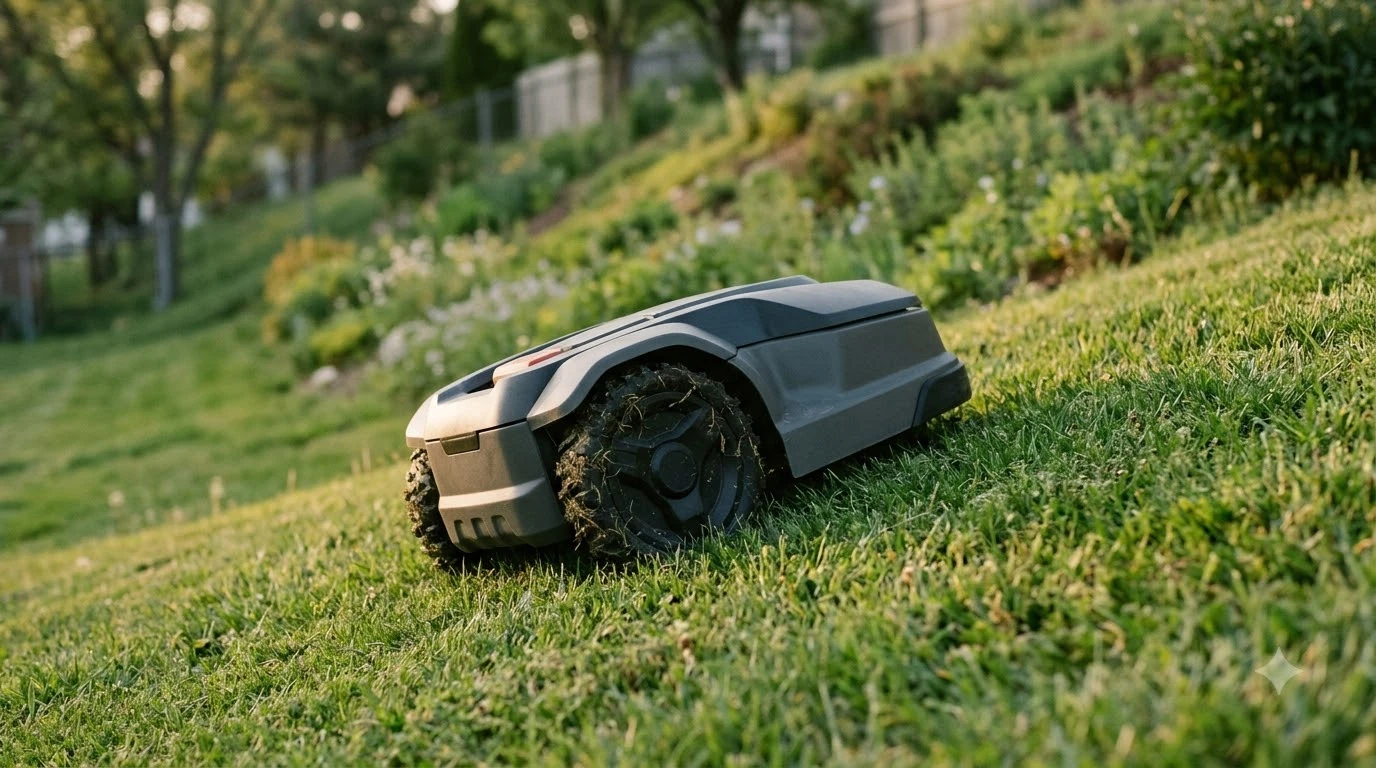

Can a robot mower mow a drainage ditch? In most yards, no, and it should be kept out of the ditch itself. We did not find a manufacturer manual that names drainage ditches, but the drop-off and edge guidance from robot mower brands points the same way: keep the mower off steep banks and wet channel bottoms, and set the boundary wire well back from the lip. The sections below explain why, using only the figures from the sources we read.
The short answer
- Keep the ditch out. Treat the channel and its banks as a no-mow area rather than part of the lawn.
- Set the wire back. Some models can roll up to 30 cm past a boundary wire placed right at an edge.
- Check the slope. A bank must stay within the rated slope limit of your model, and brand guides put basic models near 20% and hillside-ready units at 35% or higher.
- Trim by hand. Cut the ditch banks and bottom with a trimmer after the robot finishes the lawn above.
Why a drainage ditch is a poor place for a robot mower
A drainage ditch combines the three conditions that robot mower makers warn about most: a drop, a steep bank, and wet ground. The channel is cut to carry water away, so its sides are often steeper than the lawn around them and its bottom is often soft. Each of those is a problem on its own, and together they make a ditch one of the harder areas in a yard for any wheeled machine. Wet clay is a separate problem, covered in robot mowers on wet clay soil.
So can a robot mower mow a drainage ditch? Our reading is that the channel itself is off limits, because the main risks are slipping, getting stuck, and running the wheels over the lip. A mower that tips into a channel can be hard to recover, and wet grass reduces traction further. The guidance below covers each of these risks in turn.
What manufacturer guidance says about drops and edges
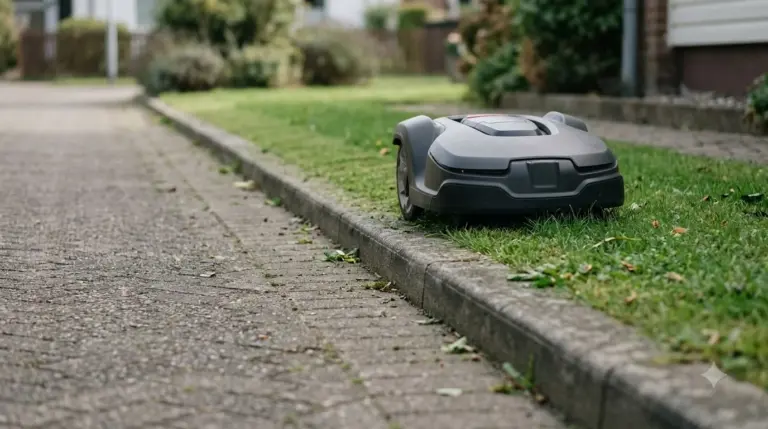
Brand guidance rarely mentions ditches by name, but it does cover drop-offs and edges, which is the closest match. Robomow’s edge guidance explains that a perimeter wire laid directly at the edge does not stop the mower at the edge. In its words, the mower “will go a little beyond it,” and “in some models even as much as 30 cm.” The same page warns that a wire placed too close to an edge risks the mower “slipping and getting stuck in the edge.”
Robomow also says a greater distance should be kept near a wall or water. The page we read gives no figure for that case, so we would not invent one. Our reading is that a ditch is a drop-off, and the same logic applies: the wire belongs well inside the lip, not on it.
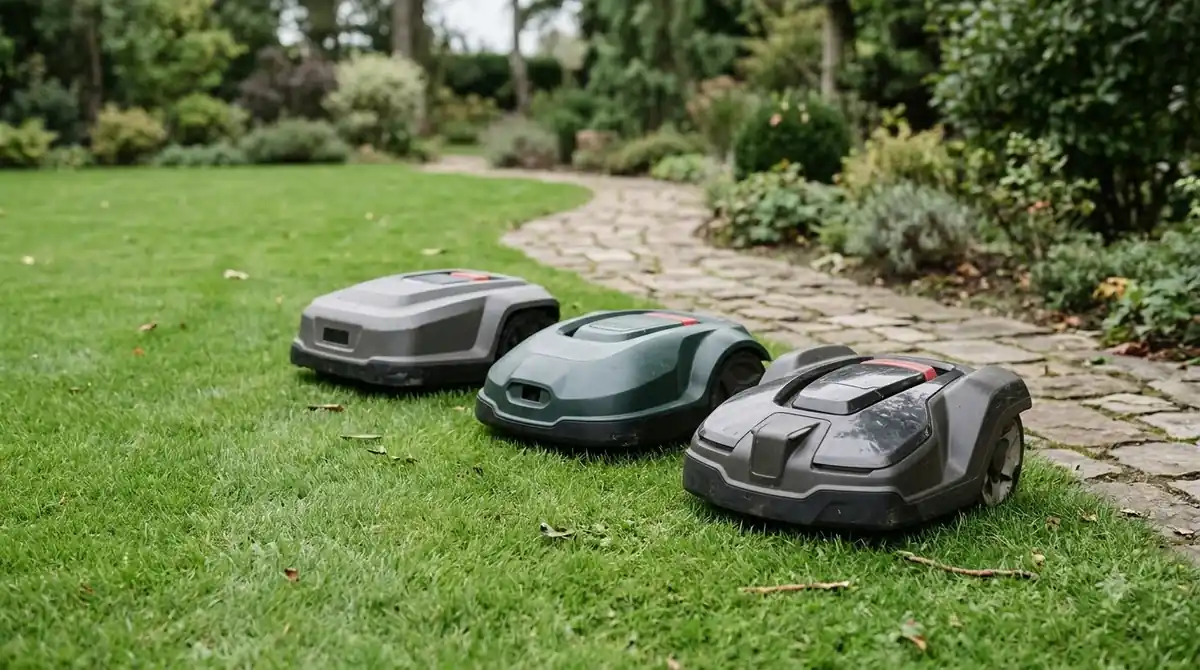
Sunseeker’s slope guide lists sudden drop-offs among the natural obstacles on uneven ground. It recommends designating no-mow areas for steep embankments and garden beds, and creating a separate zone for a particularly steep section. That is the closest published guidance we found to a ditch bank, and it supports keeping the bank out of the mowing area. In short, can a robot mower mow a drainage ditch bank? Only when the bank is a planned part of the lawn, which is rare.
Slope limits: when a bank is too steep
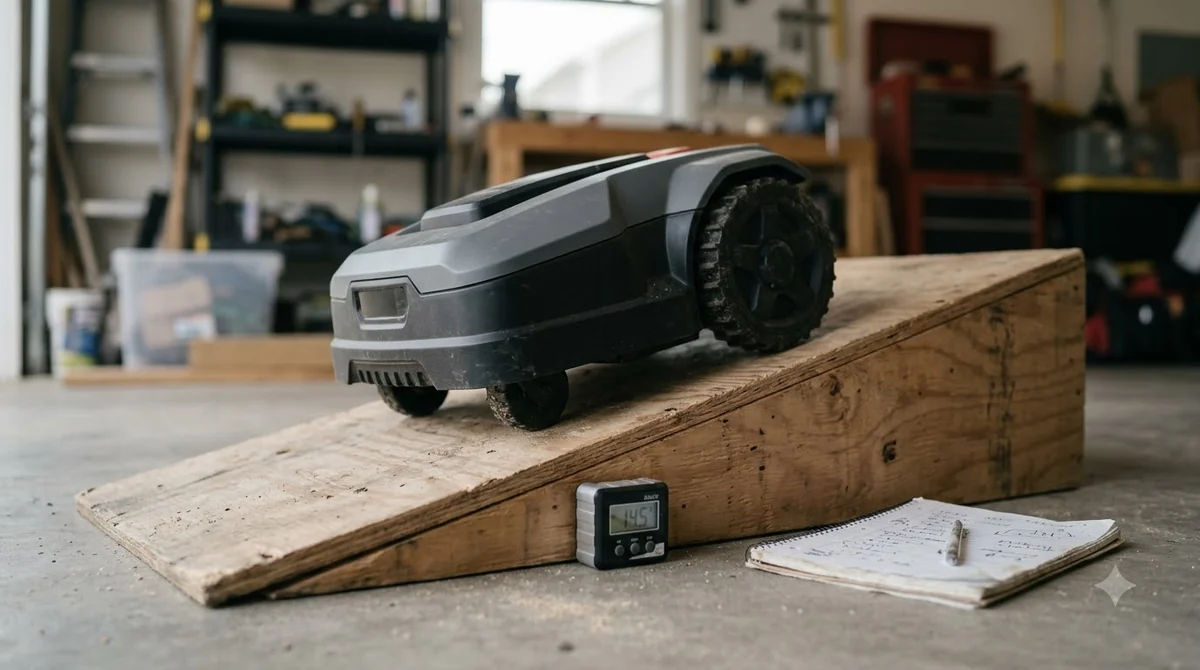
Each model has its own maximum slope, and the boundary has to stay within that limit, not just the lawn. Husqvarna’s UK installation guide says to “ensure that slopes in the work area and near boundaries do not exceed the limits specified for your lawn mower.” Its model table gives a “maximum slope by the boundary” value that ranges from 10% to 50%, depending on the model.
For slopes near the top of that range, the same guide advises keeping the wire further in. On AWD models working 50% to 70% slopes, it says to maintain 1.5 m (5 ft) from the bottom of the slope to the boundary wire. Sunseeker gives rough bands: basic models around 20%, hillside-ready units 35% or higher, and premium all-terrain models up to 35% to 70% (19 to 35 degrees). These are brand claims, so check the manual for the exact model you buy.
Eufy’s page states that conventional mowers lose traction above a 20% incline, and that its E15 and E18 have a maximum slope of 18 degrees. Note that percent and degrees are different scales: 18 degrees is roughly 32%. Our reading is that a ditch bank steeper than the rated figure is outside what the mower should handle, even when the ground at the top of the bank is flat lawn. For steep banks, the guides to robot lawn mowers for 45 percent slopes and AWD versus 2WD robot mowers for hills cover the drive and traction side.
How to set the boundary wire near a ditch edge
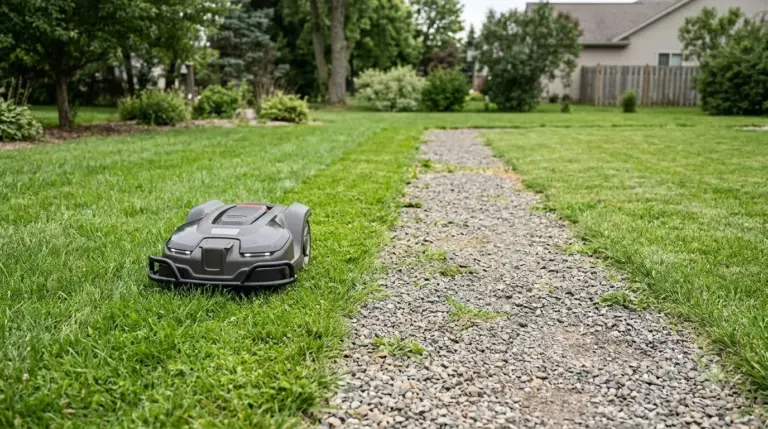
The safest boundary keeps the wire on flat ground, well back from the top of the ditch. Husqvarna’s guidance for steep outer edges says to “position the boundary further in on flat ground before the slope begins.” Applied to a ditch, that means the wire sits on the lawn side of the lip, not at the edge. Can a robot mower mow a drainage ditch once the wire is set back? The wire protects only the lawn side, so the ditch still needs separate handling.
Robomow’s cutting figures help set the distance. A centered blade cuts roughly 10 to 20 cm from a wall or edge, and edge-cutting models get closer, to about 5 cm. Our reading is that the setback should allow for the overrun of up to 30 cm on some models, plus the cutting distance, and that the final spacing should be confirmed in your model’s manual before you lay the wire.
Where a slope or ditch borders a public road, Husqvarna recommends a physical barrier, such as a wall or fence of at least 15 cm (6 in) along the outer edge. If a ditch runs beside a road or a neighbour’s property, we would treat that barrier as a safer boundary than a wire alone. That is our reading rather than a rule stated for ditches.
What to do instead: no-mow zones and hand trimming
The simplest approach is to keep the ditch outside the robot’s mowing area and handle the banks separately. Sunseeker recommends no-mow areas for steep embankments, so the zone should sit over the ditch and its banks. That is the practical answer to can a robot mower mow a drainage ditch: the mower covers the lawn, and the ditch gets a separate plan. Where your model supports no-go zones, use them as well, so the mower has a second boundary inside the lawn.
Trim the ditch bottom and banks by hand or with a trimmer after the robot has finished the lawn above. Our reading is that this is slower, but it avoids the wet, sloped ground where a robot is most likely to slip. Clearing debris from the channel before each mowing session also reduces the chance of a jam.
Can a robot mower mow a drainage ditch? What to check first
Four checks cover most of the risk, and the By Yard guides cover other tricky layouts that start with the same measurements. The table below lists each one with the figure we found in the sources.
| Check | What the sources say | Source |
|---|---|---|
| Maximum slope by the boundary | 10% to 50%, depending on the model | Husqvarna UK |
| Wire placed right at an edge | Mower can go beyond it, up to 30 cm on some models | Robomow |
| Edge cutting distance | About 10 to 20 cm for a centered blade, about 5 cm for edge-cutting models | Robomow |
| Steep embankments | Designate as no-mow areas | Sunseeker |
Frequently asked questions
Can a robot mower cut the bank of a drainage ditch?
Only if the bank is within the model’s rated slope and the wire keeps the mower well back from the lip. Our reading is that most owners should keep the bank out of the mowing area and trim it by hand.
How far from a drop should the boundary wire be?
Robomow’s page gives no single figure for drops. Because some models can overrun a wire placed at the edge by up to 30 cm, plan a wider setback and confirm the spacing in your model’s manual.
Will a robot mower stop at a ditch on its own?
We did not find a source that promises this. The guidance we read treats the boundary wire and no-mow zones as the main way to keep a mower away from edges, so the setup matters more than any stop function.
Does wet ground change the answer?
Yes. Eufy’s page notes that hills can be tricky when wet, and traction drops on wet grass. A wet ditch bank is a higher-risk area, so it is a stronger reason to keep it outside the mowing zone.
Sources
- Optimising an Automower installation for steep slopes (Husqvarna): boundary setback on slopes, model slope limits, barrier along a road.
- How cleanly does a robotic mower cut the lawn edge (Robomow): edge cutting distances, boundary overrun, wire too close to an edge.
- Can robotic lawn mowers handle slopes (Sunseeker): drop-offs as obstacles, no-mow areas for embankments, slope bands.
- Best robot mower for steep terrain (eufy): traction above 20%, model slope limits, wet hills.
 Up next7 min readBy YardCan a Robot Mower Mow Multiple Separate Lawns?Updated Nov 11, 2026
 9 min readBy YardHow Long Does a Robot Mower Take to Mow an Acre?Updated Nov 11, 2026
 9 min readBy YardRobot Mower and Dog Poop: Should You Let It Mow Over Waste?Updated Nov 11, 2026
 10 min readBy YardWhen to Mow New Sod: First Cut Height and Root TestUpdated Nov 11, 2026
 9 min readBy YardWhen to First Mow New Grass Seed (Height, Not Calendar)Updated Nov 11, 2026
 9 min readBy YardHow Often to Mow Kentucky Bluegrass by SeasonUpdated Nov 11, 2026