
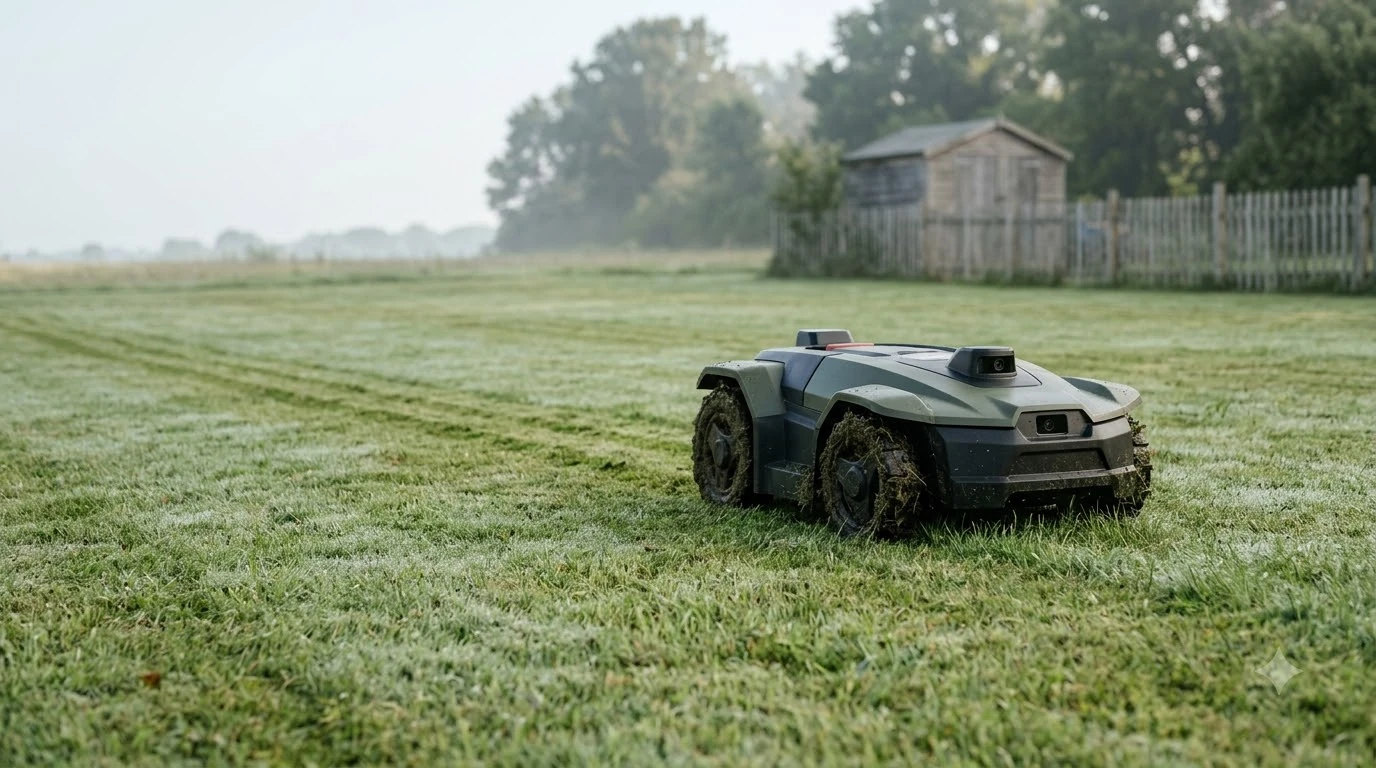

There is no single best budget robot lawn mower, but the cheapest model whose rated area, slope limit and navigation method fit your yard is, in our reading, usually the right buy. Cheaper models differ mainly in those ratings and in the parts and warranty terms around them. This guide shows which trade-offs to check and what they cost you over time. It gives no dollar prices, because retail prices change often.
The short answer
- Read the ratings first: rated area, slope limit and navigation method matter more than the price tag.
- Treat slope as a ceiling: published slope figures are absolute limits, not targets for daily mowing.
- Leave margin on area: a model rated just above your lawn size has little room for obstacles.
- Budget for wear: Robomow puts battery life at about 4 to 5 years, and Husqvarna says main blades need replacing every 3 to 6 weeks in normal conditions.
- Check the warranty terms for the battery and wear parts before you pay.
What a lower price usually leaves out
The best budget robot lawn mower is not simply the cheapest one, because a lower price usually comes with a smaller rated area, a lower slope limit or a simpler navigation setup. Each one limits where the mower can work, so a cheaper model fits only when its limits sit above your real lawn.
Slope is the limit most buyers miss. eufy publishes three rough tiers: basic robot mowers at 10 to 25 percent, mid-range models at 35 percent, and AWD models at 70 percent, which is 35 degrees. Husqvarna says all of its Automower models manage slopes of at least 25 percent, and its 435X AWD handles a 70 percent (35 degree) incline. Those are manufacturer figures, not independent tests.
| Tier (eufy published figure) | Slope limit | Our reading of where it fits |
|---|---|---|
| Basic | 10 to 25 percent | Flat or gently sloping lawns |
| Mid-range | 35 percent | Lawns with moderate banks |
| AWD | 70 percent (35 degrees) | Steep banks and uneven ground |
eufy also describes the rating as an absolute limit rather than a target for daily mowing. Our reading is that a budget model should have a slope limit comfortably above your steepest section, not just above the average slope of the yard, so measure your yard slope before you compare ratings.
How to size a budget mower to your lawn
To find the best budget robot lawn mower for your yard, match the rated area of each model to a measured lawn size, with room left over for obstacles and the mower’s trips back to the dock. Husqvarna notes that each model has a set area capacity, so the fit between capacity and lawn size matters.
- Measure the lawn. Clemson’s HGIC offset method splits an irregular lawn into rectangles, measures the width at even intervals, and adds the results. Closer offset lines give a more accurate area. Clemson reports the result in square feet.
- Set aside areas the mower cannot enter. Leave out patios, beds and pools if the mower has no zone to cover them. This is our reading, since the measuring guide does not cover mower zones.
- Compare with the rated area. If the measured figure sits close to the rating, look at the next size up. Obstacles, narrow passages and dock trips use up part of the rated capacity.
- Check the shape, not just the total. A long, narrow lawn can need a different layout than a square lawn of the same area, so check the spec sheet for how it handles passages.
Wire or wire-free: what the choice changes
A boundary wire or a satellite and sensor setup defines the mowing area, and each one has its own install and failure trade-offs. UF/IFAS states that the area is set by a boundary wire or by GPS and RTK positioning, so the navigation method is the first spec to confirm. Our wire-free vs boundary wire comparison covers the trade-offs in more detail.
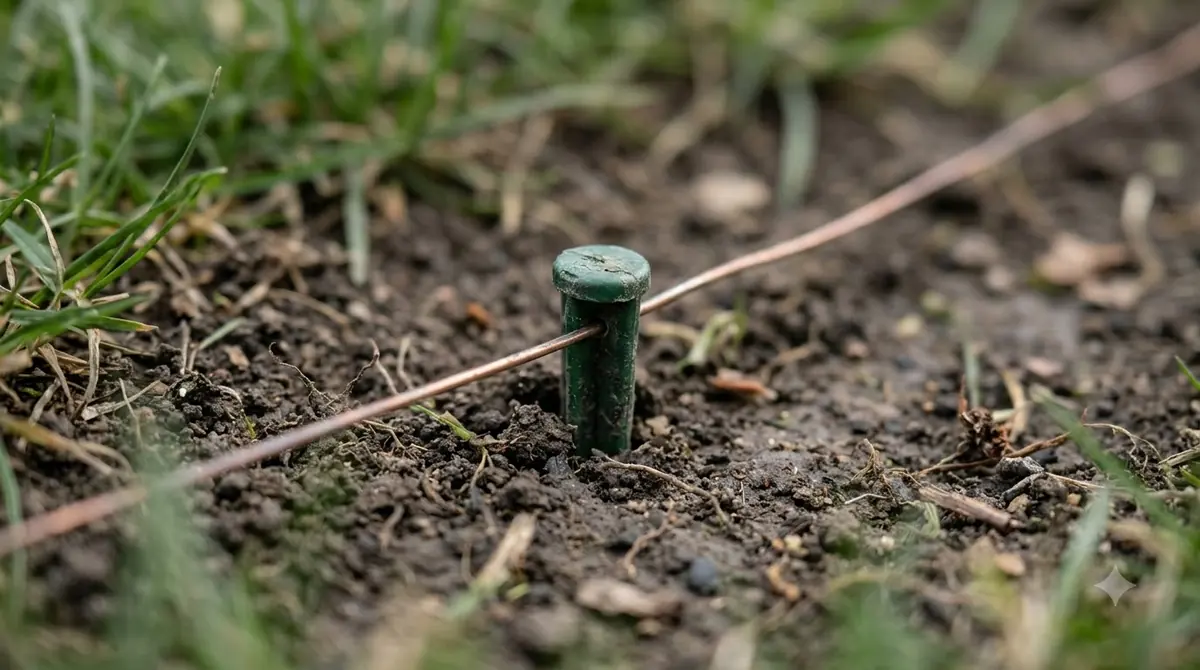
Wire-free models use virtual boundaries, which Husqvarna says removes the risk of wire breakage. RTK models depend on an open view of the sky, which is one side of the RTK vs LiDAR choice. Sunseeker explains that its RTK base computes satellite error at a fixed point and sends a correction, and that trees, walls and roof overhangs weaken that accuracy. Ecovacs says the base needs an open, unobstructed area.
- Boundary wire: in our reading, the setup takes time, and Husqvarna notes that wire breakage is a risk the virtual-boundary models avoid.
- RTK: needs open sky around the base and the mower’s path.
- Wire-free with sensors: depends on the sensors and the obstacles in your yard, so check its own rated limits.
Battery, blades and other running costs
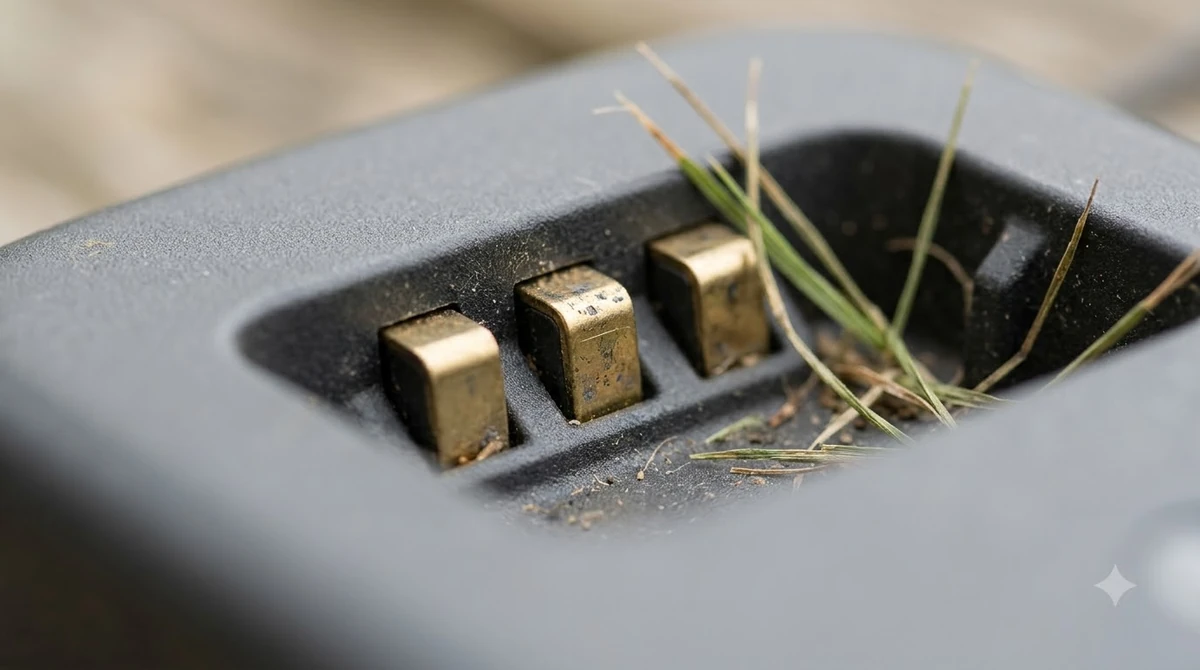
Robomow puts battery life at about 4 to 5 years depending on chemistry, and Husqvarna says main blades last about 3 to 6 weeks in normal conditions. Those figures decide the running cost more than the sticker price does, so read them before you compare two models with different prices. For more on wear, see our guide to robot mower battery life.
| Part | Life stated by the source | Source |
|---|---|---|
| Li-ion battery | About 4 years, rated 500 to 800 cycles | Robomow |
| LiFePO4 battery | About 5 years, rated 1,000 to 2,000 cycles | Robomow |
| Whole mower | Normally 3 to 5 years, depending on use | Ecovacs |
| Main blade | 3 to 6 weeks in normal conditions | Husqvarna |
Ecovacs says a large lawn mowed every day wears the battery faster than a small garden trimmed every two weeks. Repeated full charges and full drains also shorten battery life. Our reading is that a model which must run daily on a big lawn will age sooner, so the battery figure matters more for big yards.
Warranty and parts: read the terms before you buy
Warranty terms differ by brand and region, and wear parts such as blades and batteries can be excluded from free service. As of November 2026, one budget brand’s published statement gives a 3-year limited warranty on the robot body and a 2-year limited warranty on the battery.
The same statement lists blades under accessories with no warranty period. It also says free warranty service does not cover natural wear of wheels and blades or consumable batteries. Check the seller’s current warranty page before you pay, because the wording can change, and see how to register a robot mower warranty for the next step after purchase.
Best budget robot lawn mower checklist
Use these checks in order. Each check can rule a candidate out before you compare features, which is how you find the best budget robot lawn mower for your own yard.
- Rated area. Confirm the rating is above your measured lawn, with margin for obstacles.
- Slope limit. Read the figure for the working area and the boundary if the spec sheet gives both, and treat it as a ceiling.
- Navigation. Match wire, RTK or sensor navigation to your yard, including trees, buildings and the placement of any base.
- Grass type and cutting height. UF/IFAS says autonomous mowers are designed mostly for cool-season grasses and are typically mowed below 2.5 inches. For warm-season lawns, check that the lowest setting reaches the height you want.
- Parts and warranty. Check the battery, blade and wear-part terms, not only the headline warranty length.
Frequently asked questions
Is a cheap robot lawn mower worth buying?
It can be, if its rated area and slope limit fit your lawn. Measure the lawn, compare the ratings and read the battery and warranty terms. A low price alone does not show whether a model will handle your yard, so the spec sheet decides more than the sticker does when you choose the best budget robot lawn mower for your yard.
What slope can a budget robot mower handle?
eufy’s published tiers put basic models at 10 to 25 percent, mid-range models at 35 percent and AWD models at 70 percent. Husqvarna says all its Automower models manage slopes of at least 25 percent. Treat each figure as an absolute limit, not a target for daily mowing.
Does a budget robot mower need a boundary wire?
It depends on the model. UF/IFAS says the mowing area is set by a boundary wire or by GPS and RTK positioning. Check which method a model uses in its spec sheet before you buy, because wire installation and RTK base placement each bring their own trade-offs.
How long does a robot mower battery last?
Robomow gives about 4 years for Li-ion packs rated 500 to 800 cycles, and about 5 years for LiFePO4 packs rated 1,000 to 2,000 cycles. Ecovacs says a whole mower normally lasts 3 to 5 years, depending on how much it is used and how the battery is charged.
Sources
- Buying robotic lawn mowers for a small lawn (Husqvarna): slope figures, area capacity, virtual boundaries.
- Autonomous mowers, ENH1402 (UF/IFAS EDIS): navigation methods, cool-season grasses and typical mowing height.
- Robot lawn mower slope limits (eufy): published slope tiers and the meaning of the rating.
- Measuring the area of a home lawn (Clemson HGIC): offset method for irregular lawns.
- What is RTK technology (Sunseeker): RTK base and factors that weaken accuracy.
- How long do robot lawn mowers last (Ecovacs): whole-mower lifespan and wear from daily use.
- How long does the battery of a robotic lawnmower last (Robomow): battery chemistry, cycle ratings and lifespan.
- How and when to change blades (Husqvarna support): main blade life in normal conditions.
- Warranty statement (Anthbot): body and battery warranty periods and wear-part exclusions.
 Up next7 min readBest Robot MowersBest Robot Lawn Mower Under $2,000: What the Budget Buys and What to CheckUpdated Nov 13, 2026
 6 min readBest Robot MowersBest Budget Robot Lawn Mower That Actually Works: What to CheckUpdated Nov 11, 2026
 7 min readBest Robot MowersBest Robot Lawn Mower for 1.5 Acres: What to Check Before You BuyUpdated Nov 16, 2026
 7 min readBest Robot MowersUsed Robot Lawn Mower: Worth It? 5 Expert Checks FirstUpdated Nov 13, 2026
 8 min readBest Robot MowersBest Wireless Robot Mower for a 1.5 Acre Lawn: What to CheckUpdated Nov 11, 2026
 10 min readBest Robot MowersBest Robot Mower Christmas Gift for Homeowners: 5 Key ChecksUpdated Nov 11, 2026