
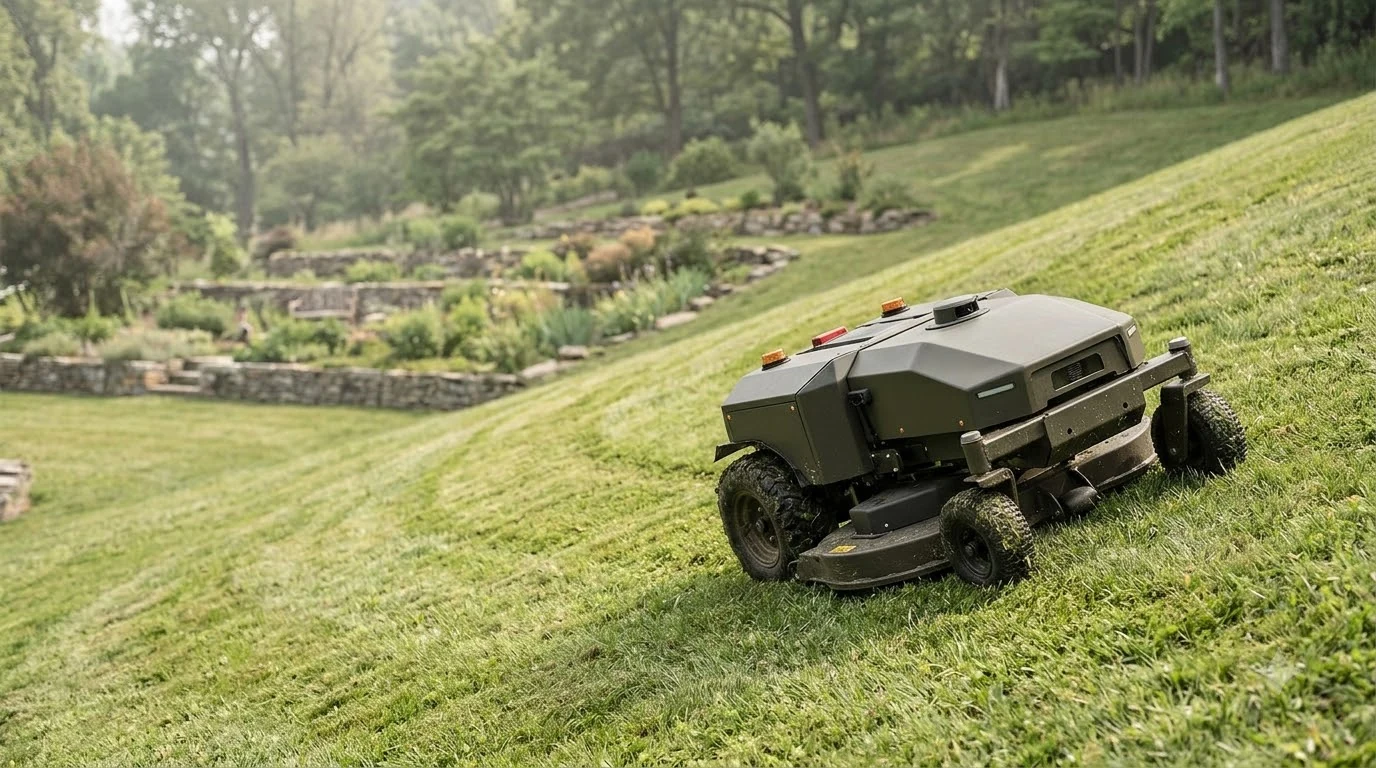

Which 4-wheel drive robot mower is the most accurate? No single model is, because drive type and positioning are two different systems. A robot mower’s accuracy comes from how it knows where it is: RTK GPS, LiDAR, camera-based vision, or a combination. Four-wheel drive (AWD) mainly affects grip on slopes and soft ground. A spec sheet that says “AWD” tells you almost nothing about edge accuracy, so check the positioning method first and then the drive layout.
The short answer
- Accuracy is set by positioning, not by drive type. RTK, LiDAR and vision each work differently, and a 4WD model can use any of them.
- RTK vendors cite centimeter-level figures in open sky. Those figures are vendor claims, and the same vendors say accuracy drops under dense tree cover or near tall buildings.
- LiDAR and vision hold up better under canopy. They do not depend on satellite visibility, though heavy rain, fog, dust, and strong shadows can reduce their performance.
- There is no independent accuracy ranking. We found no standardized test comparing AWD models on positioning, so treat any “most accurate” claim as the maker’s own claim.
What “accuracy” means for a robot mower
Accuracy in this context means how precisely the mower knows its position relative to the boundary, the mowing pattern, and any no-go zones. A mower with poor positioning can leave uncut strips along edges, cross into flower beds, or drift outside its intended area. It is a different question from whether the mower can climb a hill.
Most manufacturers describe accuracy in centimeters, but they do not agree on how they measure it. Some quote a figure for ideal open-sky conditions, and others do not state a test method. Read any number as the best case the maker chose to publish. Any claim about which 4-wheel drive robot mower is the most accurate should name the positioning method and the conditions behind the figure.
Which 4-wheel drive robot mower is the most accurate: why drive type is not the answer
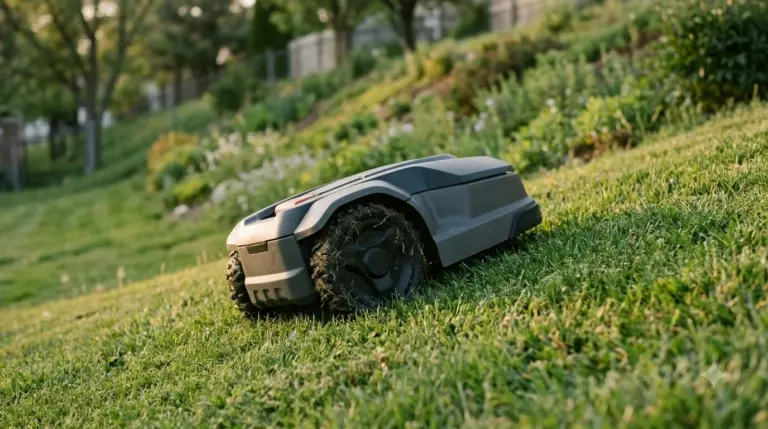
Four-wheel drive is about traction (see what AWD means on a robot mower). Powering all four wheels helps a mower keep grip on steep, wet, or loose ground. That is a useful property on a hill, but it does not say where the mower is. A 4WD model with weak positioning can still wander at the boundary, and a 2WD model with strong positioning can still track its edges precisely on flat ground.
Our reading: when you compare two AWD models, the drive layout explains how the mower handles a slope, and the positioning system explains how neatly it cuts the edges. Those are two separate purchase decisions.
How RTK, LiDAR and vision compare on paper
The three main approaches have different strengths. The table below summarizes what the manufacturer pages we read say, with the vendor framing kept in.
| Method | What the vendor says it does well | Where vendors say it struggles |
|---|---|---|
| RTK GPS | Centimeter-level global position in open areas; vendors cite 1 to 3 cm and 1 to 2 cm | Dense tree cover, tall buildings, narrow passages; network RTK needs cellular coverage in the yard |
| LiDAR | Vendors say it is not affected by tree cover or nearby buildings; excellent relative accuracy but no global position on its own | Heavy rain, fog, or dust; slower initial mapping in large open yards; typically the costliest navigation option |
| Vision (camera) | Flexible boundary detection, rated Medium-High by one vendor | Less consistent edge precision in one vendor’s comparison; depends on lighting, shadows, and weather |
Sources for the table: the Sunseeker and Mammotion comparison pages listed below. Neither gives a numerical accuracy figure for LiDAR or vision, so the table cannot show which method is more accurate in the centimeter sense.
Where each system struggles
The most common failure point for RTK (how RTK works on a robot mower) is satellite visibility. Trees and buildings block satellite signals (more on RTK near tall buildings), which is why both vendor pages say performance may decline under a dense canopy. The Sunseeker page also ties network RTK to the strength of the yard’s cellular signal.
LiDAR does not depend on satellites (here is how LiDAR robot mowers navigate), so it does not lose position under trees in the same way. It has its own limits. Heavy rain, fog, or dust can reduce sensor performance, and a large, open, featureless lawn can take longer to map. Vision systems (see how vision robot mowers work) depend on light. Shadows, glare, and poor weather change what the camera sees, and one vendor describes vision edge precision as slightly less consistent than other methods.
Some premium models combine RTK, LiDAR, and vision, and makers take different routes. These are competing design choices, and the manufacturer pages we read do not offer independent data that settles which one is more accurate.
Heads up
If you are still asking which 4-wheel drive robot mower is the most accurate, note that we found no independent, side-by-side accuracy test of 4-wheel drive models. The figures above come from vendor blogs and product pages. Check the manufacturer’s own specification sheet, then look for independent reviews that describe the same conditions you have in your yard.
What to check before you buy
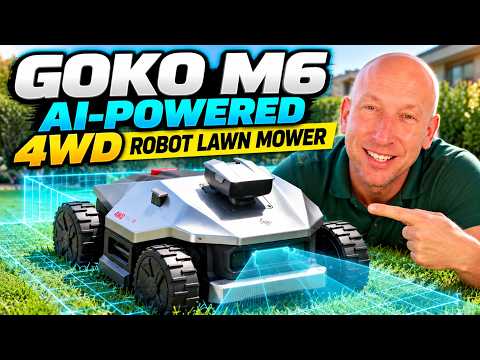
To decide which 4-wheel drive robot mower is the most accurate for your own yard, use this order when you compare two or more 4WD models:
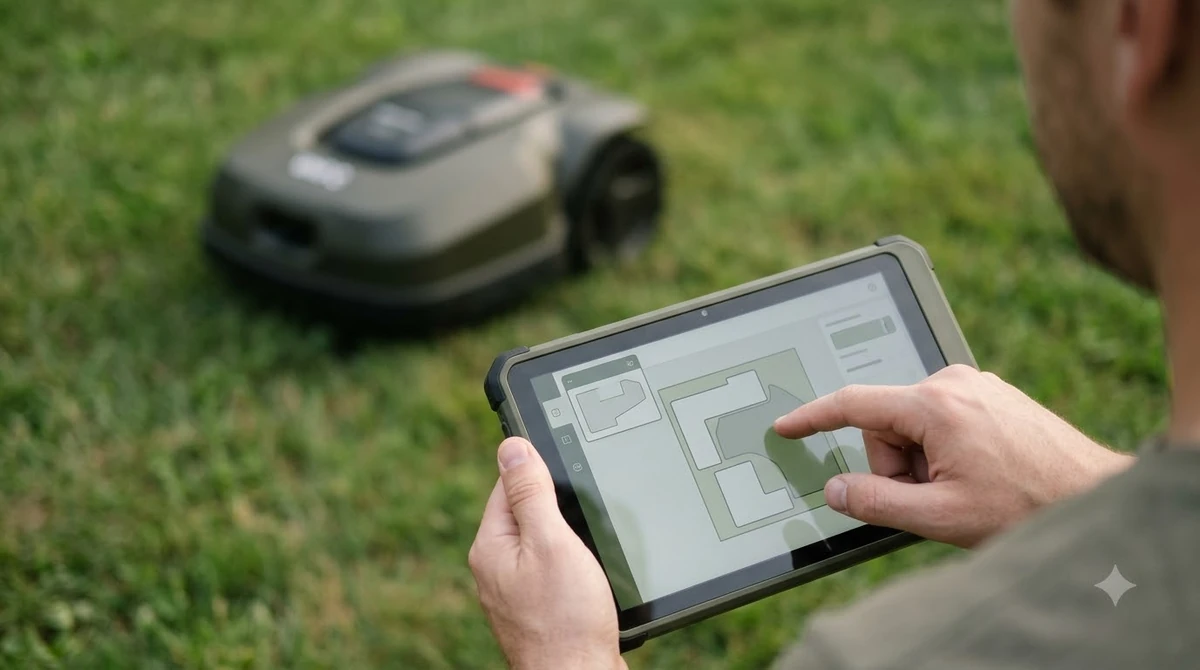
- Positioning method. Write down whether the mower uses RTK, LiDAR, vision, or a combination. Note whether RTK requires a base station, a network subscription, or both.
- Tree cover and buildings. Look at the yard map. If large trees or a two-story house shade much of the lawn, ask how the maker says the chosen method behaves in that condition.
- Boundary method. Some models use a perimeter wire, and others rely on a virtual boundary. Confirm which one the model uses, because it changes how accurately the boundary is followed.
- Slope rating and drive layout. Check the maximum slope the maker lists for that exact model, and confirm whether it is AWD, 2WD, or another layout. Treat the top limit as a ceiling, not a target.
- Support and documentation. Read the maker’s installation and troubleshooting pages. A clear guide to antenna placement or wire layout usually signals how much positioning help you will get after the sale.
Our reading: for most yards, the answer to which 4-wheel drive robot mower is the most accurate is the one whose positioning method matches your tree cover, not the one labeled “most accurate.”
Frequently asked questions
Does 4-wheel drive make a robot mower more accurate?
Not directly. Four-wheel drive improves traction on slopes and soft ground. Accuracy depends on the positioning system, such as RTK, LiDAR, or vision, and the drive layout does not determine which of these a model uses.
Is RTK the most accurate option for a robot mower?
RTK vendors cite centimeter-level accuracy in open sky. The same vendors note that accuracy can drop under dense tree cover or near tall buildings, so RTK is not automatically the most accurate choice for a shaded yard.
Will LiDAR work under trees?
LiDAR does not rely on satellite signals, and one vendor says it is not affected by tree cover or nearby buildings. Heavy rain, fog, or dust can still reduce its performance, according to the same sources.
Where can I find an independent accuracy test?
We did not find an independent test that answers which 4-wheel drive robot mower is the most accurate. Start with the maker’s specification sheet, then compare independent reviews that describe a yard like yours.
Sources
- RTK vs LiDAR robot lawn mowers (Sunseeker, manufacturer blog): RTK accuracy wording, tree-cover limits, LiDAR strengths and weaknesses.
- AI vision vs RTK vs LiDAR (Mammotion, manufacturer blog): RTK boundary accuracy claim, vision lighting dependence, LiDAR classification limit.
 Up next6 min readBest Robot MowersBest 4-Wheel Drive Robot Lawn Mower 2026: What to CheckUpdated Nov 18, 2026
 8 min readBest Robot MowersWhich Vision AI Camera Robot Mower Is the Most Accurate?Updated Nov 14, 2026
 8 min readBest Robot MowersWhich 4G Cellular Robot Mower Is the Most Accurate?Updated Nov 12, 2026
 8 min readBest Robot MowersWhich 3D LiDAR Robot Mower Is the Most Accurate? What the Numbers ShowUpdated Nov 16, 2026
 7 min readBest Robot MowersWhich Satellite Navigation Robot Mower Is the Most Accurate?Updated Nov 13, 2026
 8 min readBest Robot MowersMost Accurate Robot Lawn Mower Navigation for Your YardUpdated Nov 12, 2026