
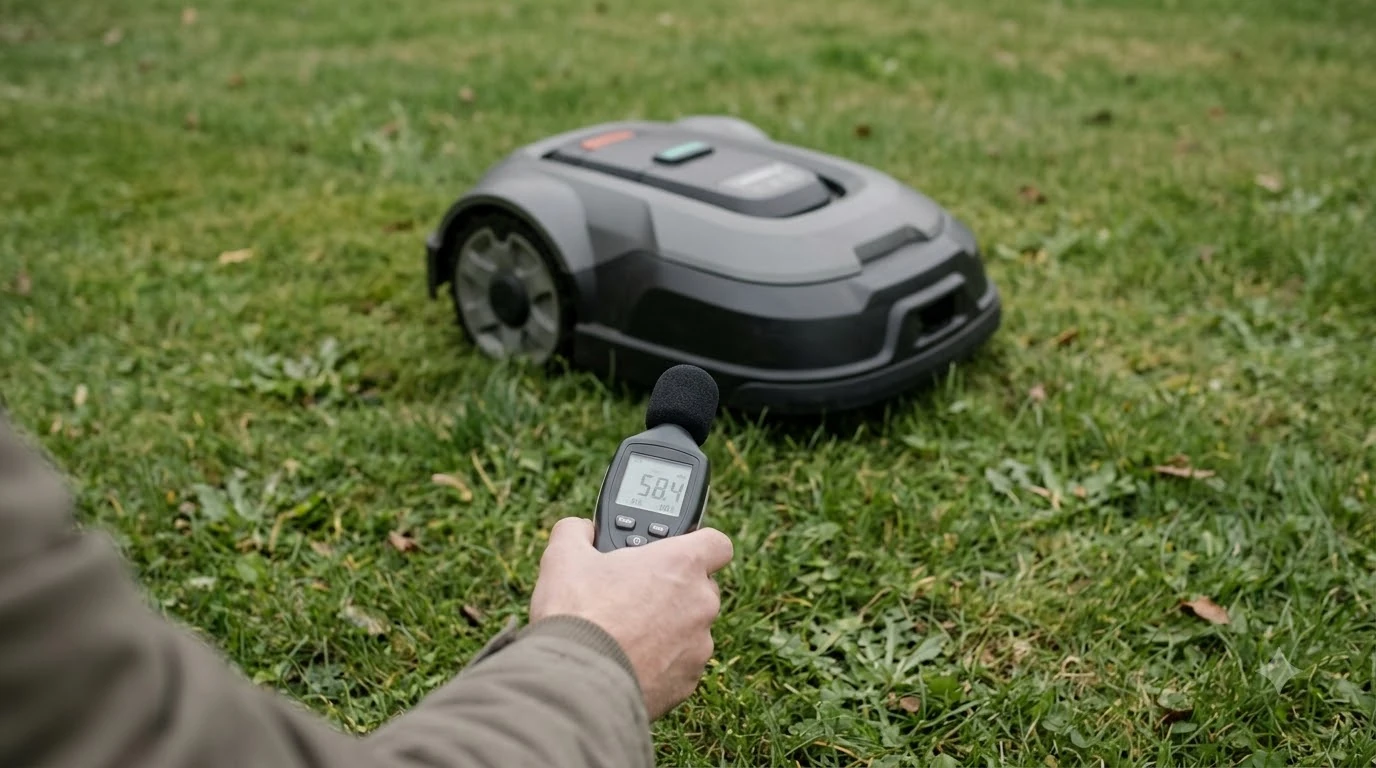

The best digital inclinometer for measuring steep yard slopes is a weather-sealed digital box gauge or torpedo level that displays both degrees and percent grade within 0.1 to 0.2 degrees of accuracy. Pairing that compact sensor with a straight wooden plank lets you bridge lawn bumps and read true ground pitch before you buy or configure a robot mower. Getting those numbers right prevents wheel slip, boundary overruns, and tipped chassis on banks that push a mower past its traction limit.
The short answer
- Pick the right form factor: A 2-to-3-inch magnetic digital cube or an 8-to-12-inch digital torpedo level gives fast, repeatable pitch numbers when set on a flat board.
- Demand dual unit readouts: Look for one-button switching between degrees and percent grade, since mower spec sheets mix both formats.
- Check outdoor durability: Choose an ingress rating of at least IP42 to IP65 and a high-contrast backlit LCD so damp grass and bright sun do not stall your survey.
- Verify accuracy specs: Standard MEMS tilt sensors rated to plus or minus 0.1 degrees near level and 0.2 degrees across mid-angles easily beat smartphone accelerometers.
- Bridge the turf properly: Always rest the gauge on a rigid 3-to-6-foot straightedge rather than directly on spongy thatch or uneven sod.
Why accurate slope measurements save your robot mower
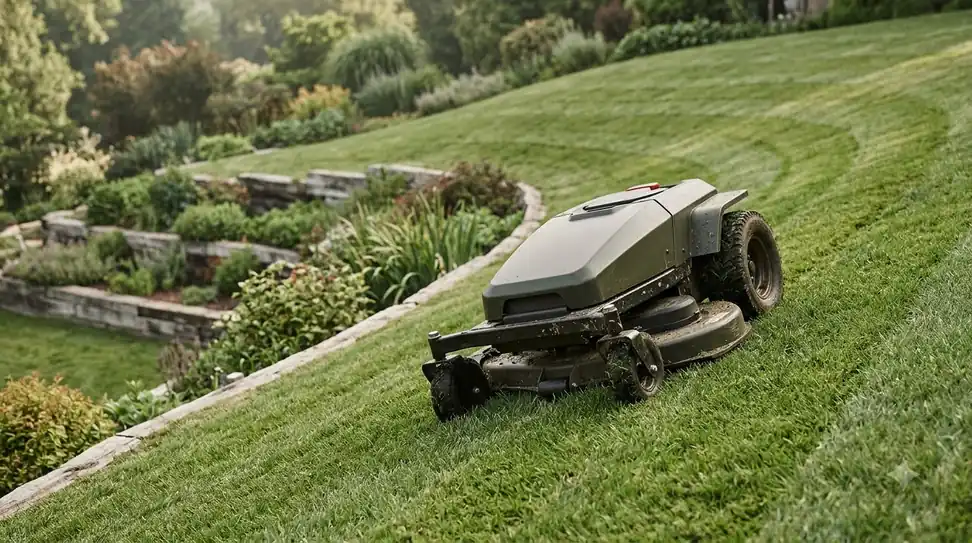
Eyeballing a hillside almost always underestimates its pitch, which leads to buying a two-wheel-drive mower that spins its tires or slides past perimeter boundaries.
Robot mower manufacturers rate hill performance in two ways: maximum slope inside the main mowing zone and maximum slope along the outer edge. According to Husqvarna Automower steep-slope guidelines, standard models handle 25 to 50 percent grades inside the lawn, while boundary edges often cap out at 10 to 25 percent. Even all-wheel-drive units rated up to 70 percent inside the yard drop to a 50 percent limit near the perimeter wire or virtual border.
A 100 percent grade equals a 45-degree angle, not a vertical wall. Confusing those two units can trick you into sending a 20-degree mower up a 35-degree embankment. Measuring the steepest section of every bank before ordering hardware ensures you match wheel drive, tread aggressiveness, and stay-out zones to real terrain.
Types of digital inclinometers for yard surveys
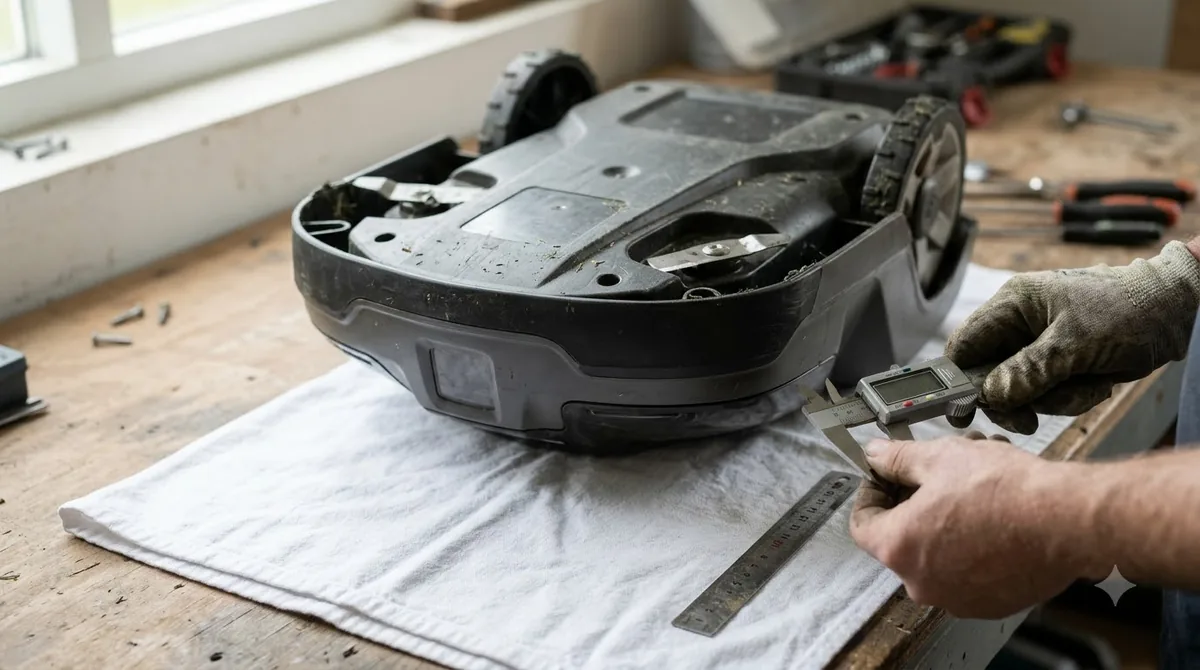
Three main tool designs measure yard grade well, and each trades pocket portability against built-in straightedge length.
Compact digital angle cubes—often called bevel boxes—measure roughly 2.2 to 2.8 inches square and slip easily into a pocket while you walk the property. Because their footprint is tiny, you must set a cube on top of a rigid board or level beam to average out tufts of grass and molehills. Torpedo digital levels stretch 8 to 12 inches long, adding built-in spirit vials and a longer reference edge for checking short transitions around garden beds or retaining walls.
Full-length digital box levels span 24 to 48 inches and bridge small lawn dips on their own, though they are bulkier to carry around multi-acre lots. Smartphone level apps work in a pinch, yet phone camera bumps and uncalibrated sensors introduce avoidable error compared with dedicated gauges.
| Inclinometer Type | Typical Length | Needs a Straightedge Plank | Best Yard Use Case |
|---|---|---|---|
| Digital angle cube (bevel box) | 2.2 to 2.8 in | Yes, required on turf | Walking large hilly yards with one 4-foot board |
| Digital torpedo level | 8 to 12 in | Yes, on bumpy sod | Checking boundary edges, ditches, and tight turns |
| Full-frame digital level | 24 to 48 in | No, for smooth turf | Rapid spot checks across wide, even embankments |
| Smartphone level app | 5 to 6 in | Yes, required | Rough initial estimates before buying a dedicated gauge |

What to look for when choosing a slope gauge
Focusing on sensor resolution, unit conversion, screen visibility, and weather sealing keeps you from overpaying for machinist features you will never use outdoors.
Most consumer and trade digital inclinometers use micro-electromechanical systems (MEMS) sensors. Look for an accuracy rating of plus or minus 0.1 degrees at 0 and 90 degrees, and plus or minus 0.2 degrees across intermediate angles, with a display resolution of 0.05 or 0.1 degrees. That precision far exceeds what any robot mower chassis requires.
Prioritize these practical hardware features for outdoor lawn work:
- Instant degree and percent toggle: One button should flip between degrees, percent grade, and inches per foot so you never need a scientific calculator in the yard.
- High-contrast backlit display: Reverse-contrast LCD or EBTN screens stay legible in midday glare and deep shade under tree canopies.
- Hold and relative-zero buttons: A hold button freezes the reading so you can stand up after crouching on a steep bank, while relative zero lets you measure grade changes against an existing patio or driveway.
- Dust and moisture protection: Look for at least an IP42 rating to shrug off morning dew, or IP54 to IP65 if you frequently work in damp grass and soil.
- Auto-rotating digits: Screens that flip right-side-up automatically prevent misreading numbers when you approach a hillside from the opposite side.
How to measure a steep yard slope accurately
Following a repeatable board-and-gauge routine removes turf irregularities and gives you the exact peak grade your mower will face.
As outlined in the University of Wisconsin–Madison Arboretum slope guide, percent slope equals vertical rise divided by horizontal run multiplied by 100. A digital inclinometer performs that trigonometry automatically, provided you align it squarely with the fall line of the hill.
- Zero the gauge on a flat reference. Place the inclinometer on a known level surface—such as a concrete garage floor or kitchen counter—and verify it reads 0.0 degrees before heading outside.
- Pick a rigid straightedge plank. Grab a straight 4-to-6-foot aluminum level, box beam, or unwarped 2×4 board roughly matching the wheelbase length of a typical robot mower.
- Find the steepest fall line. Walk your banks and place the plank straight up and down the steepest section, never diagonally across the face.
- Center the inclinometer and freeze the reading. Set the gauge in the middle of the plank, wait two seconds for the digits to settle, press the Hold button, and record both percent grade and degrees.
- Check boundary edges and transitions separately. Measure the bottom transition where flat grass meets the bank, plus any spots within 5 feet of fences, ditches, or retaining walls where the mower must brake and turn.
Heads up
Never rely on a single average reading from the top of a hill to the bottom. A bank that averages 30 percent overall can hide a 48 percent drop-off near a culvert that will beach a standard mower.
Care, calibration, and storage between seasons
Basic cleaning and periodic zero-point checks keep a digital inclinometer accurate for years of landscaping and mower setup tasks.
Wipe grass sap, mud, and moisture off the housing and magnetic base with a slightly damp microfiber cloth after every yard survey. Keep fine iron filings and magnetic dirt out of the base grooves so the tool always sits flush against your straightedge plank.
Before storing the gauge for winter, remove AAA alkaline batteries to prevent terminal corrosion, or top up rechargeable lithium-ion models to roughly half charge. Whenever you drop the tool or notice the display drifting off zero on a flat counter, run the two-step flip calibration routine described in your owner manual by rotating the gauge 180 degrees on the same level spot.
Frequently asked questions
Should I measure my yard slope in degrees or percent grade?
Record both numbers, because robot mower manuals switch between them. Percent grade equals rise divided by run times 100, meaning a 45-degree angle equals a 100 percent slope and a 20-degree angle equals roughly 36 percent.
Can I just use a smartphone level app instead of a digital inclinometer?
A phone app on a straight board works for a rough ballpark check, but protruding camera lenses and uncalibrated sensors can skew readings by several degrees. A dedicated digital gauge gives higher accuracy and survives drops onto damp ground.
Why do I need a wooden board when using a small digital angle cube?
Setting a 2-inch cube directly on grass measures the tilt of a single clump of sod or dirt clod rather than the actual hill. A 4-to-6-foot straight plank bridges minor ruts and mirrors the true wheelbase angle of a robot mower.
How much safety margin should I leave below a mower’s maximum slope rating?
Leave at least a 5 to 10 percent grade buffer below the manufacturer’s advertised maximum, especially on shady, damp, or sandy banks where tire grip drops during sharp turns.
Sources
- Optimising an Automower installation for steep slopes (Husqvarna): Used for robot mower interior versus boundary slope limits and transition area guidelines.
- Measuring Slope for Rain Gardens (University of Wisconsin–Madison Arboretum): Used for rise-over-run slope percentage calculation methodology.
- Digital Angle Gauge and Level 935DAG Specifications (Klein Tools): Used for digital inclinometer accuracy tolerances, dual measurement ranges, and IP42 ingress protection benchmarks.
 Up next9 min readGearBest Lawn Measuring Wheel for Robot Mower SizingUpdated Nov 11, 2026
 8 min readGearRobot mower traction spikes for slopes: what actually helps gripUpdated Nov 19, 2026
 7 min readGearBest Black and Decker String Trimmer for Robot Mower YardsUpdated Nov 18, 2026
 8 min readGearBest Pet Waste Scooper for Robot Mower Yards: What to CheckUpdated Nov 14, 2026
 9 min readGearBest Battery-Powered Handheld Blower for Cleaning Mower Decks: Buying & Use GuideUpdated Nov 19, 2026
 7 min readGearHusqvarna Automower Accessories Worth Buying: What to CheckUpdated Nov 20, 2026