
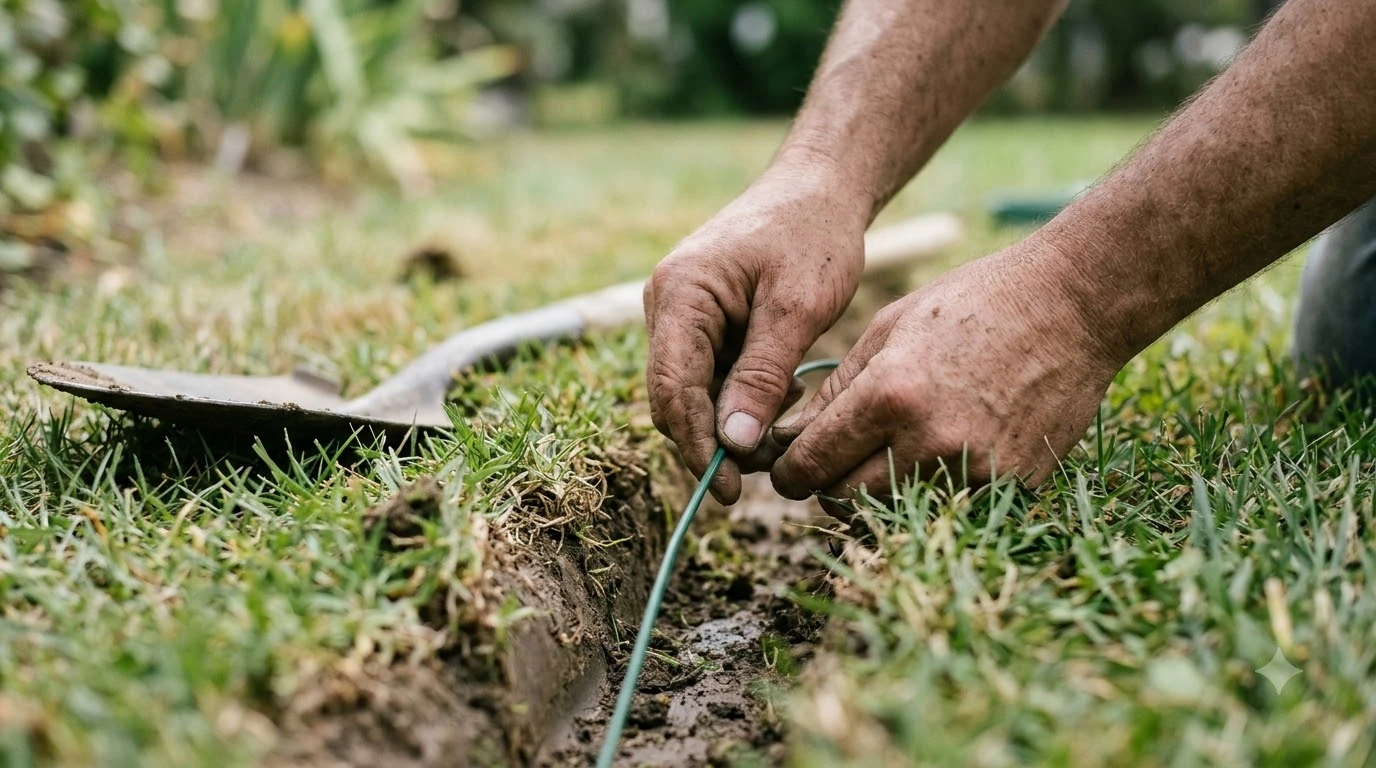

A robot mower long boundary cable roll is easiest to handle when you plan the run, unspool it in a straight line, and join reels only with the connectors the manufacturer supplies. The main risks on a big yard are kinks, tangles, and splices that corrode in wet soil, and each one shows up later as a signal fault. Buy a roll length that matches your loop plan, not a larger spare.
The short answer
- Plan the loop first. Measure the perimeter and every obstacle loop, then pick a roll length that covers them with a small margin.
- Keep the wire within the model’s maximum loop length. Resistance rises with length, which can cause signal errors.
- Splice only with supplied or waterproof connectors. Twisted wire and taped joints are the common failure points.
- Unspool gently. Lay the roll on the ground and walk it out rather than pulling it, to avoid kinks.
- Test before you bury or peg. Check the mower’s signal at each join before you secure the wire.
Why a long roll is harder than a short one
A short piece of boundary wire is forgiving. A long roll on a large lot adds more joins, more turns, and more time on the ground before the mower sees a clean signal. Each extra metre is another chance for a kink, a damaged sheath, or a poor connection, and those faults are hard to spot once the wire is pegged down. A large garden may need more than one reel, which is why it is worth reading about boundary wire in longer lengths before ordering.
Length also has a hard limit. The maximum loop length is set by the model, and it appears in the manual. Wire resistance rises with length, so a run that is technically possible can still produce weak or erratic signal at the far end.
Measure the loop before you buy the roll
Walk the perimeter with a tape or a measuring wheel and add the length of each obstacle loop, such as a tree island or a garden bed. Add the dock lead, which runs from the charging station to the loop. Then add a small margin for cutting, staking, and the joins themselves. The simplest way to estimate cable length without guessing is to walk the route with a measuring wheel for sizing the lawn and add a margin for corners. Very long loops are also affected by conductor size, so boundary wire thickness for large loops deserves a check against the manufacturer limits.
Buying a roll far larger than the plan leaves excess wire on the ground, which must be cut and stored. A roll that is too short forces an extra join, which is the weakest point in the run. Measure once, then buy to the plan.

Unspooling a robot mower long boundary cable roll without kinks
Lay the roll on a flat surface, or lift it on a stand, and walk the wire out in a straight line along the path. Do not drag the roll across the lawn, because the friction can scrape the insulation and pull the wire into tight bends. Sharp bends are the usual cause of breaks. Pulling a long cable off a reel in one go puts stress on the joints, and keeping tension on a long run helps avoid twisting the cable.
Husqvarna’s installation guidance for its wire system advises keeping sharp angles to a minimum, and its guide wire should stay well away from the boundary wire. Use the same principle on any system: make wide, gentle turns around beds and corners, and keep the wire moving in a straight run where you can.
Splicing and joining reels
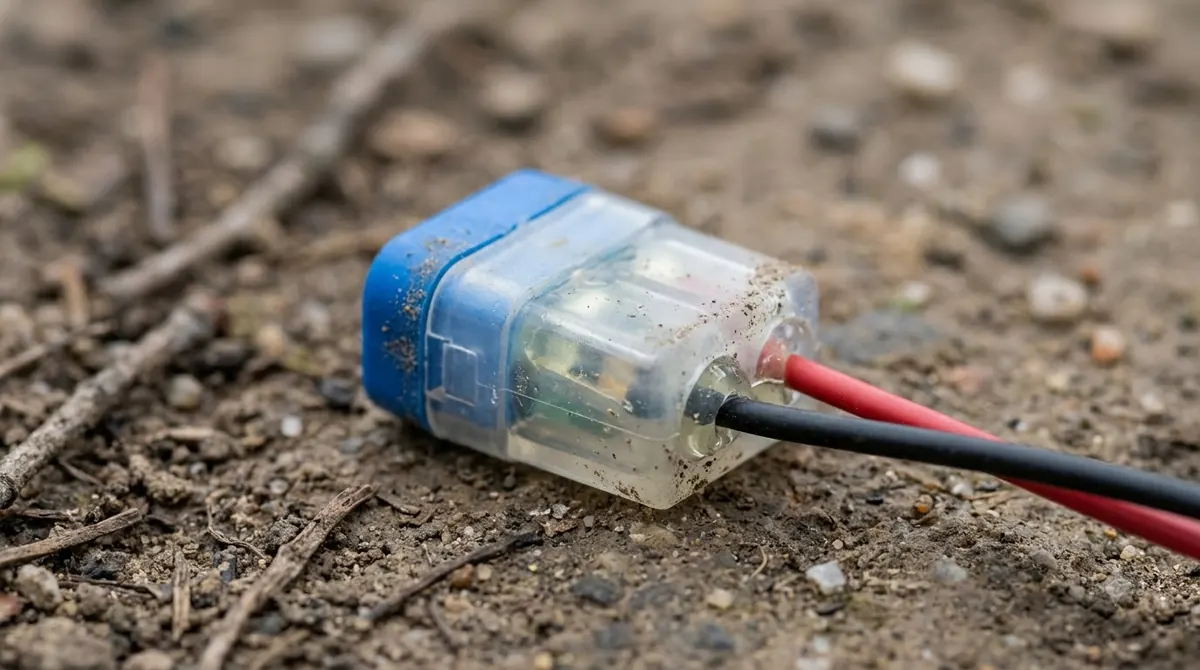
When one roll ends before the loop does, you join the next reel. The safe way is the connector supplied with the mower or a waterproof connector of the matching type. Robomow’s guidance on extending the perimeter wire lists butt, click, and waterproof connectors, and it recommends the waterproof type that can be squeezed shut with combination pliers. When two reels have to meet, joining reels with a splice kit keeps the connection sealed and avoids twisting bare conductors together.
Twisting the two wire ends together and wrapping them in electrical tape is the joint to avoid. Manufacturer manuals generally say a twisted or taped joint is not a satisfactory splice, because soil moisture oxidizes the conductors over time. The same caution applies to screw terminals with tape, which can rust through in a season.
- Cut cleanly. Use a sharp cutter to make a square cut, not a jagged one.
- Insert both ends fully. Each wire end should reach the connector’s stop.
- Crimp and seal. Squeeze the connector shut and use any gel or grease the kit provides.
- Test the join. Check the station’s status light or app signal before you move on.
Heads up
Match the extension wire to the original in material, diameter, and resistance. A mismatched wire can change the signal even when the joins are sound.
Keeping the wire in place
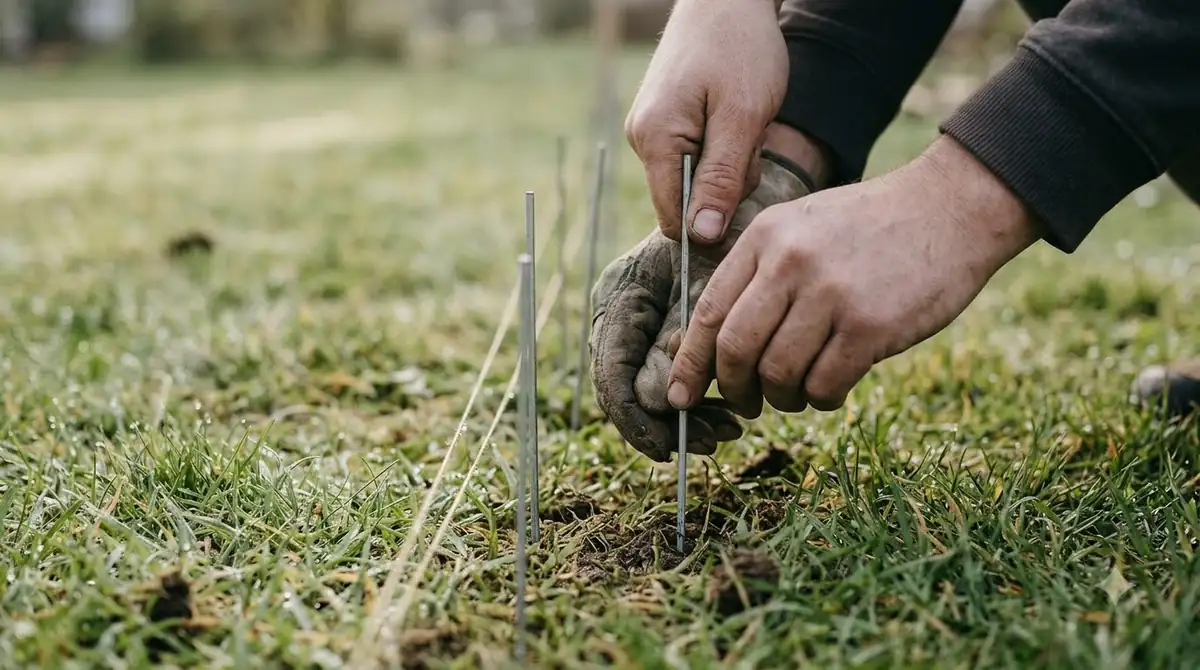
Lay the wire into the soil or secure it with staples, sometimes called pegs or hooks. Use the spacing given in your manual, and tighten it on slopes and near edges where the wire tends to lift. Stake the wire after you confirm the signal, not before, so a fault does not mean pulling every staple back out. Where the cable crosses fences or posts, UV-resistant ties for wire runs keep it from drifting without damaging the insulation.
Burying the wire is cleaner but harder to fix. Test the full loop before you bury it, and keep a note of where each join sits so a later fault is faster to find.
Storing the leftover roll
Keep the spare wire coiled loosely, out of direct sun and away from sharp tools. Label the roll with its length and the date you cut it, since leftover pieces are easy to mix up in a shed. Wire that has been kinked or stepped on can be bent back, but a damaged sheath should be cut out rather than covered with tape. Whatever is left on the reel is worth keeping as spare cable held back for repairs, since matching old cable later can be awkward.
| Task | Good practice | Common mistake |
|---|---|---|
| Joining reels | Supplied or waterproof connector | Twisted wire with tape |
| Unspooling | Walk it out straight | Dragging the roll |
| Securing | After the signal test | Pegging before testing |
| Buying length | Measured plan plus margin | Much more than needed |
The table is a summary of the points above. Follow the manufacturer’s manual for the exact connector type and maximum length.
Frequently asked questions
How long can a robot mower boundary cable roll run be?
It depends on the model. Check the maximum loop length in your manual, since resistance rises with wire length and long runs can weaken the signal.
Can I join two reels of boundary wire?
Yes, using a supplied or waterproof connector of the matching type. Avoid twisted wire with tape, which can oxidize in wet soil.
Should I bury the wire or peg it?
Either works if the signal tests clean first. Pegging is easier to fix later, while burying gives a cleaner lawn.
How do I stop the wire from tangling?
Lay the roll on a flat surface and walk the wire out straight rather than dragging it. Keep turns wide and gentle.
Sources
- Robomow: is it possible to extend the perimeter wire (manufacturer): steps for extending the wire, recommended waterproof connectors, and warnings on moisture, matching parts, and maximum length.
- Husqvarna support on wire installation tips (manufacturer): guidance on wire angles and guide-wire spacing for boundary-wire installs.
 Up next7 min readGearHow Long Do Robot Mower Blades Last? Brand Intervals ExplainedUpdated Nov 19, 2026
 6 min readGearRobot Mower Wire Locator: Finding Surface and Buried Boundary WireUpdated Nov 20, 2026
 7 min readGearRobot Mower Virtual Fence Markers: How the Boundary Points WorkUpdated Nov 20, 2026
 7 min readGearRobot Mower Boundary Flags for Setup: Test the Route FirstUpdated Nov 14, 2026
 7 min readGearBoundary Wire Gauge for Robot Mower: What the Specs SayUpdated Nov 12, 2026
 8 min readGearUniversal Boundary Wire for Worx Landroid: What to MatchUpdated Nov 11, 2026