

How to choose a robot mower for slopes starts with comparing its rated work-area limit with the steepest part of your lawn. Standard Automower models are rated from 25 to 50 percent, and the 435X AWD up to 70 percent, but that top number is a ceiling rather than a daily target.
The short answer
- Measure first: find the steepest section with rise over run, and use that number rather than the average slope.
- Convert the unit: percent and degrees differ, so 25 percent is about 14 degrees and 50 percent is about 26.6 degrees.
- Keep a margin: when you choose a robot mower for slopes, pick a model whose work-area limit sits clearly above your steepest measured slope.
- Check the edge: the boundary limit is often lower, and for some models it is 15 percent or less.
Measure your steepest section first
Measure the steepest section of the lawn, not the average, because the mower will attempt the hardest spot it reaches. The usual method is rise over run, and it is the first step in learning how to choose a robot mower for slopes. Husqvarna gives the formula as slope (%) equals vertical height divided by horizontal distance, multiplied by 100, so a 15 cm rise over a 100 cm run is 15 percent.
Eufy recommends a smartphone incline app, or a spirit level laid with a tape measure on the steepest section. It also warns that visual checks often fail, because sloping yards look flatter than they really are.
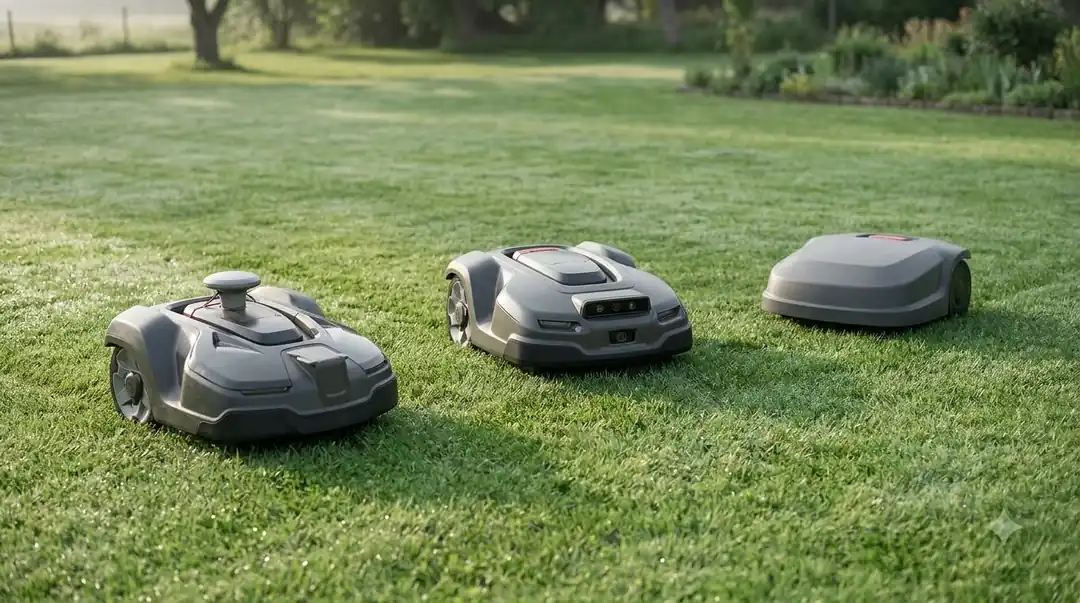
- Measure the drop. Lay a straight board across the slope and read the drop at one end with a level and tape.
- Divide by the run. Divide that drop by the horizontal length, then multiply by 100 to get percent.
- Repeat at the steepest spot. Keep the largest figure you find, since the mower will try the hardest ground it reaches.
Percent and degrees describe different angles
Robot mower makers use two units for slope when you compare models, and they are easy to mix up. Percent is the vertical rise divided by the horizontal run, multiplied by 100. Degrees measure the angle itself, so a 100 percent slope is 45 degrees, while 40 percent is only about 22 degrees.
Iowa State University Extension writes slope as a ratio too. A ratio of 1:12 means one foot of rise for every 12 feet of run, which equals 8.33 percent. One Eufy page pairs 40 percent with 18 degrees, but standard trigonometry gives about 21.8 degrees for 40 percent. Our reading is that you should confirm the unit on the spec sheet before comparing two models, which is the quickest way to avoid errors in how to choose a robot mower for slopes. The table below is our calculation, not a manufacturer figure.
| Percent | Degrees (our calculation) |
|---|---|
| 10% | 5.7 |
| 25% | 14.0 |
| 35% | 19.3 |
| 40% | 21.8 |
| 50% | 26.6 |
| 70% | 35.0 |
How to choose a robot mower for slopes by work-area limit
Husqvarna says standard Automower models can manage slopes of 25 to 50 percent (14 to 26 degrees), depending on the model. The 435X AWD and 435X AWD NERA are rated up to 70 percent (35 degrees). These figures describe the work area, the open lawn where the mower runs, and they differ from model to model, which makes them the core of how to choose a robot mower for slopes.
| Model (Husqvarna) | Work-area limit | Boundary limit |
|---|---|---|
| Aspire R4 | 25% | 10% |
| 105 | 25% | 15% |
| 305, 310, 315 | 40% | 15% |
| 320 NERA, 430X NERA, 450X NERA | 50% | 25% |
| 435X AWD, 435X AWD NERA | 70% | 50% |
Our reading is to keep headroom instead of buying the exact maximum for how to choose a robot mower for slopes. A yard whose steepest spot is 30 percent fits comfortably under a 40 percent work-area limit, while a 38 percent spot on the same model leaves almost no margin for wet grass or thick growth.
Check the boundary limit separately
For any robot mower for slopes, the boundary limit is the rating that applies near the boundary wire, and it is often lower than the work-area limit. On the Husqvarna 105, for example, the work area is rated 25 percent but the boundary is 15 percent. A steep bank at the edge can therefore be out of bounds even when the middle of the yard is fine, and that edge zone is where how to choose a robot mower for slopes most often goes wrong.
Husqvarna says slopes near the boundary must stay within the model’s limits, and if the outer edge is too steep, you should move the boundary inward onto flat ground before the slope begins. Where a slope borders a public road, the company advises a barrier, such as a wall or fence, of at least 15 cm (6 in) along the outer edge.
Traction, AWD and wet grass
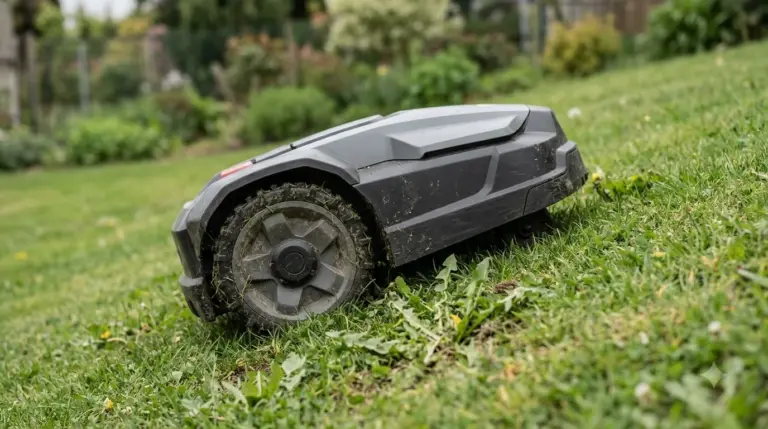
Wet grass reduces tyre grip, so a mower can slide on a slope that sits within its rating. Eufy’s page says damp turf makes the unit “slide sideways or slip downhill,” even when the incline is inside the rated limit. Our reading is that a lawn which stays damp for long periods should be judged against a lower number, so for how to choose a robot mower for slopes that means a safer model.
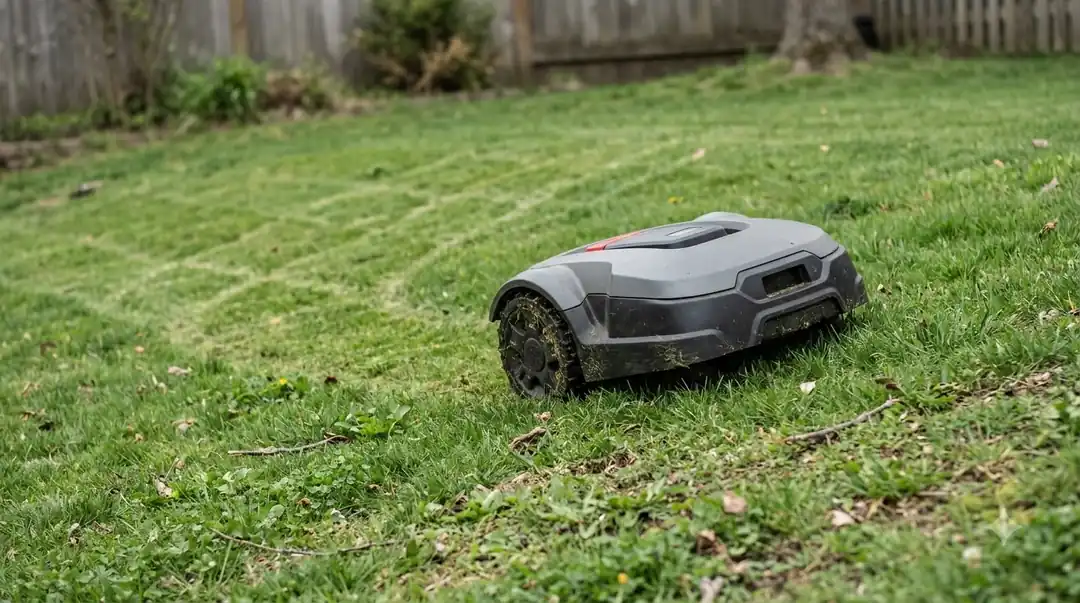
All-wheel-drive models spread power across every wheel, which helps on steep or wet ground. Husqvarna rates its 435X AWD to 70 percent, with a boundary limit of 50 percent, so AWD matters most where the hills are wet or loose and you are deciding how to choose a robot mower for slopes.
- Wet grass: the mower can slip even on a slope within its rating.
- Battery: steeper inclines noticeably reduce runtime per charge, so the mower docks more often to finish a lawn.
- Rated maximum: Eufy calls the top figure an absolute limit, not a target for daily mowing, because running at the top of the range strains the motor and increases tyre slip.
Lay the boundary wire for slopes
On slopes, Husqvarna advises laying the guide wire diagonally across the slope. That gives better traction and less grass wear. For AWD models working on slopes up to 50 percent, keep 1.5 m (5 ft) between the boundary wire and obstacles, and leave at least 50 cm (1.6 ft) of level ground between flat areas and steep slopes.
- Direction: run physical wire diagonally across the slope rather than straight up or down it.
- Clearance: keep 1.5 m between the wire and obstacles on AWD slopes up to 50 percent.
- Transition: leave 50 cm of level ground before a steep area begins.
- Exclusion: Husqvarna says areas that are too steep should be excluded from the installation.
These are Husqvarna figures for its own range, so check your model’s manual before you lay wire and finish how to choose a robot mower for slopes. Its installation guide for steep slopes is available on the Husqvarna support site.
When steep ground stops being a mowing job
Iowa State University Extension treats landscape slopes of about 30 percent or more as too steep to mow, which is a useful reality check for any lawn and for anyone learning how to choose a robot mower for slopes. The extension writes about plantings rather than robot mowers, so this is a landscape threshold, not a robot specification.
The same guidance calls slopes of 20 percent (1:5) or more steep and says plantings other than turfgrass need special consideration. It also notes that 50 percent is often considered the steepest slope able to support plant growth. Our reading is that a bank at that steepness is a planting question before it is a mower question, so how to choose a robot mower for slopes starts with the ground itself.
For sod on slopes steeper than 10 percent, the extension advises two or three wooden stakes or sod staples per strip, which can come out once the sod has rooted, usually within two to four weeks.
How to choose a robot mower for slopes: what to check before you buy
Before you buy, confirm the unit, the work-area limit, the boundary limit, the wire plan and your margin for wet weather. Those five checks tell you more than the headline number on the box when you choose a robot mower for slopes.
- Unit. Confirm whether the spec sheet uses percent or degrees, and convert before comparing.
- Work-area limit. Keep headroom above your steepest measured slope when you decide how to choose a robot mower for slopes.
- Boundary limit. Check the edge of the yard separately, since it can be much lower.
- Wire plan. Plan diagonal wire, clearance and level transitions on any slope.
- Wet weather. Use a lower number if the grass stays damp.
Frequently asked questions
Is 40 percent too steep for a robot mower?
Not by itself. Many standard Automower models list 25 to 50 percent for the work area, so 40 percent can be within range when you choose a robot mower for slopes. Check the boundary limit of your model too, and measure the steepest spot before deciding how to choose a robot mower for slopes.
Can a robot mower climb a 70 percent slope?
Only models rated that high, such as the Husqvarna 435X AWD. Its boundary limit is 50 percent, so the edge of a steep yard still needs wire clearance and may need to be moved inward when you check how to choose a robot mower for slopes.
How do I convert percent slope to degrees?
Divide the percent by 100 and take the arctangent of the result, a step that matters when you choose a robot mower for slopes. Twenty-five percent is about 14 degrees, and 50 percent is about 26.6 degrees, according to our calculation.
Does wet grass change how steep a robot mower can go?
Yes. For how to choose a robot mower for slopes, damp turf reduces tyre grip, and Eufy notes that a mower can slide even on a slope within its rating. Use a lower number for wet weather or for lawns that stay damp, and factor that into how to choose a robot mower for slopes.
Sources
- How to optimise an Automower robotic lawn mower installation for steep slopes (Husqvarna support): slope formula, standard and AWD limits, per-model limits, boundary, clearance and wire guidance.
- Gardening on Slopes and Hillsides (Iowa State University Extension): ratio and percent conversion, steep-slope thresholds, sod staking.
- Robot lawn mower slope limits (Eufy, manufacturer blog): tier ranges, rated maximum as a limit, wet grass, battery and measuring guidance.
 Up next9 min readLearnRTK vs LiDAR: Which Should You Choose for Your Robot Mower?Updated Nov 11, 2026
 9 min readLearnHow to Set Up a Robot Mower on a SlopeUpdated Nov 12, 2026
 6 min readLearnWorx Landroid Not Docking? Fix the Usual CausesUpdated Nov 10, 2026
 8 min readLearnHow to Set Up a Robot Lawn Mower Step by StepUpdated Nov 10, 2026
 8 min readLearnWhy Does My Robot Mower Keep Losing RTK Signal?Updated Nov 10, 2026
 7 min readLearnRobot Mower Leaves Uncut Strips: How to Fix ItUpdated Nov 10, 2026