
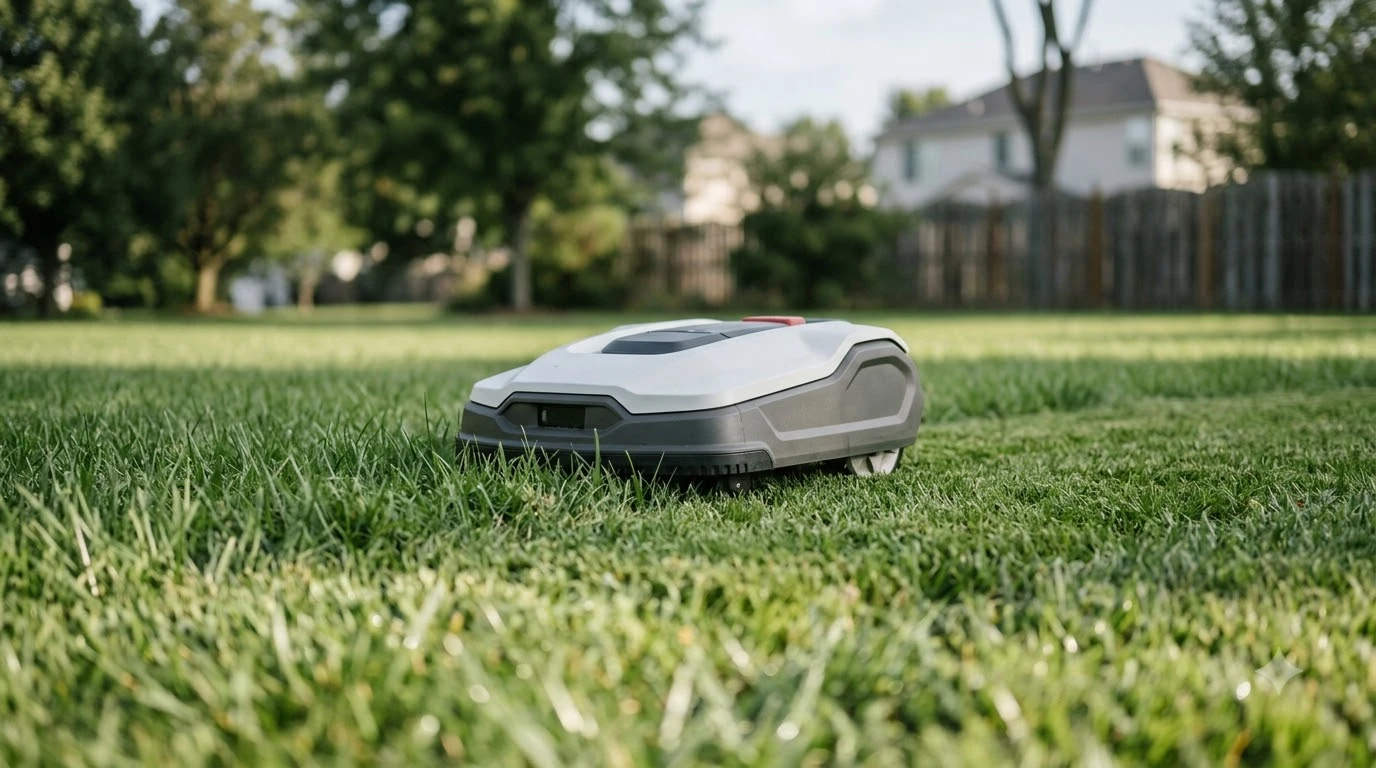

Why do robot mowers mow every day? Because each pass removes only a small amount of grass, which keeps clippings fine and the cut within the one-third rule. Husqvarna describes its mower as mowing “a little every day,” and Robomow says a robotic lawnmower is designed to generate optimal lawn conditions when it mows daily, as of 2026-11-11.
A traditional push or riding mower usually takes a larger bite once a week. A robot takes a small bite often, and the schedule is built around that difference. The reasons are mostly about how the grass responds to small cuts, not about the machine running for its own sake. This guide explains those reasons, where the daily schedule stops making sense, and what the frequency actually looks like in practice.
The short answer
- Small cuts: Husqvarna says its mower cuts “just a few millimeters at a time,” which it calls micro-mulching.
- Fine clippings: Robomow says the approach works only when clippings are shredded very fine and decompose quickly.
- Growth sets the schedule: Robomow advises daily trimming in spring and a break in winter, with every other day in hot, dry weather.
- Daily does not mean all day: Robomow’s 1,000 m² example needs about 8 hours of pure mowing, and every other day halves that.
- Rest is normal: a nightly break and no mowing in the rain are common manufacturer advice.
Why do robot mowers mow every day? Small, frequent cuts
In short, a robot removes so little per pass that a daily schedule keeps each cut inside a safe limit.
Husqvarna’s product page describes its mower cutting “just a few millimeters at a time.” The company calls this micro-mulching, meaning tiny clippings are cut daily and break down into the lawn as a natural fertilizer, a topic our guide on whether robot mowers mulch grass covers in more detail. Clippings that small fall between the grass blades and disappear, which is why the lawn does not usually show the clumps that a weekly mow can leave behind.
The cutting rule behind this is the one-third rule. Oregon State University Extension advises removing no more than one-third of the grass blade at a time, and our note on the best mowing height for a robot-mowed lawn shows how that works in practice. After a few days of fast growth, a lawn cut once a week may have grown well past that point, so a single pass has to take off more than a third. A robot that runs most days keeps the height difference small on every pass.
Our reading is that a daily robot schedule meets the one-third rule without anyone measuring each pass. The mower does the measuring by cutting only the tips, so it rarely takes a large bite. This is an inference from the cutting method, not a result from a test of our own.
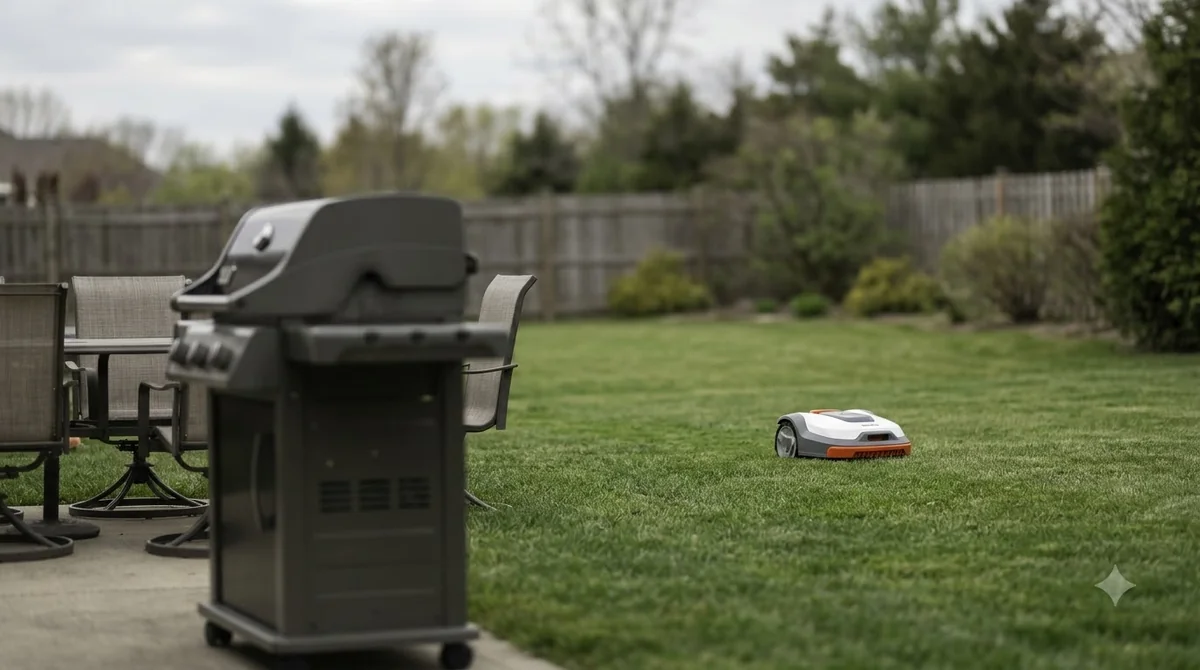
Why frequent runs help keep weeds down
In short, Robomow ties frequent short runs to fewer weeds and a greener lawn, but only when the clippings stay fine.
Robomow’s guidance says frequent cutting “helps to minimize weeds and produce green, lush results.” The same page makes that benefit conditional. The approach “only works properly if the grass clippings are shredded very fine and decompose quickly.” Daily runs help because they keep the clippings fine. Longer clippings from an infrequent mow are the ones that sit on the surface and take longer to break down.
Husqvarna describes a similar pattern. Its mower uses a weather-based timer and “mows more frequently during wet, fast-growing periods.” During dry or cold spells it cuts back. The frequency is therefore set by how fast the grass is growing, not by a fixed daily rule. A schedule that runs most days in May can run much less in August, and a robot mower lawn care calendar shows how the season changes the workload.
Our reading is that the weed benefit depends on the lawn. Frequent cutting alone does not control weeds. Fertility, mowing height and the grass type matter too, and the manufacturer pages we read do not quantify the weed effect.
Growth rate, not the calendar, sets the frequency
In short, why do robot mowers mow every day depends on growth: spring calls for daily runs, while winter and hot, dry spells call for a break or fewer runs.
Robomow says grass “grows particularly quickly in the spring and should thus be trimmed daily.” In hot, dry weather it suggests mowing every other day, so that the slightly longer blades can shade the lawn. In winter the lawn is dormant, and the mower gets “a well-earned winter break.” Robomow also states that there is “no universal rule” for cutting frequency, and that experts are not united on the question. The company’s advice is to use manufacturer recommendations as a starting point and experiment on your own lawn.
The table below summarizes the guidance from the Robomow pages we read. It is not a schedule to copy, and the steps for how to set a robot mower schedule depend on the brand. Your grass type, the local climate and the mower’s rated area all change the answer.
| Condition | Guidance | Source |
|---|---|---|
| Spring, fast growth | Trim daily | Robomow |
| Hot, dry weather | Every other day, so slightly longer blades shade the lawn | Robomow |
| Wet, fast-growing periods | Mow more often; the timer runs more frequently | Husqvarna |
| Dry or cold spells | Cut back | Husqvarna |
| Winter, dormant lawn | Take a break | Robomow |
| Rain | Do not mow | Robomow |
Why a daily run is shorter than it sounds
In short, why do robot mowers mow every day if the run is short? Daily does not mean 24 hours of cutting, because the mower’s area capacity and charging time limit each day.
Robomow’s worked example uses a 1,000 m² garden, a mower rated at 3,000 m² of maximum area output and 24 hours of operation. That gives 24 ÷ (3,000 ÷ 1,000) = 8 hours of pure mowing. Mowing every other day halves the daily figure to 4 hours. Robomow also notes that common garden factors can reduce area output by about 30%, so the rated figure is a best case.
Husqvarna explains the same limit from another angle. Its support page says the maximum cutting time per day is fixed by the mower’s work area capacity and cannot be changed by the user. When the daily cap is reached, the mower stops, shows “Today’s mowing complete,” and parks until the next day (Husqvarna’s work area capacity guide).
Charging adds time as well. Robomow notes that some models return to the dock after about 400 m², while others go on to 800 m² before recharging. Each trip to the dock adds time that does not cut grass, so the real day is longer than the pure mowing figure. Our guide to how often a robot mower needs to charge explains what to expect from the battery.
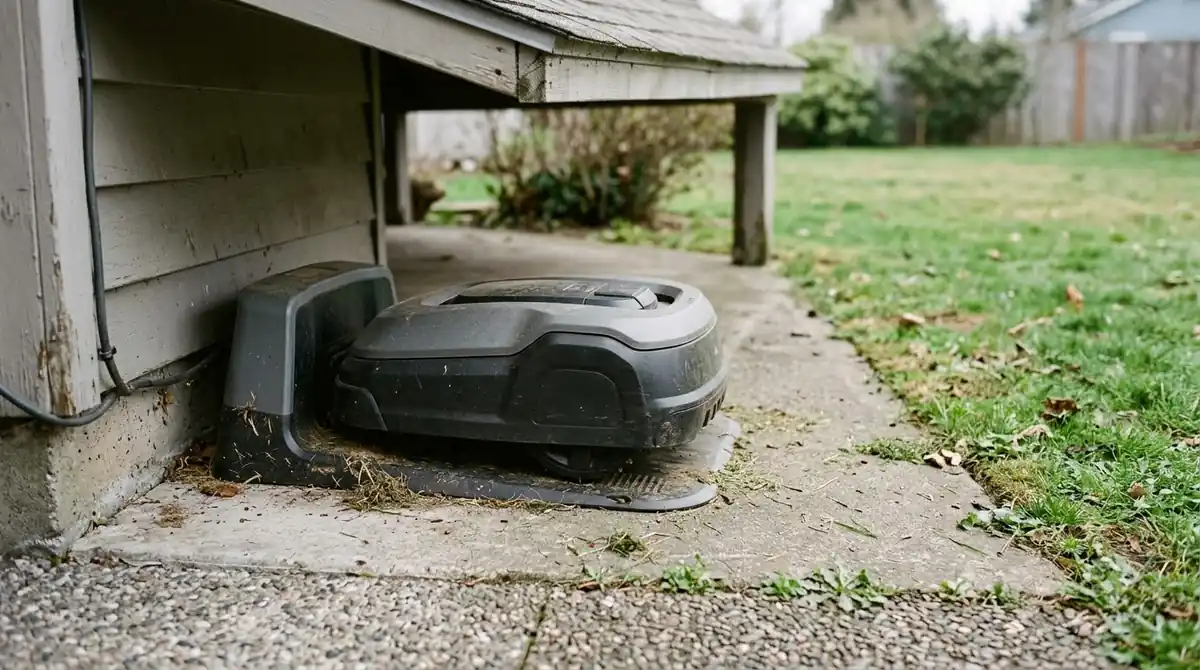
Heads up
If the mower shows “Today’s mowing complete” before the lawn is finished, the lawn is larger than the daily capacity for that model. Our reading is that the fix is more area capacity or a longer schedule window, not more runs in a day.
When daily mowing is the wrong schedule
In short, why do robot mowers mow every day is a question with exceptions: rain, hot dry spells, winter and dull blades are the usual reasons to change a daily schedule.
Robomow says that when it rains, “we recommend not mowing the lawn.” It also suggests giving the device a break at night, which reduces total mowing time. In hot, dry weather, every other day is the suggested pattern, and in winter the lawn needs a rest. Husqvarna’s timer is designed to run more in wet, fast growth, which is a different situation from active rain. Our reading is that the two statements answer different questions: one is about rain falling, the other about growth.
Blade condition also matters. Husqvarna’s US page advises replacing its small, razor-sharp blades every one to two months, with the exact interval depending on lawn size and grass type. Sharp blades cut the grass cleanly, which supports the small-cut approach. Dull blades tear the grass and undo the benefit of frequent light cuts.
Frequently asked questions
Why do robot mowers mow every day without harming the grass?
Manufacturer guidance treats daily cutting as normal in spring and in fast growth, because each pass removes only a little. Robomow suggests every other day in hot, dry weather, and it says there is no universal rule. Watch the lawn and adjust.
Do robot mowers really run 24 hours a day?
Robomow says a robotic mower can theoretically be in use between 12 and 24 hours a day, depending on the software, and it cites one model that mows for 13 hours a day. The daily capacity cap and charging time usually mean the real run is shorter.
Should I reduce mowing in summer?
Robomow advises every other day in hot, dry weather so that the slightly longer blades can shade the lawn. Husqvarna’s timer also cuts back in dry spells. The right frequency depends on the grass type and local weather.
Will daily mowing leave clippings all over the lawn?
Manufacturers say the clippings are small enough to break down, provided they are shredded very fine. Husqvarna describes micro-mulching as tiny clippings that act as natural fertilizer. Heavy growth or wet grass can still leave visible clippings, so check the lawn after a few runs.
Sources
- Robomow, “How often should a robotic lawnmower mow” (manufacturer): daily frequency, seasonal guidance, rain and nightly breaks, the 8-hour example and the “no universal rule” statement.
- Husqvarna, “How an Automower works” (manufacturer): daily small cuts, micro-mulching, timer behavior in wet and dry periods, blade replacement interval.
- Husqvarna support, work area capacity and maximum cutting time (manufacturer): daily cap, “Today’s mowing complete” behavior.
- Robomow, “How long does a robotic lawnmower need to mow the lawn” (manufacturer): 12 to 24 hour theoretical use, 13-hour example, return-to-dock areas.
- Oregon State University Extension, leave grass clippings (university extension): one-third rule and clipping size.
 Up next8 min readLearnIs It OK to Run a Robot Mower Every Day?Updated Nov 11, 2026
 7 min readLearnHow to Set a Robot Mower Schedule (and Why It Might Not Run)Updated Nov 11, 2026
 8 min readLearnCan a Robot Mower Mow Over Sticks? What the Sources SayUpdated Nov 11, 2026
 8 min readLearnCan Robot Lawn Mowers Mow in the Rain? Light vs Heavy RainUpdated Nov 11, 2026
 8 min readLearnCan a Robot Mower Mow in the Dark?Updated Nov 11, 2026
 8 min readLearnWhat Is VSLAM Navigation on a Robot Mower?Updated Nov 11, 2026