


Lymow One pros and cons come down to a wire-free design and strong navigation on one side, and weight, noise and ownership costs on the other. The points below come from two review pages we read, a Freshly Charged review of the 2024 model year and a Geeky Gadgets article from 2025, so confirm current specs with the manufacturer before you buy.
The short answer
- Main pros: no boundary wire, RTK GPS plus VSLAM navigation, and up to 0.57 acres per charge with up to 3 hours of runtime, per the review sources.
- Main cons: 77.6 lb weight, a 68 dB noise rating that one reviewer calls louder than competing mowers, and proprietary blades that are sold only through Lymow, with none in the box.
- Open question: the slope rating. One page lists 45% grade and another says 45 degrees, so check the owner manual.
- Price: the sources give list prices from different dates, so none is confirmed for today. Check the current price as of November 2026.
Lymow One pros: navigation without a boundary wire
The Lymow One needs no perimeter wire, because it finds its way with RTK GPS and VSLAM, a camera-based mapping method, according to the review sources. The writer at Geeky Gadgets describes RTK as giving centimeter-level GPS precision in open areas, with VSLAM taking over near trees, fences and buildings where GPS alone is not enough. That split is the strongest of the Lymow One pros and cons, because a wire-free layout saves the install work and lets you change the cutting area in the app.
- No wire install: there is no buried loop to lay out or repair.
- Obstacle sensing: AI vision with depth sensing, ultrasonic sensors and a bumper are meant to avoid collisions, per the Geeky Gadgets writer.
- Blade safety: the same writer says off-ground detection stops the blades when the deck lifts.
RTK accuracy depends on sky view. In our reading, a yard under dense tree cover is the first thing to check before you count navigation as a pro for your lawn, because the satellite signal is the part of the system that depends most on the site. For how RTK compares with LiDAR, see RTK vs LiDAR.
Lymow One pros: coverage, runtime and water resistance
Sources put coverage at up to 0.57 acres per charge and runtime at up to 3 hours on a single charge, which is a key figure in the Lymow One pros and cons for a larger lawn. The Freshly Charged spec table lists an IPX6 rating, which covers rain and sprinkler water. Freshly Charged says the mower runs on tank treads with omnidirectional wheels at the front, which is how it handled 45 degree slopes and 2 inch obstacles in its test.
The battery is a LiFePO4 pack rated at 15 Ah, 39 V and 585 Wh, and the reviewer says it is easy to remove. The dual rotary blades spin at up to 6,000 RPM on the 16-inch deck, which is a rotary design rather than the razor-style blades used on many robot mowers.
Lymow One cons: weight, noise and fit for your lawn
Weight is the first of the Lymow One cons most buyers notice. The Lymow One weighs 77.6 lb in the Freshly Charged review, and that reviewer lists the weight among the main criticisms. In our reading, plan for two people or a sturdy ramp if you need to move it often.
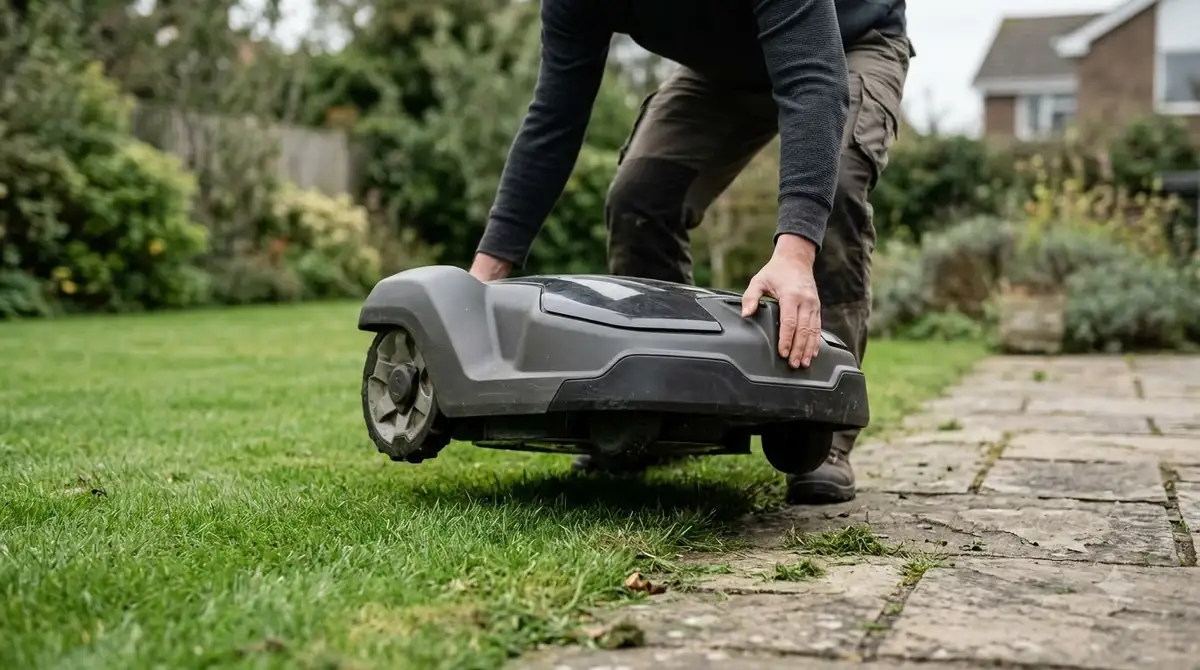
Noise is the next drawback. The spec table lists 68 dB, and the reviewer says the mower is noticeably louder than competing robot mowers. That reviewer tested a pre-production unit, and Lymow said production units would be quieter. That promise is a manufacturer claim the reviewer did not verify, so a buyer in a noise-sensitive neighborhood should not rely on it.
- Weight: 77.6 lb, which the reviewer counts as a main criticism.
- Noise: 68 dB in the spec table, and louder than competitors in one reviewer’s test.
- Lawn fit: the reviewer says flat, well-maintained suburban lawns may not need the extra power and weight.
Lymow One cons: blades, battery access and the app
Ownership costs are where the Lymow One is least forgiving. The blades are proprietary and sold through Lymow’s website, and Freshly Charged lists them at $20 to $30. No replacement blades ship with the mower, so budget for them from day one.
- Blades. Proprietary, sold only through the manufacturer, with no spares in the box.
- Battery access. The reviewer calls the battery “arguably too easy to access,” which is a theft risk in an unattended yard.
- App. The reviewer calls the app functional and says it covers the basics, but has some rough edges.
- Display. The screen is hard to read in outdoor light, according to the same reviewer.

Safety features: lift detection and obstacle height
The Freshly Charged spec table lists a 2-inch vertical obstacle rating, and the reviewer reports the mower cleared 2-inch obstacles in use. The Geeky Gadgets writer adds that off-ground detection stops the blades when the deck lifts. Neither source describes how these behave on a slope or in heavy grass, so they belong on your checklist for the manual.

In our reading, test the lift detection in your own yard before you rely on it, especially if children or pets spend time near the lawn. Ask the seller for the manual’s obstacle and slope limits in writing, because a spec table alone does not show how the mower behaves at those limits.
Early units and firmware: what to ask before you buy
Early-unit caution is part of the Lymow One pros and cons picture, not a footnote. Freshly Charged calls it an “early-adopter tax”: setup is complex, connectivity drops happen, and troubleshooting typically means forums rather than fast support. That reviewer also used a pre-production unit, so some of these points may not describe the units now on sale.
For a first-generation product, the practical question is what happens after launch. Ask the seller how firmware updates are delivered and what the support window looks like, then read recent owner reports before you buy.
Price and ownership costs as of November 2026
For the Lymow One pros and cons, price is the largest open question. The sources give list prices and launch offers from different dates, and none of them is confirmed for today. Check the current price, blade cost and warranty terms on the manufacturer site as of November 2026, and add the proprietary blades to the total.
Who the Lymow One pros and cons suit
Weigh the Lymow One pros and cons against your own yard, not against a generic robot mower. The pros favor a yard with open sky, a boundary-free layout and a buyer who is comfortable with proprietary parts. The cons weigh most on a heavily wooded lot, a noise-sensitive neighborhood or a flat lawn that needs little extra power. Our reading is that the slope question should be settled first, because it decides whether the mower fits a sloped yard at all. For more on the model, see the Lymow One review, Lymow One alternatives and Lymow One vs Mammotion LUBA 3 AWD.
Frequently asked questions
Does the Lymow One need a boundary wire?
No. According to Geeky Gadgets, which calls it a boundary-free mower, the Lymow One relies on RTK GPS, VSLAM and onboard sensors instead of a perimeter wire.
Is the Lymow One louder than other robot mowers?
The spec table lists 68 dB, and one reviewer says it is louder than competing robot mowers. That reviewer tested a pre-production unit, and Lymow said production units would be quieter. Compare the figures on the manufacturer site.
What is the Lymow One slope rating?
The sources disagree. The Freshly Charged spec table lists a maximum incline of 45% grade, while its review text and Geeky Gadgets both describe slopes up to 45 degrees. Those units are not the same, so check the owner manual before using the mower on a steep section.
How much do Lymow One replacement blades cost?
According to the Freshly Charged review, the blades are proprietary and sold through Lymow’s website at $20 to $30 each. None ship in the box, so plan for that cost. Check the current price on the manufacturer site.
Sources
- Freshly Charged, Lymow One review (2024) (independent review site): spec table, blades, app, battery access and reviewer trade-offs.
- Geeky Gadgets, Lymow One boundary-free robot mower (2025) (publisher): RTK and VSLAM description, 0.57-acre coverage, 3-hour runtime, battery cycle claim, writer caution and launch discount.
 Up next7 min readReviews & CompareLymow One Review: What the Sourced Specs Say Before You BuyUpdated Nov 12, 2026
 8 min readReviews & CompareLymow One Problems and Complaints: What the Sources ShowUpdated Nov 14, 2026
 8 min readReviews & CompareSunseeker Elite X5 Pros and Cons: What the Specs and Reviews ShowUpdated Nov 16, 2026
 9 min readReviews & CompareLymow One Alternatives: Specs to Compare Before You BuyUpdated Nov 14, 2026
 8 min readReviews & CompareLymow One Plus Review: 5 Essential Specs, Honest TakeUpdated Nov 16, 2026
 7 min readReviews & CompareLymow One Plus vs Navimow X430: Specs ComparedUpdated Nov 18, 2026