
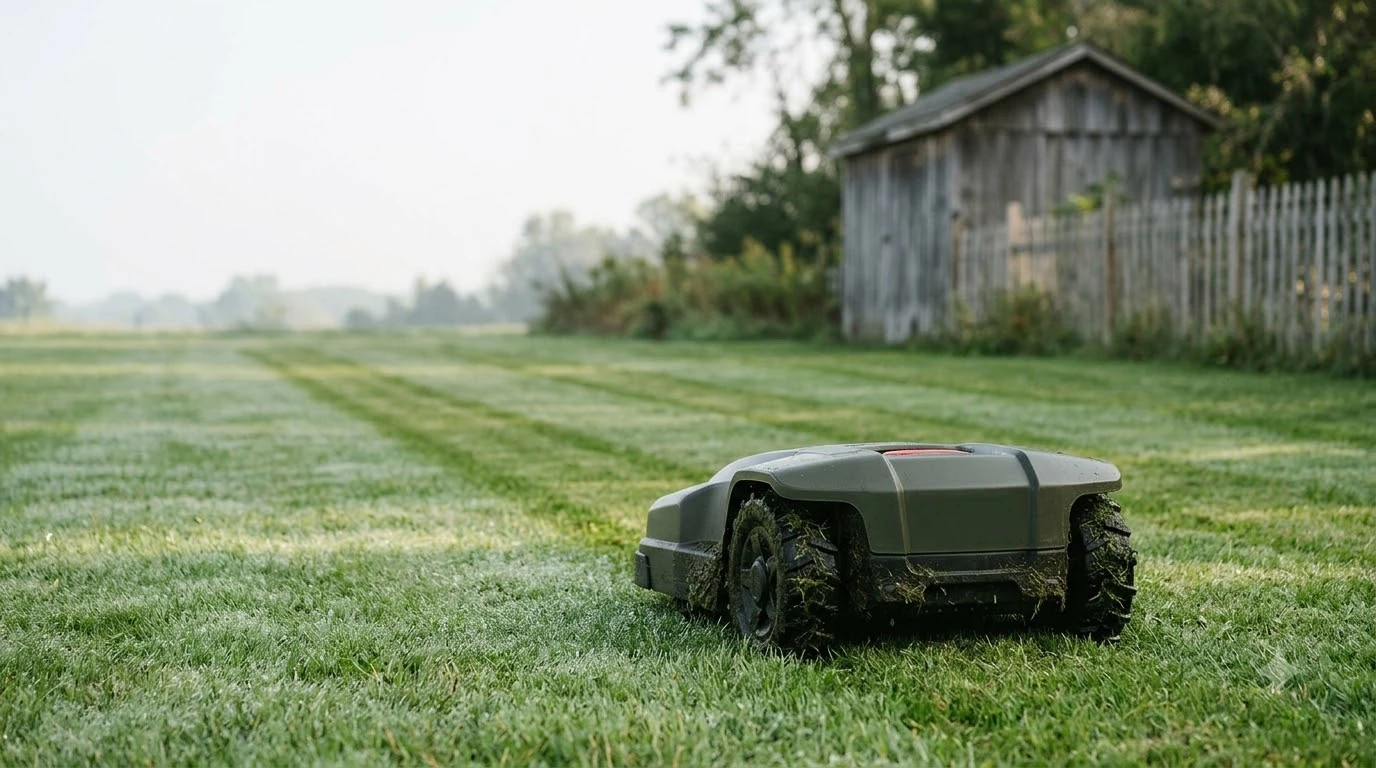

This Lymow One Plus review covers a robot lawn mower that needs no perimeter wire, with a 16-inch deck, RTK GPS plus VSLAM navigation, and a 2.8-inch obstacle rating. The main figures below come from Lymow’s own product page, read on 2026-11-11. Older reviews of the original Lymow One disagree with that page on a few numbers, so this review shows the conflicts rather than picking one.
The short answer
- What it is: a wire-free robot mower with RTK GPS, VSLAM visual mapping, AI vision, ultrasonic sensors and a bumper.
- Coverage: the product page gives 0.57 acre per charge and up to 1.73 acres per day with auto-recharge.
- Slope: up to 45 degrees (100% grade) on the product page. An older review lists 45% grade, which is a different figure.
- Price: not verified for today. No current price is quoted here.
Lymow One Plus review: what the spec sheet says
The product page lists a 16-inch deck and a cutting height range of 1.2 to 4.0 inches. Its obstacle crossing height is 2.8 inches, which the page notes is a lab measurement. The page lists the weight as 78.5 lb, with a tolerance of plus or minus 1 lb, and the size as 29.5 by 23.6 by 12.6 inches.
| Item | Lymow product page (read 2026-11-11) | Older review of original Lymow One (2024) |
|---|---|---|
| Cutting width | 16 in | 16 in |
| Cutting height | 1.2 to 4.0 in | 1.2 to 4 in (30.48 to 101.6 mm) |
| Obstacle crossing | 2.8 in (lab measurement, page footnote) | 2 in vertical obstacles |
| Max slope | Up to 45 degrees (100%) | 45% grade in spec table |
| Weight | 78.5 lb (+/-1 lb) | 77.6 lb |
| Battery | LiFePO4, 15 Ah, rated 35.2 V | LiFePO4, 15 Ah, 39 V, 585 Wh |
| Noise | Not stated on page | 68 dB |
| Price | Shown on page, not used here | $2,999 in a 2024 spec table |
A fair Lymow One Plus review has to flag that the two sets of figures do not match on weight, battery voltage and slope units. The differences may reflect a different model version or an older spec sheet. We could not confirm which, so treat any single figure as a claim to check against the manual or the current listing.
How the Lymow One Plus navigates without a boundary wire
The Lymow One Plus does not use a buried boundary wire. It combines RTK GPS with VSLAM, a camera-based mapping method that builds a map of the yard from visual features. The Lymow One Plus product page also lists AI vision, five ultrasonic sensors and a contact bumper for obstacle handling. The page describes up to 80 zones that can be set up in the app.
RTK needs a clear view of the sky. The product page says the base station, antenna and mounting pole are all in the box, so the reference station has to be placed where it can see satellites. Our explainer on what an RTK base station is covers the basics, and the guide to where to place an RTK antenna in a yard with trees helps with shade.
Lymow’s UK guide says VSLAM takes over for up to 10 minutes under dense canopy, and that performance may still degrade under extremely dense canopy. A robot mower maker quotes RTK accuracy often within 1 to 2 cm, but that is a vendor claim with no test conditions given.
- Open sky: RTK does its best work with a clear view of satellites.
- Under trees: VSLAM and vision carry more of the work near trunks and fences, per Lymow’s UK guide.
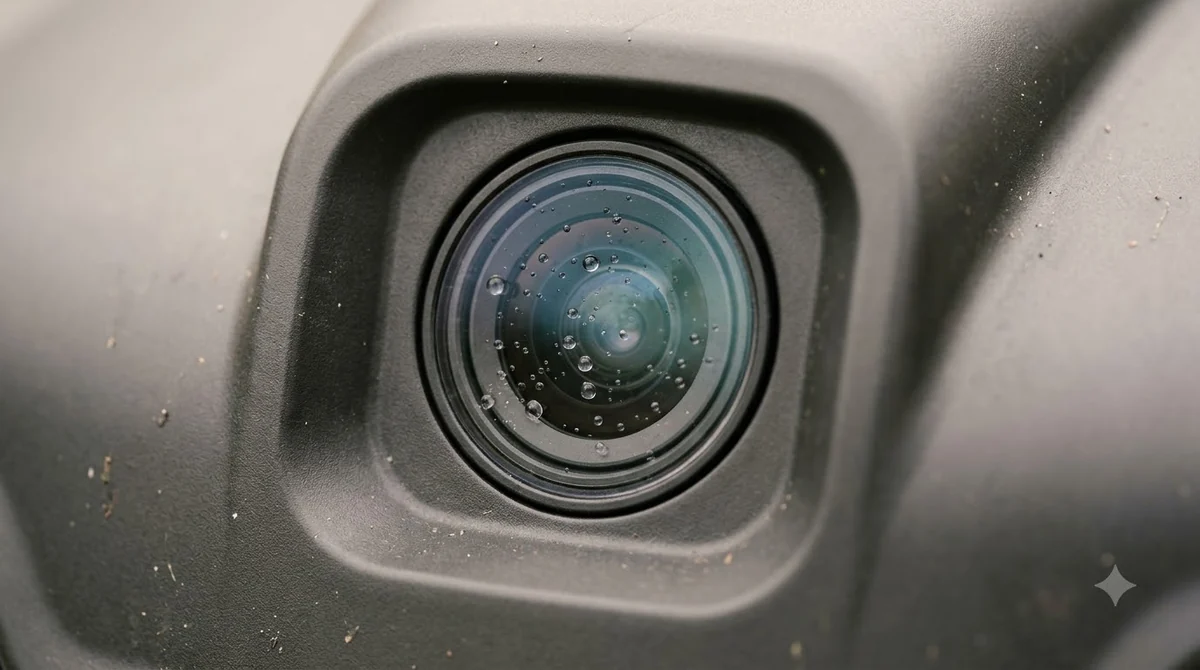
- Light and shadow: camera-based sensing depends on lighting and on the lens staying clean.
Our reading is that a yard with lots of tree cover is the case to check most carefully before buying any RTK mower. If you are still choosing a navigation type, see RTK versus LiDAR.
Coverage, slope and obstacle handling
The product page gives 0.23 acre per hour, 0.57 acre per charge and up to 1.73 acres per day with auto-recharge. Older reviews quote about 25,000 square feet per charge, which matches the 0.57 acre figure. The page does not state how the 1.73-acre daily figure was measured, so read it as a maximum rather than a typical result.
The slope figure is where the sources conflict, and any Lymow One Plus review should say so plainly. The product page lists a maximum of 45 degrees, which Lymow also gives as 100%. An older review quotes a 45% grade in its spec table. A 45% grade is about 24 degrees, not 45, so the two figures describe very different slopes. We recommend confirming the rating in the owner manual before relying on it for a steep section, and our guide on how to choose a robot mower for slopes shows how to measure yours.
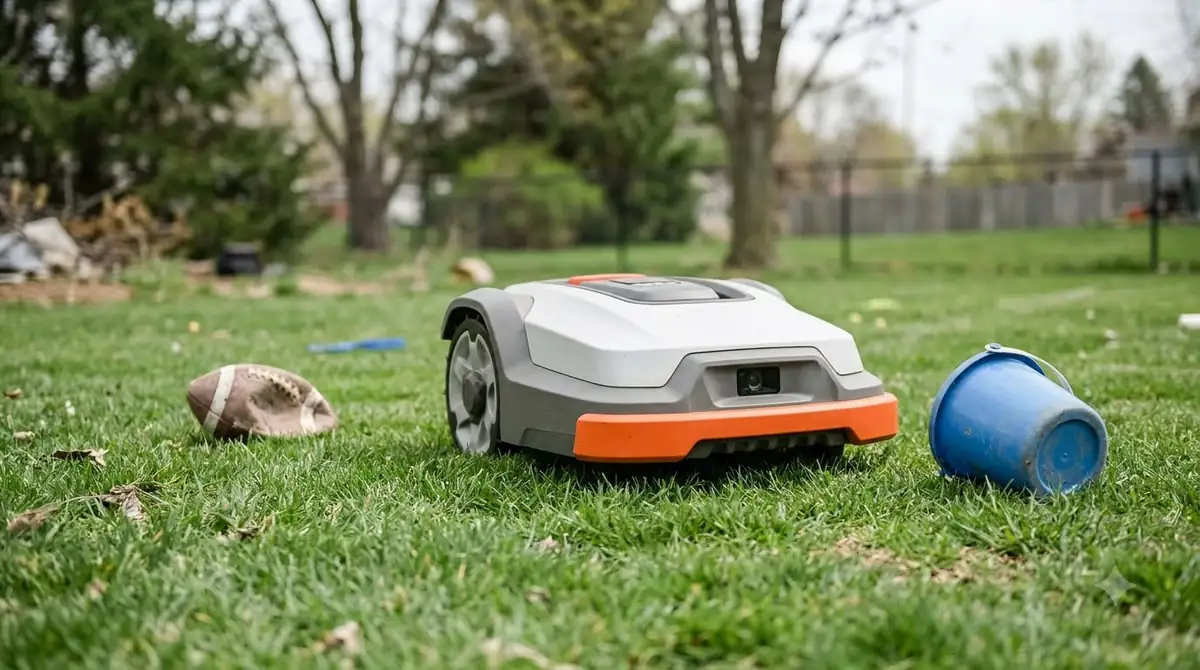
On obstacles, the product page for the Lymow One Plus lists a 2.8-inch crossing height from a lab measurement. The older review lists 2 inches and says a reviewer cleared that height in their own use. Neither source includes independent test data.
Blades, battery and runtime
The Lymow One Plus uses dual rotary mulching blades made of SK5 steel. The product page lists a speed range of 3,000 to 6,000 RPM. The older review says the blades are proprietary and sold through Lymow’s website at $20 to $30 each, which we could not confirm for today.
- Battery type. LiFePO4, 15 Ah. The product page says 2,000 charge cycles in lab tests but does not name the lab.
- Charge time. The page lists 90 minutes on the 10 A version and 150 minutes on the 5 A version, from 10% to 90%.
- Runtime. Up to 3 hours per charge, per the page.
- Warranty. A limited warranty of up to 3 years, covering key components and hardware.
The older review says the battery swaps out without tools, and it flags that the same design makes the battery easier to steal. The page does not comment on theft risk.
Noise, weight and the trade-offs reviewers raise
Noise is the main gap in the published figures. The product page does not state a noise level. The older review lists 68 dB and says the mower is louder than some competing models. At roughly 78 lb, the reviewer says manual moves are hard.
- App: the older review calls the app rough around the edges, though it covers zone mapping, schedules, cutting height, speed and blade speed.
- Display: one reviewer found the screen hard to read in direct sunlight.
- Fit: the same reviewer judged it a poor fit for flat, well-kept lawns.
Heads up
One writer advises waiting for more user reviews before buying, since the product was not fully polished at launch. These are reviews, not independent lab tests, and we did not find independent test data for the Plus.

Who the Lymow One Plus suits (our reading)
Based only on the sourced specs, our Lymow One Plus review reads it as most relevant to buyers who want to avoid installing a boundary wire and who have a clear view of the sky for RTK. Our reading is that it is a weaker fit for a heavily shaded yard, a very flat and well-kept lawn that a reviewer judged a poor match, or a buyer who needs a quiet mower and cannot confirm the noise level.
- Good fit: a large open lawn with no room for a buried wire loop.
- Check first: a yard with heavy tree cover, where VSLAM takes over for part of the time.
- Skip for now: a noise-sensitive yard, until a current noise figure is published.
What to check before you buy a Lymow One Plus
The sources do not agree on every figure, so run through these checks before you order a Lymow One Plus.
- Confirm the model name. The product page is titled for the original Lymow One but displays the Plus, so check which model you are buying.
- Confirm the slope rating in the owner manual against your steepest section.
- Check the current price and warranty on Lymow’s site. This review does not quote a price.
- Measure your lawn and compare it with the 0.57-acre per-charge figure.
- Check sky view for RTK, and plan for VSLAM under trees.
Frequently asked questions
Does the Lymow One Plus need a boundary wire?
The product page says the Lymow One Plus operates without a perimeter wire. It relies on RTK GPS, VSLAM and onboard sensors instead.
How much lawn does one charge cover?
The product page gives 0.57 acre per charge, which matches the roughly 25,000 square feet quoted in an older review. Grass height, slope and terrain will change the real result.
Is the slope rating confirmed?
Not across the sources. The product page says up to 45 degrees (100%), while an older review says 45% grade. Those are different slopes, so confirm the rating in the manual.
Is the Lymow One Plus the same as the original Lymow One?
The sources do not settle this. Some figures differ between the product page and the older review of the original One, so check the model and spec sheet you are buying.
Sources
- Lymow product page (Lymow): cutting height, deck, blades, slope, coverage, battery, warranty, base station.
- Freshly Charged, 2024 Lymow One review (independent review): older spec table, noise, price, reviewer notes.
- Geeky Gadgets, Lymow One article (independent article): navigation and launch caveat.
- Lymow UK, RTK versus wire guide (maker): VSLAM under dense canopy.
- Mammotion, AI vision versus RTK versus LiDAR (maker blog): RTK accuracy claim, no test conditions given.
 Up next7 min readReviews & CompareLymow One Plus vs Navimow X430: Specs ComparedUpdated Nov 18, 2026
 7 min readReviews & CompareSunseeker X3 Plus Expert Review: Honest Specs and FitUpdated Nov 18, 2026
 7 min readReviews & CompareLymow One Review: What the Sourced Specs Say Before You BuyUpdated Nov 12, 2026
 8 min readReviews & CompareLymow One Pros and Cons: What the Sourced Specs ShowUpdated Nov 15, 2026
 9 min readReviews & CompareLymow One Alternatives: Specs to Compare Before You BuyUpdated Nov 14, 2026
 9 min readReviews & CompareGreenworks Optimow Review 2026: Complete and Honest SpecsUpdated Nov 14, 2026