
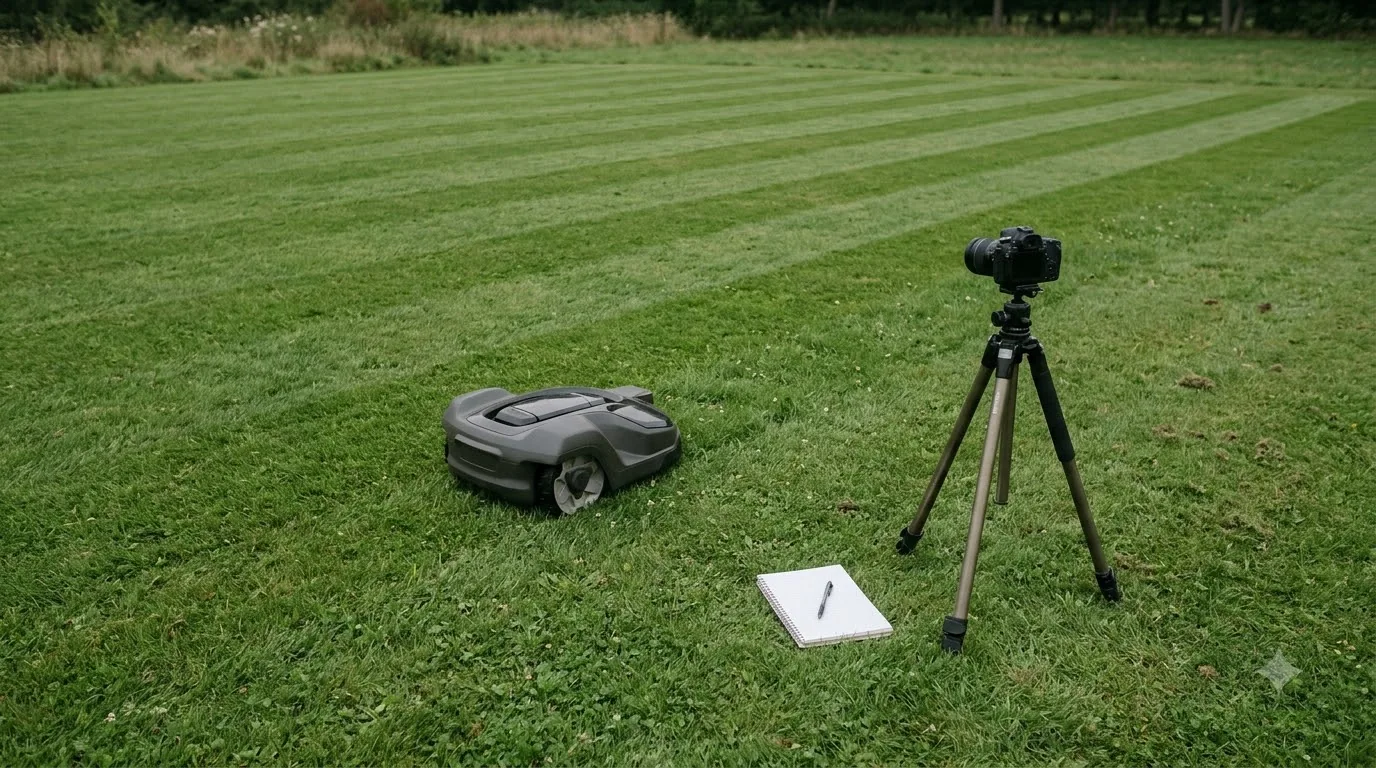

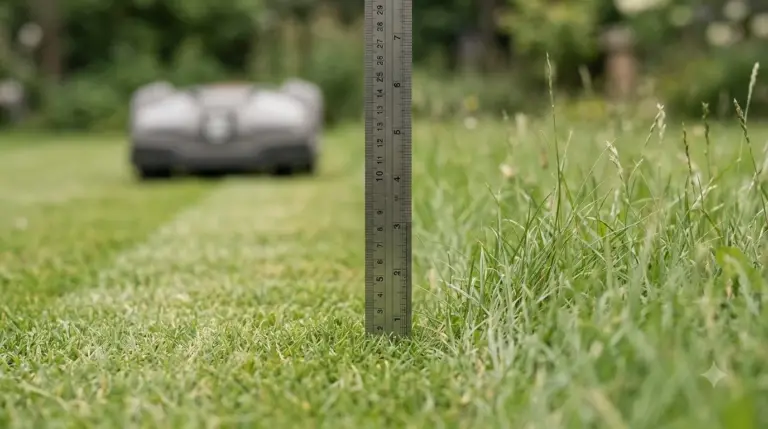
Can a robot mower cut Kentucky bluegrass? Yes, as long as its lowest cutting height reaches the height the grass needs. Iowa State University Extension recommends 3 to 3.5 inches in summer and 2.5 to 3 inches in spring and fall. Research on autonomous mowers in cool-season turf, including Kentucky bluegrass, is encouraging, but most of the trials are short or preliminary, so the cutting height matters more than the mower brand.
The short answer
- Yes: Kentucky bluegrass is a cool-season grass, and robot mowers are commonly designed for that group.
- Height: 3 to 3.5 inches in summer (June to August), 2.5 to 3 inches in spring and fall, per Iowa State.
- Limit: the mower must be able to reach that height. Check the lowest setting on the spec sheet before you buy.
- Research: a UConn trial found 2.25 inches gave the best quality and color for Kentucky bluegrass, but the results are preliminary.
- Rule: never remove more than one-third of the leaf height in one mowing.
Can a robot mower cut Kentucky bluegrass at all?
Kentucky bluegrass is a cool-season grass that grows most actively in spring and fall. Robot mowers suit that growth pattern because they cut small amounts often. The University of Florida’s IFAS extension notes that most autonomous mowers are designed mostly for cool-season grasses. The same guidance also says that autonomous mowers are typically mowed below 2.5 inches, which can cut lower than is favorable for some grasses, so height is the first thing to check.
So the short answer to whether a robot mower can cut Kentucky bluegrass is yes, because it is a reasonable match for the grass. The real question is whether your mower can cut as high as the grass prefers during the hottest months.
Kentucky bluegrass height by season
Iowa State University Extension gives the most direct height guidance for this grass. In summer, it recommends mowing Kentucky bluegrass at 3 to 3.5 inches. In spring and fall, the recommendation drops to 2.5 to 3 inches.
The reason for the taller summer cut is shade and heat. Extra leaf area shades and cools the crown of the plant, and more leaf supports deeper root growth. A slightly taller blade keeps the plant better able to handle heat and dry weather.
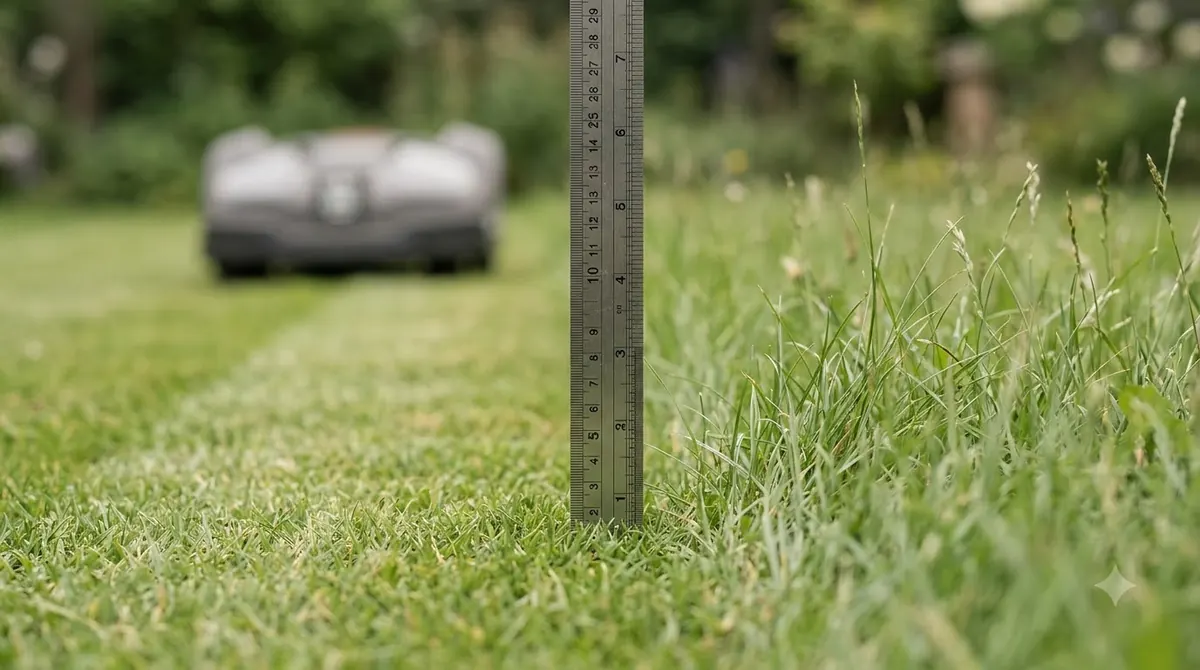
| Season | Recommended height (Iowa State) | Robot mower check |
|---|---|---|
| Spring (after green-up) | 2.5 to 3 inches | Confirm the mower’s lowest setting reaches 2.5 inches |
| Summer (June to August) | 3 to 3.5 inches | Confirm the mower can sit at 3.5 inches or higher |
| Fall | 2.5 to 3 inches | Lower the setting again as growth slows |
Heads up
If a mower’s highest setting is below 3.5 inches, it cannot follow the summer recommendation from Iowa State, even though it will still cut the grass.
What the research shows
Several recent studies have looked at autonomous mowers on cool-season turf. A University of Connecticut trial compared three cutting heights, 1.25, 2.25, and 3.25 inches. Tall fescue and Kentucky bluegrass gave the best quality and color at 2.25 inches, which the researchers describe as the middle range of two to two and a half inches. The UConn article calls these height results preliminary, because the study is ongoing. It also reports no summer data for cutting height, so it does not tell you how a robot mower should be set in July.
A 2025 study published in the International Turfgrass Research Society Journal looked at autonomous and conventional mowing over two years in Norway. Its summary says that for all three pure grass species tested, including Kentucky bluegrass, visual quality ratings were higher during the summer and fall in plots mowed by the autonomous mower. The study used a fairway cut height of 0.59 inch (1.5 centimeters) for both mower types, so it is not a guide to home-lawn height. The tiller count for Kentucky bluegrass did not change with mower type.
Taken together, the trials suggest that a robot mower can cut Kentucky bluegrass without harm when it is set correctly. The trials are short, though, and they do not settle how a home mower should handle a hot, dry summer. Our reading is that the height guidance from extension offices is more reliable than any single trial.
How to set a robot mower for Kentucky bluegrass
A robot mower follows the same one-third rule as a push mower, but it can apply that rule more easily because it runs often and removes only a small amount each time. Iowa State’s guidance uses this rule to protect the grass, and it is the main limit to keep in mind when setting the height.
Here is a simple way to set the mower for Kentucky bluegrass. These steps are our reading of the extension guidance, not instructions from a manufacturer.
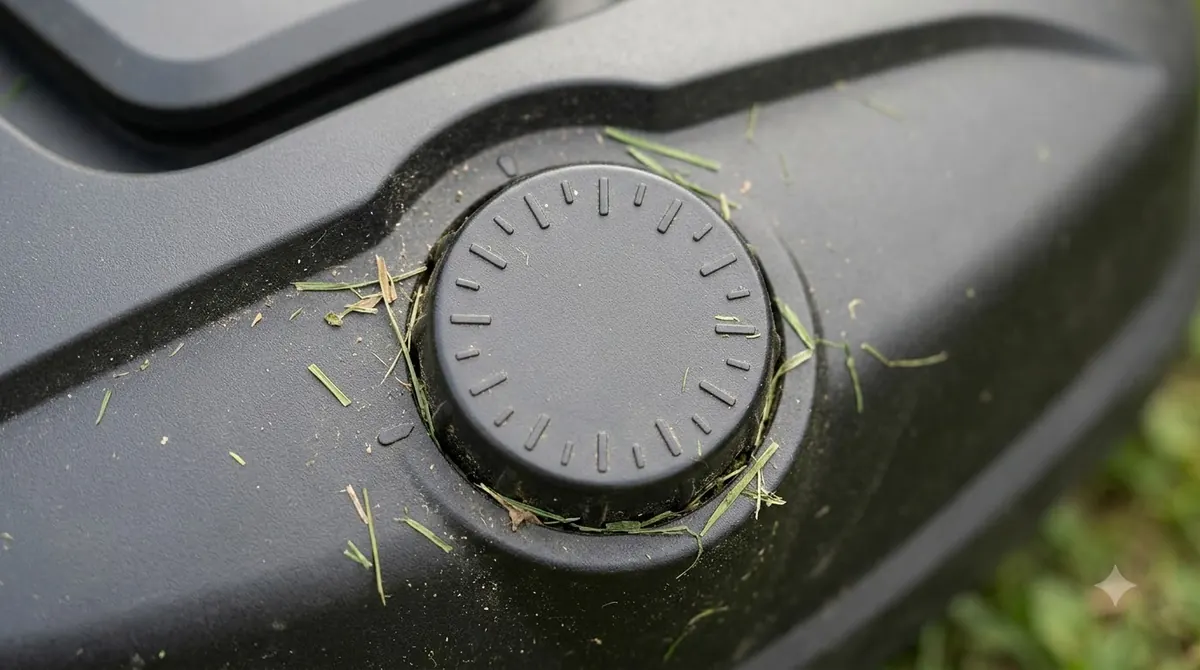
- Find the lowest and highest settings. Look up both on the spec sheet or in the manual, because they differ by model.
- Set the height for the season. Use 2.5 to 3 inches in spring and fall, and 3 to 3.5 inches in summer, as Iowa State recommends.
- Let the mower run often. Frequent short runs keep each cut within the one-third limit, so the mower removes a little leaf each time.
- Raise the setting in heat or drought. In hot, dry weather, move up one step so the grass keeps more leaf area.
- Watch the cut. If the lawn looks scalped or uneven after a run, our reading is that the height is too low for the season or the blades need sharpening.
Summer cutting height is the step most people get wrong. A mower that can only go to 3 inches will cut slightly below the summer range if you leave it on the highest setting, so it helps to know that limit before the first hot week.
What to check before you buy
If you are asking whether a robot mower can cut Kentucky bluegrass in your own yard, start with the numbers rather than the brand. Compare the lowest and highest cutting height against the spring, fall, and summer ranges above. Then look at the rest of the specification: whether the mower can handle the slope and the edges of your lawn, and whether it has enough runtime for your lawn’s size.
Ask whether the manufacturer publishes a height chart for each model. A clear chart from the company is a better guide than a general claim that the mower works on all grasses.
The one-third rule still applies. A robot mower that runs too rarely to keep up with the growth of your grass will leave long clippings and uneven cuts, which is a sign the schedule needs changing rather than the height.
Frequently asked questions
Can a robot mower cut Kentucky bluegrass?
Yes. Kentucky bluegrass is a cool-season grass, and most robot mowers are designed for that group. The key requirement is that the mower’s lowest setting reaches the height the grass needs, which Iowa State gives as 3 to 3.5 inches in summer and 2.5 to 3 inches in spring and fall.
What height should a robot mower cut Kentucky bluegrass in summer?
Iowa State University Extension recommends 3 to 3.5 inches in June, July, and August. The taller cut shades the crowns of the plants and supports deeper roots during heat.
Is 2.25 inches a good height for Kentucky bluegrass?
A UConn trial found 2.25 inches gave the best quality and color for Kentucky bluegrass and tall fescue. The researchers describe the results as preliminary and the article reports no summer data, so 2.25 inches is not the summer rule. For summer, follow the 3 to 3.5 inch range from Iowa State.
How often should a robot mower run on Kentucky bluegrass?
The general rule is that no more than one-third of the leaf height should be removed in one mowing. Because a robot mower runs often and cuts small amounts, it can follow that rule without measuring each run. Our reading is that frequent short runs suit this grass better than rare long runs.
Sources
- What is the correct mowing height for my lawn in summer? (Iowa State University Extension and Outreach): summer and spring/fall heights for Kentucky bluegrass, the reason for a taller summer cut, and the one-third rule.
- UConn Research Shows Autonomous Mowers Make the Cut (UConn Today, 2025): tested cut heights and the preliminary 2.25-inch result.
- How cool-season turf responds to autonomous mowers (summary of Hesselsøe et al., 2025, International Turfgrass Research Society Journal): visual quality results and fairway cut height in a two-year Norwegian study.
 Up next7 min readBy YardWhat Cutting Height Should a Robot Mower Use for Kentucky Bluegrass?Updated Nov 10, 2026
 7 min readBy YardBest Mowing Height for Kentucky Bluegrass by SeasonUpdated Nov 11, 2026
 9 min readBy YardHow Often to Mow Kentucky Bluegrass by SeasonUpdated Nov 11, 2026
 8 min readBy YardBest Robot Mower for Kentucky Bluegrass and Fescue: What to CheckUpdated Nov 13, 2026
 9 min readBy YardCan a Robot Mower Cut Zoysia? Height and LimitsUpdated Nov 11, 2026
 7 min readBy YardCan a Robot Mower Cut Fine Fescue? Heights and What to CheckUpdated Nov 11, 2026