
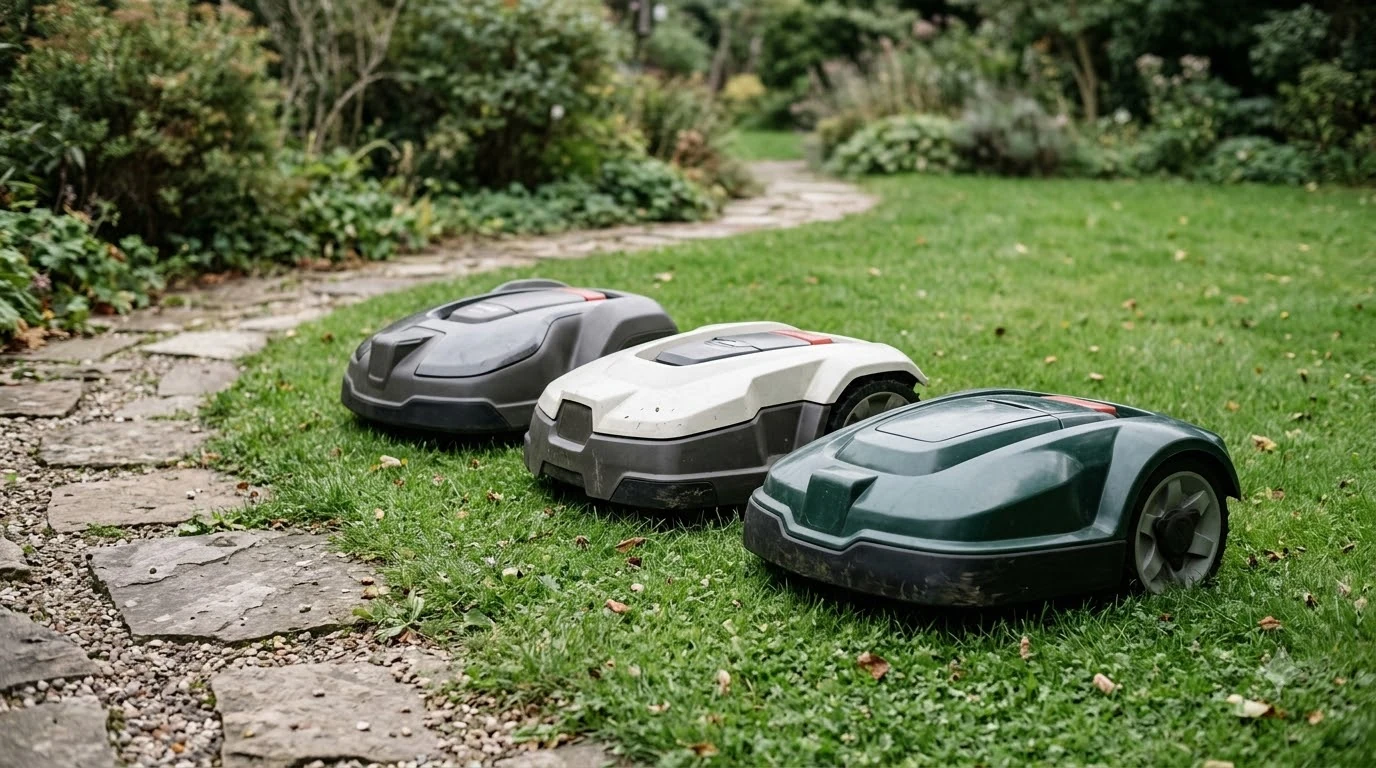

Can a robot mower work in a lawn next to a busy street? Yes, but only if the street side has a physical barrier. A boundary wire or wire-free map tells the mower where to cut, not where to stop when a wheel slips or a sensor misses something. Husqvarna’s guidance on stay-out zones says to fence off a street edge with a barrier at least 15 cm (6 in) high.
The short answer
- Stay-out zones are not road barriers: Husqvarna says never use one to stop the mower entering the street.
- Physical edge first: fence the street side with a barrier at least 15 cm (6 in) tall, and keep the boundary wire inside it.
- Wire spacing: keep guide wires at least 30 cm (12 in) from the boundary wire, and never let them cross it.
- Slope along the curb: measure the gradient on the street side, since Navimow’s listed models range from 45% to 84%.
- Sensors are backup: lift sensors and a STOP button help, but no source we read says they catch every person, pet or small object.
Can a robot mower work in a lawn next to a busy street? Why a stay-out zone is not enough
A stay-out zone tells the mower to skip an area inside the lawn, and it is no help if a robot mower works in a lawn next to a busy street without a barrier, such as a flowerbed or a play patch. Husqvarna’s AIM Technology guidance is direct about the case that matters near traffic: never use a stay-out zone to stop the mower from running into a swimming pool or the street. The same page says such areas should be fenced off with the boundary wire and a barrier at least 15 cm (6 in) high, according to Husqvarna’s stay-out zone guide.
The same guide sets limits on where a stay-out zone can sit. It must not cover the charging station or part of the guide wire, because the mower then cannot return to charge. It also should not block a passage the mower needs to use. Our reading is that a stay-out zone is a tool for keeping the mower out of a bed, not a safety device at a curb.
How to set the boundary wire next to a street
When a robot mower works in a lawn next to a busy street, lay the boundary wire inside the physical edge, not on the curb, and keep any guide wire at least 30 cm (12 in) from it. Husqvarna’s guide wire instructions say the guide wire must not cross the boundary wire, for example near an island, as described in its guide wire article.
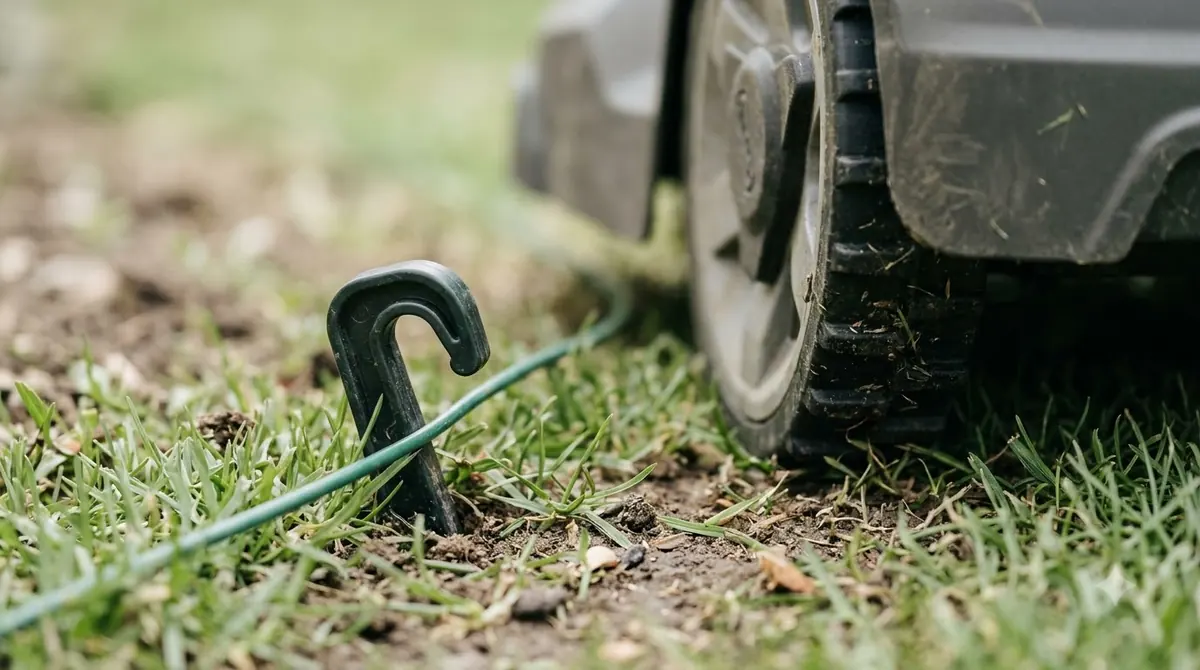
A wire that sits too close to the road is expensive to fix later. Eufy’s guide to wired and wire-free mowers says a wired layout change requires unearthing, splicing and re-burying the cable. So it is worth setting the wire line once, with a wide strip between the wire and the street, rather than correcting it after the first season.
- Peg the boundary wire on the lawn side of the barrier.
- Keep every guide wire 30 cm (12 in) from the boundary wire.
- Do not let guide wires cross each other or the boundary wire.
- Keep the charging station away from the street side, so the route back to it stays clear.
Wire-free mowers and GPS near a busy street
For a wire-free model, a lawn next to a busy street raises the signal question too. Wire-free mowers use satellite positioning, cameras or LiDAR, and a street edge can weaken that positioning. Eufy notes that high boundary walls and neighboring buildings can degrade GPS and RTK signal, and that signal quality in shaded zones can drop by 30% to 70%.
Our reading is that a robot mower in a lawn next to a busy street, wire-free or not, needs a careful first run. Eufy advises observing the first pass after remapping, a software update or a landscaping change, and that check matters most along the street. If the mower behaves oddly near the edge, add a physical barrier or a wire rather than relying on the map alone.
Sensors and stop buttons: what they cover and what they miss
Lift and collision sensors stop the blades in many models, but Eufy says small, low or partly hidden objects may be harder to recognize, and that no sensor should be expected to recognize every small animal, toy or sudden movement. A sensor that works well in a backyard is not a guarantee near a sidewalk where someone may step onto the grass.
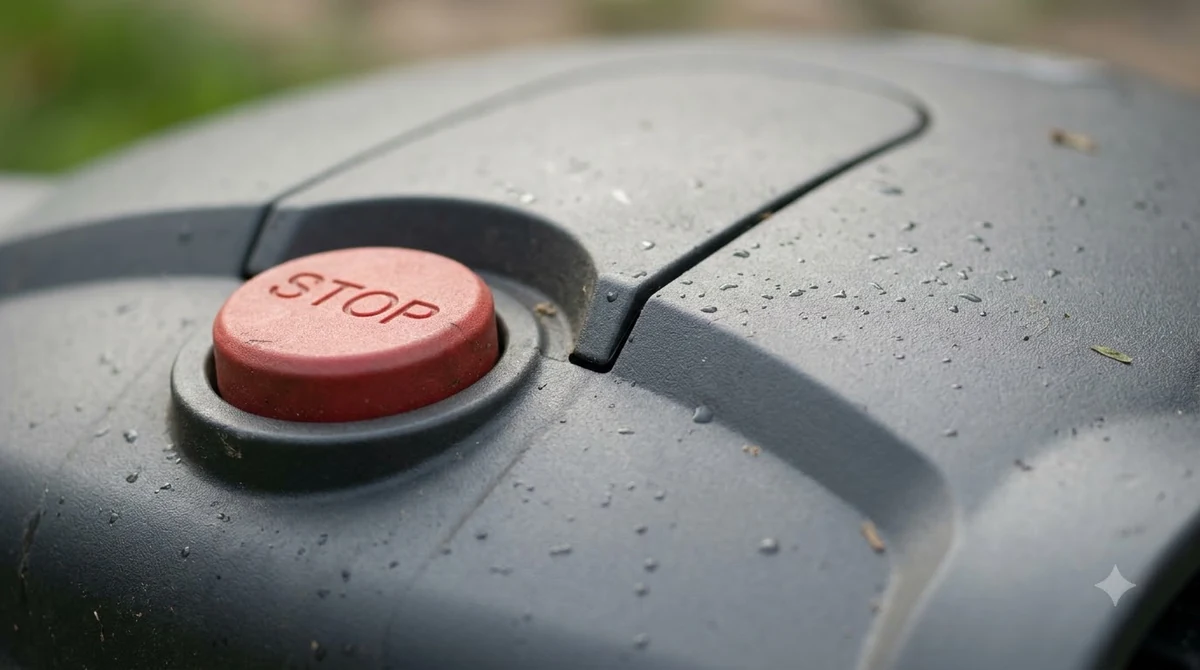
Eufy recommends a clearly visible STOP button so an adult can halt the mower without first finding a phone or opening an app. The same guide says to check whether the cutting system stops when the mower is lifted, tilted or interrupted, and whether a safety key, PIN or similar method blocks unauthorized starting. A PIN is most useful near a street, where passers-by may be close to a mower that starts on a timer.
- Confirm that the blades stop when the mower is lifted or tilted.
- Check that a STOP button is visible from the sidewalk side of the lawn.
- Use a PIN or safety key if the mower is left unattended by the street.
- Run the mower only when the lawn is empty, and keep children indoors or behind a secure barrier, as Eufy advises.
Slope and drainage along the curb
Slope along the curb matters more than the lawn average, because a street edge often runs along a bank or a dip. Navimow publishes slope ratings for its models, and its guide also says to account for trees, flowerbeds and fences when laying out the garden. The current ratings are below, as listed in Navimow’s wire layout guide.
| Navimow model | Slope rating | Angle |
|---|---|---|
| i2 AWD | 45% | 24 degrees |
| i2 LiDAR Pro | 55% | 29 degrees |
| X4 | 84% | 40 degrees |
Wired systems have their own limits. Husqvarna’s FlexiFence zones allow a maximum 10% gradient inside the zone, far below the ratings above, so a zone should not sit on a bank or drop-off. Our reading is that the lowest rating in your setup, not the best one in the brochure, decides whether the street edge is safe to mow.
Rules for a lawn next to a busy street: what the sources do and do not say
IEC 60335-2-107:2017 sets safety requirements for battery robotic rotary lawnmowers with batteries up to 75 V DC. It covers significant hazards under intended use and reasonably foreseeable misuse, according to the IEC publication page. The standard is a product safety baseline, not a rule for where a mower may be placed.
In the sources we searched, we did not find a rule that specifically governs a robot mower in a lawn next to a busy street or any public road. Local rules on fencing, sidewalks, noise or HOA covenants may still apply to a street-side lawn, so check them with your city or association before you lay wire along a public edge.
What to check before a robot mower works in a lawn next to a busy street
Before you buy or lay wire, measure the strip between the street and the lawn, and note where the barrier, wall or fence will stand. Those three checks usually decide whether a wired or wire-free setup is the simpler choice for a busy frontage.
- Physical barrier: confirm a barrier at least 15 cm (6 in) high along the street side.
- Wire clearance: keep the boundary wire inside that barrier and guide wires 30 cm (12 in) from it.
- Slope: check the gradient along the curb against the model rating, and cap any FlexiFence zone at 10%.
- Signal: look for walls, buildings and trees that cut satellite view along the frontage.
- Safety controls: test the lift stop and the STOP button, and set a PIN if the mower is left unattended.
Frequently asked questions
Can a robot mower cut right up to the curb of a busy street?
The sources we read do not give one safe distance from a curb. Husqvarna’s guidance says to fence a street edge with a barrier at least 15 cm (6 in) high, so the safest plan is a boundary wire set inside that barrier, not on the curb itself.
Is a stay-out zone enough to keep the mower off the street?
No. For a robot mower in a lawn next to a busy street, Husqvarna says never to use a stay-out zone to stop the mower from entering the street. Use a physical barrier together with the boundary wire, and treat the stay-out zone as a convenience for beds and similar areas.
Do lift sensors make a mower safe near traffic?
They help, but they do not replace a barrier. Eufy notes that small, low or partly hidden objects may be harder to recognize, and it advises checking that the cutting system stops when the mower is lifted, tilted or interrupted.
Should I use a PIN on a mower next to a busy street?
Eufy suggests checking whether a mower has a safety key, PIN or another method that blocks unauthorized starting. A PIN is useful when the mower is left unattended near a frontage where people walk past, because it limits who can start the blades.
Sources
- Husqvarna stay-out zone guide (manufacturer): street and pool warning, 15 cm barrier, charging station and guide wire limits.
- Husqvarna guide wire article (manufacturer): 30 cm spacing and no crossing rule.
- Husqvarna FlexiFence article (manufacturer): 10% maximum gradient inside a zone.
- Eufy robot mower safety guide (manufacturer): sensor limits, STOP button, PIN and running the mower only when the lawn is empty.
- Eufy wired vs wire-free guide (manufacturer): GPS and RTK degradation near walls and buildings, shaded-zone signal loss, and wired layout changes.
- Navimow wire layout guide (manufacturer): slope ratings for i2 AWD, i2 LiDAR Pro and X4.
- IEC 60335-2-107 publication page (standards body): scope and edition.
 Up next8 min readBy YardRobot Mower for Lawn Next to a Two-Story House: What to CheckUpdated Nov 11, 2026
 8 min readBy YardCan a Robot Mower Work in a Yard With No Wifi in the Back?Updated Nov 10, 2026
 9 min readBy YardCan a Robot Mower Work in a Yard Split by a Driveway?Updated Nov 10, 2026
 7 min readBy YardCan a Robot Mower Work in a Yard With Multiple Small Patches?Updated Nov 10, 2026
 8 min readBy YardCan a Robot Mower Work in a Yard With a 2 Foot Wide Passage?Updated Nov 10, 2026
 7 min readBy YardCan a Robot Mower Work in a Unfenced Front Yard?Updated Nov 10, 2026