
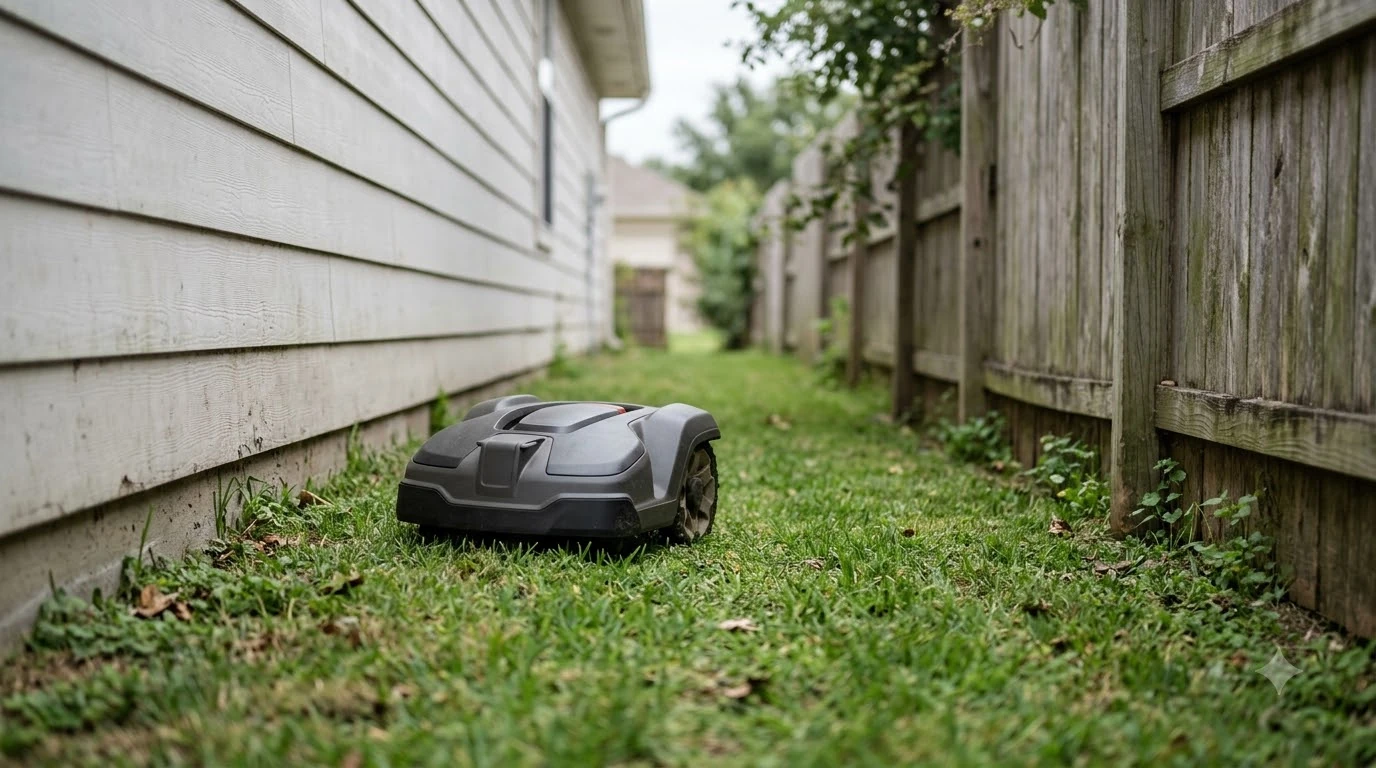

Can a robot mower work in a yard with a 2 foot wide passage? Only with a wired guide-wire setup, and even then the margin is very thin. Two feet is about 61 cm. That clears Husqvarna’s 60 cm minimum for a passage that uses a guide wire, but it falls well short of the 2 m Husqvarna asks for without one, and other brands publish larger figures still.
The short answer
- With a guide wire: Husqvarna’s minimum is 60 cm (24 in) between boundary wires, so a 2 foot gap passes by about 1 cm.
- Without a guide wire: Husqvarna recommends at least 2 m (6 ft 6 in), far wider than 2 feet.
- Other brands: Ecovacs lists a 0.7 m (about 28 in) clearance, and Robomow says a passage should be wider than 70 cm.
- Our reading: treat 2 feet as the floor for a wired passage, not as a comfortable width.
Can a robot mower work in a yard with a 2 foot wide passage? Brand minimums compared
A 2 foot passage is 24 inches, or about 60.96 cm. The published figures do not measure exactly the same thing, so each one has to be read for what it covers. Husqvarna’s number is the distance between two boundary wires, which is the lane the mower drives through. Ecovacs gives a narrow passage clearance for its GOAT mower, and Robomow gives a wire spacing for passages between zones.
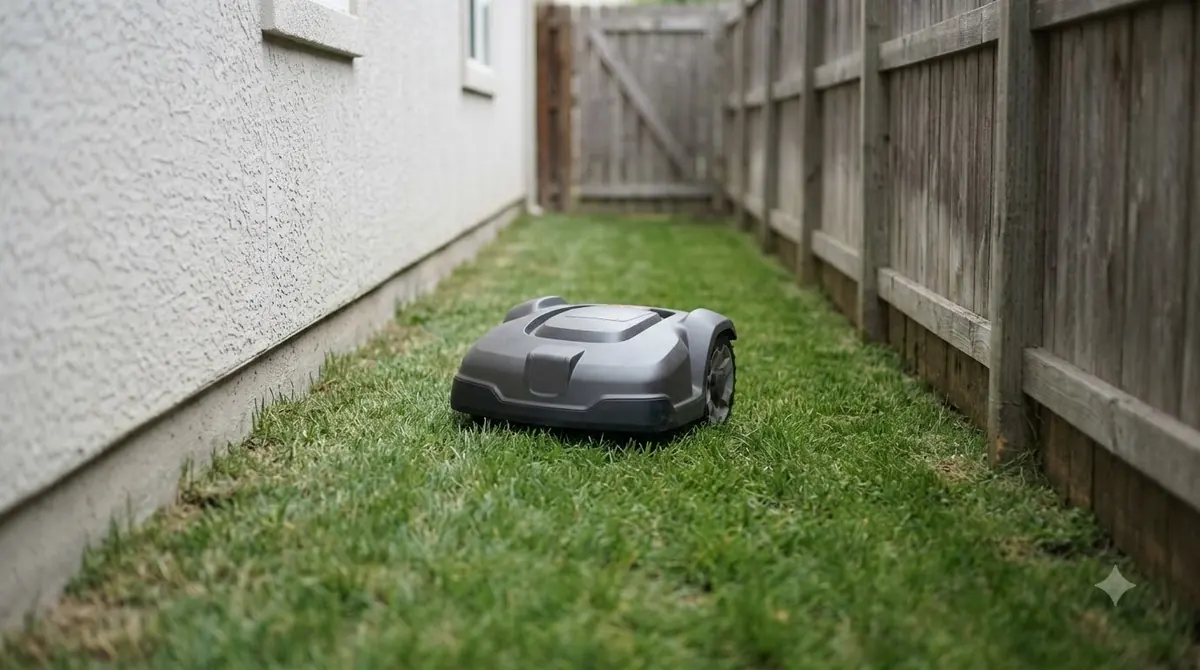
The table below puts each published figure next to a 2 foot gap. The last column is our arithmetic from those figures, not a number from any manufacturer.
| Source and setup | Published minimum | Compared with 2 feet (about 61 cm) |
|---|---|---|
| Husqvarna, passage with a guide wire | 60 cm (24 in) between boundary wires | Clears by about 1 cm |
| Husqvarna, passage without a guide wire | 2 m (6 ft 6 in) between boundary wires | Short by about 1.4 m |
| Ecovacs GOAT, narrow passage clearance | 0.7 m (about 28 in) | Short by about 9 cm |
| Robomow, passage between zones | Wider than 70 cm | Short by about 9 cm |
On paper, only Husqvarna’s guide-wire rule admits a 2 foot gap, and it does so with almost no spare width. Husqvarna’s passage guide lists both of its figures in one place, which makes it the best starting point for any wired setup. The other two figures are not wire-to-wire rules for the same setup, so they should be read as warning signs rather than as pass or fail lines.
Why the guide wire leaves almost no room
For a robot mower in a yard with a 2 foot wide passage, the guide wire is the deciding part. It is a thin wire that runs through the middle of the passage so the mower can follow it instead of bouncing between the two boundary wires.
Husqvarna says the guide wire must sit at least 30 cm (12 in) from the boundary wire. In a gap of about 61 cm, a guide wire placed 30 cm from one boundary wire ends up only about 31 cm from the other. Any uneven install shifts it toward one side, and then the mower drives closer to one wall than the other. That leaves very little margin for error, and our reading is that the guide wire needs to be measured and staked with care before you rely on a 2 foot gap at all.
Robomow adds a separate limit. Its boundary wire guide says a passage should be wider than 70 cm, because two boundary wires placed close together can interfere with each other. Robomow’s boundary wire article ties this warning to remote start points in separate mowing zones, where the passage is narrow and the mower does not handle it automatically. A 2 foot gap sits about 9 cm below that 70 cm mark, so that warning applies here.
Heads up
60 cm is a minimum, not a recommended width. For good cutting results on the Automower 435X AWD and 535 AWD, Husqvarna recommends a passage of at least 2 m (6 ft 6 in). A 2 foot gap is far below that recommendation even though it clears the guide-wire minimum.
What happens when a passage is too narrow
When a robot mower works in a yard with a 2 foot wide passage that sits below the published figures, the mower is more likely to leave uncut strips, lose its position, or stop. Ecovacs says its GOAT treats any passage narrower than 0.7 m as passable and drives straight through it. The mower then cannot zigzag-mow that section, which leaves gaps in the cut. Ecovacs’ narrow passage FAQ also warns that passages under 1 m wide with high walls beside them can weaken positioning signals so the mower gets stuck.
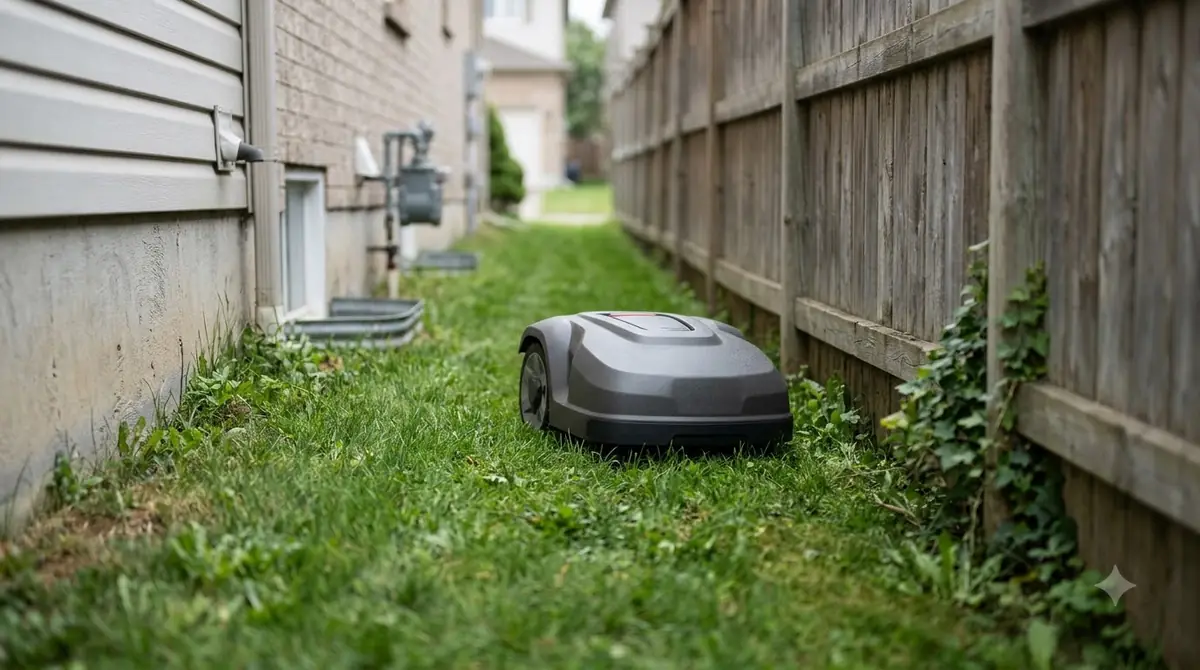
Wire-based mowers have their own failure mode. Husqvarna says that if the mower gets stuck when it follows the boundary or guide wire through a passage, you should try adjusting the corridor width. That setting depends on the model, so the simplest check is to read your manual before you assume it is available. A mower that is stuck in a 2 foot gap every time it passes will not finish its schedule, so this is the first thing to test after installation.
Options for a 2 foot passage (our reading)
If the gap is about 2 feet wide, our reading is that it should be treated as a limit, not a plan. The options below follow directly from the brand figures above, and none of them depends on a claim that a 2 foot gap works well.
- Widen the gap if you can. For a robot mower in a yard with a 2 foot wide passage, Husqvarna’s 2 m figure for good cutting is the number to aim for when you are free to move a fence, a bed, or a path edge.
- Cut the narrow strip by hand. Ecovacs suggests guiding its mower along the edge in tight spots, which points to a manual pass for the narrowest section of a yard.
- Check the corridor width setting. Husqvarna names a corridor width adjustment as the fix when a mower gets stuck in a passage, so confirm the model has it before you buy.
- Keep the guide wire centred. In a 61 cm gap, a guide wire that drifts toward one side leaves less room on the other, so measure the install more than once.
Each option trades something. Widening the gap costs work and may affect a fence line. Cutting by hand costs time each week. Choosing a model because of its corridor setting narrows the list of mowers you can consider. Our reading is that the least risky choice is the one that removes the 2 foot gap from the mower’s route altogether, if the layout allows it.
What to check before you buy or install
Before you decide whether a robot mower can work in a yard with a 2 foot wide passage, measure the narrowest point of the gap at grass height, then compare that number with the exact figure in the manual, not with the marketing copy. The steps below are our reading of how to check a 2 foot passage before committing to a layout.
- Measure the narrowest point. Check wall to wall at grass height, including fence posts, hose bibs, and raised beds, because any of them can shrink the real gap.
- Match the measurement method. Husqvarna measures between boundary wires, while Ecovacs gives a clearance. Use the same method the manual uses before you compare numbers.
- Confirm the setup option. Ask whether the model supports a guide wire, because Husqvarna’s 60 cm figure applies only to that setup.
- Read the stuck recovery steps. Find the corridor width setting or the manual guiding steps before the mower is installed, not after it has already gotten stuck.
Frequently asked questions
Can a robot mower work in a yard with a 2 foot wide passage?
Only in a wired setup that uses a guide wire, and then just barely. Husqvarna’s minimum with a guide wire is 60 cm (24 in), and 2 feet is about 61 cm. Without a guide wire, Husqvarna recommends at least 2 m (6 ft 6 in), so a 2 foot gap is not enough in that case.
Does a guide wire help a narrow passage?
Yes. It lowers Husqvarna’s minimum from 2 m to 60 cm between boundary wires. The guide wire must sit at least 30 cm (12 in) from the boundary wire, which leaves little room in a gap of about 61 cm, so placement during installation matters.
Will a robot mower get stuck in a narrow passage?
It can. Ecovacs says passages under 1 m wide with high walls can weaken positioning signals and leave the GOAT stuck. Husqvarna advises trying a corridor width adjustment when a mower gets stuck following the wire through a passage.
What is the simplest fix for a 2 foot passage?
Widen the gap if you can, since Husqvarna recommends 2 m for good cutting. If you cannot, cut the narrow strip by hand, because Ecovacs suggests guiding its mower along the edge in tight spots.
Sources
- How to create a passage in an Automower boundary wire installation (Husqvarna support): 60 cm with a guide wire, 2 m without one, 30 cm guide wire offset, the 2 m recommendation for 435X AWD and 535 AWD, and the corridor width adjustment.
- Ecovacs GOAT narrow passage FAQ (Ecovacs help center): 0.7 m clearance, passages under 1 m with high walls, and the suggestion to guide the mower manually along the edge.
- Laying the lawn boundary wire (Robomow blog): a passage should be wider than 70 cm, and two close boundary wires can interfere with each other.
 Up next6 min readBy YardBest Robot Mower for a Yard With a 3 Foot Side Passage: What to CheckUpdated Nov 13, 2026
 8 min readBy YardRobot Mower for Narrow Side Yard Passages: What Widths Work?Updated Nov 11, 2026
 7 min readBy YardBest Robot Mower for Mixed Weedy Lawn: 2 Inch Height TipsUpdated Nov 17, 2026
 9 min readBy YardWhat Is the Minimum Passage Width for a Robot Mower?Updated Nov 11, 2026
 8 min readBy YardHow Narrow Can a Robot Mower Passage Be? Simple 2026 RulesUpdated Nov 11, 2026
 7 min readBy YardCan a Robot Mower Work in a Unfenced Front Yard?Updated Nov 10, 2026