
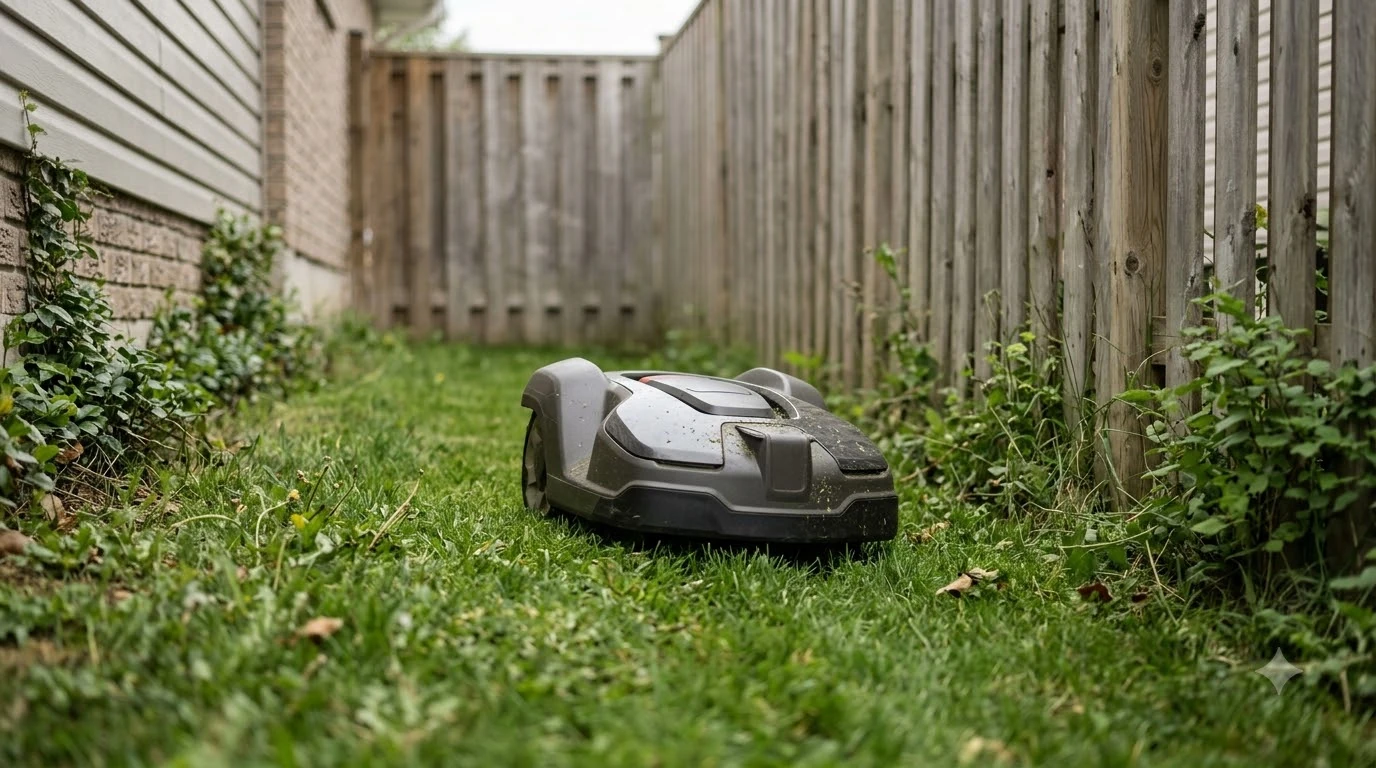

What is the minimum passage width for a robot mower? It is 60 cm (24 in) between boundary wires when a guide wire is installed. Without a guide wire, Husqvarna asks for 2 m (6 ft 6 in) and Gardena for at least 1.5 m. Brands and models differ, so the figures in your own manual come first.
The short answer
- With a guide wire: 60 cm (24 in) between boundary wires, per Husqvarna and Gardena.
- Without a guide wire: about 1.5 m (Gardena) to 2 m (Husqvarna).
- Obstacles: add the clearance from each wall or fence to the minimum.
- Guide wire: keep it at least 30 cm (12 in) from the boundary wire.
The passage width is the distance from one boundary wire to the other. If the gap is narrower than the brand’s minimum, the mower may not enter it, or it may get stuck or cut the lawn unevenly on the edges. The figures below come from manufacturer support pages, and they are the starting point for any layout.
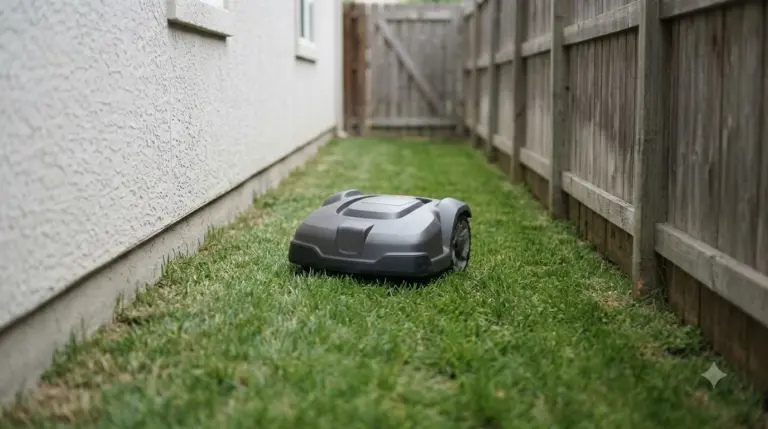
Most homeowners ask this question when a robot mower is being planned for a yard with a side passage, a gap between a shed and a fence, or a long strip that runs past a house. In those layouts the gap is rarely open lawn from edge to edge. Walls, pots, fence posts and garden beds all take up space, so the number that matters is the usable gap, not the distance you see on the ground.
What is the minimum passage width for a robot mower with a guide wire?
With a guide wire installed, Husqvarna and Gardena both list 60 cm (24 in) between boundary wires as the minimum for a passage. Husqvarna’s support article says the guide wire should sit at least 30 cm (12 in) away from the boundary wire, so the guide wire is the line the mower follows through the gap. Gardena’s CorridorCut function uses the same 60 cm figure for long narrow passages where a guide wire is installed. One exception: for the Automower 435X AWD and 535 AWD, Husqvarna recommends a passage of at least 2 m for a good cutting result. For the guide wire layout itself, see Husqvarna Automower guide wire problems.
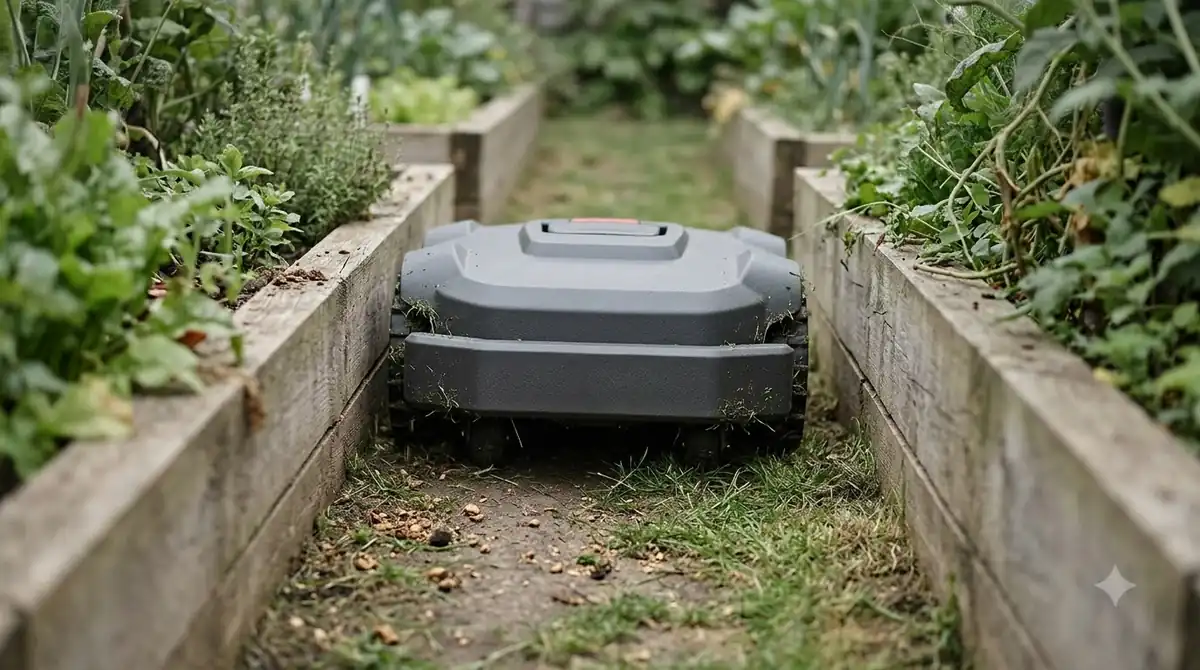
Our reading is that 60 cm is a floor, not a target. A gap of exactly 60 cm leaves no slack for grass growth, a loose wire or a slightly bent peg, so a wider gap is safer when the layout allows it.
What is the minimum passage width for a robot mower without a guide wire?
Without a guide wire, the minimum rises sharply, so the answer to the passage width question changes with the wire layout as well as the brand. Husqvarna gives 2 m (6 ft 6 in) between boundary wires, and Gardena gives at least 1.5 m for long narrow passages. The difference matters when you plan a side yard: a strip that works with a guide wire may not work without one.
The gap between the two figures is the main planning issue. A passage of 60 cm to 1.5 m is workable only if a guide wire can be installed through it. If the layout cannot take a guide wire, the wider 2 m figure from Husqvarna is the one to plan around, because it is the more conservative of the two. Our reading is that a passage between 1 m and 2 m with no guide wire is the case where a mower is most likely to need a manual check after installation.
| Source | With a guide wire | Without a guide wire |
|---|---|---|
| Husqvarna Automower | 60 cm (24 in); 2 m for 435X AWD and 535 AWD | 2 m (6 ft 6 in) |
| Gardena (CorridorCut) | 60 cm (boundary wire to boundary wire) | At least 1.5 m |
| Ecovacs GOAT | Not stated in the source used | Not stated; its help page gives 0.7 m as the narrow passage clearance |
Add room for obstacles
The 60 cm minimum is for open passages. Gardena states that the distance to an obstacle must be added to the minimum. Its example uses 35 cm from the house wall to the boundary wire, 60 cm for the passage, and 35 cm from the other side, which totals 130 cm (about 4 ft 3 in).
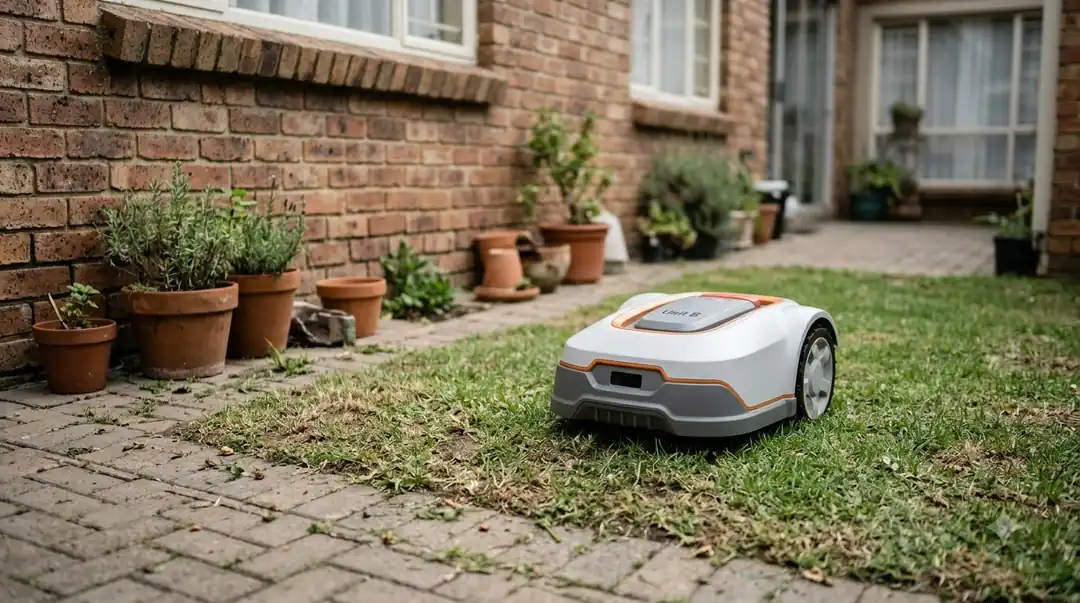
In practice, a passage that looks like 60 cm of open lawn can need about 130 cm of total space when walls, fences or garden beds sit close to the wire. Measure from wall to wall, not from the grass edge, and confirm the wire layout against the brand’s rules before you dig. Our guide to laying boundary wire around trees and obstacles covers the rest of the layout.
Obstacle distances are not the same for every obstacle. Gardena says its operation manual gives exact, model-specific distances that depend on the type of obstacle, so use the manual for your model rather than a rule of thumb. The key point is that the width you measure should be the gap left after you subtract the space each obstacle takes, and the minimum passage width for a robot mower is only the starting figure.
Other brands’ figures
Ecovacs lists 0.7 m (70 cm) of clearance for a narrow passage on its GOAT model. Robomow advises that a passage be wider than 70 cm, otherwise the signals from two boundary wires running close together can interfere with each other. These numbers sit in the same range as Husqvarna and Gardena, but they are model specific, so do not apply them to a different mower.
Ecovacs also describes what happens in a narrow passage. Its GOAT help page says that when the passage is narrower than 0.7 m, the mower treats it as passable and goes straight through, which means it cannot zigzag and can leave missed areas. The same page warns that in passages under 1 m wide with high walls blocking the path, weak positioning signals may cause the GOAT to get stuck. For a narrow side yard, a wide enough gap and a clear view of the charging station both matter.
When the mower gets stuck
Husqvarna’s passage guide notes that if the mower gets stuck in a passage, the corridor width can be adjusted on some models. The support article points to a separate guide for that setting. If your mower repeatedly stops at the same narrow point, check the corridor setting in the manual before you move any wire.
Stuck events usually have one of three causes, from our reading of the sources: the passage is narrower than the brand minimum, an obstacle takes up more of the gap than expected, or the signal is weak because high walls block the view of the base station. Ecovacs’s warning about passages under 1 m with high walls covers the last case. Our reading is that a width check, a look at the corridor setting and the charging station position (see where to put a robot mower charging station) should come before any wire change, because moving the wire can shift the whole work area.
Steps before you lay wire
Use these steps to answer what is the minimum passage width for a robot mower in your own yard before buying parts. Each step uses a figure from the sources above, so you can check it against the manual for your model.
- Measure the narrowest point. Measure from wall to wall or fence to fence, not from the lawn edge.
- Subtract obstacles. Add the clearance each wall or bed needs, using the brand’s obstacle rule.
- Check for a guide wire. If the gap is 60 cm or more, a guide wire usually makes the passage workable.
- Compare with the manual. Confirm the minimum for your exact model before you lay the boundary wire, following a full guide such as how to install a robot mower boundary wire.
Before you buy: what to check in the manual
Before you rely on any answer to what is the minimum passage width for a robot mower, read the installation section of the manual for your exact model. Look for three things: the minimum distance between boundary wires with and without a guide wire, the clearance rule for obstacles, and any note about the corridor or narrow passage setting. Those three items decide whether a gap works. A brand’s marketing page may give a rounded figure, and the manual is the document that holds the model-specific rules.
Keep a copy of the layout drawing once the wire is in. If the mower later needs a passage change, the drawing shows exactly where the wire runs, which saves time and avoids cutting into a working loop. Our reading is that a written note of the passage width and the obstacle clearances is the simplest way to answer the question again in a year, when the layout may need a repair or an extension.
Frequently asked questions
Can a robot mower go through a 60 cm gap?
Yes, if a guide wire is installed, according to Husqvarna and Gardena. Without a guide wire, both brands ask for a wider gap.
Does a guide wire make a passage narrower?
No. The guide wire is a line the mower follows inside the passage. It is what lets the 60 cm minimum apply, and it should sit at least 30 cm from the boundary wire.
How much room should I leave next to a wall?
Gardena’s example allows 35 cm between the house wall and the boundary wire. Add that clearance on each side to the 60 cm minimum, which gives 130 cm in total.
What is the minimum passage width for a robot mower if I cannot install a guide wire?
Husqvarna gives 2 m (6 ft 6 in) between boundary wires and Gardena at least 1.5 m. Plan around the wider figure for the brand you are considering, and confirm it in the manual.
What if my passage is under 60 cm?
The brands reviewed here do not recommend that layout for a standard passage. Consider a different route, a manual mowing strip, or a model whose manual lists a smaller minimum.
Sources
- Husqvarna Automower support: passage in boundary wire installation (manufacturer): 60 cm with a guide wire, 2 m without, guide wire at least 30 cm from the boundary wire.
- Gardena robotic mower FAQ (manufacturer): CorridorCut 60 cm, at least 1.5 m without a guide wire, obstacle rule with the 130 cm example.
- Ecovacs help center (manufacturer): 0.7 m narrow passage clearance for GOAT models.
- Robomow boundary wire guide (manufacturer): passage wider than 70 cm to avoid wire interference.
 Up next8 min readBy YardRobot Mower for Narrow Side Yard Passages: What Widths Work?Updated Nov 11, 2026
 8 min readBy YardHow Narrow Can a Robot Mower Passage Be? Simple 2026 RulesUpdated Nov 11, 2026
 9 min readBy YardWill a Robot Mower Get Stuck on a Soggy Lawn?Updated Nov 11, 2026
 9 min readBy YardWill a Robot Mower Get Stuck on a Lawn with Mulch Beds?Updated Nov 11, 2026
 8 min readBy YardWill a Robot Mower Get Stuck on a Lawn With Gravel Edges?Updated Nov 11, 2026
 9 min readBy YardRobot Mower for a Sloped Front Yard: Limits, Edges and SetupUpdated Nov 11, 2026