
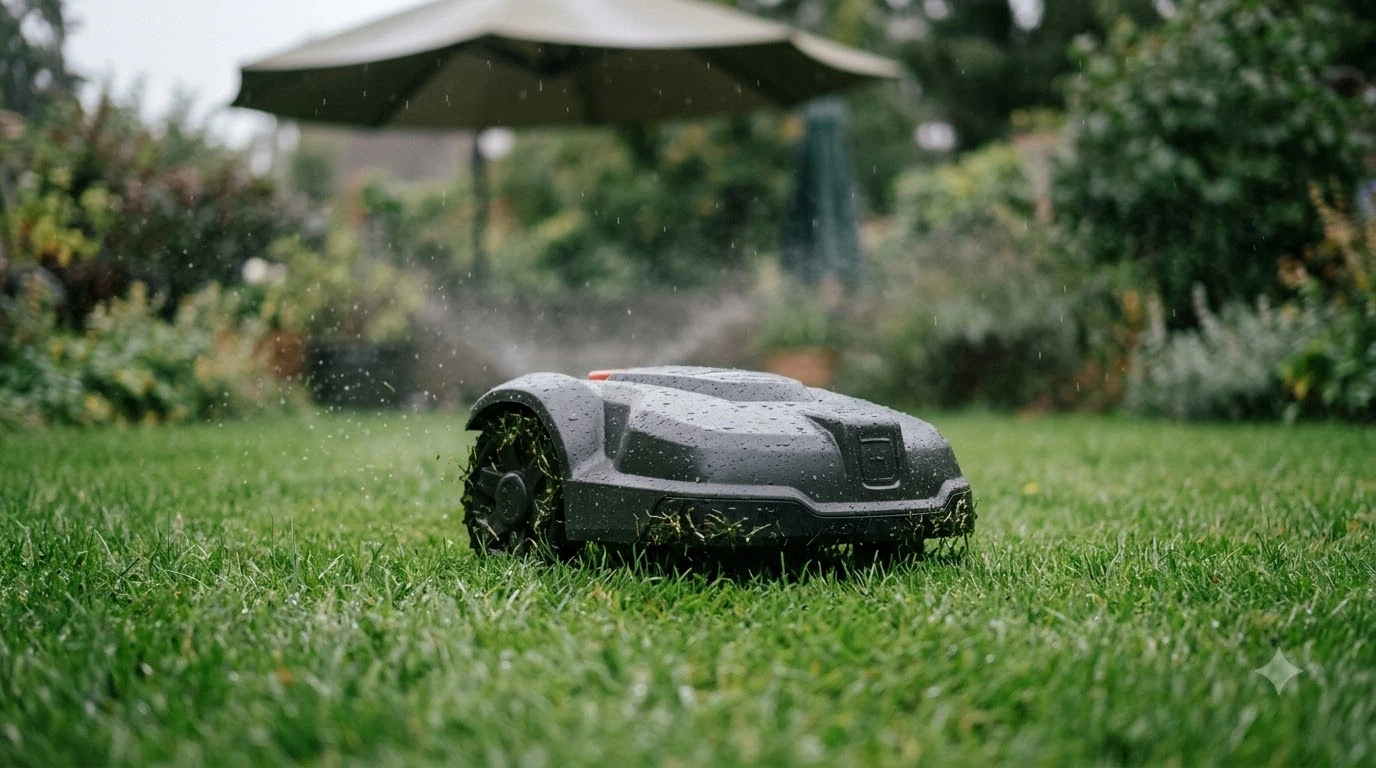

Will a robot mower get stuck on a soggy lawn? Yes, it can. The usual problem is not the rain itself but the ground under the wheels: saturated soil gives less grip, so the wheels can spin, sink, or leave ruts, and the mower may stop and report an error. Most of these stops can be prevented by waiting for the lawn to dry, setting the mower up for wet days, and filling the low spots where water collects.
The short answer
- Risk: wet ground reduces traction, so a robot mower can slip, stall, or stop with a drive error.
- Wait: Husqvarna advises waiting at least 24 hours after rain, and longer after heavy rain or on overcast days.
- Check: if the lawn feels damp or clumpy, or your footprints stay visible, it is still too wet to mow.
- Fix: fill holes and low spots, repair ruts, and mark soft or dipped areas as no-go zones in the app.
Will a robot mower get stuck on a soggy lawn?
A soggy lawn raises the chance of a stuck mower, but it does not guarantee one. Robot mowers are built to handle light moisture, and many are certified to run in the rain. The problem appears when the soil is saturated, meaning water fills the spaces between soil particles and the top layer is soft. In that state the drive wheels have less to push against.
Husqvarna’s support page for its “No drive” error lists the same pattern. It says the mower can show this error when the wheels are spinning but the product does not move, and it names a slippery slope “due to wet grass” as one of the conditions behind it. Our reading is that a soggy lawn is most likely to cause trouble on slopes, near low spots, and along paths the mower crosses every day. Slopes deserve extra care, and our guide to robot mowers sliding on wet slopes explains the grip problem in more detail.
Why saturated ground causes stuck mowers
Water changes how soil carries weight. According to Colorado State University Extension, soils are more prone to compaction when wet, because soil water acts as a lubricant that lets the particles slide together and close the large pore spaces that normally drain water. The same guide says traffic over the soil is the main driver of compaction, and that a moist soil can reach 75 percent of its maximum compaction the first time it is stepped on.
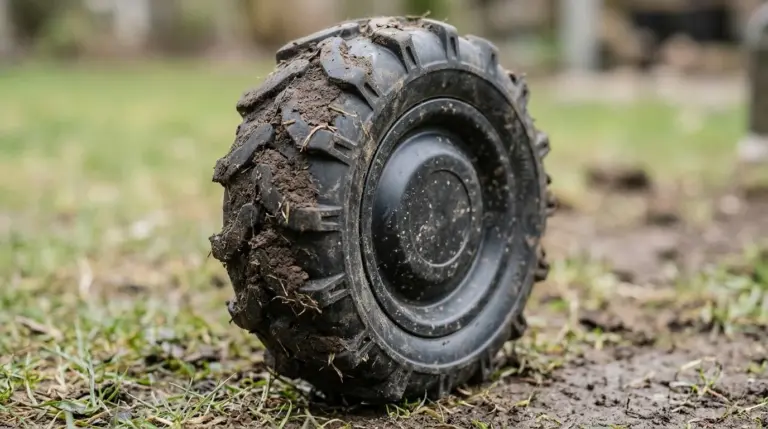
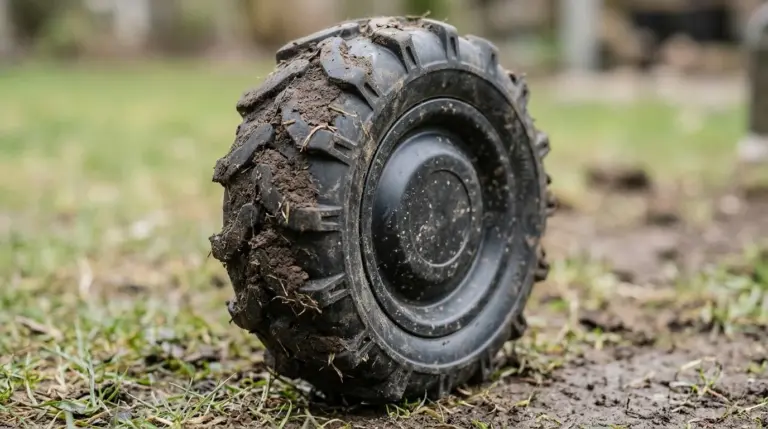
For a robot mower, this shows up in three ways. The first is wheel spin, where the tread digs into a soft surface and goes nowhere. The second is sinking, where one wheel drops into a soft spot and loses grip. The third is ruts, which form in soft ground and then hold water, so the next run is even worse. Husqvarna also warns that mowing after heavy rain can create wheel ruts in soft, wet soil.
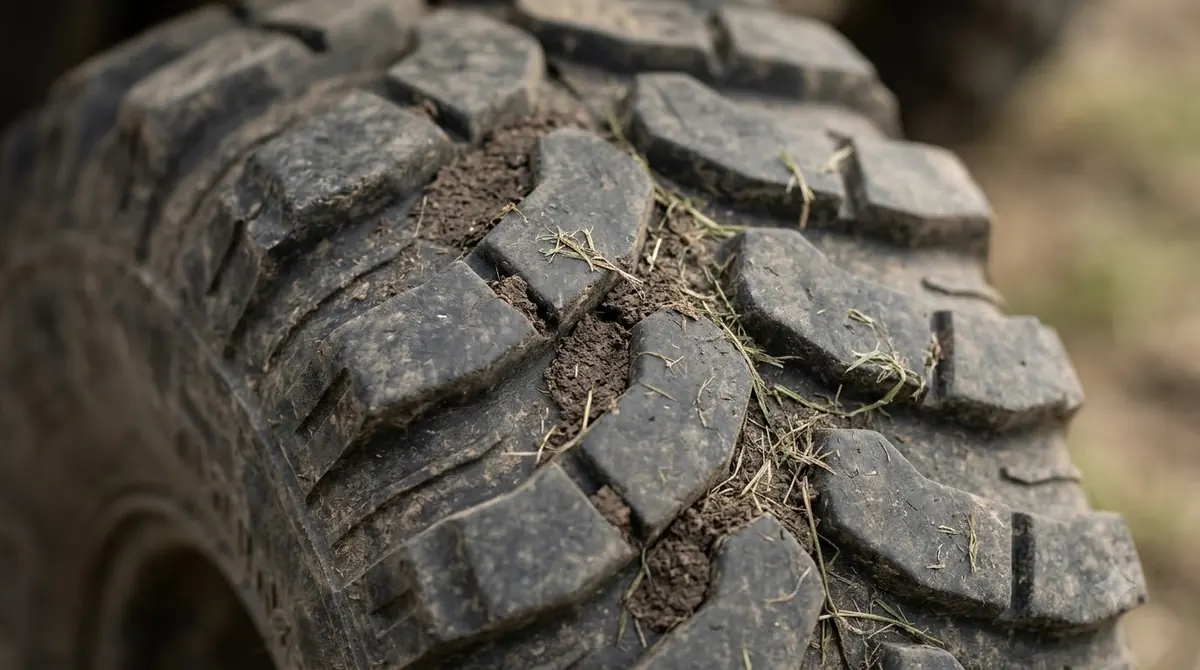
Soggy or just damp? Run three quick checks
Lawns that look wet are not always too wet to mow. Will a robot mower get stuck on a soggy lawn after one night of rain? Often not, and these three checks show why. Each one comes from a published extension or manufacturer guide. For the case where the soil is clay and stays wet for days, see our page on clay soil that stays wet.
| Check | How to do it | What it means |
|---|---|---|
| Bounce test (Husqvarna) | Walk across the grass and watch it spring back | Damp or clumpy grass is still too wet; grass that springs back is likely ready |
| Footprint test (Husqvarna) | Step on the lawn and look at the mark | Visible footprints mean the soil needs more time to dry |
| Squeeze test (CSU Extension) | Take a handful of soil and squeeze it into a ball | If it only reshapes under pressure, the soil is too wet to work |
The squeeze test is aimed at cultivation, not mowing, so treat it as a rough signal. A soil that holds a ball is wet enough that a heavy machine will likely leave marks. Our reading is that if two of the three checks say “wet,” skip the run.
How long to wait after rain
Husqvarna’s general advice is to wait at least 24 hours after rain before mowing, with a longer wait after heavy rain or on overcast days. In strong sun, a lawn may dry within a few hours. Those are rules of thumb, not fixed timers, and the answer depends on how much water the soil is holding.
Because drainage varies so much from yard to yard, the most reliable method is to check the ground itself before each run rather than relying on the calendar. A low corner that stays squishy for two days after a storm should be treated differently from a sunny slope that drains within hours.
Settings that reduce stuck events
Several settings can lower the chance of a stuck mower on a wet lawn. Ecovacs advises mowing when the lawn is dry, since wet lawns are likely to trap the robot. So will a robot mower get stuck on a soggy lawn if the settings are right? It is much less likely, because the mower stays home until the soil has had time to drain. It also suggests turning on the rain sensor with a delay, so the mower waits after a shower instead of running straight into soft ground. Our explainer on how robot mowers handle wet grass covers the cutting side of the same problem.
Cutting height matters too. Ecovacs recommends trimming the lawn below 10 cm with a regular mower before the robot’s first run, so the robot does not need to work through overgrown grass that adds drag. Husqvarna’s wet-grass guidance makes a related point: set the cutting height higher than usual on wet grass to avoid cutting too much at once.
Heads up
A rain sensor helps only if it is turned on and the delay is set long enough for the soil to dry. A mower that is pushed to run during a wet spell can still get stuck, even with a sensor installed.
Fixing low spots, holes, and ruts
Most repeat stuck spots come from the ground, not the mower. Ecovacs suggests checking the places where the robot gets stuck for small holes and filling any it finds. The Eufy troubleshooting guide on robot mower stuck causes names ruts and soft ground, notes that a wheel may sink near garden edges and frequently used paths, and says a small ground correction may be enough to stop one wheel from dropping below the chassis.
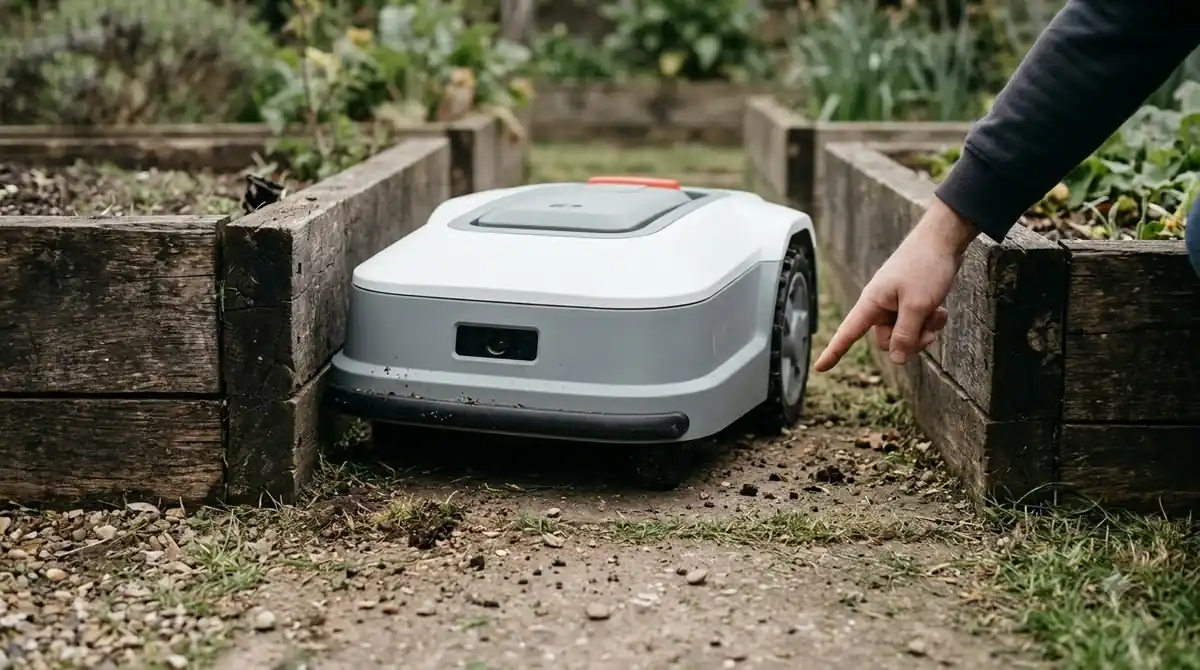
When a rut forms, Eufy’s guide advises letting the area dry, then repairing the surface before the next run. Our notes on wheel ruts and brown patches cover the lawn repair side. Filling shallow holes and firming loose soil are the usual steps. Where a dip cannot be fixed quickly, mark it as a no-go zone in the app so the mower routes around it. The same guide recommends no-go zones around low sprinkler heads, steep drops, and sections without stable turf. If sprinklers are the cause, read about how a robot mower handles sprinkler heads.
| Problem spot | Fix | When to recheck |
|---|---|---|
| Small hole or low corner | Fill and firm the soil | After the first few runs |
| Rut from wheels | Let it dry, then repair the surface | Before the next scheduled run |
| Chronic soft patch | Mark as a no-go zone in the app | Each season, or after heavy rain |
| Slope that holds water | Limit mowing on wet days; check slope limits | After every heavy rain |
Wire-free mowers that use virtual mapping can set no-go zones without touching the lawn edge, which makes it easier to keep the mower away from a soft patch. If your model uses a boundary wire, check the manual for how to reposition the wire near a problem area.
Frequently asked questions
Will a robot mower get stuck on a soggy lawn after one night of rain?
Not necessarily. One wet night does not guarantee a stuck mower, but Husqvarna advises waiting at least 24 hours after rain before mowing, and longer after heavy rain. If your footsteps leave visible marks in the soil, the lawn needs more time.
Can a robot mower damage a soggy lawn?
It can, mainly through ruts and compaction. Husqvarna notes that wet soil is softer and more vulnerable to compaction from the weight of a mower, and that mowing after heavy rain can create wheel ruts. Robot mowers are usually lightweight, so the risk is generally lower than with heavier walk-behind or riding machines.
Should I turn off the rain sensor so the mower keeps running?
Usually not. Ecovacs recommends enabling the rain sensor with a delay, because wet lawns are likely to trap the robot. Keeping the sensor on, with a delay long enough for the soil to dry, is the safer default for a lawn that stays soggy.
How long should I wait after rain before the mower runs?
Husqvarna advises at least 24 hours after rain, and longer after heavy rain or on overcast days. Strong sun can dry a lawn within a few hours. The bounce test and the footprint test are better guides than a fixed timer.
What should I do if the wheels spin in a soft spot?
Stop the mower and wait for the blades and wheels to stop before reaching near it. Let the area dry, then fill the low spot and firm the soil. Husqvarna’s No-drive guidance also recommends letting the cutting area dry before resuming, and checking whether a hole or obstacle is blocking the drive path.
Sources
- Can you mow wet grass? (Husqvarna): 24-hour wait, bounce and footprint tests, wheel ruts, cutting height on wet grass.
- No drive: Automower error message (Husqvarna): wheel spin, slippery wet slope, holes and obstacles, letting the area dry.
- Soil compaction (Colorado State University Extension): wet soil and compaction, traffic as the main cause, squeeze test.
- Why does the robot often get stuck when mowing? (Ecovacs support): dry-lawn advice, rain sensor delay, filling small holes, cutting below 10 cm.
- Robot lawn mower stuck: causes and fixes (Eufy): ruts and soft ground, dips and wheel grip, no-go zones, letting ruts dry before repair.
 Up next9 min readBy YardWill a Robot Mower Get Stuck on a Lawn with Mulch Beds?Updated Nov 11, 2026
 8 min readBy YardWill a Robot Mower Get Stuck on a Lawn With Gravel Edges?Updated Nov 11, 2026
 8 min readBy YardWill a Robot Mower Get Stuck on a Newly Seeded Lawn?Updated Nov 11, 2026
 7 min readBy YardWill a Robot Mower Get Stuck on a Lawn with Mole Hills?Updated Nov 11, 2026
 8 min readBy YardWill a Robot Mower Get Stuck on a Newly Sodded Lawn?Updated Nov 11, 2026
 9 min readBy YardWill a Robot Mower Get Stuck on a Lawn With Holes and Dips?Updated Nov 11, 2026