
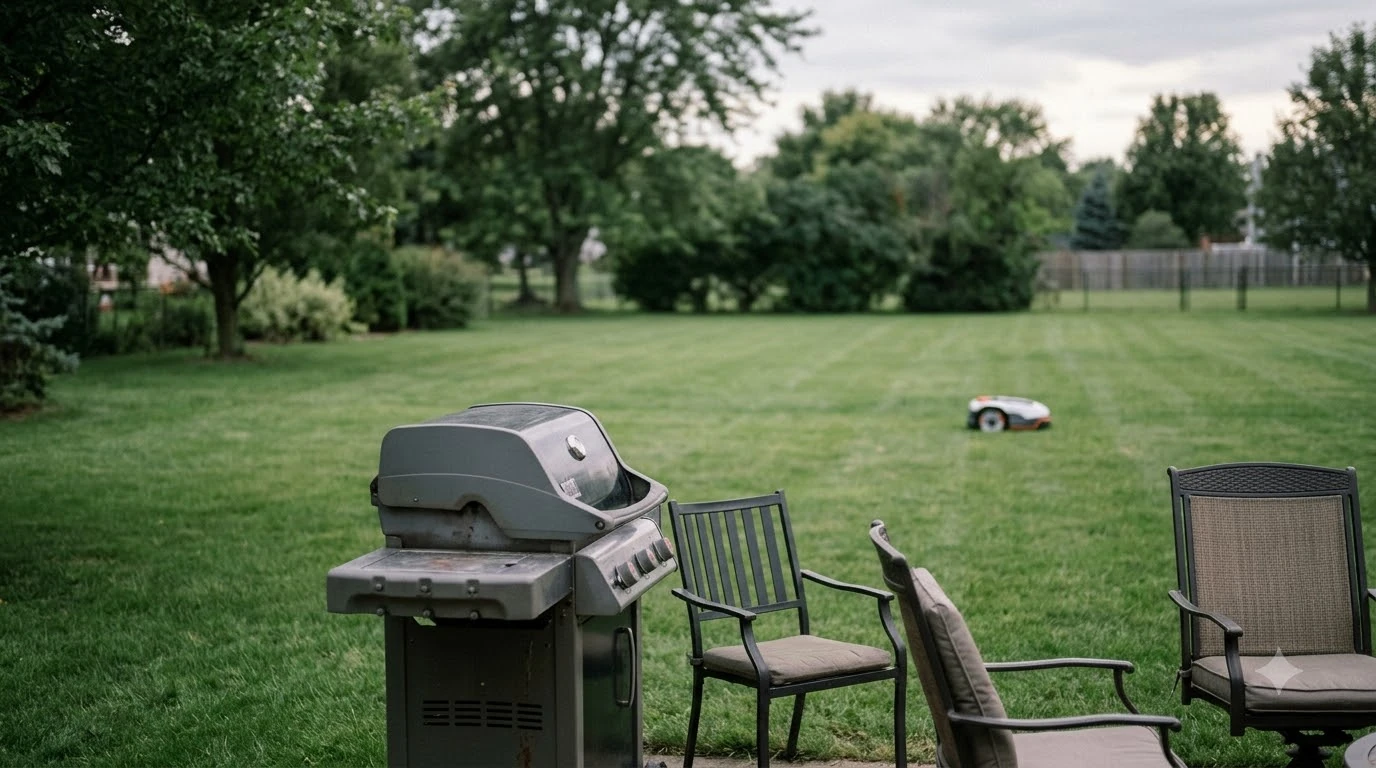

Will a robot mower get stuck on a newly seeded lawn? Not once the grass is established, and height matters more than the calendar. Iowa State University Extension says to mow new seed when it is about 3 inches tall, with a first cut at 2 to 2.5 inches. Our reading: the bigger problem is soft, wet or bare soil, where wheels can cut ruts and pull up young seedlings, more than the mower itself. Hold off until the ground is dry and the grass holds firm.
The short answer
- Wait for height, not a date. Iowa State advises mowing new seed at about 3 inches, and Ohio State times the first cut to grass that is 3 to 4 inches tall.
- Expect a few weeks. Ohio State reports 4 to 6 weeks under favorable conditions, and UC IPM notes germination can take up to 2 months.
- Check the ground. Wait for dry soil and avoid any spot where wheels leave ruts or footprints.
- Start with the deck high. Set the highest cutting height for the first sessions, then lower it over several mows.
Why a newly seeded lawn is a poor match for an early robot start
A seeded lawn is a thin stand of young plants with shallow roots and gaps between them, which is why the grass seed suited to a robot-mowed lawn still needs time to root before any machine runs on it. Until the seedlings are firm in the soil, any traffic can disturb them. UC IPM advises waiting until all seeds have germinated before the first mow, and says a seeded lawn may take up to 2 months to be ready, according to the UC IPM page on mowing new turf.
The same source says the lawn should be fairly dry before mowing so the new grass is not pulled out. That rule applies to any mower, and a robot is no exception. Our reading: a robot that runs on a schedule may pass over a seeded area on a damp morning, which a person with a push mower would usually skip.
How long to wait before the first robot session
The sources do not agree on a single number, and most give a height rule rather than a calendar date. The table lists what each one states, so you can see where the timing ranges come from.
| Source | Trigger | Timing stated |
|---|---|---|
| Ohio State Turfgrass Science | Grass 3 to 4 inches tall; mow at 4 inches to cut to 3 | 4 to 6 weeks under favorable conditions |
| Iowa State University Extension | About 3 inches tall; first cut 2 to 2.5 inches | No timing given; height only |
| UC IPM | Wait for germination; let grass reach about 1.5 times the recommended height | Up to 2 months |
| Lawn Love (secondary, citing University of Maryland Extension) | Begin when new turf is one-third higher than normal mowing height | 4 to 8 weeks, depending on conditions |
So, will a robot mower get stuck on a newly seeded lawn after 4 weeks? Our reading: treat the height as the trigger and the week count as a rough check. A lawn seeded in cool, moist weather may reach 3 inches sooner than one seeded in a dry summer. Lawn Love gives the same rule of thumb: wait 4 to 8 weeks, or until the grass reaches 3 to 4 inches.
Will a robot mower get stuck on a newly seeded lawn when the ground is wet?
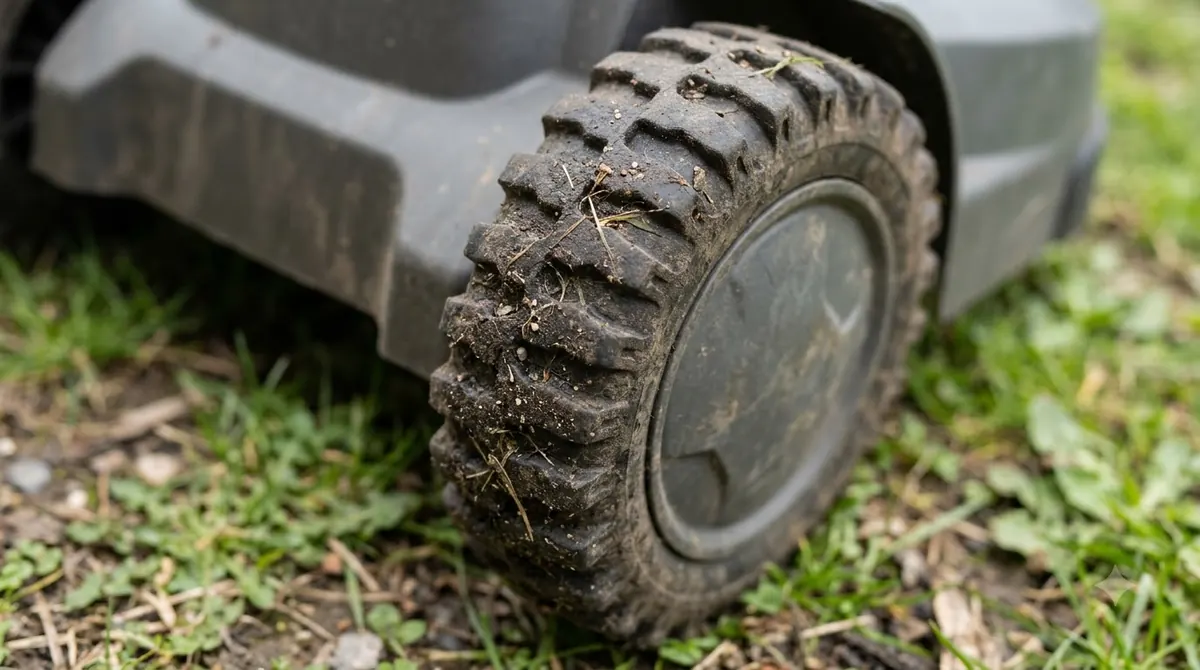
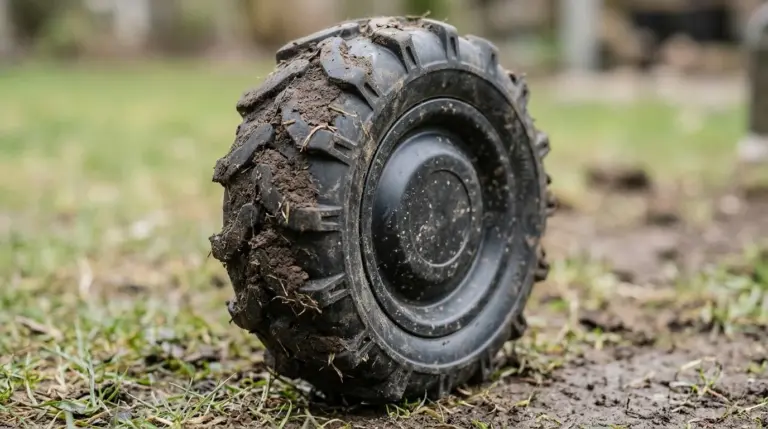
Ohio State lists wet ground as a cause of ruts when a mower runs over new turf, and our guide to how a robot mower handles wet grass covers the same rule for established lawns. Husqvarna’s guidance on mowing wet grass says to wait at least 24 hours after rain and to use a footprint test: if you see footprints or the soil gives under your weight, wait longer. The same page notes that many robot mowers are light enough not to compact soil, but wet soil can still rut under any wheel. You can read the full advice in the Husqvarna guide on mowing wet grass.
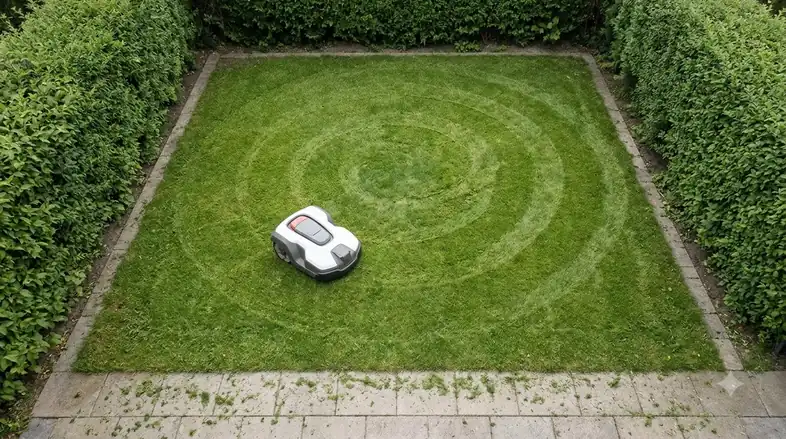
Will a robot mower get stuck on a newly seeded lawn at all? We did not find a published stuck rate for robot mowers on seeded lawns, so the risk is best framed as a ground-condition issue. Our reading: a robot that repeats the same paths can wear narrow bare lines into thin turf, even when it never fully stops, which is the pattern described in our guide to wheel ruts and brown patches. Watch for that pattern in the first few weeks and widen the boundary or pause the schedule if it appears.
Set the cutting height for the first robot sessions
Iowa State’s advice for a seeded lawn is to mow at 2 to 2.5 inches for the first cut, with a sharp blade. If the grass grows to 4 inches or more before that cut, it says to raise the blade as high as possible and mow promptly. Later mowings should lower the height gradually, which helps the grass spread and thicken, according to the Iowa State Extension FAQ on mowing newly seeded lawns.
Ohio State adds a limit per cut: remove no more than one-third of the grass height at one mow. Our reading: for a robot, set the highest available height for the first few sessions and step it down over several weeks. Robot settings differ by model, so check the cutting-height range in your manual before the first run. If the lawn is only patchy, our note on overseeding with a robot mower explains how to fill gaps without waiting for a full reseed.
What one manufacturer says about seeded lawns
Sunseeker, a robotic mower maker, says any robotic mower should only be introduced after newly seeded grass is fully established, and its blog gives no fixed number of weeks. The stated reason is to protect young turf. Because this is a manufacturer blog and not an independent extension page, treat it as the company’s position rather than a measured threshold. The safest source for a specific model is its owner’s manual or support page.
Checks to make before the first robot session
Run these checks in order. They answer the main question: will a robot mower get stuck on a newly seeded lawn like yours? If any one fails, wait and check again in a few days, and use our guide to preparing your yard for a robot mower for the rest of the setup.
- Height. Confirm the new grass is about 3 inches tall. Iowa State uses this as its trigger for a seeded lawn.
- Tug test. Gently tug a few blades. Lawn Love says that if the grass stays firmly in the ground, the roots are established enough; if it pulls up easily, wait longer.
- Dryness. Wait at least 24 hours after rain or watering, and until the morning dew has burned off. Husqvarna’s general guidance gives the 24-hour figure.
- Footprints and ruts. Walk the lawn. Visible footprints or soft spots mean the ground is not ready.
- Blade and height. Use a sharp blade and the highest setting, as Iowa State advises for a seeded lawn.
Frequently asked questions
Will a robot mower get stuck on a newly seeded lawn?
It can, mainly when the ground is soft or the grass is too thin to hold the mower’s wheels. We did not find a published stuck rate for seeded lawns. The practical rule is to wait until the grass is about 3 inches tall, feels firmly rooted, and the soil is dry.
How long after seeding can a robot mower start?
There is no single answer. Ohio State gives 4 to 6 weeks under favorable conditions, UC IPM says up to 2 months, and Lawn Love gives 4 to 8 weeks. Height and a tug test are more reliable than the calendar.
Can a robot mower pull up seedlings?
UC IPM warns that a new lawn can be pulled out if mowed while wet. Our reading is that the risk is highest before the seedlings are rooted, so the tug test and a dry lawn are the two checks that matter most.
What should I do if the grass grows past 4 inches before the first robot session?
Iowa State says to raise the blade as high as possible and mow promptly. Then lower the height gradually over later mowings, so the grass can spread and thicken.
Sources
- When should I start mowing a newly seeded lawn? (Iowa State University Extension): 3-inch trigger, 2 to 2.5 inch first cut, the 4-inch rule.
- Turfgrass Establishment Series: Mowing (Ohio State University Turfgrass Science): 3 to 4 inch height, 4 to 6 week timing, one-third rule, wet-ground ruts.
- Mowing new turf (UC IPM, University of California): wait for germination, up to 2 months, dry lawn before mowing.
- Can you mow wet grass? (Husqvarna): 24-hour wait after rain, footprint test, ruts.
- When to mow after aeration and seeding (Sunseeker, manufacturer blog): robot mowers should wait until seeded grass is fully established.
- When to cut new grass (Lawn Love, secondary source): 4 to 8 weeks, one-third-higher rule, tug test.
 Up next8 min readBy YardWill a Robot Mower Get Stuck on a Newly Sodded Lawn?Updated Nov 11, 2026
 8 min readBy YardWill a Robot Mower Get Stuck on a Lawn With Gravel Edges?Updated Nov 11, 2026
 9 min readBy YardWill a Robot Mower Get Stuck on a Lawn with Mulch Beds?Updated Nov 11, 2026
 9 min readBy YardWill a Robot Mower Get Stuck on a Soggy Lawn?Updated Nov 11, 2026
 7 min readBy YardWill a Robot Mower Get Stuck on a Lawn with Mole Hills?Updated Nov 11, 2026
 9 min readBy YardWill a Robot Mower Get Stuck on a Lawn With Holes and Dips?Updated Nov 11, 2026