
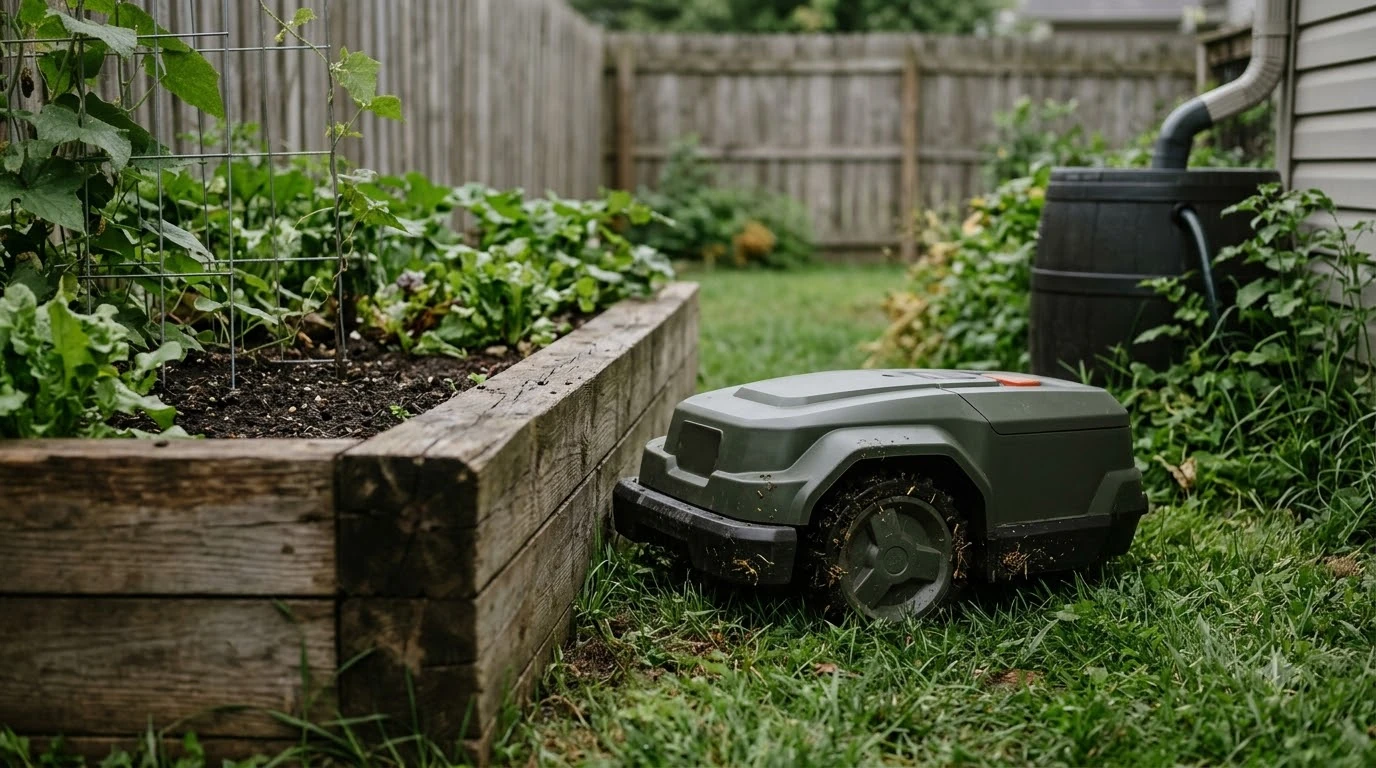

Will a robot mower get stuck on a lawn with mulch beds? Usually not, if the boundary is set up correctly. The mulch itself is rarely the whole story. In most cases the trouble comes from where the boundary wire sits, or from mulch that has spilled onto the grass. As of November 2026, the manufacturer and extension guidance we read gives clear clearance rules you can follow before the mower ever runs.
The short answer
- Mulch beds are not a trap by themselves. A correctly placed boundary keeps the mower out of the bed and on the grass.
- Keep the wire 25 to 30 cm (10 to 12 in) from a soft edge. That covers flower beds, gravel and mulch, according to one installation guide we read.
- Loose mulch on the grass line is the usual failure. When it spreads after rain or edits, the mower can stop short or lose its path.
Will a robot mower get stuck on a lawn with mulch beds?
A robot mower does not decide by itself that mulch is a no-go surface. Most models rely on a buried boundary wire to define the cutting area, so the mower follows the loop and stops when it reaches it. A mulch bed that sits inside the loop is not a problem, because the mower is kept off it by the wire. The risk appears when the wire runs too close to the bed edge, or when the bed sits outside the loop and the mower has to pass over it to reach the grass.
Our reading is that loose mulch is a poorer surface for a wheel to grip than a mown lawn, so the edge is where trouble shows up first. The pages we read did not give a mulch-specific limit for any model, so this article does not state a depth or slope for mulch as a sourced fact. The practical rule from installation guides is simpler: treat a mulch bed as a soft edge and keep the wire clear of it.
Keep the mower’s own limits in mind too. Robot mowers are designed to handle gentle bumps, but the Husqvarna guidance we read also tells owners to check the lawn for visible roots, because roots can damage the cutting blades. A bed with exposed roots or stones along its edge should be cleaned before setup. A bed that is raised rather than mulched is a different case, covered in our guide to how a robot mower handles raised garden beds.
Wire distance from mulch beds
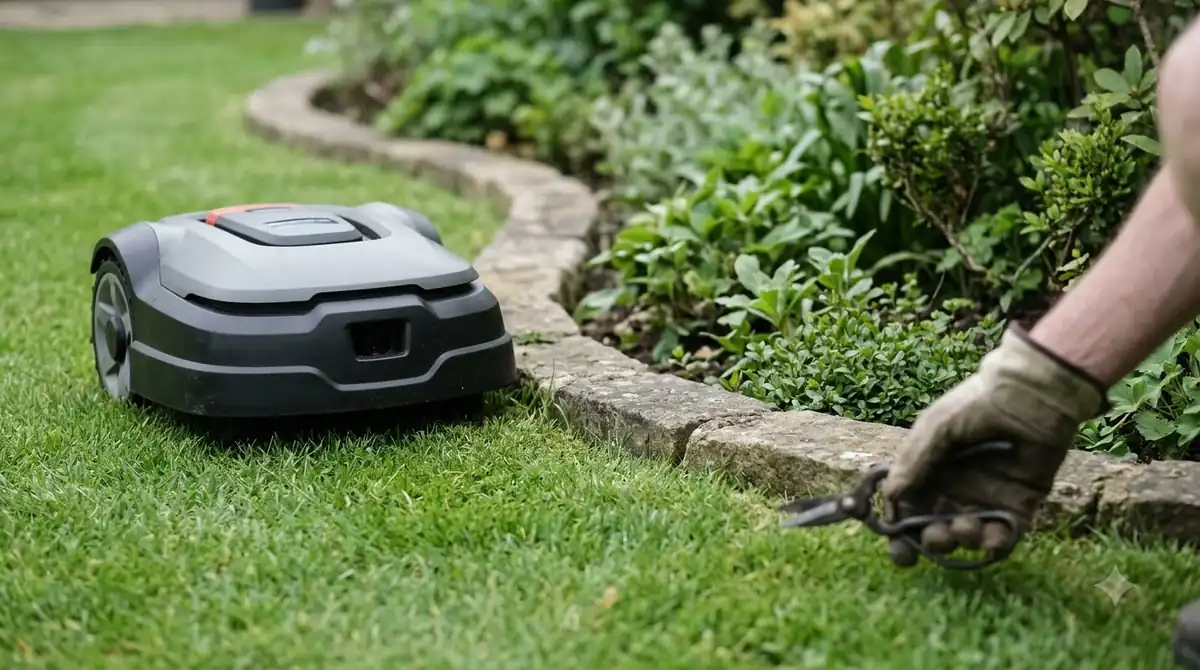
Distance is the single biggest factor. The lawnmowers.com boundary wire guide gives a specific rule for soft edges: keep the wire 25 to 30 cm (10 to 12 inches) from a flower bed, gravel or mulch. For hard edges such as walls, fences and tree trunks, the same guide advises at least 30 cm so the mower can turn without scraping. The guide also says the mower will stop short at soft edges, so you should finish those strips with a string trimmer every couple of weeks. Our guide to cordless string trimmers for robot mower edges covers that job. Read the boundary wire setup guide.
Robomow’s edging guidance points the same way for beds planted to the edge. It says the distance should be slightly greater than for beds that have a natural finish with mulch, and it gives no exact mulch figure. Its spacing advice also matters: do not plan a lawn edge where the perimeter wire runs well under a meter apart. See Robomow’s edging page.

Our reading: if you are unsure, leave a little more room than the minimum. A wire that sits too far in only means the mower cuts slightly less lawn at that edge, which is easy to trim by hand. A wire that sits too close is what sends the mower into the bed.
When mulch spills onto the lawn
Our reading is that many stop-and-stuck problems start after the first setup rather than during it. A new bed or a mulch ring added after the wire was laid is enough to put the wire out of step with the yard. Once mulch migrates onto the grass line, the mower sees a surface it was never told to avoid, and the wire no longer matches the yard.
Rain makes this worse. Wet mulch clumps and washes out onto the grass, and a bed that was clean in spring can shift its edge by autumn. A yard that ran cleanly in May can end up with a robot mower stuck on a lawn with mulch beds by October, simply because the edge moved. Check the border after heavy rain, rake spilled mulch back onto the bed, and look at the wire path before you assume the mower has a fault. If the wire has to change, see how to lay boundary wire around trees and obstacles.
Keep the lawn edge level as well. Robomow notes that plastic and rubber edging is usually not level, so the mower cannot simply drive over it, and metal edging is not recommended for robot mowers at all. A raised, uneven lip at the edge of a mulch bed can produce the same stop-and-start behavior as a loose border. Our page on landscape edging for robot mower borders covers edging that suits a robot mower.
Using islands for mulch beds
When a mulch bed sits in the middle of the lawn, an island is often easier than running the wire around the outside. Husqvarna’s installation guidance recommends creating islands with the boundary wire for areas the mower should avoid, and gives flower beds and rockeries as examples. Run the wire from the border to the bed, around it, and back, without letting the wires cross. Our guide to a robot mower in a lawn with island beds goes further into this layout.
The crossing rule matters most. If the wires cross, the mower will not recognise the island and will stop, according to the same page. On the return path, lay the two wire runs close together so their signals cancel and the mower can pass over them. The page gives no clearance numbers for islands, so use the soft-edge distance above as your starting point and test the loop after the wire is connected.
Islands also need maintenance. Mulch that spreads around the island over time can move the effective edge, so the same check after rain applies. If the island goes in after the lawn is already mowed on a schedule, plan the wire path before you spread fresh mulch. Checking the bed edge once a season is a cheap way to keep a lawn with mulch beds from becoming a stuck-mower problem.
What to check before you blame the mower
Work through the most common causes in order when you ask will a robot mower get stuck on a lawn with mulch beds in your own yard. Most mulch-bed problems are solved by the first two checks, and they cost nothing to test.
| Check | What to look for | Source point |
|---|---|---|
| Wire distance from bed | 25 to 30 cm from mulch or flower bed edge | lawnmowers.com guide |
| Wire near hard edges | At least 30 cm from walls, fences, trunks | lawnmowers.com guide |
| Mulch on the grass line | Loose mulch past the bed edge after rain or edits | Our reading (after bed changes) |
| Wire crossings in islands | Wires must not cross; return runs laid close together | Husqvarna island guide |
| Wire spacing on the lawn edge | Not well under a meter apart on the perimeter | Robomow edging page |
| Level edge | No raised lip, plastic or rubber edge that the mower cannot drive over | Robomow edging page |
If the mower still stops after these checks, look at the mower’s manual and the charging and wire connections. Run the loop test after connecting the wire, as the lawnmowers.com guide advises, and confirm the loop is closed before you dig anything up.
Frequently asked questions
Will a robot mower get stuck on a lawn with mulch beds after heavy rain?
It can stop short if mulch has washed onto the grass line. Our reading is that wet mulch clumps and spreads, so the bed edge moves after a storm. Rake the mulch back, check the wire path, and trim the strip the mower leaves, as the lawnmowers.com guide advises for soft edges.
Will a robot mower drive onto a mulch bed?
It should not, if the boundary wire is placed correctly. The wire defines the cutting area, and the guidance we read says to keep the wire 25 to 30 cm from soft edges such as mulch. A bed that is inside the loop is kept clear by the wire, not by the mulch itself.
How far should the boundary wire be from a mulch bed?
The lawnmowers.com setup guide gives 25 to 30 cm (10 to 12 inches) from a soft edge, which includes mulch and gravel. Robomow advises a slightly larger distance for beds planted to the edge than for beds with a mulch finish, but it gives no exact mulch figure.
Why does my robot mower stop at the edge of a mulch bed?
Mowers can stop short at soft edges, and the lawnmowers.com guide says you should finish those strips with a string trimmer every couple of weeks. A stop can also come from loose mulch on the grass line, a wire that no longer matches the yard after edits, or wires that cross in an island.
Should I use an island for a mulch bed in the middle of the lawn?
Husqvarna’s guidance recommends islands with the boundary wire for areas the mower should avoid, such as flower beds and rockeries. Keep the wires from crossing, lay the return runs close together, and test the loop after connecting. Our reading is that an island suits a bed in the middle of a lawn better than a long perimeter run around it.
Sources
- Robotic mower boundary wire setup guide (lawnmowers.com): wire distances from soft and hard edges, stop-short behavior, bury depth and loop test.
- Which lawn edging is suitable for robotic mowers (Robomow): mulch-bed distance note, blade offset, wire spacing, metal and plastic edging.
- How to create islands in a boundary wire Automower installation (Husqvarna): islands for flower beds and rockeries, wire crossing rule, return-loop layout.
 Up next8 min readBy YardWill a Robot Mower Get Stuck on a Lawn With Gravel Edges?Updated Nov 11, 2026
 9 min readBy YardWill a Robot Mower Get Stuck on a Soggy Lawn?Updated Nov 11, 2026
 8 min readBy YardWill a Robot Mower Get Stuck on a Newly Seeded Lawn?Updated Nov 11, 2026
 7 min readBy YardWill a Robot Mower Get Stuck on a Lawn with Mole Hills?Updated Nov 11, 2026
 8 min readBy YardWill a Robot Mower Get Stuck on a Newly Sodded Lawn?Updated Nov 11, 2026
 9 min readBy YardWill a Robot Mower Get Stuck on a Lawn With Holes and Dips?Updated Nov 11, 2026