
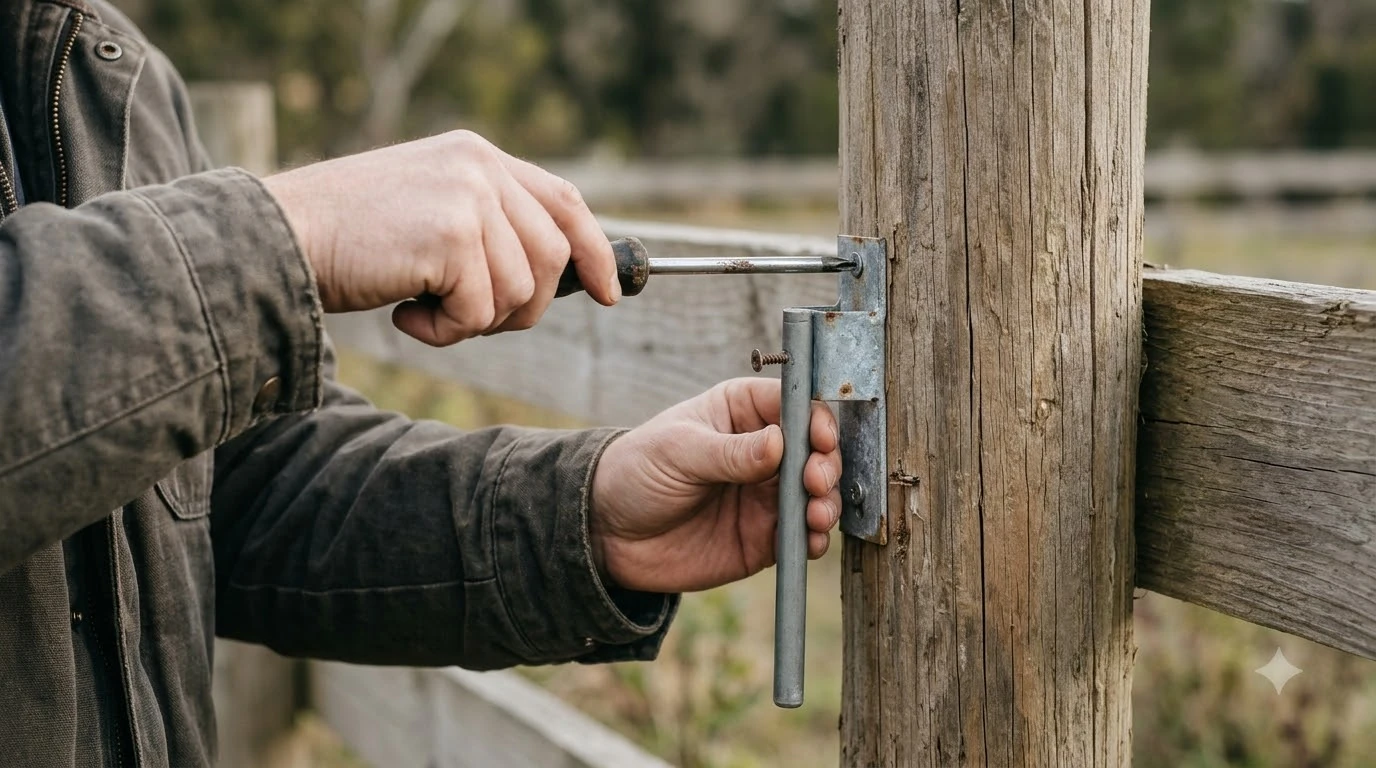

A robot mower for a yard with a split-rail wooden fence works reliably when you set the perimeter boundary to account for the open gap beneath the bottom rail and the spaced vertical posts. Unlike solid privacy fencing, a split-rail layout lets a low-profile mower slip right under the rails onto a neighbor’s lawn or roadside ditch unless you establish a firm virtual or wired border. With the right boundary clearance and obstacle settings, however, an automated mower handles these open-post perimeters cleanly while trimming most of the grass along the fence line.
The short answer
- Bottom-rail clearance is the main hazard: Builders commonly set the lowest rail at least 6 inches above ground, which gives a robotic mower enough room to roll right under the fence if no boundary stops it.
- Posts act like scattered bollards: Vertical posts spaced every 8 to 12 feet do not form a continuous physical wall, so bumpers, ultrasonic sensors, or cameras only detect the posts themselves rather than the fence line between them.
- Boundary wires need consistent setback: Manufacturers such as Husqvarna and Worx specify keeping boundary wire roughly 10 to 14 inches (26 to 35 cm) away from solid obstacles so the mower chassis does not strike posts.
- Wire-free RTK and vision models work well: Open split-rail fencing does not block satellite signals the way tall solid walls or dense tree canopies do, making RTK-GPS and camera-guided mowers strong matches.
- Expect light string-trimming around posts: Even offset-blade mowers leave a narrow collar of uncut grass around wooden posts and directly beneath low rails where the deck cannot safely reach.
Why split-rail wooden fences challenge robot mowers
Split-rail wooden fences create a deceptive perimeter because they look like a clear boundary to human eyes while remaining mostly open air at ground level.
According to fence installation guidance from Lowe’s split-rail fence installation guide, builders typically plan for at least 6 inches of clearance between the ground and the bottom rail, often adding an extra couple of inches to allow for soil settling. While that gap helps homeowners swing a string trimmer underneath, most residential robotic mowers stand low enough at the nose to wedge under a high bottom rail or drive straight through the opening.
Between those horizontal rails, wooden posts sit roughly 8 to 12 feet apart. A robot mower relying solely on bump sensors treats each post like a standalone tree trunk—bumping, backing up, and turning—while cruising straight past the open bays in between. If your split-rail fence borders a road, drainage ditch, neighbor’s property, or livestock pasture, relying on physical contact with the fence will not keep the mower inside your yard.
Boundary wire placement along posts and open bays
Wired robot mowers rely on a low-voltage perimeter loop to define where the machine turns around, and split-rail fencing requires treating the entire fence line like a continuous obstacle.
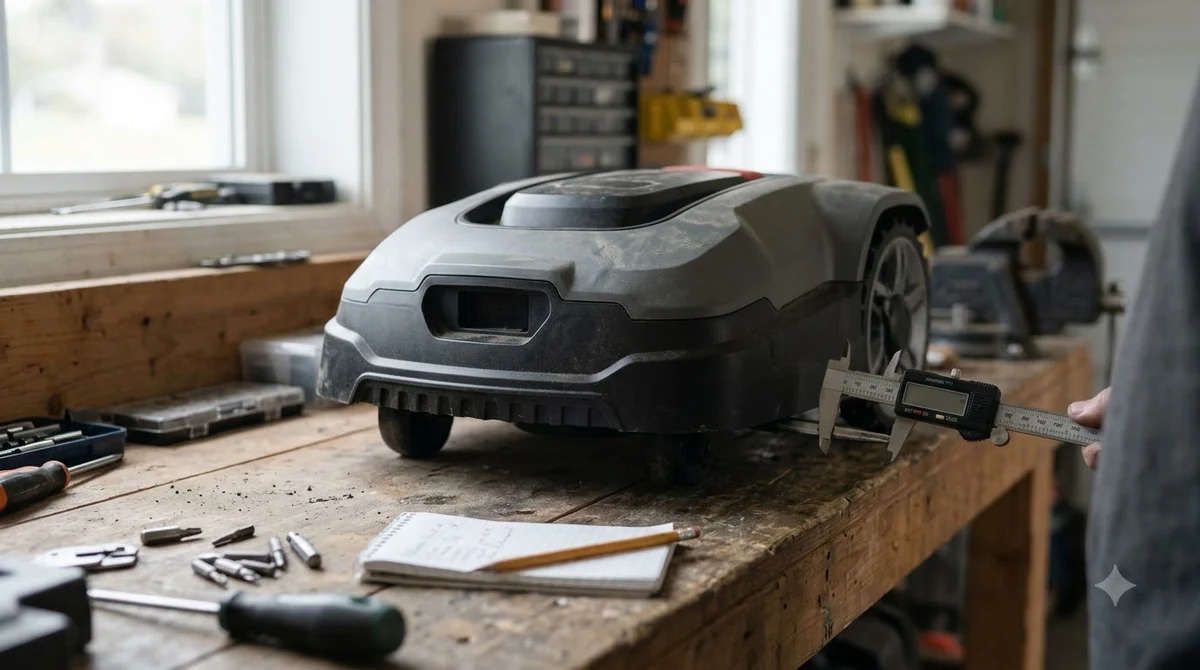
According to operator manuals from Husqvarna Automower support documentation and Worx Landroid installation manuals, boundary wires must be set back from solid objects to account for mower overrun—the short distance a machine travels past the wire before braking and reversing. Worx specifies keeping the wire 10.2 inches (26 cm) from steps or solid borders, while Husqvarna manuals specify 14 inches (35 cm) from solid obstacles so the outer shell does not scuff against wood or stone.
| Fence-line scenario | Recommended boundary approach | Why it matters |
|---|---|---|
| Standard split-rail bordering a neighbor or road | Run a straight boundary wire 10–14 inches inside the inner face of the posts | Prevents the mower from slipping under the bottom rail and keeps the body from scraping wooden posts |
| Split-rail with welded wire or chicken mesh added | Maintain the same 10–14 inch setback from the mesh plane | Mesh stops the mower physically, but proper wire distance prevents repeated bumper impacts and blade-edge snags |
| Flush garden bed or mulch strip directly under the rails | Place the boundary wire 4 inches from flush edging, or 10–14 inches from raised stone/wood | Keeps mower wheels out of loose mulch and gravel where traction drops and blades dull faster |
| Sloped yard edge along a stepped or racked split-rail fence | Follow manufacturer slope limits at the perimeter rather than placing wire on steep drop-offs | Wet grass on steep perimeter slopes can cause the mower to slide past the wire under the rail |
Rather than weaving the boundary wire in and out around every wooden post, lay the cable in a clean, straight line parallel to the inner edge of the posts. Weaving creates tight corners that confuse perimeter-following algorithms when the mower heads back to its charging dock, and straight runs are far easier to edge around later.
Heads up
Before burying your boundary wire, peg it above ground for two to three weeks of test runs. Watch how far your specific mower overruns the wire on damp grass so you can nudge the line an inch or two if the bumper taps the wooden posts.
How wire-free RTK, LiDAR, and vision mowers cope
Boundary-wire-free robotic mowers map virtual perimeters using RTK-GPS satellites, cameras, LiDAR, or a combination of those sensors, and split-rail fences actually play to their strengths.
Solid 6-foot privacy fences and brick walls can reflect or block satellite signals right at the lawn edge, causing RTK positioning drift. By contrast, a two- or three-rail wooden fence leaves mostly open sky above the mower, allowing RTK receivers to maintain steady satellite lock along the border. When you walk the mower around the yard via the smartphone app to record the virtual map, you simply steer it along a straight path roughly 8 to 12 inches inside the posts.
Camera- and LiDAR-equipped models add a second layer of protection along open fencing. Optical and depth sensors spot individual wooden posts ahead of time and slow down smoothly instead of slamming into them. However, thin horizontal rails suspended 6 to 12 inches off the ground can sit right at the upper edge of a low-mounted camera’s field of view, so you should never rely on obstacle-avoidance sensors alone to stop the mower from crossing beneath a rail—always define a strict virtual boundary line.
Step-by-step setup for a split-rail perimeter
Setting up a robot mower along a split-rail fence goes smoothly when you prepare the ground strip and test the border before locking in your schedule.
- Clear twigs, bark, and low-hanging brush. Split-rail cedar and locust fences regularly shed bark strips and splinters along the grass line; pick up loose wood debris so small spinning blades do not chip or jam.
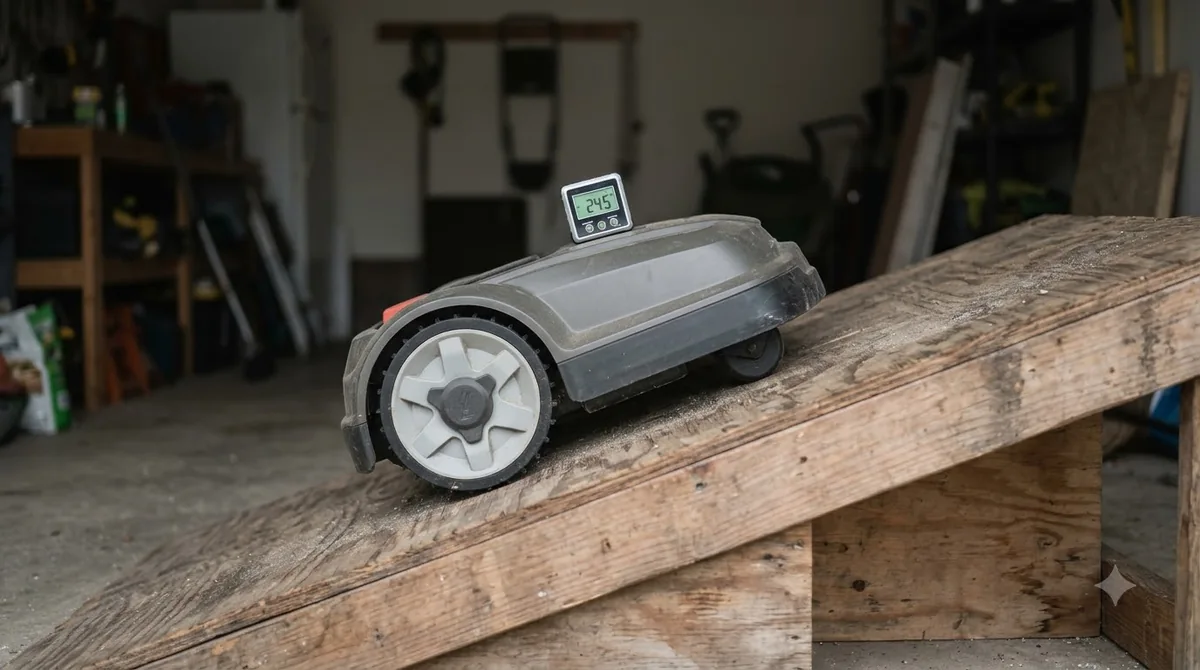
- Measure the lowest rail height around the entire yard. Check every bay, especially across dips or slopes where builders stepped the fence, to see whether the mower body could fit underneath if a sensor hiccups.
- Establish a straight perimeter line inside the posts. Peg your boundary wire 10 to 14 inches inside the post line (following your manual’s exact ruler gauge), or drive your wire-free mower at that same offset while recording the virtual border.
- Check wire mesh and gate gaps. If you added welded wire mesh to contain pets, make sure the bottom edge is pinned flat against the turf so loose wire ends cannot snag a wheel or cutting disc.
- Run a perimeter-cut test pass. Trigger a manual edge-mowing cycle and walk alongside the machine to confirm it tracks cleanly parallel to the rails without clipping a post or drifting under the bottom rail.
Managing trimming, gates, and multi-zone yards
Even the best-configured robot mower leaves a thin strip of grass untouched near wooden posts, and planning for that edge keeps your fence line looking sharp.
Because robotic mowers tuck their cutting discs safely beneath the chassis for foot protection, an unmowed band remains between the outer wheel track and the fence posts. Models with offset cutting decks narrow that strip, yet you will still want to run a battery string trimmer along the posts and under the bottom rail every couple of weeks. Laying a narrow mulch bed or mowing strip of flush pavers directly beneath the rails eliminates the need to trim under the wood altogether—just keep the boundary wire set back from loose mulch so the mower stays on turf.
If your split-rail fence separates a front yard from a backyard with a wooden gate, check whether you want the mower to cross between zones. For wired systems, narrow passages between fence gate posts generally need at least 6.5 feet (2 meters) of width or a dedicated guide wire to prevent the mower from bouncing endlessly inside the bottleneck, as noted in Husqvarna Automower setup guides. Wire-free mapped mowers handle gates more gracefully through virtual corridor channels, provided the gate stays propped open during scheduled mowing windows.
Frequently asked questions
Can a robot mower fit under the bottom rail of a split-rail fence?
Yes, many low-profile robot mowers can physically pass beneath the bottom rail of a split-rail fence. Builders typically leave at least 6 inches of ground clearance under the lowest rail, and two-rail fences often leave even more space, which is why you must rely on a boundary wire or virtual map border rather than the fence itself to contain the mower.
Should I wrap boundary wire around every wooden fence post?
No, you should run the boundary wire in a straight line 10 to 14 inches inside the inner face of the posts rather than weaving around each one. Straight runs prevent the mower from striking the posts, avoid tight wire angles that confuse return-to-dock navigation, and make lawn maintenance much easier.
Do wire-free RTK robot mowers lose signal near a split-rail wooden fence?
No, split-rail wooden fences rarely interfere with RTK-GPS signals because the open spaces between rails and posts leave the sky unobstructed. Signal problems along split-rail fences usually only happen if dense overhanging trees or adjacent buildings block the mower’s view of satellites.
What if I attach wire mesh to my split-rail fence for pets?
Adding welded wire or pet mesh turns the open bays into a physical barrier, which prevents a stray mower from rolling off your property if it ever loses boundary tracking. Keep your boundary wire or virtual perimeter 10 to 14 inches inside the mesh so the mower does not repeatedly bump the wire, and stake the bottom edge of the mesh flat so the blades cannot catch it.
Sources
- How to Install a Split-Rail Fence (Lowe’s): used for standard split-rail post spacing and minimum 6-inch ground-to-bottom-rail clearance benchmarks.
- Install and use Automower FlexiFence in boundary wire installations (Husqvarna): used for standard 35 cm (14 in.) boundary wire setback distances from obstacles and corridor spacing guidelines.
- Worx Landroid WR140M Operator’s Manual (Worx): used for 10.2 in. (26 cm) solid-edge and gravel boundary wire clearance rules and 4 in. flush-path offsets.
 Up next9 min readBy YardChoosing and Setting Up a Robot Mower for a Yard With a Wooden Boardwalk PathUpdated Nov 19, 2026
 9 min readBy YardChoosing and Setting Up a Robot Mower for a Yard With an Above-Ground Pool LadderUpdated Nov 19, 2026
 8 min readBy YardChoosing and Setting Up a Robot Mower for a Yard With a Pool Deck Coping LipUpdated Nov 19, 2026
 9 min readBy YardChoosing and Setting Up a Robot Mower for a Yard with Crushed Granite PathwaysUpdated Nov 19, 2026
 9 min readBy YardChoosing and Setting Up a Robot Mower for a Yard With an Outdoor Kitchen IslandUpdated Nov 19, 2026
 10 min readBy YardChoosing and Setting Up a Robot Mower for a Yard with Exposed Septic Cleanout PipesUpdated Nov 19, 2026