
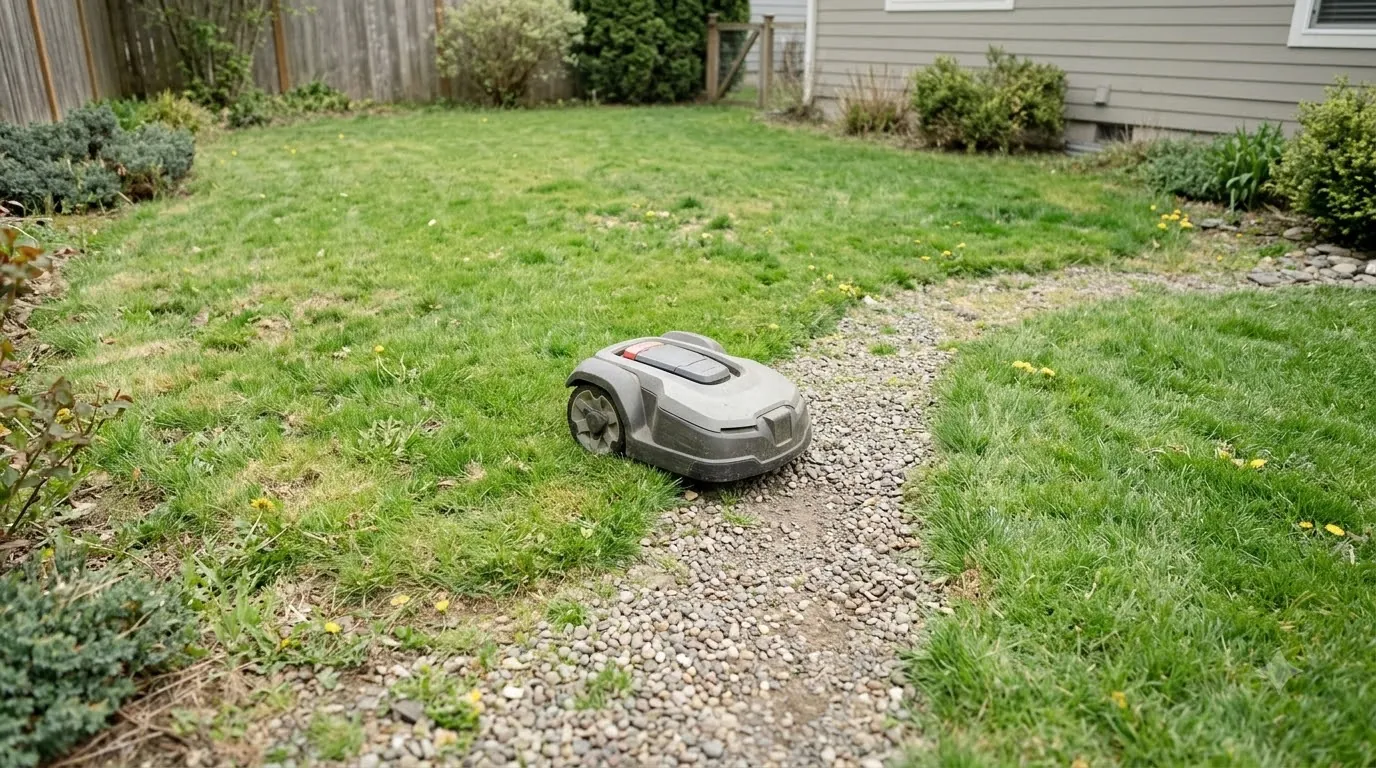

A vision robot mower for yard with poor satellite signal can keep cutting for short stretches where its camera sees grass, but Husqvarna describes the camera as back-up navigation, not a replacement for the satellite signal. Its camera-assisted models are designed to bridge brief gaps, and the manufacturer’s own guidance for weak-coverage areas still points to a buried boundary wire. Here is what the published material supports as of November 2026.
The short answer
- What it does: Husqvarna says the camera lets the mower keep mowing “for a limited distance, provided it can see grass” when satellite signal drops. The page gives no distance or time limit.
- What it does not do: If no grass is found, the mower searches for a satellite signal and stops. Camera vision does not replace satellite positioning.
- Night and models: Vision features stop working at night on the Aspire R6V, 308V and 312V. Only the 405VE, 410VE, 430V and 450V NERA add infrared for night detection.
- Weak coverage: Husqvarna’s how-it-works FAQ says that in areas with poor satellite coverage you can bury a physical boundary wire. The page does not define “poor.”
What a vision robot mower for yard with poor satellite signal does
The camera checks for grass during a satellite dropout, keeps the mower going for a short distance, and starts a search if it finds none.
Husqvarna describes the sequence in its AI vision support article, which states that the system works together with EPOS satellite navigation. When the satellite signal is lost, the camera checks whether the mower is still on grass. If it sees grass, the mower keeps mowing a limited distance. If it sees no grass, it rotates to search in each direction. If it finds nothing in any direction, it stops and searches for a satellite signal.
In our reading, the sequence suits a short dropout, such as passing a shed corner or a tall hedge for a few meters. It is not a guarantee of coverage. The page gives no distance, time limit or accuracy figure for the camera fallback, so a buyer cannot size the gap a model tolerates from the manufacturer’s material alone. Our reading is that the fallback is best treated as a safety margin, not as a plan for a yard where satellites are blocked most of the day. Our explainer on how vision robot mowers work covers the camera side in more detail.
Which vision models add night detection and boundary assist
Only four NERA models add infrared cameras for night, and boundary assist is off by default on all of them.
| Model group (per Husqvarna) | Vision at night | Boundary Assist |
|---|---|---|
| Aspire R6V, 308V, 312V | No. Vision features do not work at night | Not listed for these models |
| 405VE, 410VE, 430V, 450V NERA | Yes, through an infrared camera | Available, disabled by default |
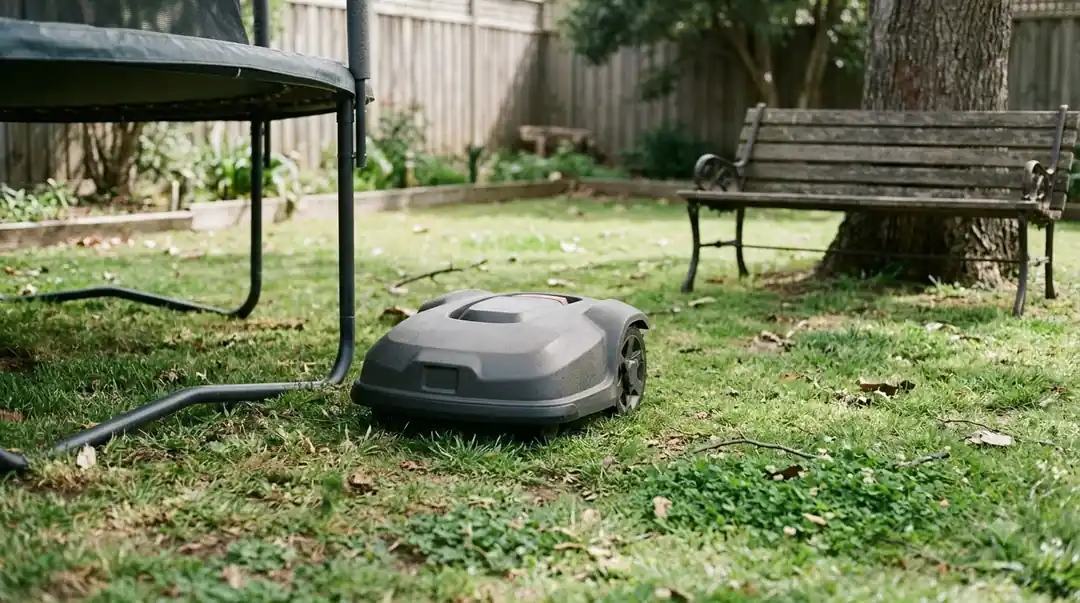
Boundary Assist uses the camera to detect the physical lawn edge, such as a flower bed, gravel or paving, and adjusts turning points at that edge. It stays off until you enable it in the Automower Connect app under More, then Settings, then Operation. For a vision robot mower for yard with poor satellite signal, our reading is that a buyer with a shaded or partly dark yard should confirm the night and boundary features on the exact model page before counting on the camera. If you are still weighing navigation types, see RTK versus vision navigation.
Why “poor satellite coverage” is hard to measure
Husqvarna’s wire-free guidance does not set a numeric signal threshold, so the choice to switch to a wire is left to the buyer.
The Automower how-it-works page says Husqvarna’s virtual boundaries use high-precision RTK-GNSS satellite signals through the Automower Connect app. In areas with poor satellite coverage, it says you can install and bury a physical boundary wire to let the mower operate there. It gives no minimum satellite count, signal strength or accuracy figure for that switch.
Husqvarna’s UK FAQ gives the conditions it expects. Wire-free mowers need an open sky view, and passages narrower than 4 m with tall hedges or walls on either side can block the satellite signals. The same page says positional accuracy is typically within 5 cm, and says the newest camera models combine AI vision with satellite navigation to cover areas where the signal is weak, which is a manufacturer claim rather than a tested result. These are the closest thing to a measurable threshold in the published material. They come from the UK version of the page, so check the version for your market.
Narrow side yards and tree cover
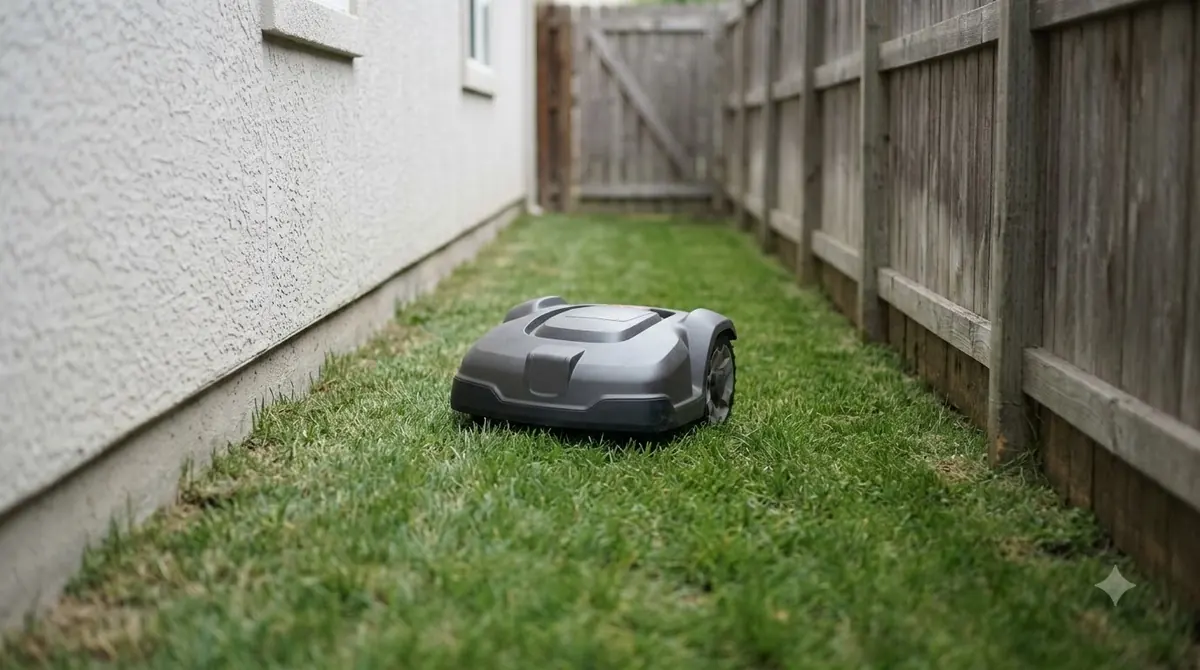
Narrow side yards between a house wall and a fence, and lawns under tree canopy, are the two layouts where satellite signal is most often blocked, according to the manufacturer material reviewed for this article. A vision robot mower for yard with poor satellite signal faces its hardest case in these layouts. Our guides to narrow side-yard passages and yards with heavy tree canopy cover each one.
Mammotion’s US article on boundary wires says accuracy drops under heavy canopy or close to tall buildings, and that dense trees, sheds and urban canyons can degrade GPS and RTK mapping. This is a vendor statement, not an independent test, so the size of the effect in any one yard is unmeasured.
The same article says some hybrid setups combine GPS navigation with small sections of boundary wire for tricky areas. That matches Husqvarna’s approach of burying wire in weak-coverage zones. A short wire run can cover the one passage where satellites are blocked, while the rest of the yard stays wire-free.
Where the camera fallback stops
The camera fallback is limited by daylight on daytime-only models and by what the camera can see. Husqvarna’s AI vision page says the vision features do not work at night on the R6V, 308V and 312V, so a dropout after dusk leaves those mowers with satellite navigation alone. The page also notes that model availability differs between markets.
The fallback depends on the camera finding grass. Bare soil, very short turf or a mowed-out path may give the camera a weaker cue. The page does not describe that case in detail, so this is our reading of how the fallback is described, not a tested result.
What to check before you buy
Before you commit to a vision robot mower for yard with poor satellite signal, check the satellite conditions in your yard, the night rating of the model, and whether a wire run is an option. Camera-based models are compared in our roundup of vision AI camera robot mowers.
- Map your yard’s blind spots. Note any passage narrower than 4 m between walls or hedges, and any tree canopy over the lawn. Those are the spots the manufacturer material flags.
- Confirm night and boundary features on the model page. Only the NERA models with infrared cameras detect at night, and boundary assist is off by default.
- Ask about the wire option. Husqvarna’s own guidance for poor coverage is a buried wire, so check whether the model supports it and how much wire the weak zone would need.
- Treat the camera as a margin. Our reading is that the camera helps with brief dropouts. It is not a substitute for a clear sky view over the mowing area.
Frequently asked questions
Can a vision robot mower work without any satellite signal?
Husqvarna’s AI vision page says the mower can keep mowing a limited distance if it sees grass. If no grass is found, it stops and searches for a satellite signal. The page gives no duration for the fallback.
Does a vision robot mower for yard with poor satellite signal need a boundary wire?
Husqvarna’s how-it-works page says that in areas with poor satellite coverage you can bury a physical boundary wire. The same material does not say a wire is always required, and it does not define what “poor” means.
Do vision robot mowers work at night in a dark yard?
Only the 405VE, 410VE, 430V and 450V NERA models have infrared vision for night detection. Husqvarna says the Aspire R6V, 308V and 312V vision features do not work at night.
Is wire-free accuracy the same in every yard?
No. Husqvarna’s UK FAQ says accuracy is typically within 5 cm where the signal is good. Mammotion says accuracy drops under heavy tree canopy or near tall buildings, so the result depends on the yard.
Sources
- How Automower AI vision technology works (Husqvarna): camera fallback sequence, day and night models, boundary assist default.
- How Automower works (Husqvarna): RTK-GNSS virtual boundary and wire option in poor coverage.
- Robotic mower FAQ (Husqvarna UK): open sky view, 4 m passage limit, typical 5 cm accuracy.
- Do robot lawn mowers need a boundary wire? (Mammotion): vendor statement on canopy and buildings, and hybrid wire use.
 Up next9 min readBy YardRobot Mower for Terraced Yard: What to Check FirstUpdated Nov 11, 2026
 8 min readBy YardRobot Mower for Yard With Retaining Walls: What to CheckUpdated Nov 11, 2026
 9 min readBy YardRobot Mower for a Sloped Front Yard: Limits, Edges and SetupUpdated Nov 11, 2026
 8 min readBy YardBest Robot Mower for a Duplex Yard: What to Check Before You BuyUpdated Nov 11, 2026
 8 min readBy YardBest Robot Mower for a Coastal Yard With Salty Air: What to CheckUpdated Nov 11, 2026
 8 min readBy YardCan a Robot Mower Work in a Yard With a Detached Garage?Updated Nov 11, 2026