
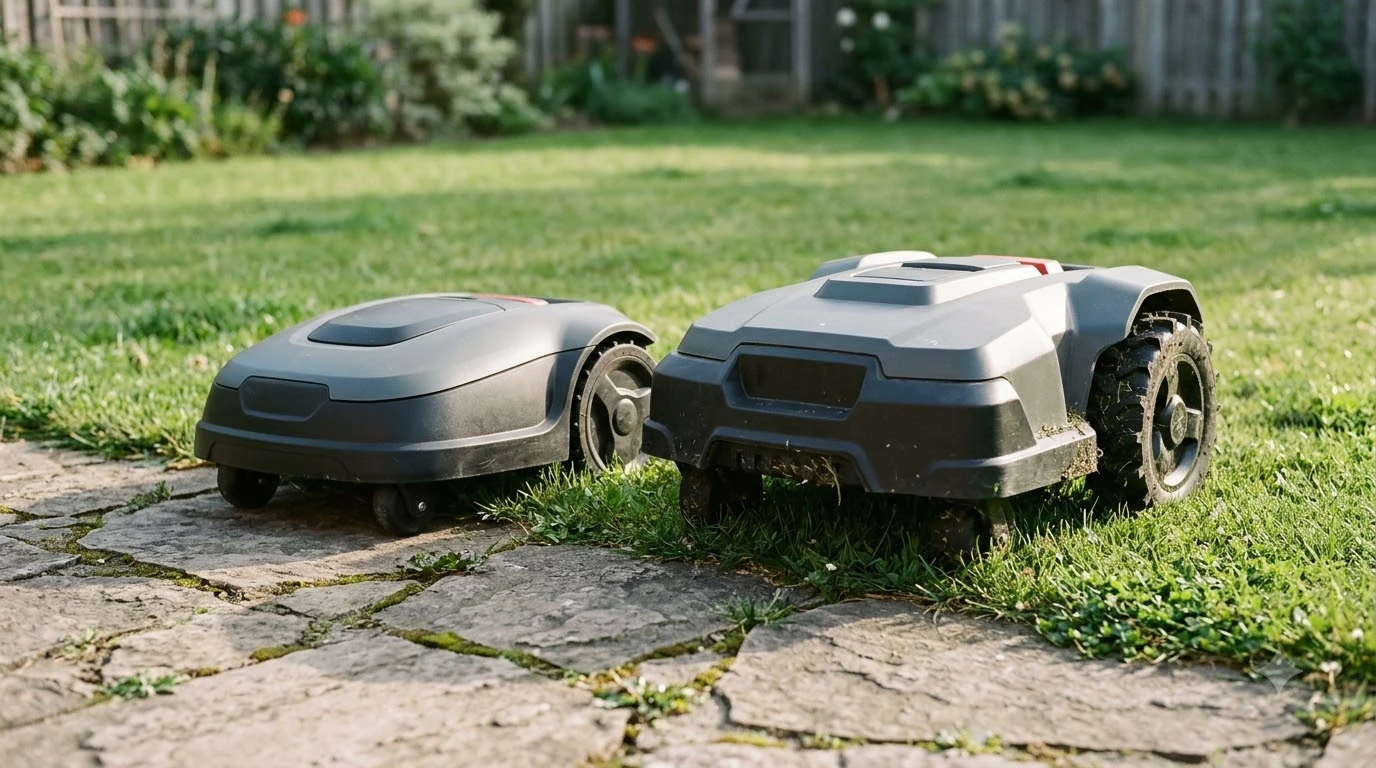

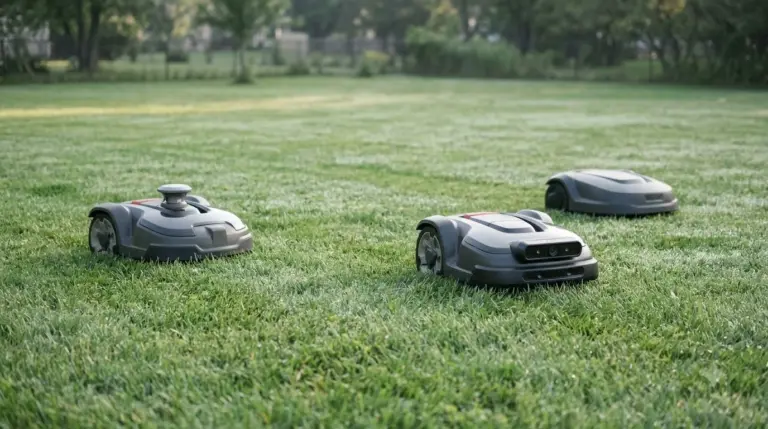
Can you run two different robot mower brands together? Yes, you can operate two different robot mower brands on the same property provided each unit relies on its own independent guidance loop or virtual map and you prevent signal overlap and physical collisions. Mixing brands works best when each machine handles a distinct section of the yard, such as assigning one robot to the front lawn and another to the backyard. Before staking down a second perimeter wire or mapping overlapping GPS zones, you need to plan around electromagnetic crosstalk, base station placement, and staggered mowing schedules.
The short answer
- Independent systems are mandatory: Two different robot mower brands cannot share a single charging dock or energize the same physical boundary wire at the same time.
- Wire spacing prevents signal crosstalk: According to Worx Landroid owner documentation and installation guidelines, parallel boundary wires from separate mowers should be kept at least 1 meter (about 3.3 feet) apart to avoid electromagnetic interference.
- Loop signal resets solve frequency clashes: If one wired mower gets confused by a neighboring signal, generating a new loop signal ID on supported models—such as Husqvarna Automower—often clears the conflict.
- Wire-free mowers coexist easily across separate zones: RTK-GPS, LiDAR, and AI-vision models do not emit ground-loop signals, meaning two different wireless brands rarely interfere electronically.
- Physical collisions require schedule separation: Segway Navimow support explicitly advises against running two robotic mowers in the exact same mowing area simultaneously because obstacle-avoidance sensors can trigger erratic behavior or bumps.
How different robot mower navigation systems interact
Whether two mismatched robot mowers interfere with each other depends entirely on how each brand detects its perimeter.
Traditional boundary-wire mowers use a charging station to send a low-frequency alternating current signal through a buried or staked perimeter loop. Internal inductive sensors inside the mower read the magnetic field strength and polarity to tell whether the chassis is inside or outside the cutting zone. Because each manufacturer modulates its loop signal differently, a Husqvarna mower generally ignores a Worx or Gardena wire under normal conditions. However, laying two active boundary loops right next to each other allows electromagnetic energy to couple from one wire into the other, which can cause a mower to cross its perimeter or stop with a signal fault.
Modern boundary-free mowers eliminate ground wires altogether by combining Real-Time Kinematic (RTK) satellite positioning, 3D LiDAR, and onboard cameras. Because an RTK rover calculates its position using satellite corrections from its own reference antenna rather than an electromagnetic wire loop, a wireless mower will not confuse a wired mower’s perimeter cable—and two wireless brands will not scramble each other’s virtual maps.
| Pairing setup | Electronic interference risk | Physical collision risk | Best deployment strategy |
|---|---|---|---|
| Two wired brands (separate zones) | Low to moderate if wires run close together | None if zones are physically separated | Keep parallel boundary wires at least 1 meter (3.3 feet) apart. |
| Two wired brands (adjacent/overlapping) | High due to inductive coupling | Moderate to high if schedules overlap | Separate wires by 1 meter, reset loop signal IDs, and stagger schedules. |
| One wired brand + one wire-free brand | Very low (different guidance physics) | Moderate if cutting areas overlap | Assign separate yards or run during opposite hours. |
| Two wire-free brands (RTK/LiDAR/Vision) | Negligible | Moderate if virtual maps overlap | Draw non-overlapping virtual boundaries or alternate active times. |
Managing boundary wire interference between two brands
When both robots rely on perimeter wires, physical wire routing determines whether the pair runs reliably or triggers daily error alerts.
First, never splice two different brands into one continuous perimeter wire or connect two charging stations to the same loop. Each base station expects a specific loop resistance—for example, Husqvarna Automower support notes roughly 0.8 ohm per 100 meters of wire—and transmits a proprietary waveform. Connecting two transmitters to one circuit risks damaging the charging boards and corrupting both signals.
Second, pay close attention to shared borders where the front yard meets the backyard or along a central divider. Our reading of Worx Landroid installation manuals shows that manufacturers advise keeping your boundary wire at least 1 meter (about 3.3 feet) away from a neighbor’s robotic mower wire to prevent cross-talk. The exact same rule applies when installing two different brands on your own property. Leaving a 1-meter buffer strip between two parallel loops prevents the magnetic field of one cable from bleeding into the other, though it does leave a narrow strip of grass that you will need to trim manually.
Heads up
Avoid laying two active boundary wires directly on top of one another in the same turf slit or running them parallel for long stretches. Even when the brands use different carrier frequencies, prolonged parallel contact can induce phantom voltages that cause one robot to drive straight across its boundary.
Why physical collisions are a bigger headache than radio signals
Even when two different robot mower brands experience zero electronic interference, letting them roam the same patch of grass at the same time creates mechanical and navigation problems.
In Segway Navimow’s official support documentation, the manufacturer warns against running two robotic mowers in the same mowing area simultaneously because mutual obstacle-avoidance routines can interfere with normal path planning. Ultrasonic sensors, bumper switches, and AI cameras treat the second mower as a moving obstacle, causing both machines to repeatedly pause, reverse, and re-route.
Worse, mismatched chassis heights can lead to physical entrapment. Many robot mowers feature a sloped, low-profile front bumper designed to deflect off vertical walls or tree trunks. If a low-slung mower strikes the angled rear shell of a different brand head-on, one robot can ride up onto the other’s deck, triggering tilt sensors, gouging plastic housings, or stalling both machines in the middle of the lawn.
Step-by-step setup for running two robot mower brands safely
Following a structured layout and scheduling plan lets you combine two different brands on one property without signal faults or fender-benders.
- Divide the property into dedicated zones. Assign each mower to a physically distinct lawn area—such as putting a compact wire-guided model in a fenced backyard and an all-wheel-drive RTK mower on a sloped front yard—so neither robot enters the other’s workspace.
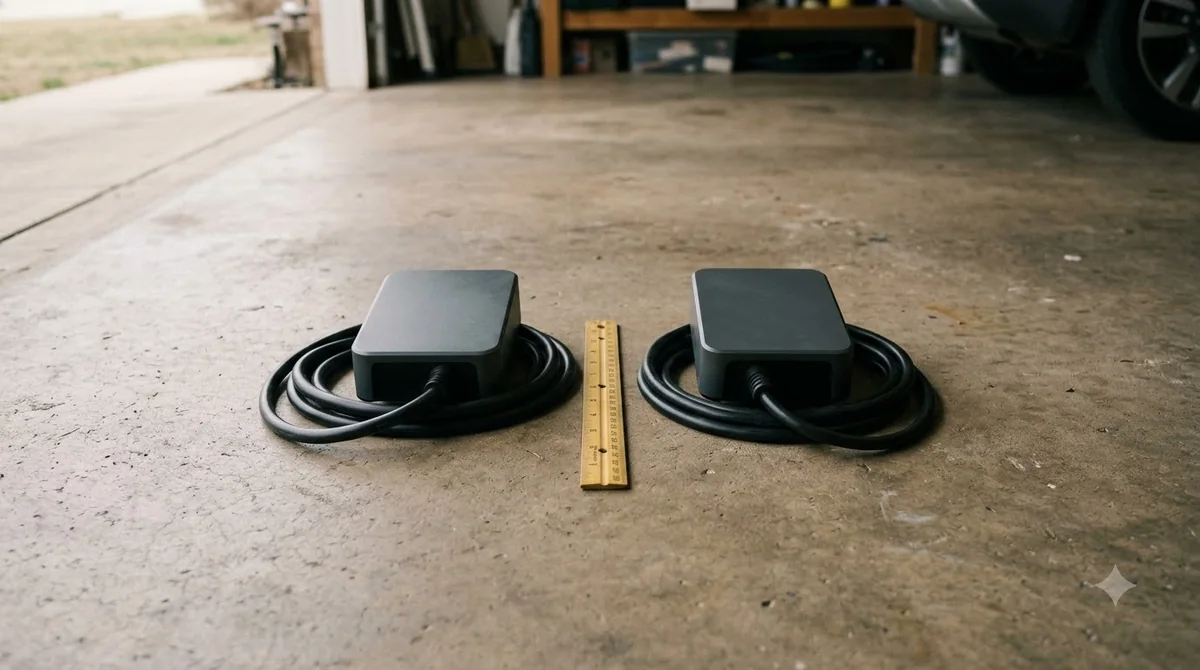
- Maintain a 1-meter buffer between parallel wires. If two wired zones must border each other without a fence or driveway in between, stake the two perimeter wires at least 1 meter (3.3 feet) apart along any parallel run.
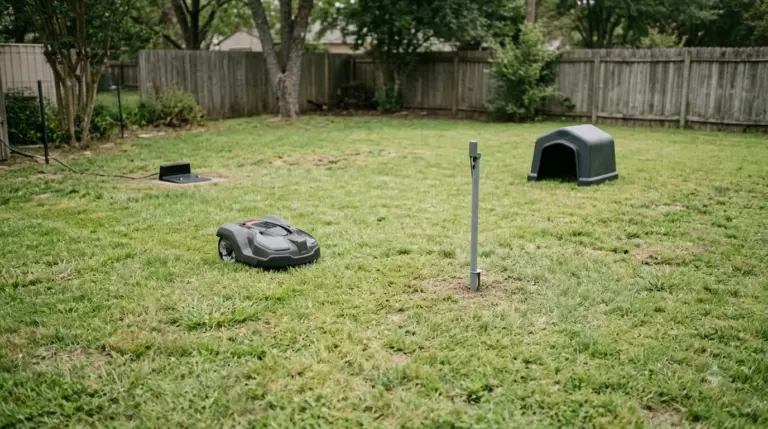
- Place charging stations on opposite sides of the yard. Keep the two base stations well separated and away from metal fences or buried power lines, as base docks emit concentrated magnetic fields that can disrupt a nearby robot trying to dock.
- Generate a fresh loop signal if a wired mower hesitates. If one robot slows down, flashes a loop error, or wanders near the shared border, use its app or onboard menu to generate a new loop signal ID—a built-in troubleshooting feature on brands like Husqvarna Automower.
- Stagger active mowing windows on shared turf. Whenever two brands must cover overlapping or tightly bordering grass, program Mower A to run during morning hours and Mower B to operate in the late afternoon or evening so only one machine is active on the turf at any moment.
When mixing brands makes sense (and when one system is better)
Running two different robot mower brands is rarely the cleanest starting point for a brand-new installation, yet it solves several practical homeowner scenarios.
Adding a second brand makes strong practical sense when you already own a reliable wired mower for a flat backyard and want a boundary-free RTK or LiDAR model for a complex front yard without ripping up existing turf. It also works well when a property has disconnected grass sections separated by a wide driveway or locked gate, allowing each brand to operate independently inside its own enclosure.
On the other hand, if you are outfitting an open, contiguous lawn from scratch, buying two units from the same ecosystem—or choosing a single higher-capacity multi-zone mower—keeps maintenance simpler. Staying within one brand lets you manage every zone inside a single smartphone app, stock one type of replacement blade, and use native multi-mower features built to prevent crosstalk.
Frequently asked questions
Can two different robot mower brands use the same boundary wire?
No, two different brands cannot share a single boundary wire or charging station. Each brand transmits its own proprietary electrical signal and expects a specific loop resistance, so connecting two base stations to one wire will cause signal failure or hardware damage.
How far apart should boundary wires be for two different robot mowers?
You should keep parallel boundary wires from two separate robot mowers at least 1 meter (about 3.3 feet) apart. That spacing prevents the electromagnetic field of one loop from coupling into the neighboring wire and confusing the other mower’s sensors.
Will an RTK wireless robot mower interfere with a boundary-wire mower?
No, an RTK satellite-guided mower and a boundary-wire mower will not interfere with each other’s navigation signals. Wire-free mowers rely on satellite corrections, cameras, or LiDAR rather than ground-loop magnetic fields, though you should still stagger their schedules if their cutting zones overlap so they do not bump into each other.
What happens if two robot mowers bump into each other in the yard?
Most mowers will register a physical bump via their impact sensors, stop, back up, and turn away. However, if a low-profile mower strikes the sloped rear shell of another brand, one unit can climb onto the other and get stuck, which is why manufacturers recommend running them at different times.
Sources
- No loop signal—Automower error message (Husqvarna): referenced for loop resistance guidelines, magnetic interference rules, and generating a new loop signal ID.
- Landroid Owner’s Manual (Worx): referenced for inductive loop operating specifications and spacing requirements near neighboring robotic mower boundary wires.
- Segway Navimow Support Guide (Segway): referenced for manufacturer guidance against operating two robotic mowers in the same mowing area simultaneously.
- How AI Vision Robot Lawn Mowers See, Decide, and Navigate (Mammotion): referenced for how RTK-GPS, LiDAR, and vision systems navigate without perimeter wires.
 Up next7 min readLearnCan Two Robot Mowers Share One Lawn?Updated Nov 14, 2026
 9 min readLearnCan a Robot Mower Run Over a Garden Hose Without Cutting It?Updated Nov 19, 2026
 7 min readLearnCan a Robot Mower Run on a Lawn Treated With Pre-Emergent?Updated Nov 19, 2026
 7 min readLearnShould a Robot Mower Run After Rain?Updated Nov 13, 2026
 6 min readLearnHow Often Should a Robot Mower Run?Updated Nov 14, 2026
 9 min readLearnShould a Robot Mower Run After Aeration?Updated Nov 12, 2026