

Why does my robot mower leave unmowed circles around trees? Your mower is responding to safety buffers—either from a physical boundary-wire island, a virtual no-go zone, or proactive camera and ultrasonic obstacle avoidance that steers clear of trunks and exposed roots before the blades can reach the base. Because the cutting disc sits inset beneath the mower’s outer shell for safety, even a machine that gently bumps a trunk cannot trim right up to the bark. Depending on your mower’s navigation system, you can shrink that ring through app sensitivity settings, tighter mapping, or a simple mulch border.
The short answer
- Proactive obstacle sensors: AI cameras, ultrasonic sensors, and LiDAR spot tree trunks from a distance and initiate an early avoidance arc, leaving a wide ring of uncut turf.
- Oversized boundary islands or no-go zones: Perimeter wire loops and virtual stay-out zones deliberately keep the chassis away from trunks and surface roots, adding an extra safety margin.
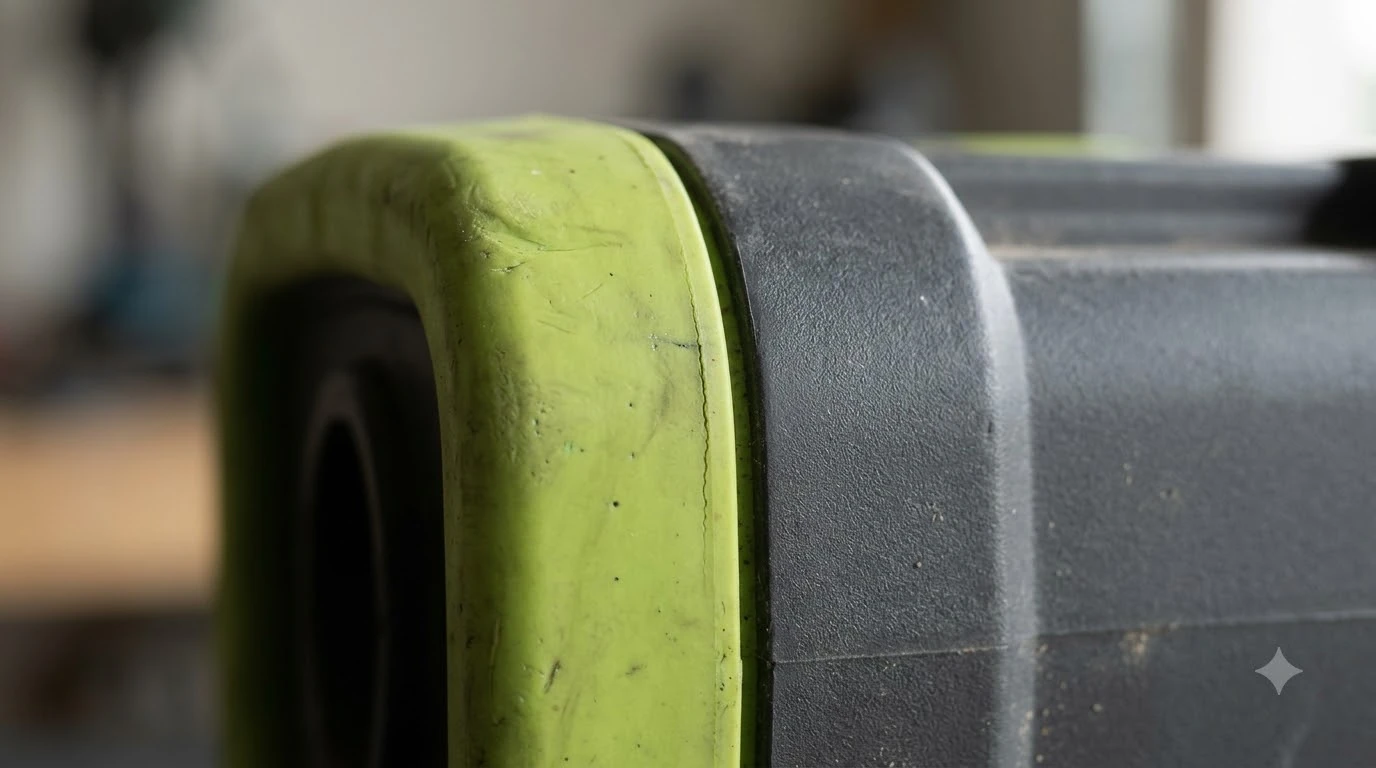
- Inset blade deck geometry: Robot mower blades are recessed inside the protective body shell, meaning several inches of grass nearest any vertical obstacle stay out of reach.
- Tall grass triggering false alarms: Once a small ring of grass grows taller than the surrounding lawn, vision sensors often mistake those tall blades for a solid obstacle and steer even wider.
- Single-direction mowing patterns: Systematic parallel stripes approach a trunk from only two angles, whereas multi-directional or irregular patterns shave closer around curves.
How navigation systems create unmowed rings around trees
The way your robotic mower navigates your yard dictates both why that unmowed halo appears and how wide it gets.
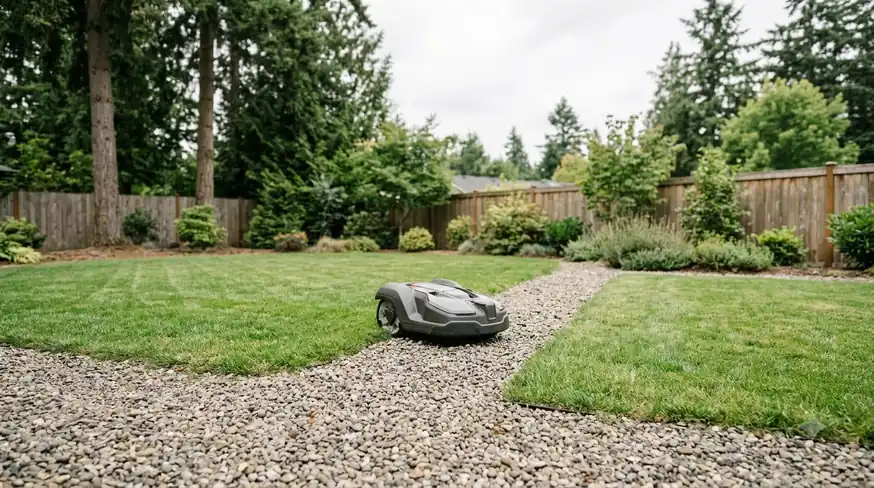
Traditional boundary-wire mowers use a buried or staked low-voltage loop to define where the machine can travel. When you route that wire around a tree—a setup manufacturers call creating an island—the mower stops as soon as its sensors detect the wire’s electromagnetic signal. Because installers usually place the wire outside surface roots and low branches, the machine turns around well before reaching the trunk. Even on wire-free models that rely on satellite positioning or visual mapping, Husqvarna’s systematic mowing documentation notes that virtual stay-out zones and unexpected obstacles create predictable clearance gaps around yard features.
Modern camera- and LiDAR-equipped mowers add another layer of caution. Instead of bumping into objects and reversing, proactive obstacle avoidance identifies trunks, roots, and dappled shadows ahead of time and carves a smooth detour around them. While that protects bark and prevents bumper scuffs, it routinely leaves a noticeable collar of uncut grass. Worse, if you skip string-trimming for a couple of weeks, those unmowed blades grow tall enough that optical grass-recognition systems classify the tall grass itself as a physical barrier, pushing the mower’s path farther out with every cycle.
Comparing causes by mower type
Different navigation technologies leave unmowed circles for distinct mechanical and software reasons.
| Mower Navigation Type | Primary Cause of Unmowed Ring | Typical Ring Width | Best Adjustment Method |
|---|---|---|---|
| Boundary-wire (bump-and-turn) | Wire island laid too far from trunk, plus recessed blade deck | Narrow to moderate | Move island wire closer or remove island around mature trunks |
| Wire-free RTK / GPS + Vision | Proactive camera avoidance and conservative virtual no-go zones | Moderate to wide | Lower obstacle sensitivity or map a tight no-go zone |
| Pure Vision / Optical Grass Recognition | Shade contrast, exposed roots, or tall grass mistaken for barriers | Moderate to wide | Trim tall tufts manually and create high-contrast mulch rings |
| 3D LiDAR + Sensor Fusion | Safety buffer around trunks and low-hanging branches | Narrow to moderate | Adjust edge-avoidance distance and alternate mowing angles |
Regardless of guidance style, physical deck geometry also plays a role. Safety regulations require robotic mower blades to sit well inward from the outer bumper so stray fingers or paws cannot contact spinning steel. Even if a bumper-sensing mower touches a smooth tree trunk directly, the gap between the outer shell and the cutting edge leaves a thin ring of grass standing.
How to shrink the unmowed circle around your trees
You can usually cut the width of those unmowed rings in half with a few targeted changes to your mower’s map, sensor settings, or landscaping.
- Trim existing tall grass first. Use a string trimmer to knock down the overgrown collar around every tree before changing mower settings. Camera-based systems rely on visual contrast and height cues, so removing tall tufts prevents the mower from treating overgrown grass as a solid object.
- Re-evaluate boundary wire islands. Mature trees with sturdy bark and no exposed surface roots rarely need a boundary-wire island at all; letting a bump-sensor mower gently tap the trunk and reverse eliminates the wire buffer completely. If roots require an island, peg the wire closer to the root flare while keeping parallel out-and-back wires touching so their signals cancel cleanly.
- Tighten virtual no-go zones and sensor overrides. On wire-free mowers, check your app’s mowing preferences for obstacle avoidance sensitivity or edge-clearance toggles. For example, Segway Navimow’s H Series guide explains how mapping a tight off-limit island or designating specific VisionFence-off zones keeps the mower from detouring widely around fixed yard features.
- Switch to alternating or irregular mowing patterns. If your mower runs parallel stripes in a single direction, it misses triangular wedges on the front and back sides of every circular trunk. Enable checkerboard, triangle, or multi-angle mowing modes so the deck approaches each tree from different directions across the week.
- Install a clean mulch or edging ring. Replacing the inner few inches of turf around a trunk with dark bark mulch or flush pavers gives optical sensors a crisp boundary and eliminates grass right where the inset blade deck cannot reach.
Heads up
Never disable obstacle avoidance or remove a boundary island around young saplings with thin bark, trees with flared surface roots that could high-center the chassis, or trees with low branches that can snag the mower’s top shell.
When you should leave the buffer alone
Sometimes an unmowed ring is doing an important job by protecting both your tree and your mower’s drivetrain.
Exposed roots are the most common hazard around established shade trees. When a robot mower climbs onto a woody root, its chassis can lift off the ground, triggering tilt sensors or leaving a drive wheel spinning in midair until the battery drains. Repeated wheel spin on bare root zones also wears ruts into the soil and damages feeder roots near the surface. Similarly, soft bark on newly planted ornamental trees can be bruised or girdled over time by repeated bumper impacts.
Tree canopies also affect satellite-guided machines. Dense overhead foliage can weaken GPS-RTK signals directly beneath large evergreens or oaks, causing a mower to rely more heavily on onboard cameras or odometry. Keeping a generous virtual stay-out zone or a well-placed mulch bed under heavy canopy prevents the mower from wandering off course when satellite lock degrades.
Frequently asked questions
Why does my robot mower leave unmowed circles around trees even without a boundary wire?
Wire-free robot mowers use AI cameras, ultrasonic sensors, or LiDAR to spot trunks and roots before impact, steering around them with a built-in safety buffer. Because the blades also sit recessed inside the mower body, a ring of grass remains uncut even when the mower passes close by.
Is it safe to let a robot mower bump into tree trunks?
For mature trees with tough, thick bark and flat ground at the base, standard bump-and-turn robot mowers can safely tap the trunk and reverse without harming the tree or the machine. Avoid letting mowers bump young saplings with thin bark or trees surrounded by exposed surface roots.
Why does the unmowed circle around my tree keep getting wider?
As the narrow ring of grass missed by your mower grows taller than the rest of the lawn, camera and ultrasonic obstacle sensors begin mistaking those tall grass blades for a solid barrier. Each mowing session then routes slightly wider around the tuft until you trim it back down.
Does changing the mowing pattern help cut closer to trees?
Yes, switching from a single-direction parallel pattern to a multi-angle, checkerboard, or irregular pattern lets the mower approach the curved trunk from multiple sides over consecutive runs, trimming away the wedge-shaped patches left behind by straight passes.
Sources
- What is systematic mowing? (Husqvarna): Referenced for how systematic patterns, stay-out zones, and unexpected obstacles leave uncut clearance areas and how alternating directions improves edge coverage.
- Segway Navimow H Series – Robot Mowers Without Perimeter Wire (Segway Navimow): Referenced for how VisionFence obstacle detection, off-limit islands, and alternating mowing directions work around yard obstacles.
- In-Depth Look at LawnMaster OcuMow Vision Navigation (Cleva / LawnMaster): Referenced for how optical grass-recognition cameras use visual contrast and proactive avoidance around trees and borders.
- EPOS Support by Wire and virtual boundaries (Husqvarna): Referenced for how tree cover affects satellite signals and how physical wire loops pair with virtual stay-out zones.
 Up next10 min readLearnWhy does my robot mower turn around before reaching the edge?Updated Nov 19, 2026
 6 min readLearnWhy Does My Robot Mower Spin in Circles? Causes and FixesUpdated Nov 14, 2026
 6 min readLearnWhy Does My Robot Mower Leave Tire Marks on the Dock Area?Updated Nov 13, 2026
 7 min readLearnWhy Does My Robot Mower Leave Stripes in the Lawn?Updated Nov 13, 2026
 7 min readLearnWhy Does My Robot Mower Leave Clumps of Grass?Updated Nov 13, 2026
 6 min readLearnHow Do Robot Mowers Mow Around Trees?Updated Nov 14, 2026