
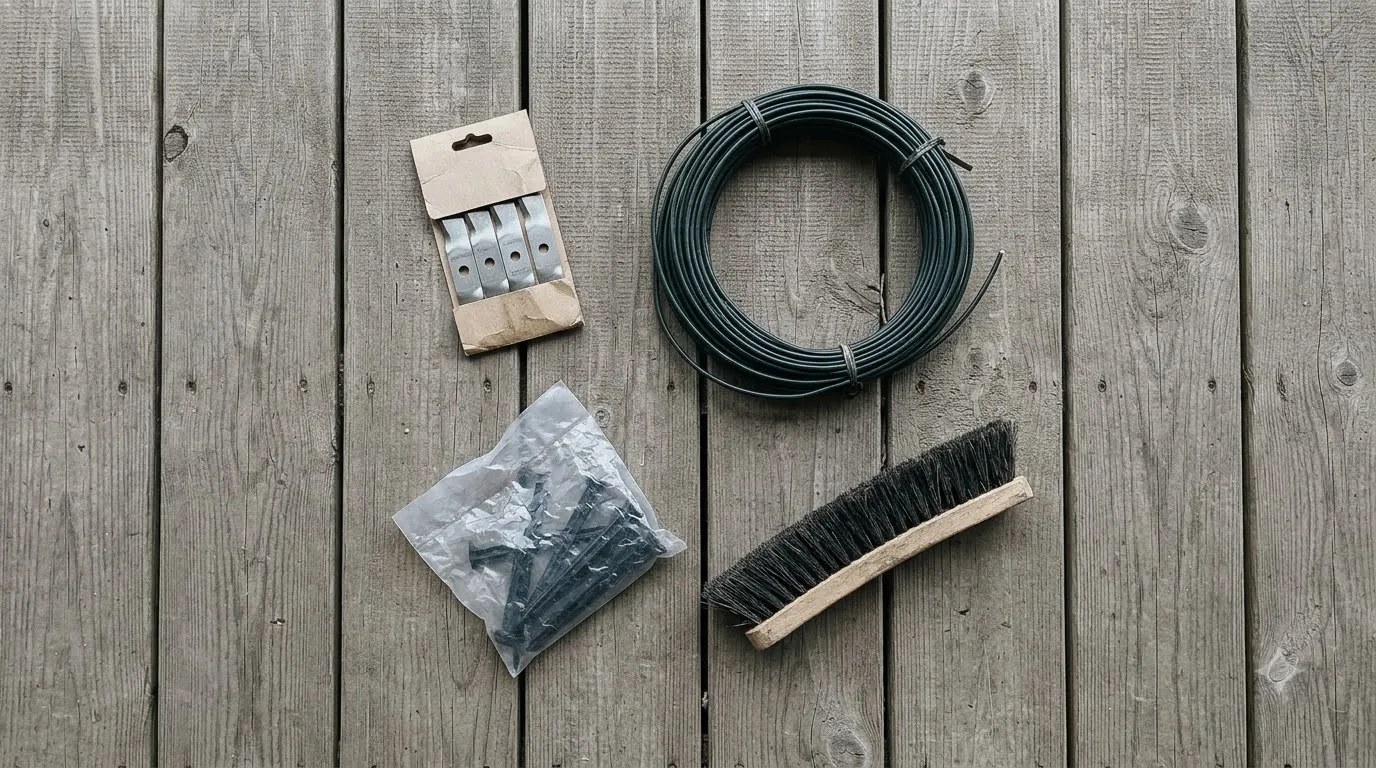

The best non-conductive plastic scraper for cleaning mower decks is a rigid, non-marring nylon or polyoxymethylene (POM) blade tool with a contoured tip that clears caked grass without scratching housings or shorting live contacts. Robot lawn mowers pack sensitive wiring, battery terminals, and exposed charging strips close to the cutting disc. Choosing an electrically insulating polymer scraper keeps your maintenance routine safe while protecting soft composite shells from permanent gouges.
The short answer
- Why plastic matters: Non-conductive polymers prevent accidental electrical shorts across exposed charging plates, battery bays, and sensor harnesses while avoiding gouges in ABS or polycarbonate housings.
- Best material choices: Polyoxymethylene (POM/acetal) offers high rigidity and low moisture absorption for baked-on sap, while glass-free nylon provides slight flex for curved skid plates.
- Design features to check: Look for a dual-ended profile with a wide flat edge for open deck pans, a narrow hooked or pointed tip for tight blade-disc gaps, and an ergonomic non-slip grip.
- Maintenance frequency: According to Mammotion’s maintenance guidance, cleaning the underside every one to two weeks during the growing season prevents heavy buildup that drains battery efficiency.
- What to avoid: Never use steel putty knives, wire brushes, or metal screwdrivers near a robot mower deck, and avoid carbon-fiber-filled plastics that can conduct electricity.
Why robot mower decks need non-conductive plastic scrapers
Unlike traditional gas walk-behind mowers with stamped steel shells, robotic mowers feature compact composite chassis packed with low-voltage electronics, making an insulating scraper essential for safe underside cleaning.
Wet grass clippings mixed with soil and plant sap quickly bake onto the underside of a cutting deck. As University of Illinois Extension mower maintenance guidance explains, accumulated clippings hold moisture against underside surfaces and shorten equipment lifespan when left uncleaned. On a robotic mower, that buildup also creates drag on the cutting disc motor, reducing runtime per charge and throwing off blade balance.
Metal putty knives are common in sheds for traditional mowers, yet they pose two distinct risks on autonomous units. First, steel blades easily gouge molded polypropylene and ABS undercarriages, creating rough grooves where fresh grass sticks even faster. Second, many robot mowers place exposed metal charging contacts, rain sensor pins, or battery compartment seams near the outer shell. Bridging two terminals with a steel scraper—or nicking an internal wire harness—can cause sparks, blown fuses, or control board damage.
Heads up
Even when using a non-conductive plastic scraper, always power off the mower completely using its main switch or safety key and wear cut-resistant gloves before touching the underside.
Types of non-conductive plastic scrapers and materials
Non-conductive deck scrapers vary by polymer hardness and blade geometry, allowing owners to match tool stiffness to stubborn sap or delicate sensor housings.
Not all plastics behave the same way under pressure. Standard polypropylene or soft polyethylene scrapers bend easily when pushed against dried mulch, forcing you to apply extra wrist force that increases the chance of slipping near sharp pivot blades. Engineering thermoplastics provide much better edge retention without introducing electrical conductivity.
Polyoxymethylene (POM / Acetal): Often sold under trade names like Delrin, POM is a dense, rigid engineering thermoplastic with a naturally low coefficient of friction. Because it absorbs almost no water, a POM scraper stays stiff and keeps a sharp chisel edge even when scraping damp grass paste. It excels at lifting crusty, sun-baked clippings off flat deck pans and skid plates.
Unfilled Nylon (PA6 or PA66): Pure, unreinforced nylon combines high impact toughness with controlled flexibility. When pressed against curved wheel wells or rounded cutting shrouds, a nylon blade flexes slightly to follow the contour without biting into the mower’s softer outer shell. Be sure to avoid carbon-fiber-reinforced nylon tools, as carbon additives make the polymer electrically conductive.
Replaceable Plastic Razor Scrapers: Compact handles fitted with double-edged, snap-in plastic razor blades offer a thin, acute bevel for slicing sticky sap off spinning blade discs. While the individual blades wear down faster than thick molded pry-style scrapers, swapping in a fresh edge takes seconds and keeps cleaning pressure minimal.
| Scraper Type | Best For | Stiffness & Edge Hold | Electrical Safety | Key Limitation |
|---|---|---|---|---|
| POM (Acetal) Chisel Scraper | Hard, baked-on grass and soil crusts on flat deck pans | High rigidity; holds a crisp beveled edge in wet conditions | Fully non-conductive insulator | Less flex on tightly curved housings |
| Unfilled Nylon Trim Scraper | Curved shrouds, wheel arches, and around sensor bezels | Medium-high stiffness with slight contour flex | Fully non-conductive insulator | Absorbs minor moisture over time; edge rounds gradually |
| Plastic Razor Blade Holder | Sticky plant sap and thin grass film on blade discs | Thin, sharp bevel for low-force slicing | Non-conductive blade (check handle material) | Blades chip on embedded pebbles and need replacement |
| Brush-and-Scraper Combo Tool | Quick weekly cleanups and tight motor shaft gaps | Moderate stiffness with integrated bristles | Non-conductive polymer body | Shorter handle offers less leverage on heavy buildup |
What to look for when choosing a deck scraper
Selecting the right scraper comes down to blade profile, handle ergonomics, chemical resistance, and verified dielectric safety.
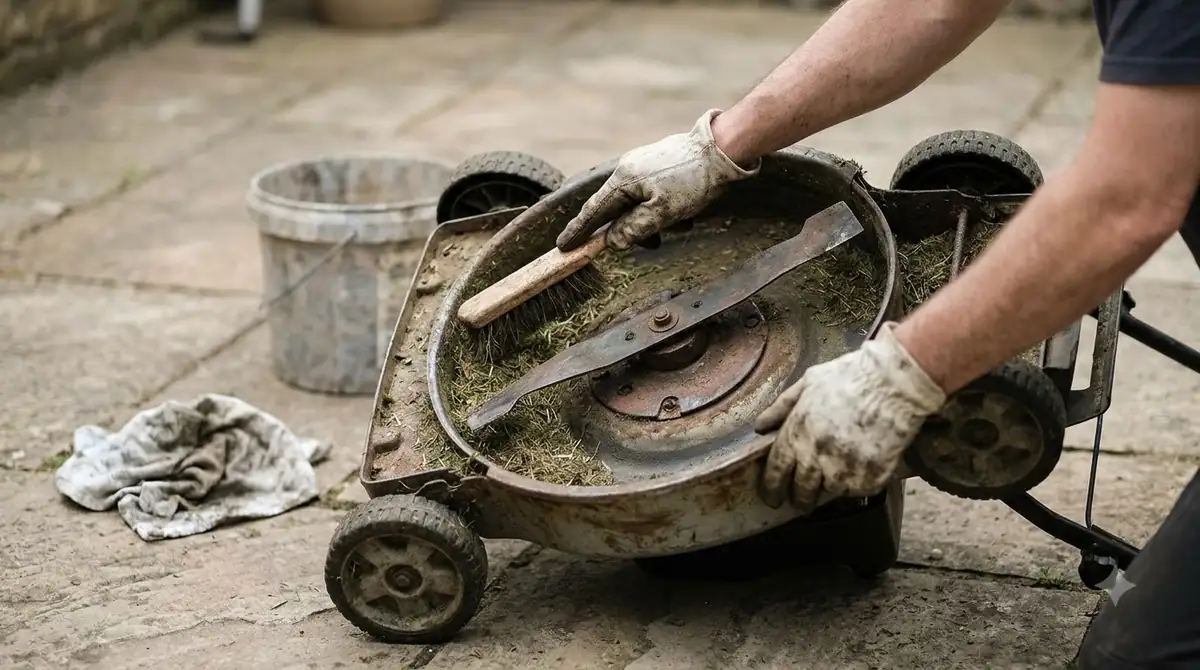
Manufacturer maintenance kits offer useful clues about ideal geometry. In its official maintenance guide, Husqvarna’s Automower cleaning checklist highlights pairing a slim, steep-angled brush with a small scraper tool to reach narrow crevices around the skid plate and wheels. When evaluating standalone scrapers, prioritize four practical design details:
- Dual-tip or tapered geometry: A wide flat edge clears broad underside surfaces in a few passes, while a narrow 10 mm to 15 mm tapered tip reaches between the cutting disc and surrounding deck shroud without forcing you to disassemble the rotor.
- Chamfered working bevel: Look for a 30-degree to 45-degree beveled edge rather than a blunt square tip. A clean bevel slides underneath dried grass cakes instead of plowing into them.
- Textured, flared handle: Grass sap and morning dew make tools slick. A contoured handle with a rubberized overmold or finger guard prevents your hand from sliding toward the exposed razor blades on the cutting disc.
- Pure polymer construction: Confirm the tool has no exposed metal rivets, steel bolster cores, or conductive carbon fillers that could bridge electrical contacts if dropped across the chassis or charging dock.
How to safely scrape and clean a robot mower deck
Following a structured dry-first scraping routine removes packed debris safely without forcing moisture into sealed motor bearings or electronics.
Our reading of major manufacturer manuals—including guidance from Husqvarna and Mammotion—shows consistent agreement on one core rule: scrape dry debris first, and never blast the underside with a high-pressure washer. High-pressure jets can push water past shaft seals and damage internal circuit boards. Instead, use this six-step routine every one to two weeks during peak growing season:
- Shut down and isolate power. Turn the mower completely off using the physical power button or main switch, and remove the safety key or battery pack if your model includes one.
- Set the mower on a soft surface. Flip the robot upside down onto a folded towel, rubber mat, or thick patch of dry grass so the top cover, LiDAR turret, or camera lenses do not get scratched.
- Clear loose clumps by hand. Wearing thick gardening or cut-resistant gloves, pull away loose leaves, twigs, and wet grass wads from the wheel arches and outer housing.
- Scrape packed grass with shallow strokes. Hold your non-conductive plastic scraper at a low angle against the deck shell and push away from your body. Use the narrow tip to clear debris trapped between the cutting disc and skid plate, rotating the disc gently by hand to inspect blade pivot screws.
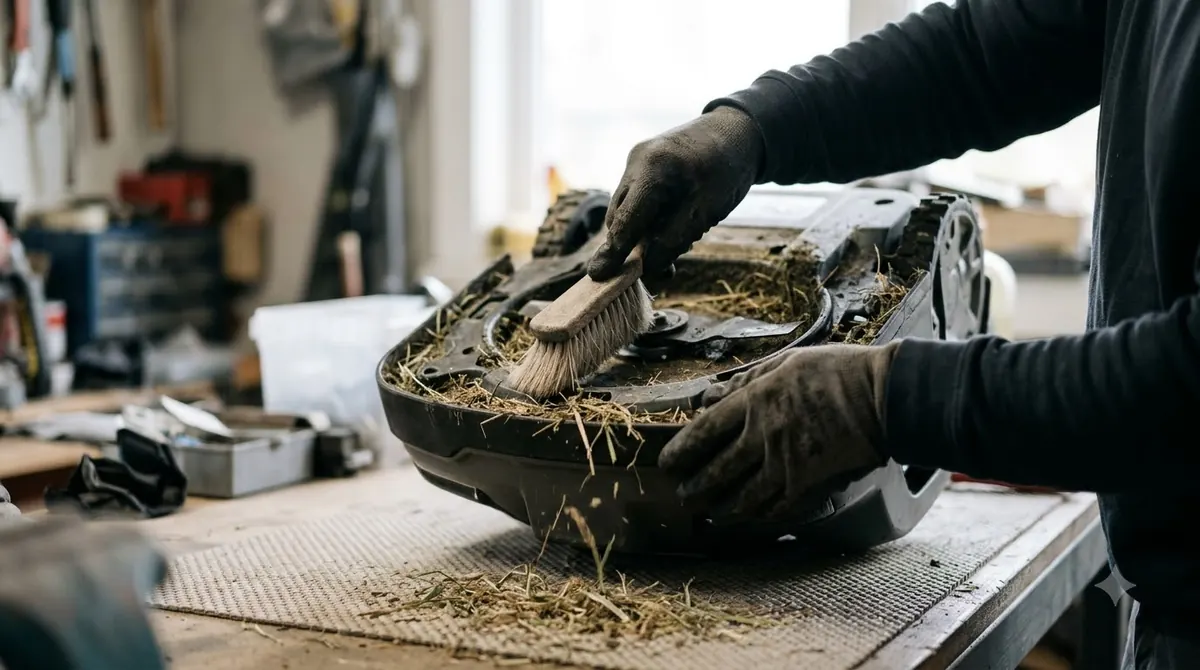
- Brush and wipe remaining residue. Follow up with a stiff nylon brush to sweep loose crumbs out of wheel treads and axle gaps, then wipe the housing and camera or sensor lenses with a slightly damp microfiber cloth.
- Dry completely before docking. Place the mower upright on its wheels and let the underside air-dry thoroughly before returning it to the charging station.
Maintaining and resharpening your plastic scraper
Simple post-cleaning care keeps a plastic scraper’s beveled edge sharp and free of abrasive grit that could mar your mower’s housing.
Over dozens of cleanings, sand particles embedded in lawn clippings will round over the working edge of a nylon or POM scraper. Unlike metal putty knives that require wet stones or grinders, a solid engineering plastic scraper is easy to restore at home. Lay a sheet of medium-grit sandpaper (around 180 to 240 grit) flat on a workbench and draw the scraper’s beveled edge across it at its original angle for five to ten strokes, then finish with 400-grit paper to smooth out burrs.
Wash the scraper in warm water with mild dish soap after each session to remove sticky plant resins and soil grit. Avoid soaking nylon or acetal tools in strong chlorine bleach, harsh acids, or industrial solvents, which can weaken polymer chains and make the blade brittle over time. Store the tool in a dry shed or toolbox out of direct sunlight to prevent UV degradation.
Frequently asked questions
Can I use a regular metal putty knife to clean my robot mower deck?
No, manufacturer guides from brands like Mammotion and Husqvarna advise against using metal tools on robot mower decks. Metal blades easily gouge plastic housings, scratch protective coatings, and risk shorting exposed charging contacts or damaging wiring harnesses.
What is the difference between nylon and POM plastic scrapers?
Polyoxymethylene (POM or acetal) is stiffer, absorbs almost no water, and holds a sharper edge for chiseling hard, dried-on grass crusts. Unfilled nylon offers slightly more flex, making it gentler and easier to maneuver along curved wheel wells and rounded deck shrouds.
Are all plastic scrapers completely non-conductive?
Standard unfilled polymers like nylon, polypropylene, and POM are natural electrical insulators. However, specialty static-dissipative (ESD) or carbon-fiber-reinforced plastic scrapers contain conductive additives and should be avoided around battery terminals and charging plates.
How often should I scrape the underside of a robot lawn mower?
During active growing seasons, cleaning the underside every one to two weeks prevents dense grass buildup and preserves battery runtime, according to Mammotion’s maintenance recommendations. If your mower frequently cuts damp grass, a quick weekly scrape works best.
Sources
- Robot Lawn Mower Maintenance Guide: Cleaning, Blades & Battery (Mammotion): referenced for recommended cleaning intervals, prohibition on metal scraping tools, and safe shutdown steps.
- Cleaning Robotic Lawn Mower – Step-by-Step Guide (Husqvarna): used for official Automower cleaning tool profiles, skid plate maintenance, and pressure-washer warnings.
- Mower Maintenance (University of Illinois Extension): cited for how trapped underside grass clippings retain moisture and accelerate mower deck wear.
 Up next9 min readGearBest Battery-Powered Handheld Blower for Cleaning Mower Decks: Buying & Use GuideUpdated Nov 19, 2026
 10 min readGearBest Waterproof GPS Tracker Tag for Non-Cellular Robot Mowers: Buyer’s GuideUpdated Nov 19, 2026
 9 min readGearChoosing the Best Heavy-Duty Plastic Shed Ramp for Robot Mower EntryUpdated Nov 19, 2026
 7 min readGearBest Replacement Cutting Disc Guard for Rocky Lawns: Materials, Fit, and CareUpdated Nov 19, 2026
 10 min readGearBest Replacement Rubber Bumper Strip for Brick Walls: Materials, Fit, and CareUpdated Nov 19, 2026
 9 min readGearBest Lawn Leveling Sand for Robot Mower: Soil First, Then MaterialUpdated Nov 11, 2026