
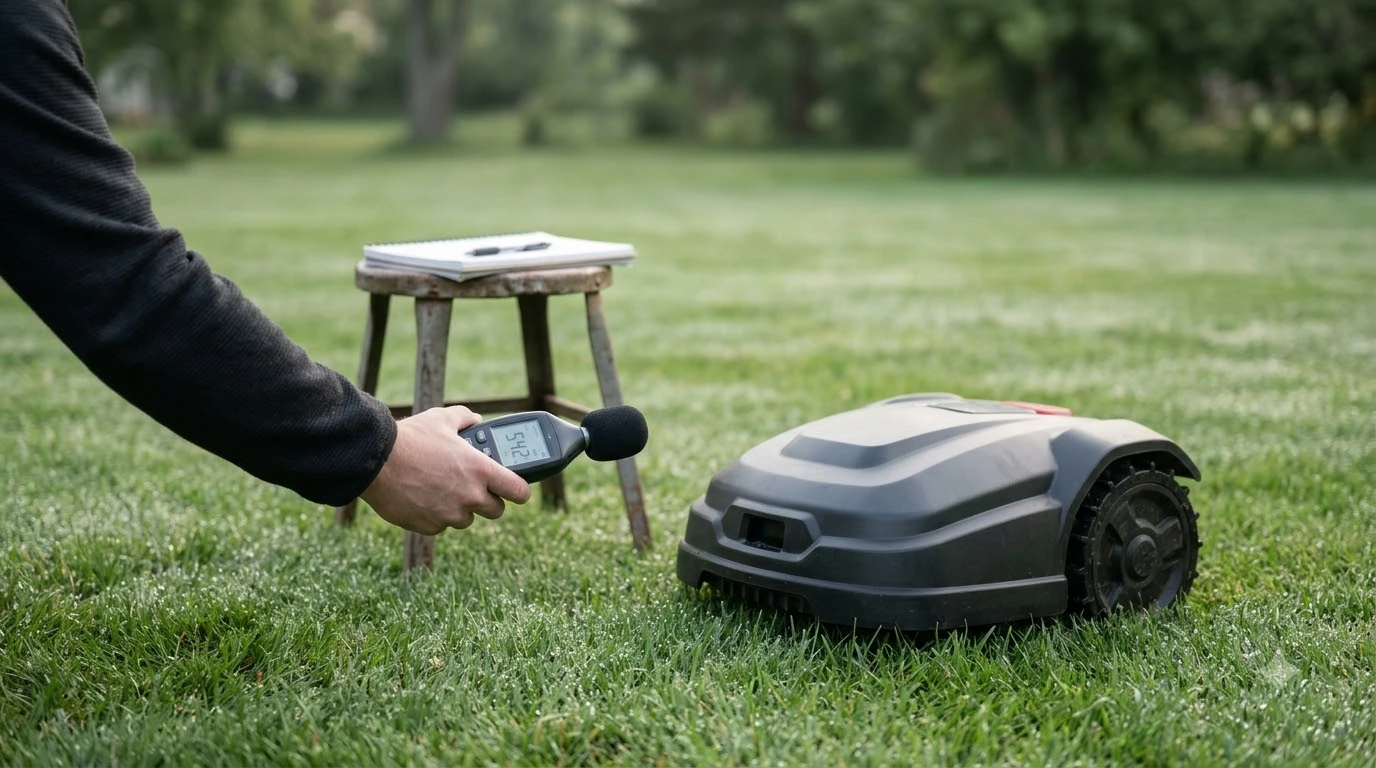

Why does my robot mower struggle on freshly topdressed lawns? Loose sand, screened compost, and topsoil temporarily eliminate the firm root-zone grip your mower’s drive wheels need, causing wheel spin, chassis bottoming out, and premature blade wear. Until watering and turf growth settle that topdressing layer into the thatch, light robotic mowers treat the surface much like soft mud or loose gravel. Pausing scheduled runs for a few days and adjusting your cutting height prevents ruts, error codes, and damaged turf.
The short answer
- Loss of wheel traction: Unsettled sand or compost shifts sideways under lightweight rear drive wheels, triggering wheel-slip halts and tearing up fresh grass shoots.
- Lowered ground clearance: Even a standard 1/4-inch to 1/2-inch topdressing layer raises the effective ground line, letting the mower belly drag on high spots.
- Accelerated blade dulling: Quartz sand grains and grit kicked up by airflow rapidly chip thin, razor-style pivoting blades.
- Sensor and wheel clogging: Damp organic compost packs into wheel treads, caster bearings, and ultrasonic or bumper sensors.
- The fix: Pause your mowing schedule for 5 to 10 days, water the topdressing in thoroughly, and raise your cutting deck to its highest setting for the first two recovery cuts.
Why topdressing disrupts robot mower traction
Unlike heavy walk-behind gas mowers that press down into the turf with broad, wide tires, robot mowers rely on light chassis weights and narrow lugged wheels that spin freely on loose surface material.
According to turfgrass maintenance guidance from the University of Tennessee Extension, a standard topdressing application spreads 1/8 to 1/4 inch of sand, mature compost, or topsoil across actively growing turf, with 1/2 inch serving as the upper limit before grass crowns risk smothering. While 1/4 inch sounds negligible to a human walking across the yard, it creates an unanchored layer sitting directly on top of the existing soil canopy.
When a robot mower turns at the boundary wire or climbs even a gentle grade, its drive wheels push horizontally against that loose layer. Instead of propelling the chassis forward, the tire lugs shear the topdressing aside, digging twin ruts down to the crown level. As documented in eufy’s robot mower troubleshooting guide, soft or shifting ground causes a wheel to sink, prompting the mower to execute repeated recovery maneuvers before halting completely with a stuck or wheel-slip alert.
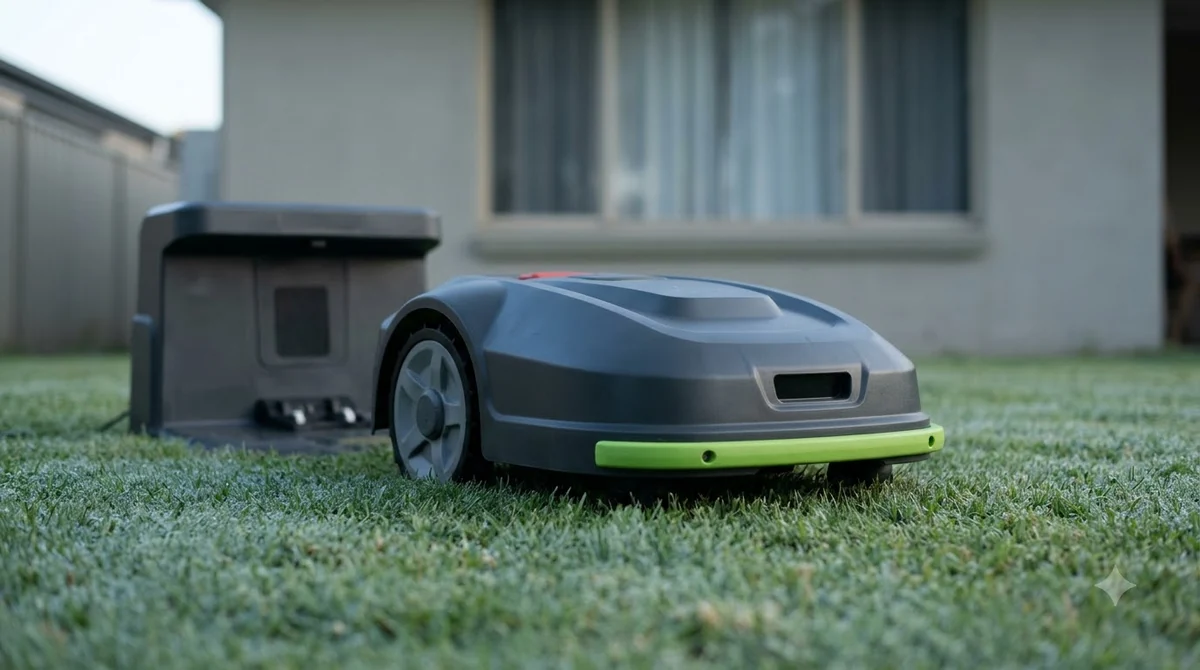
Slopes amplify this traction loss immediately. Manufacturer slope ratings—such as Husqvarna’s guidance that standard Automower units handle 25% to 50% inclines while all-wheel-drive models manage steeper grades—assume firm, established turf with clean wheel treads. Once loose sand or compost coats those treads, effective climbing capacity drops sharply, and the mower may slide sideways across boundary lines or stall mid-slope.
How loose sand and compost affect blades, decks, and sensors
Beyond wheel spin, freshly applied topdressing creates mechanical friction and airborne grit that interfere with your mower’s cutting disc and navigation hardware.
Most residential robot mowers cut grass using three small, lightweight pivoting blades mounted to a spinning disc. Those thin steel blades are engineered to slice tender leaf tips cleanly, not strike mineral grit. When topdressing sand sits high on the grass blades before being watered down into the thatch, suction from the spinning disc pulls abrasive particles directly into the blade path. Within a single afternoon run, sharp edges turn rounded and nicked, leaving shredded, brown-tipped grass blades that invite fungal disease.
| Topdressing Material | Primary Traction Impact | Hardware & Component Risk | Recommended Wait Before Mowing |
|---|---|---|---|
| Washed masonry or silica sand | High lateral slip; behaves like loose ball bearings on slopes | Severe blade chipping and grit buildup in wheel hub seals | 7 to 10 days after watering in |
| Screened organic compost | Smears when damp; packs tightly between tire lugs | Clogs caster wheels, deck shrouds, and bumper seams | 5 to 7 days once surface dries |
| Topsoil and compost blend | Forms soft ruts if irrigated heavily before settling | Triggers lift/tilt sensors when one wheel drops into a pocket | 7 to 14 days until firm underfoot |
Compost-heavy blends introduce a different mechanical headache: clumping. Morning dew or light irrigation turns fine organic matter into a sticky paste that cakes onto the undersides of fenders and packs inside front caster wheel forks. Once a front caster locks up with compacted compost, it drags like a plow blade across your newly leveled lawn, undoing the smoothing work you just completed.
Heads up
Never use a garden hose jet or pressure washer to blast caked compost or sand out of wheel motors and underbody seals. Manufacturer maintenance guides warn that pressurized water forces fine grit past rubber gaskets into drive gearboxes and circuit boards; use a dry stiff-bristle brush and wooden scraper instead.
Step-by-step recovery plan before restarting your mower
Giving the topdressing time to settle into the root zone protects both your lawn’s leveled surface and your mower’s drivetrain.
- Pause your automated schedule immediately. Disable timers, rain-resume triggers, and app schedules before spreading material so the robot does not leave its docking station onto an unworked pile.
- Drag and water the topdressing into the canopy. Use the back of a leaf rake or a flexible drag mat to work material down past the grass blades, then apply light, frequent irrigation so particles settle firmly against the existing soil surface.
- Verify firmness with the footprint test. Walk across the lawn in flat-soled shoes; if your soles leave impressions in loose sand or damp compost, the surface is still too soft for narrow robot mower tires.
- Raise the cutting height to maximum. Adjust the deck to its tallest setting—often around 3.5 to 4 inches depending on your model—so the spinning blades clear any remaining surface grit sitting near the crowns.
- Inspect and clean after the first two runs. Brush packed soil from the drive wheel lugs, verify that front casters spin freely, and check blade edges for nicks once the mower finishes its initial post-topdressing cycles.
Adjusting mower settings for uneven or soft recovery zones
If your lawn has low spots that received heavier topdressing—up to the 1/2-inch repair maximum noted by university turf specialists—temporary software adjustments keep your robot out of trouble while grass grows back through the patch.
For vision-based, LiDAR, or RTK-GPS mowers with app mapping, draw temporary no-go zones around deep repair depressions where soil was used to fill ruts or aeration holes. Keeping the mower off those pockets for two weeks lets stolons, rhizomes, or fresh overseeding anchor the loose fill before wheels roll over it.
For boundary-wire mowers without virtual map zones, check your app or onboard menu for collision sensitivity and slope-control settings. Many models allow you to reduce obstacle sensitivity slightly or widen perimeter mowing behavior so the unit turns gently rather than executing sharp pivot turns that churn up soft topdressing at the lawn edge. If one damp corner continues to trap a wheel, place temporary physical pegs or weighted planks along that border until the turf knits together.
Frequently asked questions
How long should I wait to run my robot mower after topdressing?
Wait 5 to 10 days after topdressing, depending on whether you applied screened compost or heavier sand and how quickly irrigation settles the material into the thatch. Mowing should only resume once grass blades stand visibly above the topdressing and walking across the yard leaves no loose tracks.
Can topdressing sand ruin my robot mower’s wheel motors?
Brief wheel slip on topdressing will not instantly break a motor, but repeated stalling and abrasive sand buildup around axle seals accelerate bearing wear and trigger wheel-motor overload errors. Keeping the mower parked until the sand settles and brushing debris off the hubs after early runs prevents long-term damage.
Should I core aerate and topdress with a robot mower boundary wire installed?
If your robot mower uses a buried or pegged perimeter wire, never run a core aerator near the lawn edge unless you know the exact wire depth and path, because hollow tines will sever shallow cables. RTK-GPS, LiDAR, and camera-guided wire-free mowers avoid this risk entirely during aeration and topdressing.
Do I need to replace my robot mower blades after topdressing?
Inspect your blades after the first two or three runs following a topdressing application, especially if you used masonry or silica sand. If the cutting edges look rounded, chipped, or leave frayed white tips on the grass, install a fresh matched set of blades and screws.
Sources
- Turfgrass Maintenance Topdressing (University of Tennessee Extension): standard topdressing depth guidelines (1/8 to 1/4 inch) and turf recovery timing.
- Robot Lawn Mower Stuck? Causes and How to Free It (eufy): wheel-slip behavior on soft soil, rutting causes, and safe clearing steps.
- Optimising an Automower installation for steep slopes (Husqvarna Support): slope traction limits, wheel-tread cleaning, and slope-control behavior.
- Lawn Mowers: Robot Gets Stuck During Operation (Dreame Support): troubleshooting uneven terrain, soft ground traps, and temporary no-go zones.
 Up next7 min readLearnWhy Does My Robot Mower Lose WiFi When the Garage Closes?Updated Nov 19, 2026
 9 min readLearnWhy Does My Robot Mower Beep Three Times on the Dock?Updated Nov 19, 2026
 8 min readLearnWhy Does My Robot Mower Battery Lose Charge While Docked?Updated Nov 19, 2026
 10 min readLearnWhy does my robot mower turn around before reaching the edge?Updated Nov 19, 2026
 8 min readLearnWhy Does My Robot Mower Skip Shaded Areas of the Lawn?Updated Nov 19, 2026
 8 min readLearnWhy Does My Robot Mower Leave Unmowed Circles Around Trees?Updated Nov 19, 2026