
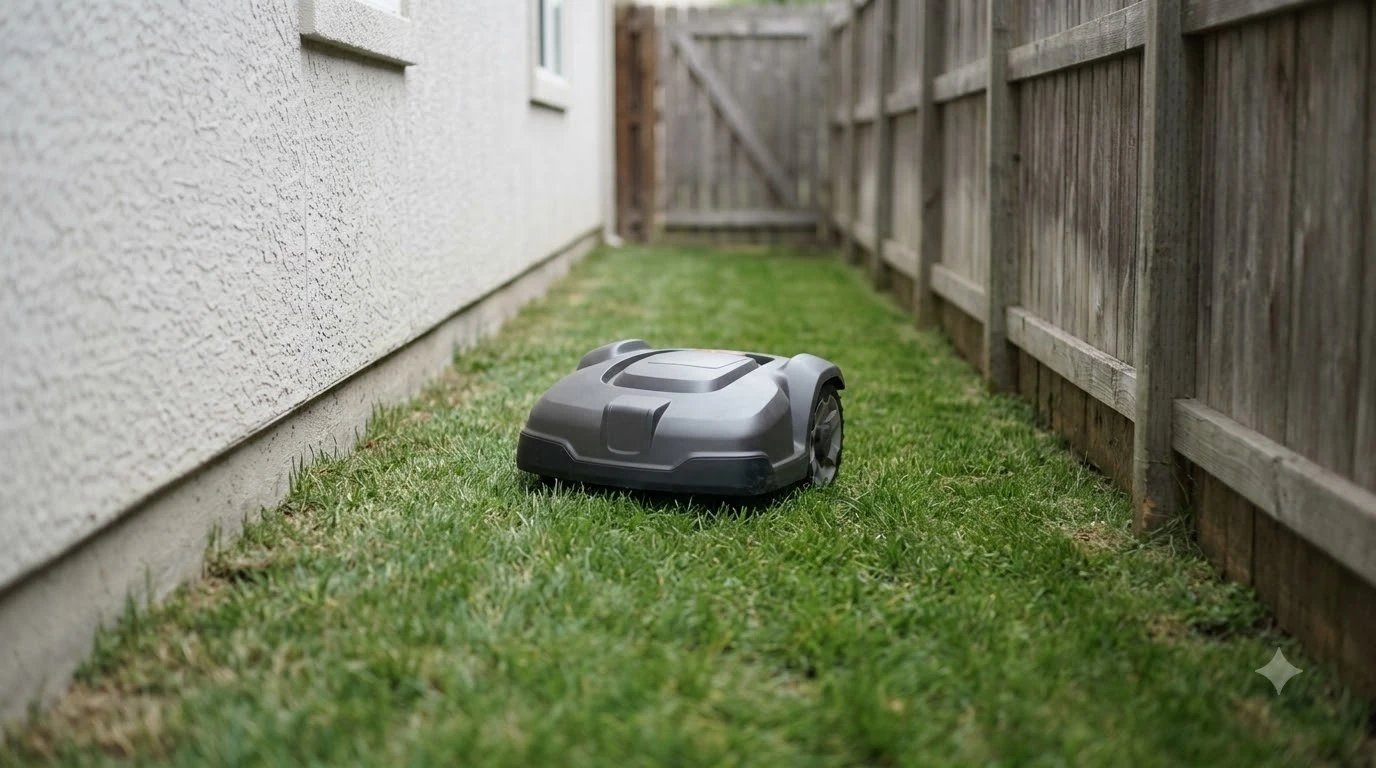

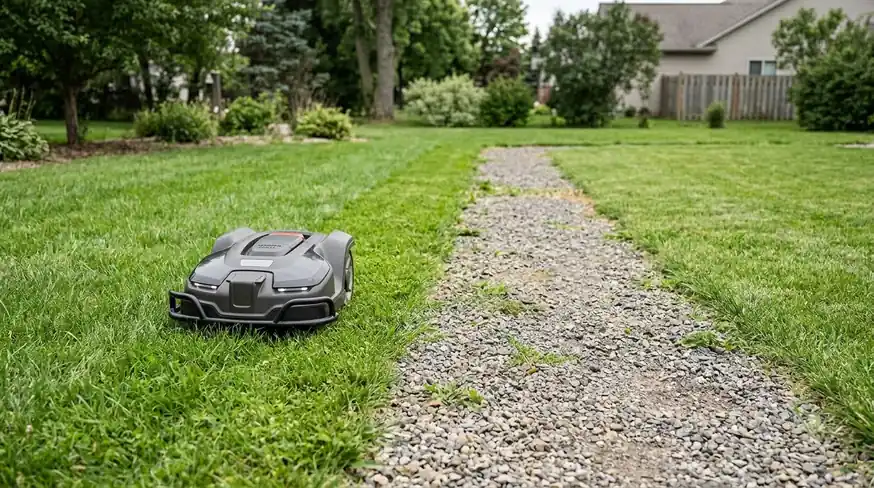
A robot mower for a yard with a gravel parking pad transition can work reliably when the transition is either blocked by a boundary setback or bridged with a flat, compacted crossing strip. Loose aggregate poses two distinct hazards: spinning blades can strike kicked-up stones, and small drive wheels can dig into deep pebbles during turns. Whether your mower stops at the pad edge or crosses over to reach a secondary lawn zone depends on how you grade the lip and configure your boundary rules.
The short answer
- Loose vs. compacted stone: Firm, compacted fine gravel may allow transit when blades are off, whereas loose or rounded gravel causes wheel spin and blade strikes, according to Anker’s path-crossing guide.
- Keep mowing zones off the pad: Standard boundary wire installations intentionally overshoot the wire by several inches, so wiring directly along loose gravel pulls the cutting deck onto the stones unless you leave a setback.
- Use dedicated transit channels: Wire-free RTK and vision models let you map a non-mowing transport path across a parking pad so the blades stay disengaged while the chassis crosses.
- Grade the grass-to-gravel lip: A drop-off or raised timber border can beach the chassis; backfilling with soil or setting flush pavers keeps both drive wheels in contact with the ground.
- Schedule around parked cars: Both manufacturer manuals and our reading of multi-zone setups emphasize running crossings only during hours when vehicles are not entering, exiting, or blocking the transit lane.
Why gravel parking pads challenge robot mowers
Unlike poured concrete or asphalt, a gravel parking pad shifts under vehicle tires and creates an uneven, shifting boundary where grass meets stone.
Most residential robot mowers use small, lightweight caster wheels up front and narrow rear drive wheels designed for turf traction. When a mower turns at the edge of a gravel parking pad, the pivoting rear wheel exerts lateral force that pushes loose stones aside. On rounded river rock or deep crushed stone, the wheel digs a rut and triggers a “wheel slipped” or “mower trapped” error.
The second issue is the cutting deck itself. Robot mowers rely on lightweight, razor-style pivoting blades spinning at high speeds just inches above the soil. Because vehicles frequently push gravel outward onto the adjacent turf, a mower trimming the grass border can strike migrated stones, nicking or shattering the blades and flinging debris.
Height differences compound both problems. Over time, car tires compact the center of a parking pad while pushing gravel toward the perimeter, or lawn thatch builds up higher than the stone bed. Robomow’s path-crossing documentation notes that level transitions are critical so the mower does not drop off a ledge or catch its undercarriage on the edge.
Edge-only perimeter vs. full pad crossing
Before installing wire or mapping virtual zones, decide whether your robot mower only needs to trim up to the parking pad or must cross it to reach another patch of grass.
| Yard layout goal | Gravel condition | Recommended setup | Blade status on gravel |
|---|---|---|---|
| Stop at the parking pad border | Loose, deep, or rounded stone | Set boundary wire or virtual perimeter back from the stone lip | Active in grass only; never enters gravel |
| Cross pad to a second lawn | Firmly compacted fine crushed stone | Map a straight, narrow transit channel or wire corridor | Disengaged during transit (wire-free) or raised |
| Cross pad to a second lawn | Loose gravel or deep ruts | Install two flush rows of pavers or bonded gravel | Disengaged during transit across the hard strip |
| Reach an isolated side strip | Wide, heavily trafficked parking pad | Treat as a manual secondary area without a crossing | Active only after manual carry to the zone |
If the parking pad sits along one edge of your property and does not split the lawn into two pieces, you do not want the mower touching the stone at all. In a boundary-wire setup, remember that the mower’s nose travels past the wire before turning around. According to Husqvarna’s installation guidance, wire placement distance depends on edge height: low flush edges use a tighter setback (around 10 cm or 4 in), while borders that behave like obstacles require 30 to 35 cm (12 to 14 in) of clearance so the wheels stay safely on turf.
Treating a loose gravel pad like a hard obstacle leaves a narrow strip of untrimmed grass along the border that you will need to finish with a string trimmer. That minor manual touch-up prevents damaged blades and stranded recoveries.
Preparing a gravel transition for reliable crossings
When a gravel parking pad separates your front lawn from a side yard, building a stable bridge across the pad prevents wheel spin and keeps stones out of the deck.
- Pick the straightest, narrowest crossing line. Choose a route perpendicular to the parking pad rather than a diagonal path, minimizing the distance the mower spends off turf and avoiding areas where car tires turn sharply.
- Compact or pave the wheel tracks. For loose gravel, Anker recommends laying two flush rows of solid pavers or creating a narrow bonded-gravel strip spaced to match your mower’s wheel track width.
- Level the turf-to-gravel lip. Backfill low spots with topsoil or tamped fines so the mower rolls smoothly onto the pad without its front bumper scraping or its caster wheels dropping into a trench.
- Set the corridor width to match your model. According to Husqvarna’s boundary passage support page, narrow passages with a guide wire require at least 60 cm (24 in) between boundary wires (with 30 cm or 12 in between the guide wire and each boundary wire), while Anker notes that 80 to 100 cm is a practical starting width for general path crossings.
- Run supervised test passes in both directions. Send the mower across to the secondary zone and trigger a return-to-dock test, watching closely for wheel slip, chassis drag, or repeated route recalculations.
Wired vs. wire-free navigation across gravel pads
The way your mower navigates a gravel parking pad transition differs sharply between traditional perimeter-wire machines and modern GPS-RTK or vision-guided robots.
In a classic boundary-wire yard, the mower cannot turn off its cutting motor exclusively while crossing a mid-yard strip unless it is following a dedicated guide wire home. When the mower enters a wired corridor between two lawn sections during normal mowing, the blades remain spinning. That makes a hard, stone-free surface—such as flush pavers or tightly compacted crushed stone—mandatory so the spinning blades do not strike loose pebbles.
Wire-free mowers using RTK satellite positioning, LiDAR, or cameras handle parking pad transitions more cleanly. Instead of treating the gravel as part of the mowing zone, you map the main lawn and the secondary lawn as separate zones and link them with a virtual transport path or channel. When traveling along that channel, the mower disengages its cutting blades and drives directly from point A to point B without random turns that could dig into the gravel.
Heads up
Never route a boundary wire or virtual transit path across a public street or shared municipal sidewalk, and avoid scheduling parking pad crossings during hours when family members or delivery drivers regularly park or pull out.
Vehicle parking patterns also affect wire-free models. A parked SUV or delivery van sitting directly over your mapped transit channel will block the mower’s path and can shadow satellite signals near the vehicle body. Most multi-zone apps allow you to assign specific time windows to each zone, making it simple to schedule the far-side lawn during mid-morning or mid-afternoon hours when the parking pad is empty.
Ongoing maintenance at the grass-and-gravel border
Even a well-graded transition requires periodic checks because both grass growth and vehicle traffic gradually alter the edge profile.
Vehicle tires inevitably kick loose stones onto the adjacent lawn perimeter, especially after heavy rain or when a driver turns the steering wheel while stationary. Walking the transition line once a week to sweep stray gravel back onto the pad protects your blades and prevents the mower from stalling on an unexpected rock.
Check the boundary wire stakes every spring and autumn if you use a wired setup. Frost heave and vehicle weight near the pad edge can push wire staples upward, exposing the copper cable to the mower’s blades or a string trimmer. Burying the wire a couple of inches deep where it approaches the gravel transition keeps it secure through seasonal shifts.
Frequently asked questions
Can a robot mower drive over loose gravel to reach another part of the yard?
Not reliably. Loose or rounded gravel causes narrow drive wheels to dig in during turns and risks stones hitting the spinning blades. To cross a loose gravel parking pad safely, install two flush rows of solid pavers or a compacted, bonded-gravel strip.
How far from a gravel parking pad should I place my boundary wire?
If you want the mower to stay completely off loose gravel, place the wire at the obstacle setback distance listed in your manual—typically 30 to 35 cm (12 to 14 in) from the gravel edge—because mowers intentionally travel several inches past the wire before turning.
Do robot mowers turn off their blades when crossing a parking pad?
Wire-free RTK and vision models typically shut off their cutting blades while following a mapped transport path between separate zones. Traditional boundary-wire mowers usually keep their blades spinning during regular mowing passes unless they are following a guide wire straight back to the charging dock.
What happens if a car is parked on the gravel pad during a scheduled crossing?
The mower will treat the parked vehicle as an obstacle, pause, or fail to reach the secondary lawn zone, and eventually return to its dock or stop with an error. Scheduling crossings during times when the parking pad is normally clear prevents interrupted runs.
Sources
- Can Robot Lawn Mower Cross Path? A Practical Setup Guide (Anker): gravel surface suitability, paver strip recommendations, and 80–100 cm path width guidance.
- Can a robotic lawnmower cross paths? (Robomow): guidance on leveling path edges, avoiding height drops, and stone-blade risks.
- How to create a passage in an Automower boundary wire installation (Husqvarna): minimum 60 cm passage width and 30 cm guide-to-boundary wire spacing rules.
- Husqvarna Automower virtual boundary installation guide (Husqvarna): transport path setup and stay-out zone mapping for wire-free installations.
 Up next8 min readBy YardRobot Mower for a Lawn with an RV Parking PadUpdated Nov 13, 2026
 9 min readBy YardChoosing and Setting Up a Robot Mower for a Yard With a Wooden Boardwalk PathUpdated Nov 19, 2026
 9 min readBy YardChoosing and Setting Up a Robot Mower for a Yard With an Outdoor AC Condenser UnitUpdated Nov 19, 2026
 8 min readBy YardChoosing and Setting Up a Robot Mower for a Yard With Decorative River Rock BordersUpdated Nov 19, 2026
 9 min readBy YardChoosing and Setting Up a Robot Mower for a Yard With Flagstone Walkways Set in GrassUpdated Nov 19, 2026
 8 min readBy YardChoosing and Setting Up a Robot Mower for a Yard With a Pool Deck Coping LipUpdated Nov 19, 2026