
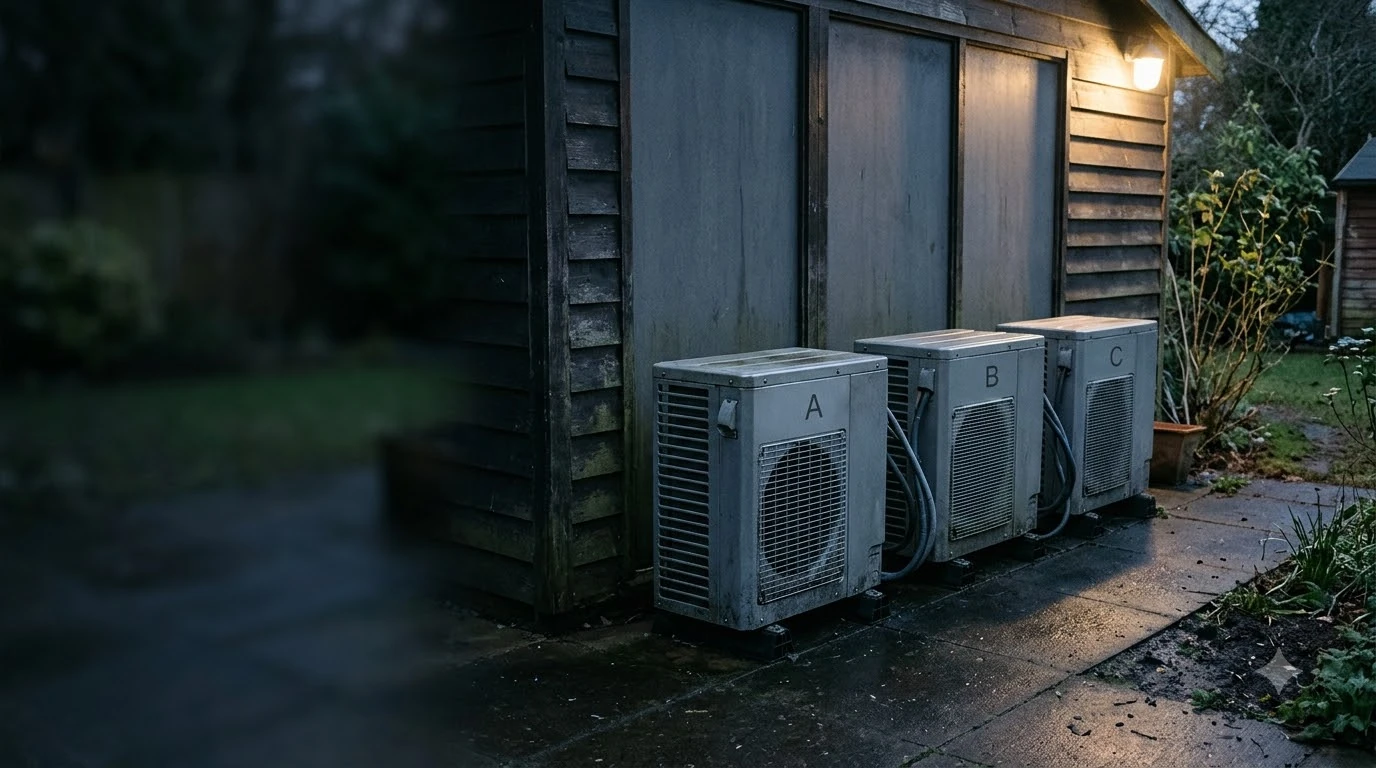

A robot mower for a yard with an outdoor ac condenser unit works well once you establish a clear exclusion zone around the equipment pad and exposed utility lines. Central air conditioners and heat pumps introduce concrete slabs, metal cabinets, low-hanging refrigerant tubing, and electrical whips that can trap a mower or suffer cosmetic damage from repeated bumper impacts. Proper boundary setup—whether through buried perimeter wire or virtual mapping buffers—keeps the unit safe while letting the bot handle the surrounding lawn automatically.
The short answer
- Create an exclusion zone: Use a boundary wire island or a virtual no-go zone so the mower stays off the condenser pad and avoids hitting the metal cabinet or insulated refrigerant lines.
- Respect manufacturer setback distances: Husqvarna specifies placing boundary wire roughly 14 inches (35 cm) from rigid obstacles taller than 1.4 inches to prevent collisions, while Worx manuals call for about 10.2 inches (26 cm) around edges and off-limits islands.
- Account for side-yard signal bounce: Condensers usually sit tight against an exterior house wall where metal panels and brick reflect satellite signals, making vision cameras or LiDAR helpful backups on RTK wire-free models.
- Keep the charging dock separate: Metal cabinets and electrical disconnects can interfere with low-voltage docking signals, so manufacturers like Gardena recommend keeping charging stations at least 3 feet (1 meter) away from metallic objects.
- Expect light manual trimming: A safe buffer around the pad leaves a narrow ring of uncut grass that requires occasional string trimming or a gravel border.
Why an outdoor AC condenser challenges a robot mower
An outdoor HVAC unit combines hard vertical surfaces, ground-level concrete edges, and vulnerable exposed lines in a tight corner of the yard.
Unlike a smooth tree trunk or a solid masonry wall, a residential condenser sits on a composite or concrete pad that often rises an inch or two above the soil. When a robot mower approaches at an angle, one drive wheel can climb the lip of the pad while the other stays in the turf, beaching the chassis or nicking the spinning razor blades against rough concrete. Even if the pad sits flush with the lawn, letting a bump-and-turn mower repeatedly ram the sheet-metal louver panels can dent the fins or rattle loose access screws over a long summer.
The bigger vulnerability lies on the house side of the cabinet. Insulated copper refrigerant lines, PVC condensate drain pipes, and flexible electrical conduit whips often droop close to grass level before entering the exterior wall. A mower without a defined perimeter around the unit can snag the foam line-set insulation or chew through low-voltage thermostat wiring. Furthermore, according to residential HVAC maintenance guidance from Back Bay Heating and Cooling, split-system condensers typically need 12 to 18 inches of open side clearance for proper airflow and technician access, meaning tall grass or dense weeds against the coils should never be left unchecked.
Boundary wire versus wire-free navigation near HVAC equipment
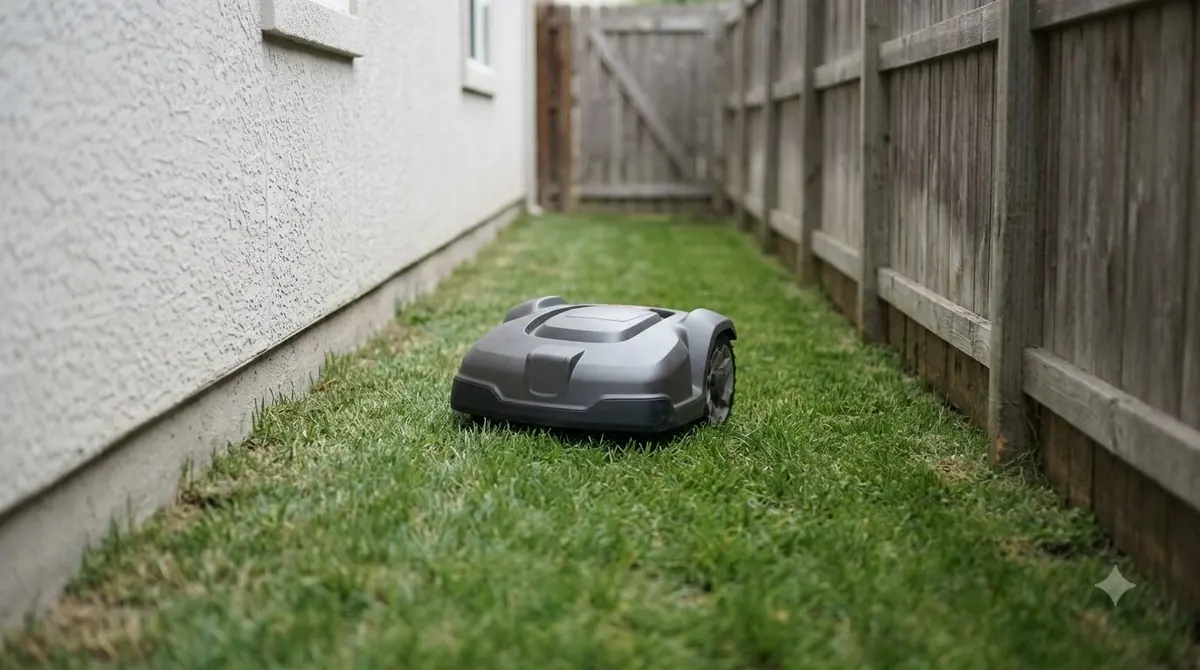
How a robot mower behaves around your air conditioner depends heavily on whether it relies on a physical perimeter cable or satellite and optical sensors.
Wired mowers remain predictable around HVAC pads because the buried or pegged copper loop creates a hard electronic fence regardless of roof overhangs or metal siding. However, you cannot simply run the perimeter wire straight up to the concrete pad; you must route an “island” loop out from the main border, around the condenser, and back along the exact same path so the two parallel wires cancel each other’s signal. If the two return strands cross over each other, the mower will fail to recognize the island and either stop with an error or drive right over the pad.
Wire-free mowers using Real-Time Kinematic (RTK) GPS face a different set of hurdles near an AC unit. Condensers are typically tucked into narrow side yards beneath roof eaves, flanked by brick or siding on one side and a privacy fence on the other. Large metal cabinets, brick walls, and tight corridors reflect satellite signals and block low-horizon sky view, causing positioning to drop from a centimeter-level “fix” to a less accurate “float” state. Wire-free models that pair RTK antennas with onboard RGB vision cameras, ultrasonic sensors, or 3D LiDAR handle condenser corners far more reliably than satellite-only units because they visually detect the cabinet even when GPS multipath errors occur.
| Navigation Type | How It Excludes the AC Unit | Main Limitation Near Condensers | Best Setup Practice |
|---|---|---|---|
| Boundary Wire | Physical wire island looped around the pad | Requires careful spacing so parallel return wires do not cross | Set wire 10 to 14 inches out from the pad or cabinet edge |
| RTK GPS Only | App-drawn virtual no-go zone | Metal cabinet and house wall cause satellite multipath drift | Add a generous virtual buffer and keep the RTK base in open sky |
| RTK + Vision / LiDAR | Virtual no-go zone plus real-time obstacle avoidance | Deep shadows or tall weeds can confuse optical sensors | Combine a mapped no-go zone with a clean gravel border |
How to set up a safe exclusion zone around your condenser
Measuring your setback accurately before laying wire or driving a virtual mapping loop prevents both clipped refrigerant lines and excessive hand-trimming.
Check your mower’s installation manual for its specific obstacle offset, because different brands overhang the boundary line by different distances before reversing. According to the Husqvarna Automower installation support guide, rigid obstacles taller than 1.4 inches require roughly 14 inches (35 cm) of clearance from the wire so the body never contacts the surface, whereas Worx Landroid manuals specify 10.2 inches (26 cm) using their cardboard spacing gauge. If your condenser sits within two or three feet of the house wall, check whether that narrow strip is wide enough for a legal mowing corridor; most wired mowers need at least 24 to 36 inches between opposing boundary wires to pass through without bouncing endlessly.
- Inspect the pad and line set first. Confirm where the concrete pad ends, where the copper refrigerant lines and drain pipe sit, and whether any low-voltage thermostat wires rest on the soil.
- Decide whether to block the wall gap. If the space between the back of the AC unit and your house wall is narrower than your mower’s minimum corridor width, include that dead gap inside the exclusion zone rather than inviting the bot to get wedged behind the condenser.
- Lay the island or map the no-go buffer. For wired bots, run the cable from the nearest perimeter edge, circle the pad at your manual’s required offset, and staple the incoming and outgoing wires tightly together without crossing them. For wire-free bots, walk the mower slowly around the unit with a 12-to-18-inch visual safety margin.
- Test approach angles at low speed. Run a border test or manual perimeter check while watching how the front bumper and blade deck clear the pad corner and refrigerant insulation.
Heads up
Never place your robot mower’s charging station right next to the outdoor AC condenser, even if an exterior GFCI outlet sits right there. Gardena support documentation warns that metallic objects within roughly 3 feet (1 meter) of the base can distort docking guide signals and cause the mower to park crooked or miss its charging contacts.
Managing grass clippings, airflow, and the unmowed trim ring
Leaving a protective buffer around your condenser solves collision risks, but you still need a plan for the grass growing inside that margin.
Unlike a traditional walk-behind mower with a side-discharge chute that blasts heavy clumps of wet grass directly into the condenser’s aluminum fins, a robot mower uses small pivoting razor blades to shave tiny clippings every day or two. Those micro-clippings fall straight down into the turf canopy rather than blowing sideways into the coil grille. Interestingly, laboratory research from the University of Nebraska-Lincoln found that light dust or minor debris on residential condenser coils rarely hurts heat transfer efficiency on its own, though heavy matting of grass and weeds can still restrict airflow and trap moisture against the metal cabinet.
To eliminate weekly string-trimming around the exclusion zone, many homeowners replace the grass inside the buffer with a 12-to-18-inch border of crushed stone, river rock, or pavers laid flush with the lawn. A flush hardscape border serves two purposes: it suppresses weeds right up against the condenser base where airflow matters most, and it lets your robot mower’s outer wheel ride smoothly along the stone edge so virtually zero grass blades remain uncut.
Frequently asked questions
Can a robot mower damage the refrigerant lines on an outdoor AC unit?
Yes, if the mower is allowed to drive right up to the cabinet. While the small pivoting blades on most robot mowers are unlikely to slice through solid copper tubing, they can easily shred foam pipe insulation, nick plastic condensate drain lines, or sever thin low-voltage thermostat control wires resting near the ground.
Should I put a boundary wire island around my AC condenser pad?
In almost every yard, yes. Creating a boundary wire island or a virtual no-go zone keeps the mower from climbing onto the raised concrete or composite pad, prevents repeated bumper collisions against delicate louver fins, and stops the bot from wedging itself between the condenser and the exterior wall.
Do robot mowers blow grass clippings into outdoor air conditioner coils?
No, far less than a conventional rotary mower. Because robot mowers cut tiny amounts of grass frequently without high-lift vacuum blades or a side-discharge chute, clippings drop directly into the lawn rather than spraying onto the condenser fins.
Can I plug my robot mower charging base into the outlet next to my AC unit?
You can use the exterior GFCI outlet for power if the low-voltage cable reaches, but you should mount the charging dock itself at least 3 feet away from the metal condenser cabinet. Nearby sheet metal and electrical disconnects can interfere with the dock’s positioning signal and cause erratic docking.
Sources
- How to create islands in a boundary wire Automower installation (Husqvarna Support): Referenced for island wiring rules, parallel signal-canceling layout, and obstacle clearance guidelines.
- Wire-free Robot Mower RTK Accuracy Guide for Precise Boundary (RTKdata): Used for satellite multipath interference near metal HVAC units, walls, and narrow side yards.
- How Much Outdoor AC Unit Clearance Do You Need? (Back Bay Heating and Cooling): Referenced for standard residential condenser airflow clearance and service access spacing.
- Skip this chore: Cleaning your air conditioner condenser probably won’t make it work better (University of Nebraska-Lincoln): Referenced for academic research on how airborne grass clippings and coil fouling affect condenser heat transfer.
 Up next9 min readBy YardChoosing and Setting Up a Robot Mower for a Yard With an Outdoor Kitchen IslandUpdated Nov 19, 2026
 8 min readBy YardChoosing and Setting Up a Robot Mower for a Yard With Decorative River Rock BordersUpdated Nov 19, 2026
 9 min readBy YardChoosing and Setting Up a Robot Mower for a Yard With a Wooden Boardwalk PathUpdated Nov 19, 2026
 9 min readBy YardChoosing and Setting Up a Robot Mower for a Yard With Flagstone Walkways Set in GrassUpdated Nov 19, 2026
 8 min readBy YardChoosing and Setting Up a Robot Mower for a Yard With a Pool Deck Coping LipUpdated Nov 19, 2026
 9 min readBy YardChoosing and Setting Up a Robot Mower for a Yard With a Split-Rail Wooden FenceUpdated Nov 19, 2026