
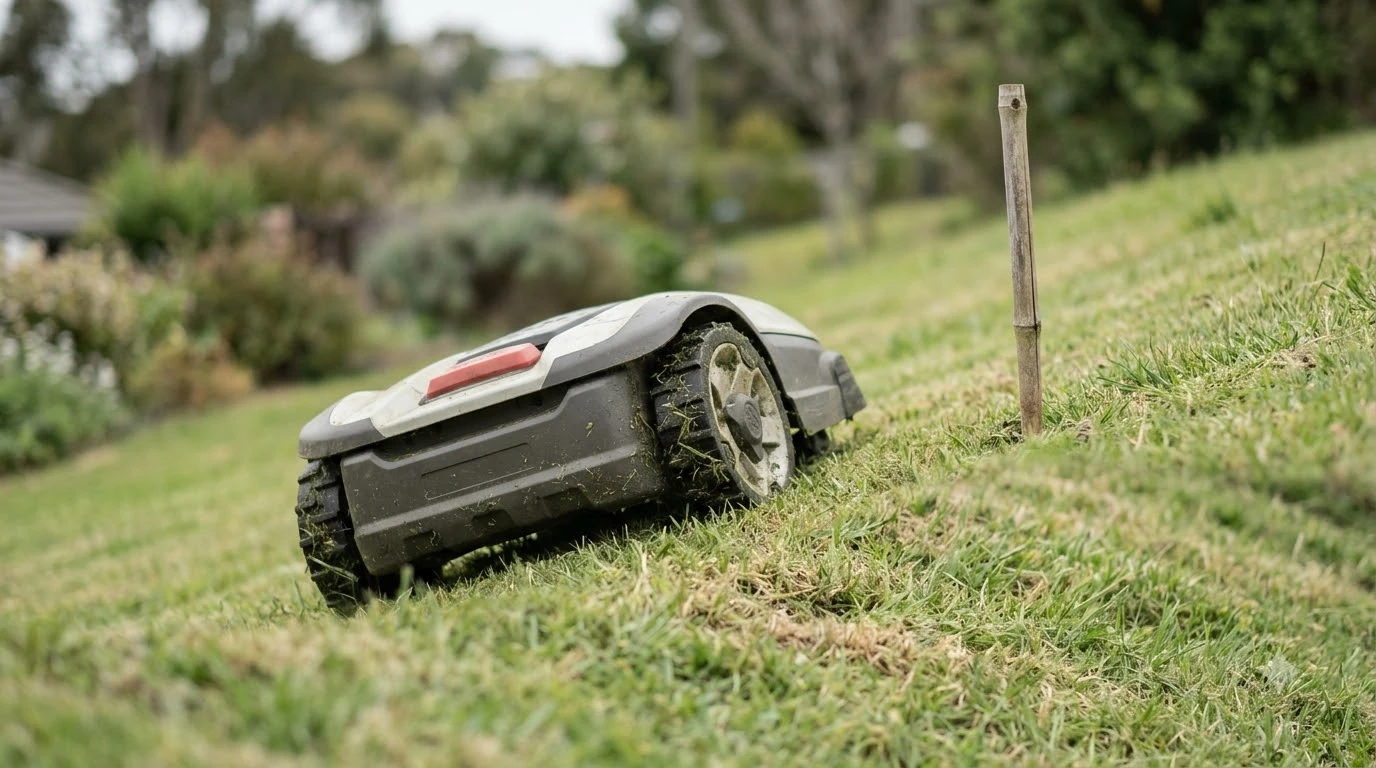

What does AWD mean on a robot mower? It means all-wheel drive: the machine sends power to all four wheels instead of just the front or rear pair. That extra grip helps on slopes and on damp grass, but it also adds cost, weight, and drivetrain parts. Prices and features below are as of 2026-11-09 and vary by brand, so check the spec sheet before you buy.
The short answer
- AWD: all four wheels are driven, so the mower pulls itself up and across slopes more reliably.
- 2WD: two wheels are driven, usually fine for flat and dry lawns.
- Slope rating: the number on the spec sheet matters more than the drive label.
- Trade-off: AWD usually costs more, weighs more, and has more parts to maintain.
What does AWD mean on a robot mower, and how does it work?
So, what does AWD mean on a robot mower in plain terms? All-wheel drive, or AWD, means every wheel receives power from the drive system. Some vendors use the term 4WD for the same design, so read the spec sheet for the number of driven wheels rather than relying on the name alone.
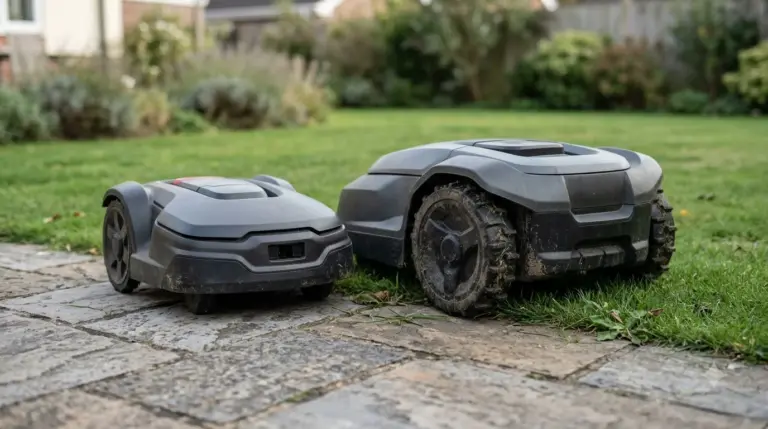
Robot mowers use three common layouts. In a front-wheel-drive (FWD) design, one central motor sends power through a differential to the front wheels, and the rear wheels follow. In a rear-wheel-drive (RWD) design, the rear wheels do the driving and the front wheels only steer. An AWD design typically uses multiple motors, often one per side or one per wheel. Mammotion describes its LUBA 2 AWD as using four independent in-hub motors, which is a vendor claim we could not check independently.
AWD vs 2WD on slopes
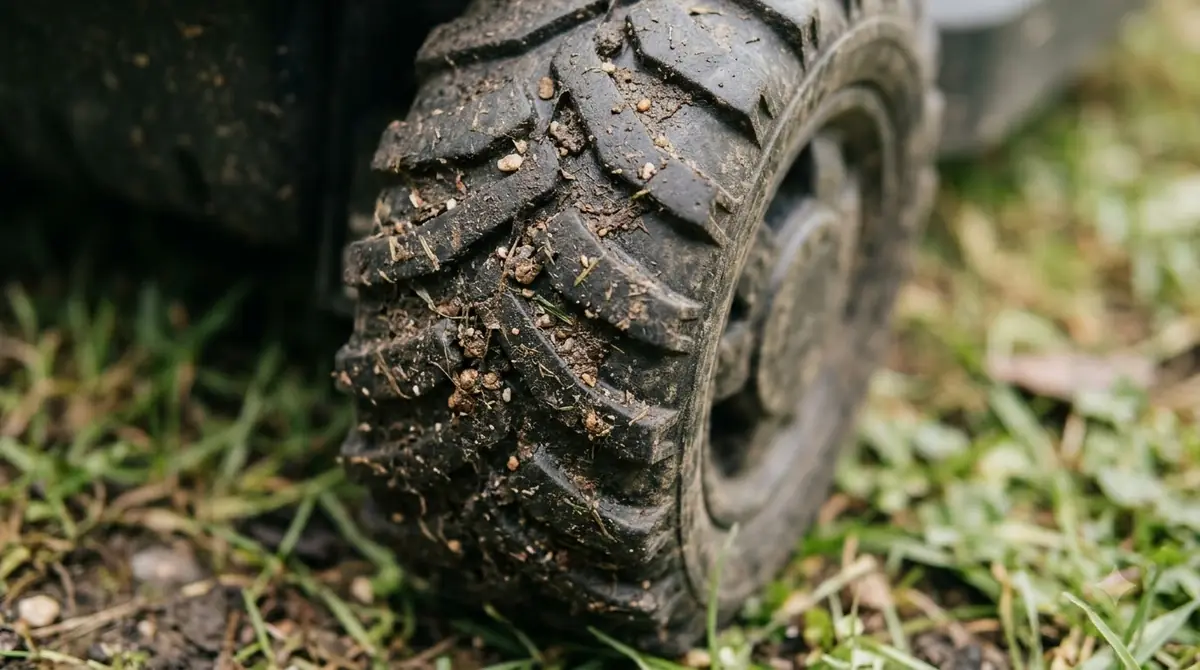
What does AWD mean on a robot mower when the lawn tilts? More traction, because each driven wheel can push against the turf. Sunseeker’s guide says front-wheel drive can lose traction on a climb, since weight shifts off the front wheels and the driven wheels can spin or dig into soft soil. Its guide describes AWD models as handling inclines that are often over 35 degrees, which it presents as beyond what FWD or RWD designs manage.
The vendor guides do not agree on exact limits for two-wheel models. Mammotion’s 2WD comparison gives conflicting figures within the same page, so we would not rely on any single number for a 2WD mower. The table below compares the layouts on the points that matter for a slope decision, and our deeper comparison of AWD versus 2WD robot mowers on hills covers the same choice from the buyer’s side.
| Layout | Driven wheels | Slope behavior (vendor guidance) | Best fit |
|---|---|---|---|
| FWD | Two front | Front wheels can spin on a climb and dig into soft soil | Flat or gently rolling yards |
| RWD | Two rear | Moderate slopes; vendors suggest up to about 25 degrees | Yards with mild slopes and dry grass |
| AWD | All four | Better grip on steep, wet, or loose ground | Steeper yards, damp lawns, and uneven ground |
Whatever the layout, a mower that works on a steep slope in dry weather can still struggle on the same slope after rain. Plan for the wettest days of the year, not the best ones.

What the slope numbers mean
Husqvarna rates its AWD 435X at up to 70 percent, which is 35 degrees. Its standard models range from 25 percent to 50 percent, depending on the model. Slope is measured as vertical rise divided by horizontal distance, multiplied by 100, so 15 cm of rise over 100 cm of run is a 15 percent slope.
Husqvarna’s AWD guidance also shows how the rating is used in practice. On an AWD model, the mower operates normally on slopes up to 50 percent inside the work area. Between 50 and 70 percent, the company advises keeping obstacles off the slope and leaving 1.5 m (5 ft) between the bottom of the slope and the boundary wire. For wire-based installs, Husqvarna says to lay the guide wire diagonally across the slope for better traction and less grass wear.
Eufy, a retailer, makes a useful point about the rating itself. It calls the maximum slope an absolute limit rather than a target for daily mowing, and warns that running at the top of the range strains the motor, drains the battery, and increases tire slip. Our reading is that a mower rated above your steepest slope gives a margin for that wear. Husqvarna’s steep-slope installation guide gives the model-by-model limits.
How AWD handles wet grass
Wet grass reduces tire grip on every drive layout. Eufy says a slope that is within the rated limit can still cause sideways slides or downhill slips after rain (see our guide to mowers sliding on wet slopes), because the tires lose bite on damp turf. AWD does not remove that risk, but it spreads the pulling force across four wheels, which is why vendors position it for damp lawns.
Mammotion says AWD models grip damp or soft turf instead of sliding over it, and that the extra drive keeps the mower on course over rutted ground. Those are vendor claims without independent test data, so treat them as direction rather than measurement. Mammotion also notes that AWD systems add weight, which can compress soft turf more in early spring or after rain.
A few habits help on wet slopes whatever the drive type:
- Clean the wheels. Husqvarna says clogged wheels make slopes harder to handle, and recommends a soft brush or hose. A set of wheel brushes for a robot mower makes that quick.
- Check the tread. Eufy credits deep tread and heavy rear wheels with better grip on sloping lawns.
- Use a rain sensor. Eufy recommends automatic rain sensors, which send the mower back to its dock when it starts to rain, and some models listed under robot mowers with rain sensors include one.
Trade-offs of AWD
AWD usually costs more than a comparable two-wheel mower. Mammotion describes AWD models as typically costing significantly more than standard robot mowers, and its FAQ gives a range of around $2,000 to $5,000 or more, as of 2026-11-09, depending on brand and features. Sunseeker says AWD is the most expensive of the three layouts, but does not tie a dollar figure to drive type.
- Price: AWD sits at the premium end of the range, according to both Mammotion and Sunseeker.
- Weight: AWD adds weight, but neither vendor publishes a weight figure to compare.
- Maintenance: more motors and gears mean more parts to service. Sunseeker and Mammotion both say AWD needs more upkeep than simpler layouts.
- Service access: Mammotion notes that not every local shop has experience servicing AWD units.
Battery use is another factor. Sunseeker says AWD uses the most power of the three layouts, since four wheels draw from the battery. No runtime figures are published for comparison, so a mower with a larger battery is worth checking on steep yards.
Is AWD worth it for your lawn?
For most owners, the real question behind what does AWD mean on a robot mower is whether their slope justifies the price. AWD is worth considering when the lawn has steep sections or stays damp for long periods. A 2WD or RWD mower can be the better buy for a flat, dry yard, where the extra drive adds cost without much benefit. Our guide to picking a robot mower for sloped yards walks through the slope side of that decision.
- Measure the steepest slope. Use the rise-over-run formula and note the highest percentage in the yard.
- Compare that number to the rating. Choose a mower rated above the steepest slope, not just at it.
- Check the wet-season lawn. If the yard stays damp for weeks, weight more heavily toward AWD.
- Price the upkeep. Factor in the higher cost and maintenance before you buy.
Vendors often describe 2WD as suited to yards under roughly a quarter to half an acre, per Mammotion. That is a vendor view, not a standard, so use it as a starting point rather than a rule.
Frequently asked questions
What does AWD mean on a robot mower compared with 4WD?
In most product listings, AWD and 4WD mean the same thing: the mower drives all four wheels. Vendors use the labels inconsistently, so check the spec sheet for the number of driven wheels and any slope rating before you buy.
Does AWD make a robot mower safer on slopes?
AWD improves grip, but it does not replace a proper rating. Husqvarna advises keeping obstacles off steep ground and placing boundary wire carefully, and Eufy warns that running at the top of the rated limit strains the mower. Safe setup still matters on any drive type.
Can a 2WD robot mower handle a hill?
It can handle gentle slopes, especially when the grass is dry. Vendor guides disagree on the exact limits for two-wheel models, so compare the rated slope on the spec sheet with your steepest section rather than relying on the drive label.
What slope can Husqvarna’s AWD model handle?
Husqvarna rates its AWD 435X at up to 70 percent, which is about 35 degrees. On that model, the company says the mower operates normally on slopes up to 50 percent inside the work area, and advises keeping obstacles off slopes between 50 and 70 percent.
Sources
- Optimising an Automower installation for steep slopes (Husqvarna): slope ratings by model, AWD operating zones, slope formula, guide wire advice.
- Robot lawn mower slope limits (Eufy, retailer): rating meaning, wet-grass grip, rain sensors, tread.
- All-wheel drive robot lawn mowers: pros and cons (Mammotion, manufacturer): AWD definition, in-hub motors, cost and weight trade-offs.
- 2WD vs 4WD robot mower (Mammotion, manufacturer): 2WD yard size guidance and drive comparison.
- FWD vs RWD vs AWD robot mowers (Sunseeker, manufacturer): drive layouts, traction, cost and maintenance by layout.
 Up next9 min readBest Robot MowersRobot Mower Coverage Rating Explained: What the Number MeansUpdated Nov 11, 2026
 8 min readBest Robot MowersRobot Mower IP Rating Explained: What IPX4, IPX5 and IPX6 MeanUpdated Nov 11, 2026
 8 min readBest Robot MowersHow Does RTK Work on a Robot Lawn Mower?Updated Nov 11, 2026
 9 min readBest Robot MowersHow Much Does a Robot Lawn Mower Cost?Updated Nov 11, 2026
 9 min readBest Robot MowersHow Many Hours a Day Does a Robot Mower Run?Updated Nov 11, 2026
 8 min readBest Robot MowersHow Much Electricity Does a Robot Mower Use?Updated Nov 11, 2026