
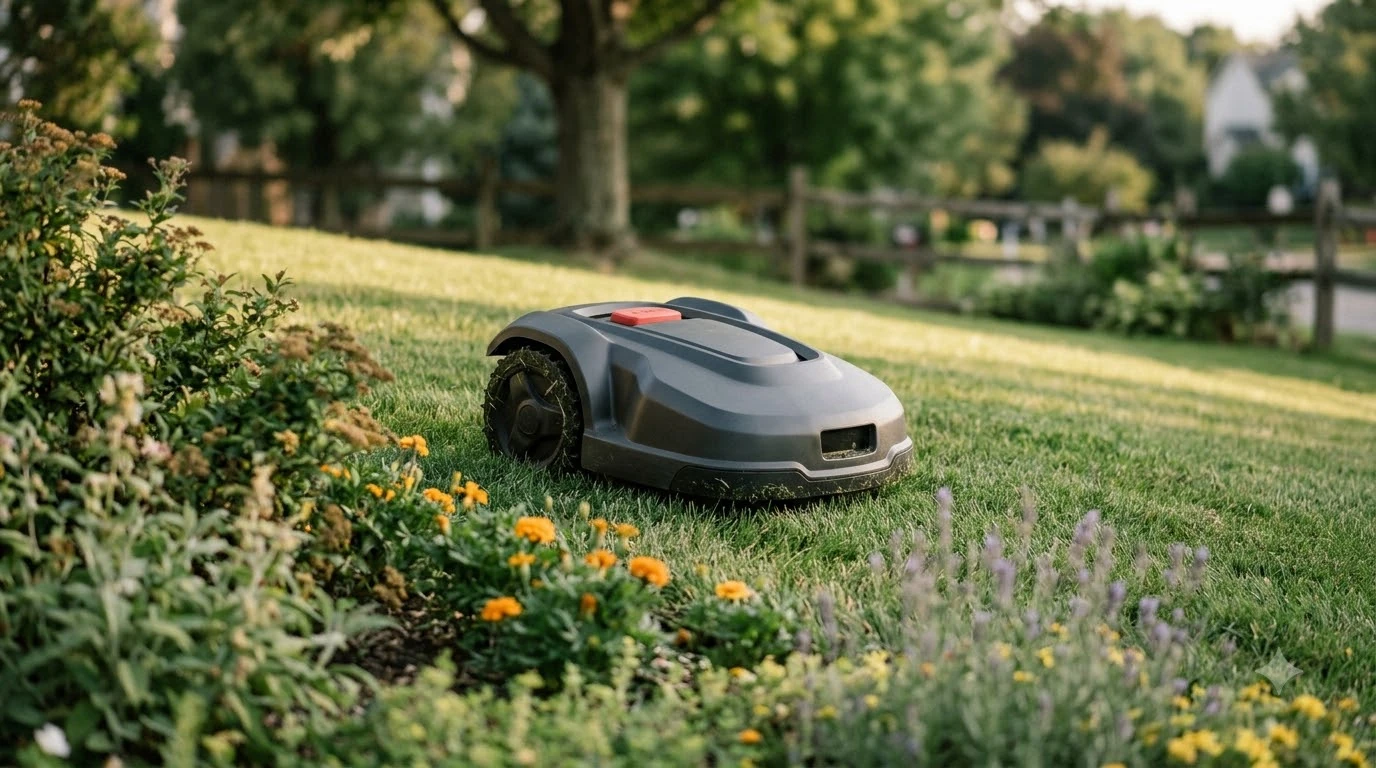

If you are looking for the best robot lawn mower for people with back pain, know that a robot can take over the walking, pushing and steering that make manual mowing hard on a sore back, but it does not remove every physical task. Based on the sources we read, the mower’s weight, the boundary setup and the way the unit is lifted or picked up are the parts that still land on you. Choose a model you can lift or ask someone to help you lift, and plan the installation before you buy.
The short answer
- What it removes: walking behind and pushing the mower. Penn State Extension advises pushing rather than pulling a manual mower, which is the motion a robot makes unnecessary.
- What it does not remove: lifting the unit, carrying the charging station, and installing the boundary wire or the stakes that hold it.
- Weight to expect: the Husqvarna Automower 430X is listed at 28.7 lb and the 435 iQ AWD at 39.9 lb. Both list lift and tilt sensors.
- Setup: wire-free models skip the buried wire, but they need a clear view of the sky at the base station.
- Our reading: if lifting is the hard part, a lighter model with a wire-free setup is the more likely fit. This article is not medical advice; check with your doctor or physical therapist about lifting limits.
What manual mowing asks of your back
Before comparing robots, it helps to name the strain. Penn State Extension’s gardening tips, written by Master Gardener Erin Howell and updated June 23, 2025, give three points that apply to mowing. First, set the handle at mid-waist height. Second, push the mower rather than pull it, so the legs do more of the work and the arms and upper body do less. Third, mix in other activities so the back gets a rest. The same page gives lifting rules: hinge at the hips, bend the knees, and keep the lower back straight. It also warns that “lifting a 10-pound load incorrectly can actually put 100 pounds of pressure on your lower back.”
Those tips describe manual mowing, not robot mowers. The Penn State page does not study robots, and we found no robot-specific study of back pain. The useful takeaway is that the risky parts of mowing are the repeated pushing, the stooping, and any lifting of the machine itself.
What a robot mower takes off the to-do list
A robot removes the repeated pushing that the Penn State tips warn about. Family Handyman, in a June 4, 2025 guide to accessible lawn mowers by Dan Stout, quotes Tyler Graham of The Lawn Review: “Riding mowers make it way easier for someone with mobility issues because no walking or pushing is involved.” The same guide calls robot mowers “a great way for a disabled DIYer to still have a hand in lawn care” because app control suits people who “may not always be able to physically push or ride on a mower.”
In practice, most robot mowers are run from a phone app. The Husqvarna Automower 435 iQ AWD product page lists app control for cutting height, mowing schedule and mowing pattern. Once the boundary is set, the mower starts on its own schedule, so you do not need to walk the lawn each time.

Weight: what you may still have to lift
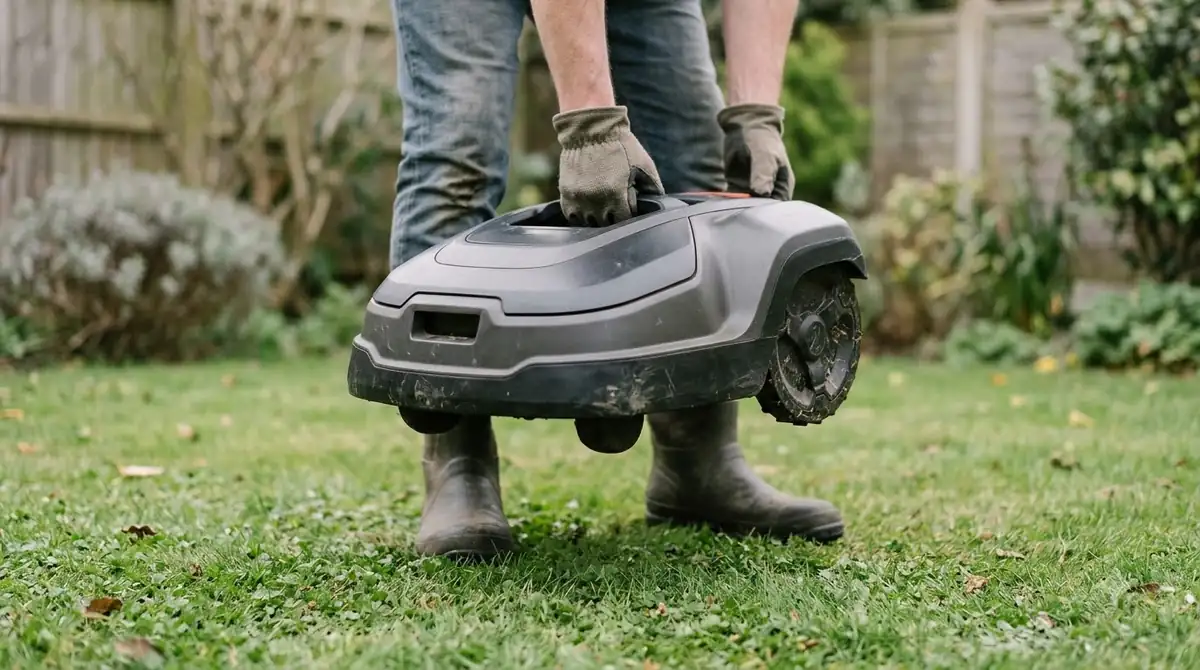
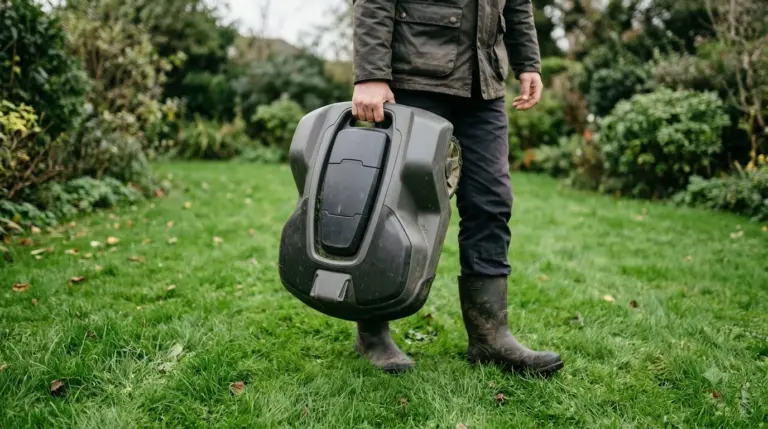
The mower itself is the first lifting task. The table below lists the weights we could confirm on manufacturer or publisher pages. The figures are as read on 2026-11-10 and can change with model revisions.
| Mower | Listed weight | Listed capacity or note |
|---|---|---|
| Husqvarna Automower 430X | 28.7 lb | 0.8 acre (+/-20%), lift and tilt sensors listed |
| Husqvarna Automower 435 iQ AWD | 39.9 lb (about 18.1 kg) | Lift and tilt sensors listed, anti-theft alarm when picked up |
| WORX WR165 (per Family Handyman) | 21 lb | Aimed at yards of one-eighth acre or less |
Weight is not the whole story. Family Handyman notes that a wide-based robot “will be heavy, making it harder to lift and clean out grass clippings,” so a light base matters as much as the number on the scale. Our reading is that a 20 to 25 lb unit is easier to lift than a 40 lb unit, and that a narrow body is easier to carry than a wide one.
Setup: wire versus wire-free
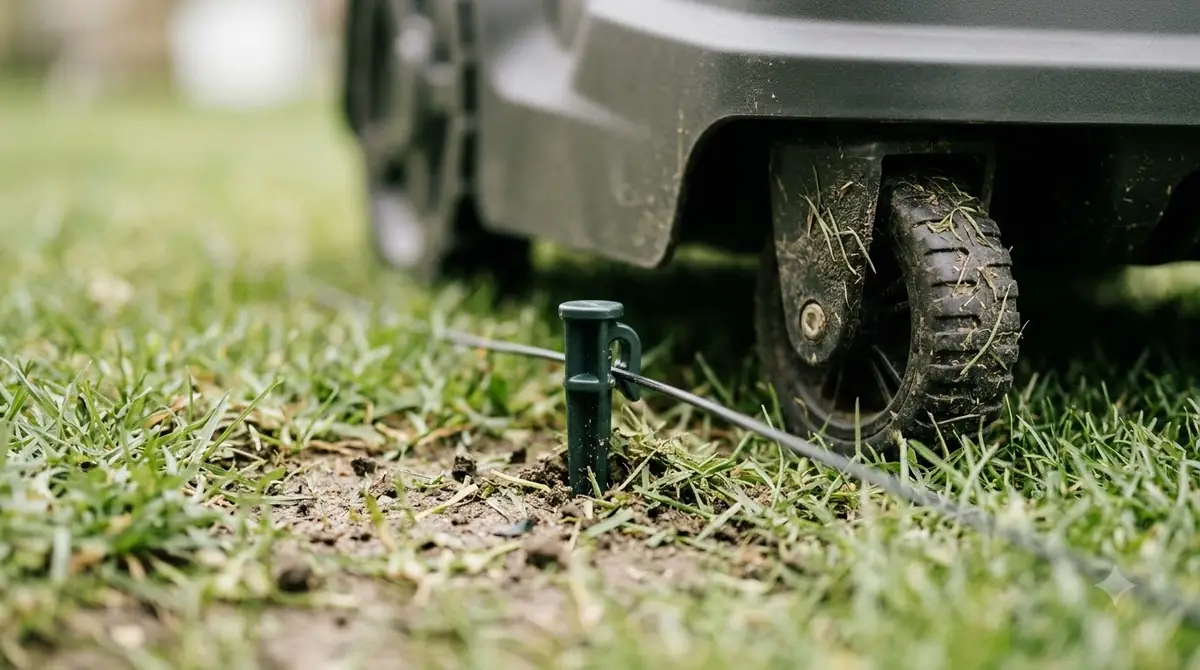
Setup is where many buyers feel the strain. A lawnmowers.com guide from 2026 says burying the boundary wire takes an afternoon with an edger or wire-laying machine, at a depth of 2 to 5 cm. Plastic stakes go in every 50 to 80 cm to hold the wire, and grass can grow over it in three to four weeks. Mammotion, a maker that favors wire-free systems, describes wired installation as “labor-intensive,” so treat that comparison as vendor opinion.
Wire-free models skip the buried wire. The same lawnmowers.com guide says they remove the installation afternoon but carry a higher price, often 30 to 50 percent more than wired models, and they need a clear view of the sky at the base station. Heavy tree cover can weaken their signal. Our reading: if bending and digging are the problem, a wire-free model is the better fit, but only if your yard is open enough to suit it.
Lift sensors, blades and safety when picked up
Many robot mowers include a lift sensor and a tilt sensor, which stop the blades when the unit is raised or tipped. Both the Husqvarna 430X and 435 iQ AWD pages list these sensors as present. Anker and eufy state that many of their models stop blades when lifted or tipped, but not all models do, so check the specific model before you rely on it. The 435 iQ AWD page does not say what its blades do when the mower is lifted, so we did not confirm that behaviour for any model.
The sensors protect people who lift the mower, but they do not make the lift lighter. Use the hip-hinge and knee-bend method from the Penn State tips, ask a helper to take one end, and keep the mower low when you carry it. Blade changes are another task. The 435 iQ AWD page says blades can be changed in minutes, but the same bending and lifting applies, so plan the blade change for a day when you feel well.
Slopes and uneven ground
Uneven ground makes a robot work harder, and it can also make you work harder during setup. Husqvarna support rates its standard models for slopes of 25% to 50% and its AWD models for slopes up to 70%, with the 50 to 70% zone treated as an avoid-obstacle area. Our reading is that a flat or gently sloped lawn is the easiest case for both the mower and the person who sets it up.
When a riding or zero-turn mower may fit better than a robot
A riding mower removes walking and pushing in a different way. Family Handyman lists a 42-inch zero-turn riding mower that “requires just one hand” on its joystick and uses no foot controls, and the article notes that zero-turn mowers with lap bars or joysticks are a popular choice for people who struggle with fine foot movements. The trade-off is that a riding mower still needs you to climb on and off, and it does not solve the lifting problem. Penn State’s advice to mix in other activities to rest the back still applies. We did not find a source that measures back strain from riding-mower seats, so we do not make that claim here.
What to check before you buy the best robot lawn mower for people with back pain
- Listed weight and the base shape. Compare the weight with what you can lift safely, and look for a narrow base.
- Setup method. Decide between buried wire and wire-free based on your yard’s sky view and how much digging you can manage.
- Lift and tilt sensors. Confirm they are listed for the exact model, and check the manual for what the blades do when lifted.
- App control. Confirm you can start, stop and change the schedule from a phone, so you do not need to go outside to adjust it.
- Slope and lawn size. Match the mower to your lawn’s size and slope using the manufacturer’s rating, not a general claim.
- Help available. Plan for a helper for the first setup and for any lift you cannot manage alone.
Frequently asked questions
Does a robot lawn mower remove the pushing?
Yes, a robot moves itself, so you do not push or steer it during mowing. Family Handyman quotes a lawn reviewer saying that riding mowers avoid “walking or pushing” for people with mobility issues, and robot mowers avoid it too. You still handle the mower during setup, cleaning and blade changes.
How heavy is a robot lawn mower to lift?
It depends on the model. The Husqvarna Automower 430X is listed at 28.7 lb, the 435 iQ AWD at 39.9 lb, and the WORX WR165 at 21 lb according to Family Handyman. Check the listed weight for the exact model you plan to buy.
Is it hard to install a robot lawn mower on a bad back?
Wired installation means burying a boundary wire, which a 2026 lawnmowers.com guide estimates takes an afternoon with an edger or wire-laying machine. Wire-free models skip that step but need a clear sky at the base station. Ask a helper to handle digging and stake placement.
Is it safe to pick up a robot mower while it is on?
Do not pick up a running mower. Many models have lift and tilt sensors that stop the blades, and the Husqvarna 430X and 435 iQ AWD list both. Anker and eufy say not all models stop their blades when lifted, and the Husqvarna 435 iQ AWD page does not say what the blades do. Check the manual for your model.
Sources
- Healthy tips to garden with fewer aches and pains (Penn State Extension): mid-waist handle, push rather than pull, lifting method, rest from repetitive tasks.
- Husqvarna Automower 435 iQ AWD (Husqvarna): listed weight, lift and tilt sensors, app control, blade change time.
- Husqvarna Automower 430X (Husqvarna): listed weight, lift and tilt sensors, capacity.
- Best Accessible Lawn Mowers (Family Handyman, Dan Stout, updated June 4, 2025): quoted mobility comments, WORX WR165 weight, wide-base lifting note.
- Robotic mower boundary wire setup guide (lawnmowers.com, 2026): wire depth, stake spacing, wire-free trade-offs.
- Do robot lawn mowers need a boundary wire? (Mammotion, vendor view): wired and wire-free setup effort, noted as vendor opinion.
- How to optimise an Automower installation for steep slopes (Husqvarna support): slope ratings for standard and AWD models.
 Up next8 min readBest Robot MowersBest Robot Lawn Mower for People Who Travel OftenUpdated Nov 11, 2026
 7 min readBest Robot MowersBest Robot Mower for People with Allergies: What to CheckUpdated Nov 17, 2026
 8 min readBest Robot MowersWhat Size Robot Mower Do I Need for 1/4 Acre?Updated Nov 11, 2026
 7 min readBest Robot MowersWhat Size Robot Mower Do You Need for 2 Acres?Updated Nov 11, 2026
 8 min readBest Robot MowersWhat Size Robot Mower Do I Need for 1.5 Acres?Updated Nov 11, 2026
 8 min readBest Robot MowersDo Robot Lawn Mowers Need a Boundary Wire?Updated Nov 11, 2026