
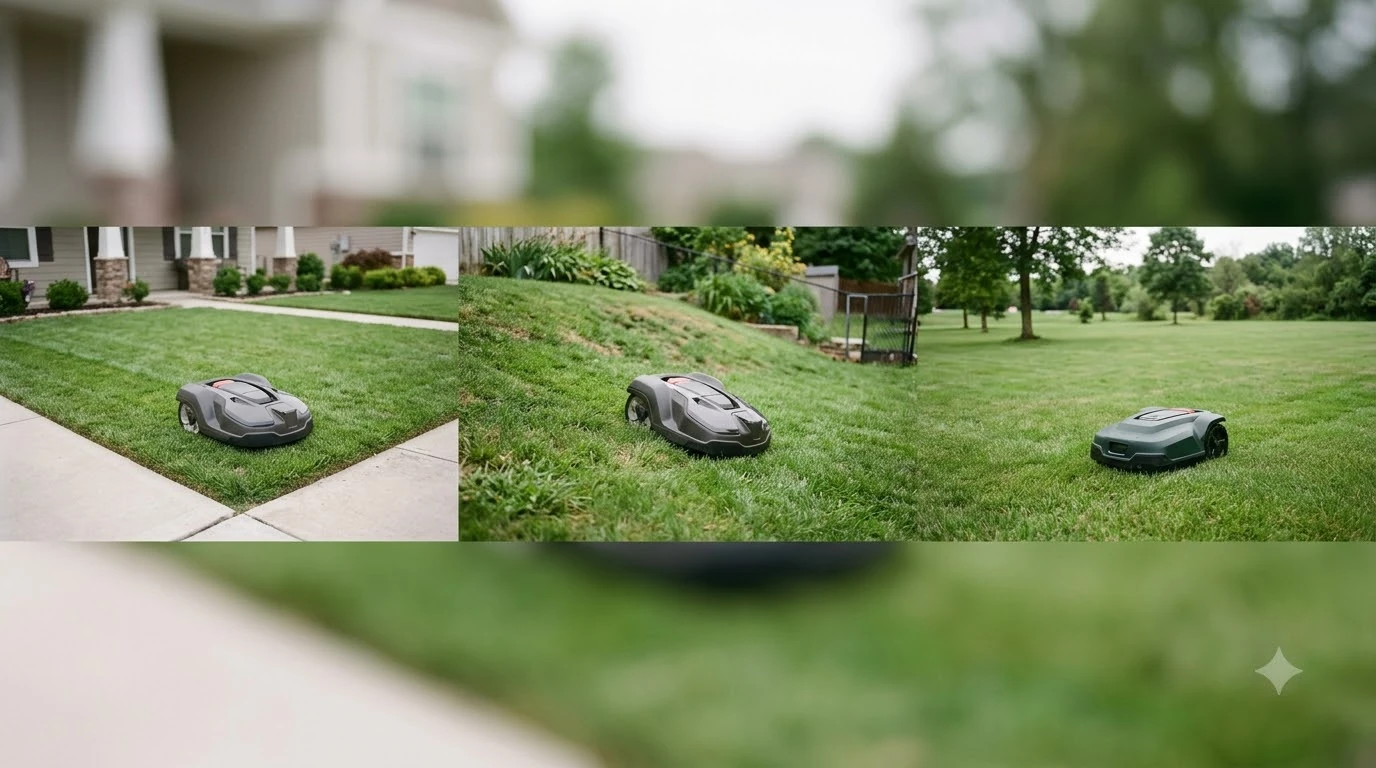

Does a robot mower work in a yard with poor GPS signal? Often yes, but not on satellite positioning alone. Tree canopy, tall walls and roof overhangs weaken the signal that RTK mowers depend on. Mowers that pair RTK with a fallback sensor, or that follow a boundary wire, handle those spots better. Whether a particular mower copes depends on its navigation method, so this guide explains what vendors and extension sources say about each one.
The short answer
- RTK alone: accuracy drops when trees, buildings or walls block the satellite view, and vendors say so directly.
- LiDAR or vision: these sensors do not need satellites to find their way, though each has a named limit such as fog, rain or sensor dirt.
- Boundary wire: the wire gives a fixed edge with no satellites involved, but installation takes hours and the wire can be damaged.
- Check first: ask what the mower does when the satellite fix is lost, not only what its accuracy is when the sky is open.
Why RTK struggles under trees
RTK mowers rely on a base station that corrects satellite signals, so the base and the mower both need a clear view of the sky. Ecovacs says RTK “struggles under dense trees and buildings” because obstructions can interfere with satellite connectivity. Sunseeker lists heavy tree cover, walls and roof overhangs as factors that weaken accuracy, and it describes a base station sky view of about 160 degrees vertically.
Lymow puts it in terms of canopy: performance may degrade under extremely dense tree canopy, though its own vision fusion is meant to reduce that problem. Mowrator adds the physical cause. Trees block, weaken and reflect satellite signals, which creates multipath errors near trunks, fences and walls. Resident’s contributor article makes the same point about hedges and fences, describing path drift when the mower sits close to them.
None of these sources gives a canopy accuracy figure in metres that we could check, so this guide does not quote one. Our reading is that the practical question is not how accurate RTK is in an open lawn, but how long the fix holds in your yard and what the mower does when it does not.
Navigation methods that do not rely on satellites alone
The table below sets out what each navigation method’s makers say and the limit they name. Vendor claims are not independent tests, so read them as the maker’s own description.
| Method | What vendors say | Limit named |
|---|---|---|
| RTK with base station | Accuracy within a few centimetres when the fix holds (Sunseeker) | Dense canopy, buildings and walls weaken the signal (Ecovacs, Lymow) |
| LiDAR | Unaffected by shade or structures (Ecovacs) | Fog and heavy rain scatter the beams (Ecovacs, Anker) |
| Vision (VSLAM) | Takes over for up to 10 minutes when GPS weakens under dense cover (Lymow) | Smaller branches may not always trigger avoidance (Lymow) |
| Boundary wire | Needs no satellites, so trees do not affect the edge | Breaks from equipment, burrowing animals and frost heave; 4 to 8 hours to install (Lymow) |
Some makers combine methods. Ecovacs describes its GOAT O1000 RTK as adding a solid-state LiDAR and a fish-eye camera so that shade or roofs cause less disturbance. Mammotion’s comparison table rates RTK as poor to moderate in shade, LiDAR as excellent and vision as moderate, which is why it and others now sell dual-sensor designs.
How LiDAR and vision keep the mower on course
LiDAR mowers spin a laser sensor that builds a map of the yard from returned pulses, so they do not need a satellite fix to know where the lawn edge, trees and beds are. Ecovacs says LiDAR is unaffected by shade or nearby structures. Vision systems use cameras to recognise obstacles, and Lymow says its VSLAM system can carry navigation for up to 10 minutes when GPS weakens under dense cover. That figure is the vendor’s own claim, and the page gives no test data behind it.
Both sensor types have practical limits. Anker warns that heavy fog, strong rain or water droplets can scatter laser pulses and make navigation less accurate, and that sensors may need cleaning after rain, mud or dust. It also says LiDAR can be less effective on very open lawns with few trees, walls or borders, because there are fewer fixed points to map against. Vision depends on lighting and shadows, so it can be less consistent at the edge of the lawn.
Cost is the other trade-off. Anker says LiDAR mowers are generally more expensive than RTK or basic vision models, and Ecovacs ties the higher price to advanced hardware. Our reading is that LiDAR makes most sense when the yard has heavy canopy and you are willing to pay for that coverage.
When boundary wire is the satellite-free choice
A boundary wire gives the mower a fixed edge that it follows, so it does not depend on satellites or on the sky above the yard. Lymow puts a wired install at 4 to 8 hours of digging trenches and burying perimeter wire, and it calls wire installation “impractical” on steep terrain.
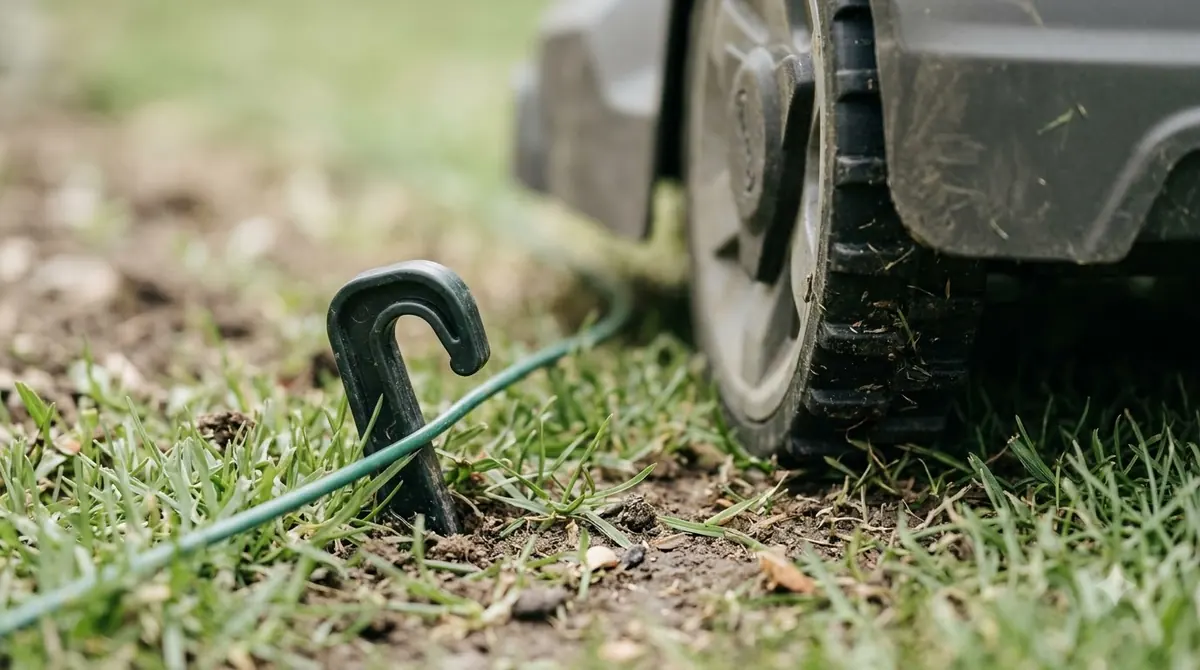
The wire has its own failure modes. Lymow lists breaks caused by landscaping equipment, burrowing animals and frost heave. Those problems are less common than GPS trouble in a shaded yard, but they are harder to find and fix once the wire is buried. Lymow’s own price ranges for the comparison were wired models at $800 to $2,000 and wireless models at $2,000 to $5,000, which the vendor gave as of 2026-11-10. Those are vendor figures, so check current prices before you buy.
Some newer mowers claim to work without a base station or a wire. Mammotion describes its LUBA mini AWD as using NetRTK through its iNavi service instead of a local base, with the service free for the life of the mower. That is a vendor claim. NetRTK still uses satellites, so a yard with heavy canopy can still weaken its accuracy.
Shade and tree roots still affect the grass
A mower that works well under trees can still leave a weak lawn if the grass itself struggles in shade. Mississippi State University Extension notes that shaded turf may need additional water because tree roots compete with the grass. It also says foot traffic can cause excessive stress for shaded turf, and that under many shade trees the wheels of riding mowers are a main cause of turf decline.
The MSU advice is written for riding mowers, so applying it to robot mowers is our reading, not the extension’s claim. A robot mower that runs often, on light wheels, is unlikely to cause the same damage as a riding mower, but it does not fix water or root competition. Shaded areas usually need a higher cutting height and a closer look at watering than the mower settings alone can solve.
What to check before you buy and set up
Use the questions below to compare mowers for a yard with weak satellite coverage. Each one is taken from the sources above, and none needs a test drive to answer.
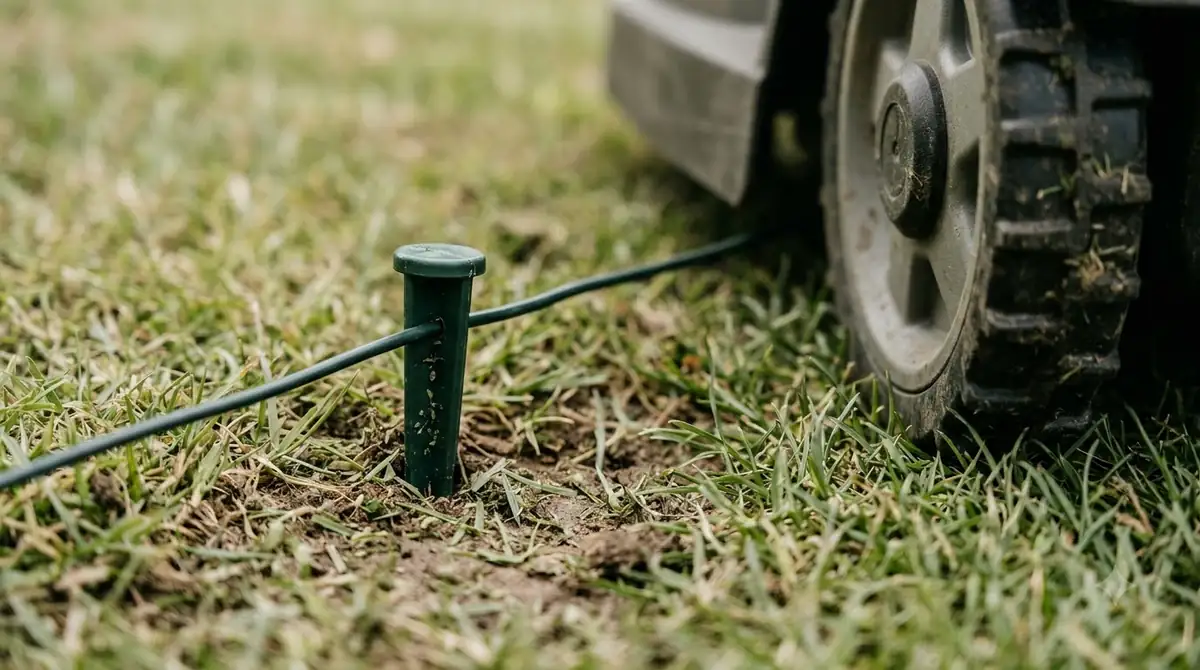
- Read the spec sheet for the fallback sensor. Look for LiDAR, vision or a boundary wire. A mower that lists RTK only has no named fallback in the material we read.
- Ask about base placement. Ecovacs says incorrect setup reduces precision. Pick a spot with the widest sky view you can get, and keep it away from walls, which Sunseeker describes as a source of multipath.
- Ask what happens when the fix is lost. Mowrator describes pausing, slowing and route correction. Yarbo says its mower falls back to vision, IMU and odometry. Ask the maker which one applies to your model.
- Check the lawn shape. Lymow and Anker both note that wire can be hard on steep ground, while LiDAR can struggle on very open lawns. Match the method to the lawn.
- Plan the install before buying. A wire install can take 4 to 8 hours, and a base station needs a power and mounting spot. Budget time and space for either.
- Keep the sensors clean. Anker advises cleaning after rain, mud or dust, which matters more for LiDAR than for wire.
Frequently asked questions
Does a robot mower work in a yard with poor GPS signal at all?
Not always. RTK mowers can lose precision under trees and near buildings, and Mowrator describes them pausing, slowing or correcting routes when the fix is lost. Mowers with LiDAR, vision or a boundary wire do not depend on satellites alone, so they keep working in those spots, though each has its own limits.
Is RTK or LiDAR better for a yard under trees?
Vendors describe LiDAR as unaffected by shade and structures, while RTK weakens under dense canopy. LiDAR can be less effective on very open lawns and is generally more expensive. Our reading is that LiDAR suits heavy canopy better, but the answer depends on the mower model and the yard.
Do I need a boundary wire if my yard has poor GPS?
No, but a wire is the most reliable satellite-free edge. Lymow puts installation at 4 to 8 hours, and wire can break from equipment, animals or frost heave. Many owners choose LiDAR or vision to avoid wire, so compare the install effort with the sensor cost.
Can tree roots affect how a robot mower cuts?
Tree roots mainly affect the grass, not the mower’s navigation. Mississippi State Extension says shaded turf may need extra water because roots compete with grass. Raising the cutting height in shade, as our reading suggests, helps the lawn cope, and it does not change how the mower finds its way.
Sources
- LiDAR vs RTK robot lawn mowers (Ecovacs, vendor): RTK base placement, RTK under trees, LiDAR shade and fog, LiDAR cost.
- RTK vs wire: which robot mower setup is easier (Lymow, vendor): canopy effect on RTK, VSLAM 10-minute figure, wire install hours and failure causes, price ranges.
- LiDAR robot lawn mower guide (Anker, brand): fog and rain effects, sensor cleaning, open lawns, LiDAR cost against RTK and vision.
- Selecting and Managing Turfgrass for Shade, P2892 (Mississippi State University Extension): tree root competition, watering and foot traffic under shade.
 Up next8 min readBy YardVision Robot Mower for Yard with Poor Satellite Signal: What the Specs ShowUpdated Nov 11, 2026
 8 min readBy YardWhy a Robot Mower Loses Signal Near House WallsUpdated Nov 10, 2026
 7 min readBy YardRobot Mower for a Lawn Under Solar Panels: Signal and Shade FixesUpdated Nov 14, 2026
 7 min readBy YardCan a Robot Mower Work in a Yard With Multiple Small Patches?Updated Nov 10, 2026
 9 min readBy YardCan a Robot Mower Work in a Yard Split by a Driveway?Updated Nov 10, 2026
 8 min readBy YardCan a Robot Mower Work in a Yard With No Wifi in the Back?Updated Nov 10, 2026