
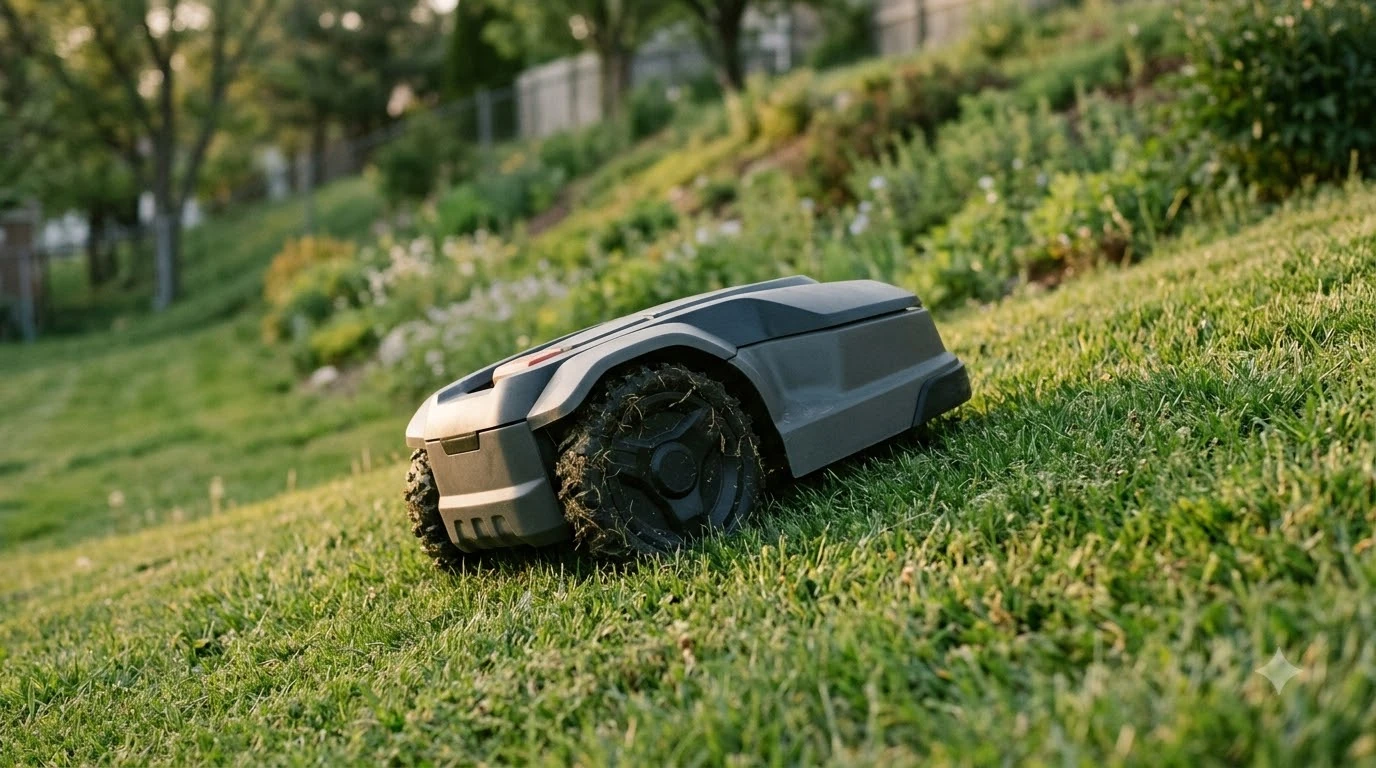

A robot mower for hillside lawn should be chosen by its rated slope limit, measured against your steepest working strip, with a clear margin below the rating. Spec sheets list two numbers: a work-area limit and a lower limit near the boundary wire. Manufacturers print these in percent, degrees, or both, and the top figure is a ceiling rather than a daily target.
The short answer
- Measure the steepest strip you would mow, not the average slope of the yard.
- Compare two ratings: the work-area limit and the lower boundary limit. Husqvarna lists the boundary figure lower on most models.
- Leave a margin below the rated maximum, since the rating is an absolute limit, not a target for daily mowing.
- Expect less grip when the grass is wet or the soil is loose, even inside the rating.
- Above about 30 percent, Iowa State Extension says turf is too steep to mow.
Start by measuring the steepest strip
Slope is the vertical rise divided by the horizontal run, multiplied by 100. Husqvarna’s worked example is a rise of 15 cm over 100 cm of run, which is a 15 percent slope. Extension guides use the same idea written as a ratio: Iowa State describes a 1:12 slope as a rise of one foot for every 12 feet, which equals 8.33 percent. Its guide also treats 1:5, or 20 percent, as steep enough to need special planting, which is a useful signal that the ground will be hard to keep mowed.
Percent and degrees are not the same unit, so check which one your spec sheet uses; robot mower slope ratings are explained in a separate guide. A 100 percent slope is 45 degrees, because the angle is the arctangent of the percent. Going the other way, percent equals 100 times the tangent of the angle. Some retailer blogs print pairs that do not match this formula, so use the math rather than a table from a sales page when you convert.
Measure with a spirit level and a tape, or with a phone inclinometer app (our guide explains how to measure the slope of your yard step by step), and take readings at several points along the strip you actually mow. Visual judgment is often wrong, and the steepest spot is usually near the top of the rise or along a drop-off, not in the middle of the lawn. Our reading is that one reading per strip is enough for a rough check, but a second reading near the steepest point confirms the number you compare against the spec sheet.
Read the work-area and boundary numbers
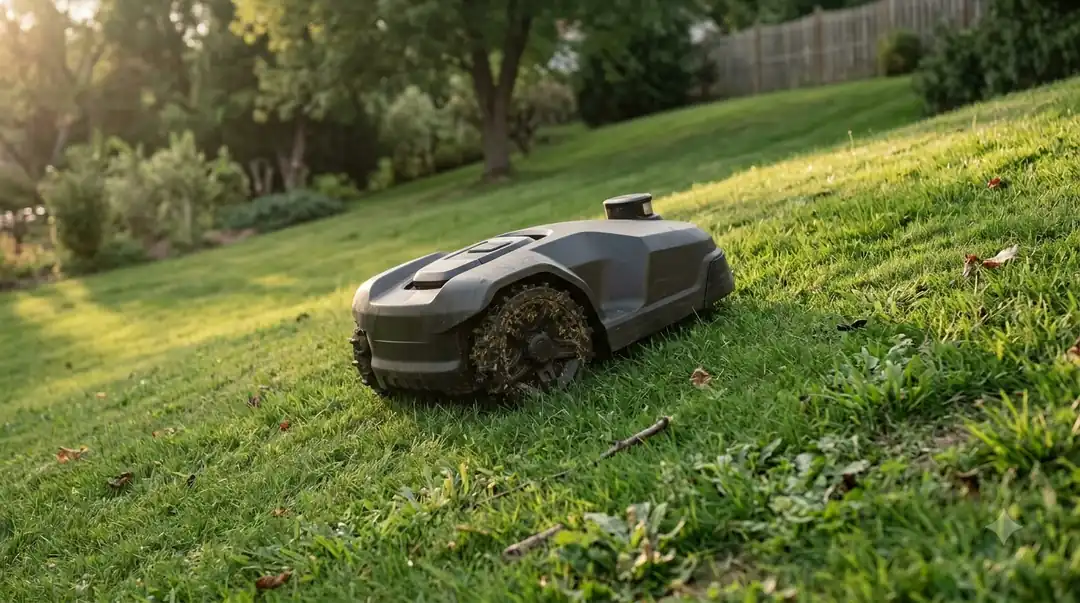
Husqvarna’s support page for steep-slope installation lists two maximum slopes for each model: one for the work area and one for the zone near the boundary wire. The boundary figure is always the lower of the two on the models listed, which is why a mower that looks suitable on a brochure can still struggle along the edge of a steep yard.
| Husqvarna model | Work area | Near boundary |
|---|---|---|
| Aspire R4 | 25% | 10% |
| 105 | 25% | 15% |
| 305, 310, 315 | 40% | 15% |
| 320 NERA, 430X NERA, 450X NERA | 50% | 25% |
| 435X AWD | 70% | 50% |
The boundary figure matters most when the steep part of your lawn sits against the edge, a fence, a retaining wall, or a drop-off. Husqvarna’s guidance for slopes that meet a public road asks for a protective barrier, such as a wall or fence, at least 15 cm (6 in) along the outer edge, so, in our reading, the mower stays clear of the drop. Read the spec sheet for a robot mower for hillside lawn use for your exact model, because the figures differ from one model to the next.
Why a rating assumes good footing
A slope rating describes what the mower can climb under the manufacturer’s conditions, and those conditions usually mean dry grass and firm soil. Eufy’s guidance on slope limits says damp grass reduces tire grip, so a mower can slide even on a slope that is inside its rating. Sunseeker’s guide adds that wet grass, loose soil, and steep inclines together raise the chance of wheel slip, and that clay soil, new turf, and heavy shade make slipping more likely.
Battery life is the other cost. Eufy notes that running at the top incline strains the motor, drains the battery and increases wheel slip. That is why its rated maximum is best read as an absolute ceiling rather than a target for daily mowing. For wet ground, see why robot mowers slide on wet slopes. Our reading is to aim for the middle of a model’s range on the slope you actually have, which is the safer way to size a robot mower for hillside lawn conditions, and to hold back on the steepest section in wet weather.
Heads up
Some retailer pages print slope pairs that do not match the trigonometry. Eufy’s own page pairs 40 percent with 18 degrees, while the formula gives about 21.8 degrees. Trust the percent figure from the mower’s manual and convert only with the formula.
Why all-wheel drive changes the buffer
All-wheel drive models carry the highest ratings in Husqvarna’s range. The 435X AWD is listed at 70 percent in the work area and 50 percent near the boundary. That extra grip comes with a layout requirement (and a separate guide compares AWD vs 2WD robot mowers for hills): Husqvarna asks for at least 50 cm (1.6 ft) of level ground between flat areas and steep slopes on AWD models, which gives the mower room to transition before it climbs.
For a hillside yard, that means the flat strip at the bottom of the slope needs to be clear of obstacles and wide enough for the transition. Our reading is that a steep lawn with a short flat margin may suit a two-wheel-drive model at a lower rating better than an AWD model that cannot get a proper run-up, so measure the flat ground as carefully as the slope itself.
Guide wire and layout on a slope
On boundary-wire installs, Husqvarna recommends laying the guide wire diagonally across the slope rather than straight up and down. The stated reasons are better traction and less wear on the grass where the mower repeatedly passes. In our reading, a diagonal route also keeps the mower off the straight fall line of the hill. Our gear guide covers traction spikes for slopes, though the guide wire advice comes first.
Where a robot mower for hillside lawn stops being the right tool
Some slopes are simply too steep for turf maintenance with any mower. Iowa State Extension states that slopes of about 30 percent, or 1:3, or more are too steep to mow, and that plantings other than turfgrass should be used. The same guide describes mowing on an incline as inconvenient and possibly dangerous, which is a reasonable reason to stop before buying equipment.
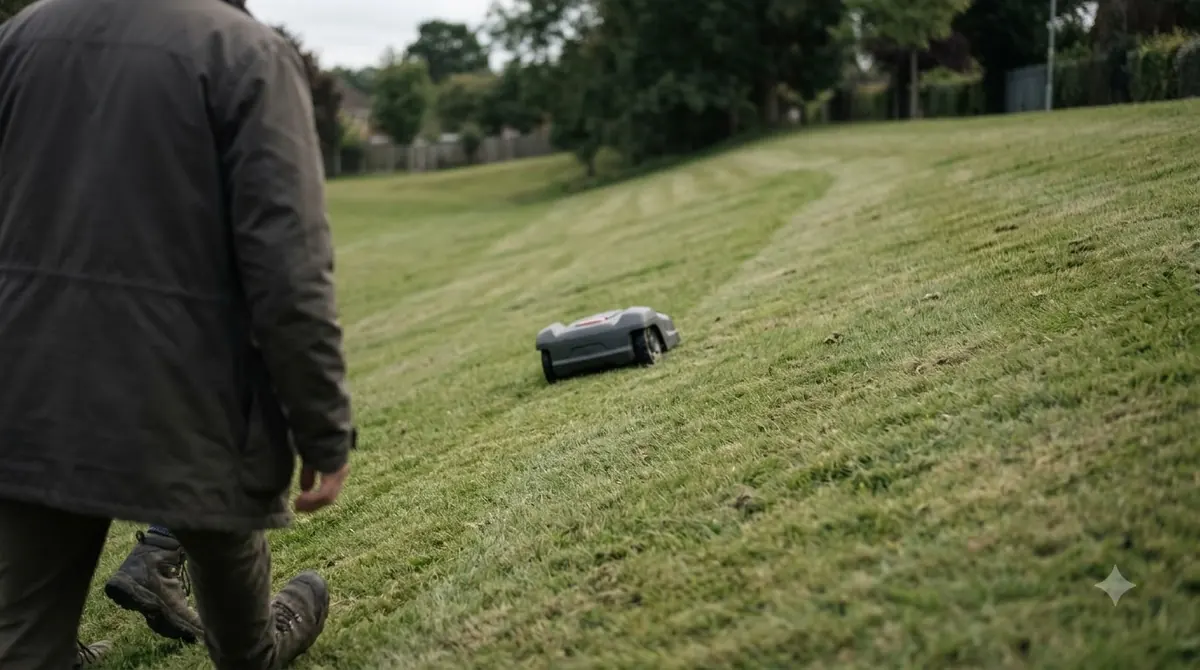
For new grass on a steep bank, the extension guidance is to secure sod before the mower ever runs over it. On slopes steeper than 10 percent, Iowa State advises 2 to 3 wooden stakes or sod staples, 6 to 8 inches long, for each strip. Our reading is that a freshly laid slope should be staked and allowed to root before a robot mower is set to run on it, because loose sod is the first thing a mower will move.
What to check before you buy
Use this order to decide whether a robot mower for hillside lawn conditions is realistic for your yard. Each step uses the numbers you have already measured.
- Measure the steepest strip. Take two or three readings in percent, and convert degrees with the formula if the spec sheet uses them.
- Find the work-area and boundary ratings for the exact model, not the product family, and check that both sit above your reading with a margin.
- Check the flat transition. If the model is AWD, confirm there is level ground at the bottom of the slope for the transition.
- Plan the boundary. Keep the wire and barrier away from drop-offs, and place the guide wire diagonally across the slope.
- Test grip in wet weather. Watch the mower on the steepest section after rain, and treat any slipping as a reason to lower the setting or the rating you need.
- Stop at about 30 percent. Above that, plan for planting or a different mowing method rather than a robot mower.
Frequently asked questions
What slope can a robot mower for hillside lawn use handle?
It depends on the model and the zone. Husqvarna’s support page lists work-area limits from 25 percent on entry models to 70 percent on the 435X AWD, and lower numbers near the boundary wire. Iowa State Extension treats about 30 percent as too steep to mow for turf, so that is a practical upper limit for most lawns.
How do I measure the slope of my yard?
Use a spirit level and a tape, or a phone inclinometer app, and measure the steepest strip you would mow. Divide the rise by the run and multiply by 100 to get percent. Iowa State’s ratio guide shows 1:12 equals 8.33 percent, which is a quick check for the math.
Does a higher slope rating mean the mower is better for a hill?
Not by itself. A higher rating means more margin on a steep section, but it does not account for wet grass, loose soil, or the flat transition an AWD model needs. Our reading is to compare the rating with your measured slope and the conditions you expect, not with the highest number on the page.
Why is the boundary slope rating lower than the work-area rating?
In our reading, the boundary zone sits at the edge of the work area, where a mower is close to drop-offs, walls, and obstacles. Husqvarna lists a lower limit there on each model in its table, and it recommends a protective barrier of at least 15 cm (6 in) where a slope meets a public road.
Sources
- Gardening on slopes and hillsides (Iowa State University Extension): steepness thresholds, 1:12 ratio conversion, sod staking on slopes steeper than 10 percent, and the 30 percent limit for mowing turf.
- How to optimise an Automower installation for steep slopes (Husqvarna support): per-model work-area and boundary limits, the 15 cm barrier, the 50 cm AWD transition, and the diagonal guide wire.
- Slope fundamentals (UBC Topo): percent and degree conversion, including 100 percent equals 45 degrees.
- Robot lawn mower slope limits (Eufy, manufacturer blog): rated maximum as an absolute limit, wet-grass grip, battery effects, and measuring tools.
- Robot lawn mowers on uneven or sloped lawns (Sunseeker, manufacturer blog): wet grass, loose soil, and soil types that raise slip risk.
 Up next9 min readBy YardCan a Robot Mower Cut Zoysia? Height and LimitsUpdated Nov 11, 2026
 9 min readBy YardRobot Mower for a Sloped Front Yard: Limits, Edges and SetupUpdated Nov 11, 2026
 8 min readBy YardCan a Robot Mower Cut Centipede Grass? Heights and LimitsUpdated Nov 11, 2026
 8 min readBy YardRobot Mower in Cold Climates: Frost, Snow and Battery LimitsUpdated Nov 11, 2026
 8 min readBy YardRobot Mower for Tall Fescue Lawns: Height Limits That MatterUpdated Nov 11, 2026
 8 min readBy YardVision Robot Mower for Yard with Poor Satellite Signal: What the Specs ShowUpdated Nov 11, 2026