
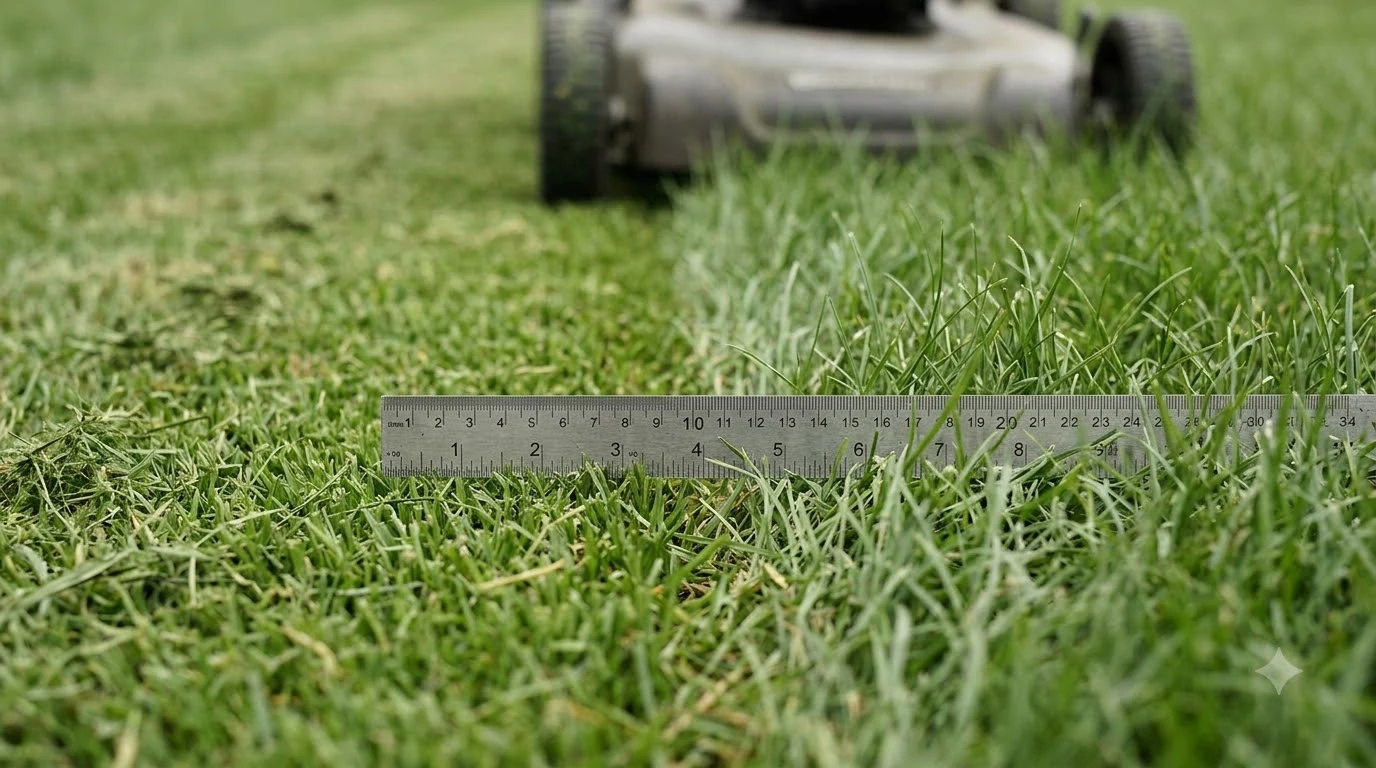

The best grass seed for robot mowed lawn is a cool-season blend that matches your light and your mower’s cut range. Extension guidance points to Kentucky bluegrass for sunny yards, fine fescue for shade, and a small share of perennial ryegrass for fast cover. Check the mower’s highest and lowest settings before you choose, because a grass that grows taller than the mower can cut will not stay neat.
The short answer
- Sunny lawn: Kentucky bluegrass, the best choice for areas with at least 6 hours of direct sun, according to Iowa State University Extension.
- Shade: fine-leaf fescues, which Iowa State calls the best grasses for shady locations.
- Mixed light: about 60% Kentucky bluegrass, 30% fine-leaf fescue and 10% perennial ryegrass.
- Ryegrass limit: keep perennial ryegrass at 20% or less of the blend.
- Height check: many robot mowers cut between about 0.8 and 2.4 inches, so match the grass set height to that range.
Start with the mower’s height range, not the seed bag
Choose the grass only after you know the lowest and highest cut your robot can make, because many models stop well short of tall lawn heights. Robomow, a robot mower maker, says many robot mowers cut between 20 and 60 mm, about 0.8 to 2.4 inches, and some models reach 100 mm, about 3.9 inches. That is a brand blog figure, so confirm the exact range in your model’s manual before you buy.
University of California Integrated Pest Management gives set heights of 1.5 to 2.5 inches for Kentucky bluegrass and perennial ryegrass, and 1.5 to 3 inches for tall fescue. Those set heights fit most robot ranges, but the top of the tall fescue range sits at or above the upper limit of many models. The University of Florida’s IFAS extension notes that autonomous mowers were designed mostly for cool-season grasses and are typically mowed below 2.5 inches. Our reading is that the top setting matters more than the seed label.
Kentucky bluegrass: the default for sunny lawns
Kentucky bluegrass is the standard pick for sunny yards, and it repairs itself well after wear. Cornell Turf rates its wear tolerance as good and its drought tolerance as poor, and says its spreading rhizomes intertwine to form a strong sod. Cornell lists sunny mixes as needing at least 6 to 8 hours of direct sun, so check your yard’s light before you commit.
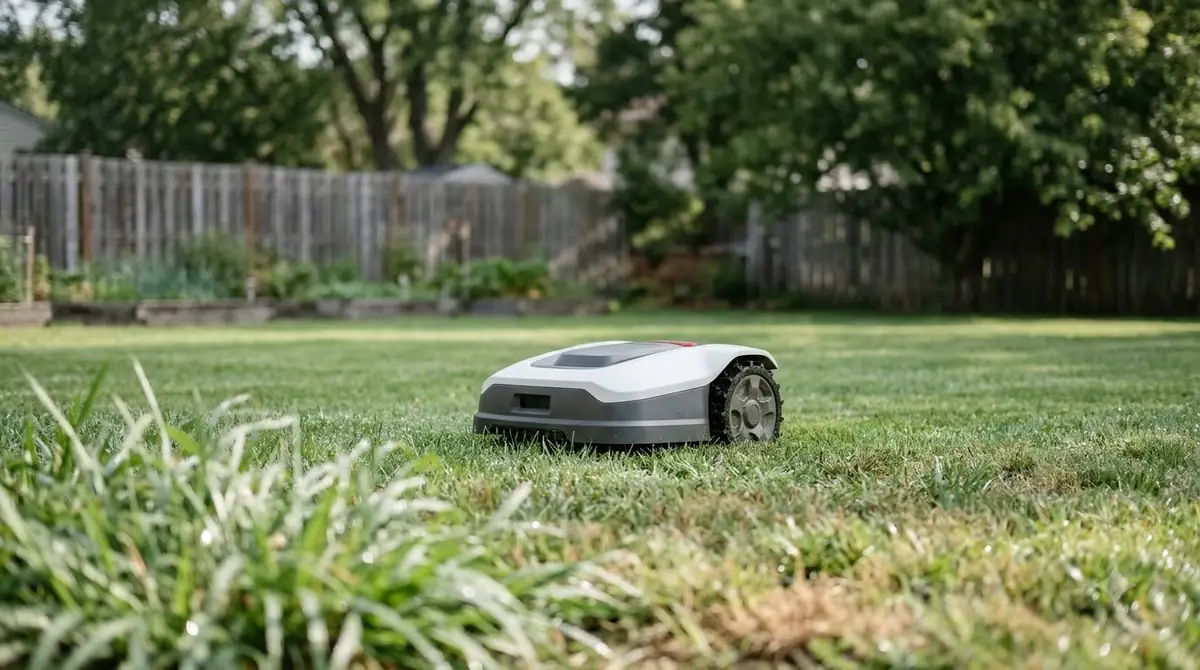
The height target is where a robot owner can make the grass work. UC IPM’s mow-when height for Kentucky bluegrass is 2.25 to 3.75 inches, and Iowa State gives a summer range of 3 to 3.5 inches with 2.5 to 3 inches in spring and fall. A robot that can hold about 2 to 2.5 inches keeps the grass inside the UC set range in cool months. A preliminary University of Connecticut trial of autonomous mowers found 2.25 inches performed best for tall fescue and Kentucky bluegrass, but that work is preliminary, so treat it as a starting point rather than a rule.
Fine fescue: the shade choice
Fine fescues are the most shade-tolerant cool-season option, and Cornell Turf rates their shade tolerance as excellent. For shady lawns, Cornell recommends a 100% fine fescue blend, and it lists shade mixes for 4 to 8 hours of direct sun. Iowa State makes the same point, calling the fine-leaf fescues the best grasses for shady locations.
Clemson HGIC gives winter heights of 1.5 to 2.5 inches for fine fescue and summer heights of 2.5 to 3 inches. Our reading is that a robot set low for winter may need to rise in summer, and a summer setting near 3 inches sits at the top of many robot ranges. Check that the mower can go that high before you sow a shade blend.
Tall fescue: wear and heat, with a height ceiling
Tall fescue handles wear and some drought, but its height ceiling is the main issue for robot owners. Cornell Turf rates tall fescue wear tolerance as good, drought tolerance as some, and shade tolerance as good. UC IPM gives a mow-when height of 2.25 to 4.5 inches, and Clemson HGIC gives summer heights of 3 to 3.5 inches.
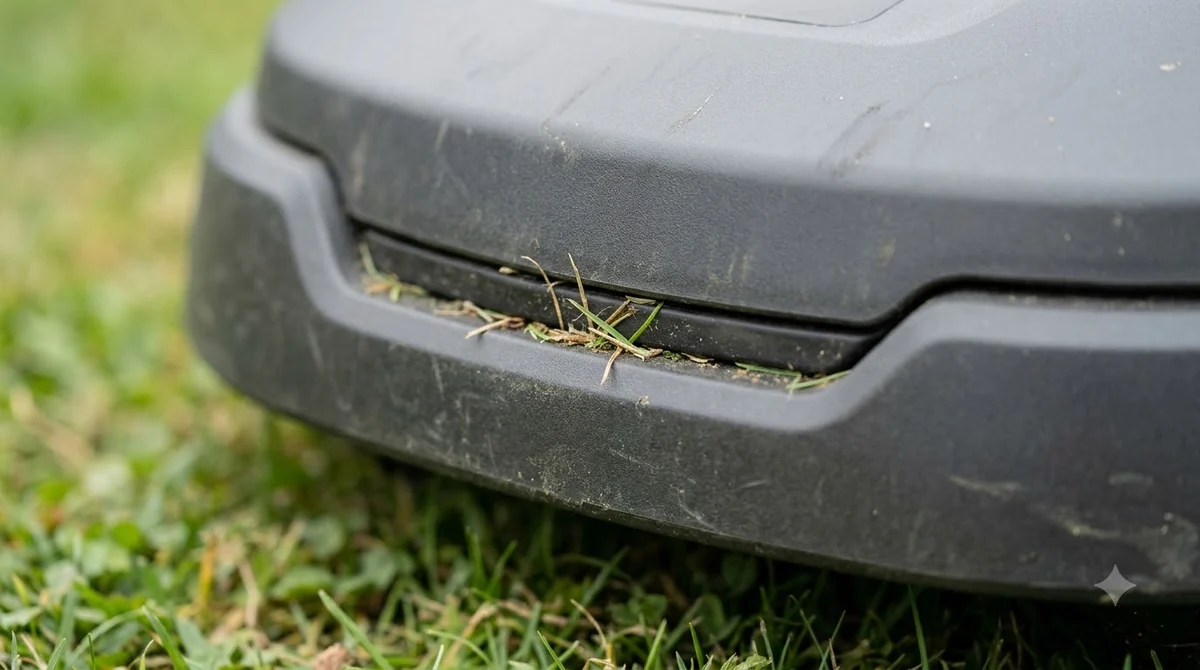
That means a tall fescue lawn will often need a robot setting near the top of its range, and some models cannot reach it. Our reading is that tall fescue suits a busy yard in hot weather only if your mower’s highest setting covers 3 to 3.5 inches. Otherwise, pick a blend with more Kentucky bluegrass or fine fescue and leave tall fescue out of the robot-mowed zones.
Perennial ryegrass: fast cover in a small share
Perennial ryegrass sprouts fastest, so it fills gaps quickly, but it should stay a minor part of the seed. Cornell Turf says 100% perennial ryegrass should only patch small bare spots, and it advises avoiding new-seeding mixes with more than 20% ryegrass. Iowa State gives the same cap of 20% or less for a bluegrass mix.
UC IPM lists a set height of 1.5 to 2.5 inches and a mow-when height of 2.25 to 3.75 inches for perennial ryegrass, the same as Kentucky bluegrass. Keep it as a quick-cover helper, not the main grass, and the robot will treat the whole lawn more evenly. If you plan to patch thin areas, read about overseeding with a robot mower first.
Best grass seed for robot mowed lawn, by light
Pick the row that matches your light, then check the set height against your mower. Each row is a starting point for the best grass seed for robot mowed lawn in that condition. The percentages come from Iowa State, and the heights come from UC IPM and Clemson HGIC.
| Yard condition | Seed approach | Height to check on the robot |
|---|---|---|
| Full sun, 6 or more hours | Kentucky bluegrass based, with up to 20% ryegrass | Set 1.5 to 2.5 in; mow-when 2.25 to 3.75 in (UC IPM) |
| Shade, 4 to 8 hours | 100% fine fescue (Cornell) | Winter 1.5 to 2.5 in; summer 2.5 to 3 in (Clemson HGIC) |
| Mixed sun and shade | About 60% Kentucky bluegrass, 30% fine fescue, 10% ryegrass (Iowa State) | Use the lowest set height of the blend, 1.5 to 2.5 in, and raise in summer |
| Heavy wear, hot summer | Tall fescue, which Cornell rates good for wear and some for drought | Summer 3 to 3.5 in (Clemson HGIC); check the mower’s top setting first |
Mistakes that hurt robot-mowed lawns
Most problems come from a mismatch between the seed and the mower, not from the seed alone. These are the errors extension sources and our reading point to most often.
- Tall fescue on a low robot: a blend that needs 3 inches will not fit a mower that tops out near 2.4 inches.
- Too much ryegrass: more than 20% in a new seeding goes against Cornell and Iowa State guidance.
- Cutting too low in summer: Iowa State gives 3 to 3.5 inches for Kentucky bluegrass in summer, above the spring and fall range of 2.5 to 3 inches.
- Forgetting the higher cut: UC IPM advises the higher end of the range for a new lawn, and for turf that must tolerate drought, heat, traffic, shade and pests.
What to check before you buy seed
Use this short check before you buy the best grass seed for robot mowed lawn. It covers the grass and the mower together, since either one can limit the other. After sowing, plan feeding with the best fertilizer for a robot-mowed lawn.
- Count sun hours. Note how many hours of direct sun each zone gets, using 6 hours as the sun line.
- Read the mower’s range. Find the lowest and highest cutting settings in the manual, not the marketing page.
- Match the set height. Confirm the grass set height falls inside that range, and the summer height too.
- Cap the ryegrass. Keep perennial ryegrass at 20% or less of any blend.
Heads up
This guide covers cool-season grasses. Warm-season lawns such as Bermuda or St. Augustine use different cutting heights and seed or sod choices, so check a warm-season source before you apply these numbers.
Frequently asked questions
What is the best grass seed for robot mowed lawn in full sun?
Iowa State University Extension names Kentucky bluegrass the best choice for sunny areas, defined as at least 6 hours of direct sun. Keep the robot’s set height in the 1.5 to 2.5 inch range UC IPM gives for it.
Can a robot mower cut tall fescue?
Many robot mowers can, but tall fescue’s mow-when height runs up to 4.5 inches, according to UC IPM, which is above many robot ranges. Check the top setting in your manual before choosing a tall fescue blend.
Is fine fescue a good choice for a shaded lawn with a robot mower?
Cornell Turf rates fine fescue shade tolerance as excellent, and Iowa State calls it the best grass for shade. Clemson HGIC gives summer heights of 2.5 to 3 inches, so confirm your robot can reach that setting.
How much perennial ryegrass should go in a robot lawn seed mix?
Keep it at 20% or less. Cornell Turf advises avoiding new-seeding mixes with more than 20% ryegrass, and Iowa State gives the same cap for a bluegrass mix.
Sources
- What type of grass seed mix should I purchase? (Iowa State University Extension): sun and shade picks, the 60/30/10 blend and the 20% ryegrass cap.
- Choose Seed (Cornell Turf): sun and shade hours, wear and drought ratings, and the ryegrass cap.
- Mowing cool season grasses (UC IPM): set and mow-when heights for each cool-season grass.
- Clemson HGIC turfgrass mowing height (Clemson Home and Garden Information Center): winter and summer heights for fine and tall fescue.
- What is the correct mowing height for my lawn in summer? (Iowa State University Extension): Kentucky bluegrass summer and spring-fall heights.
- Autonomous or Robotic Mower Use on Florida Lawns (University of Florida IFAS Extension): autonomous mowers designed for cool-season grasses and typical cut heights.
- What is the ideal cutting height for a robotic lawnmower? (Robomow): typical robot cutting range, a brand source.
- UConn Research Shows Autonomous Mowers Make the Cut (University of Connecticut Today): preliminary trial of 1.25, 2.25 and 3.25 inch heights.
 Up next8 min readGearBest Fertilizer for Robot Mowed Lawn: How to Choose the Right TypeUpdated Nov 11, 2026
 8 min readGearBest Garden Fence for Robot Mower No-Go Zone: What Works and What Doesn’tUpdated Nov 11, 2026
 8 min readGearBest Mowing Strip Pavers for Robot Mower Edges: What to CheckUpdated Nov 11, 2026
 8 min readGearBest Garage for Dreame Robot Mowers: 5 Checks Before You BuyUpdated Nov 11, 2026
 7 min readGearBest Landscape Edging for Robot Mower Borders: What Works and What to AvoidUpdated Nov 11, 2026
 7 min readGearBest Lawn Roller for a Bumpy Lawn Before a Robot MowerUpdated Nov 11, 2026