
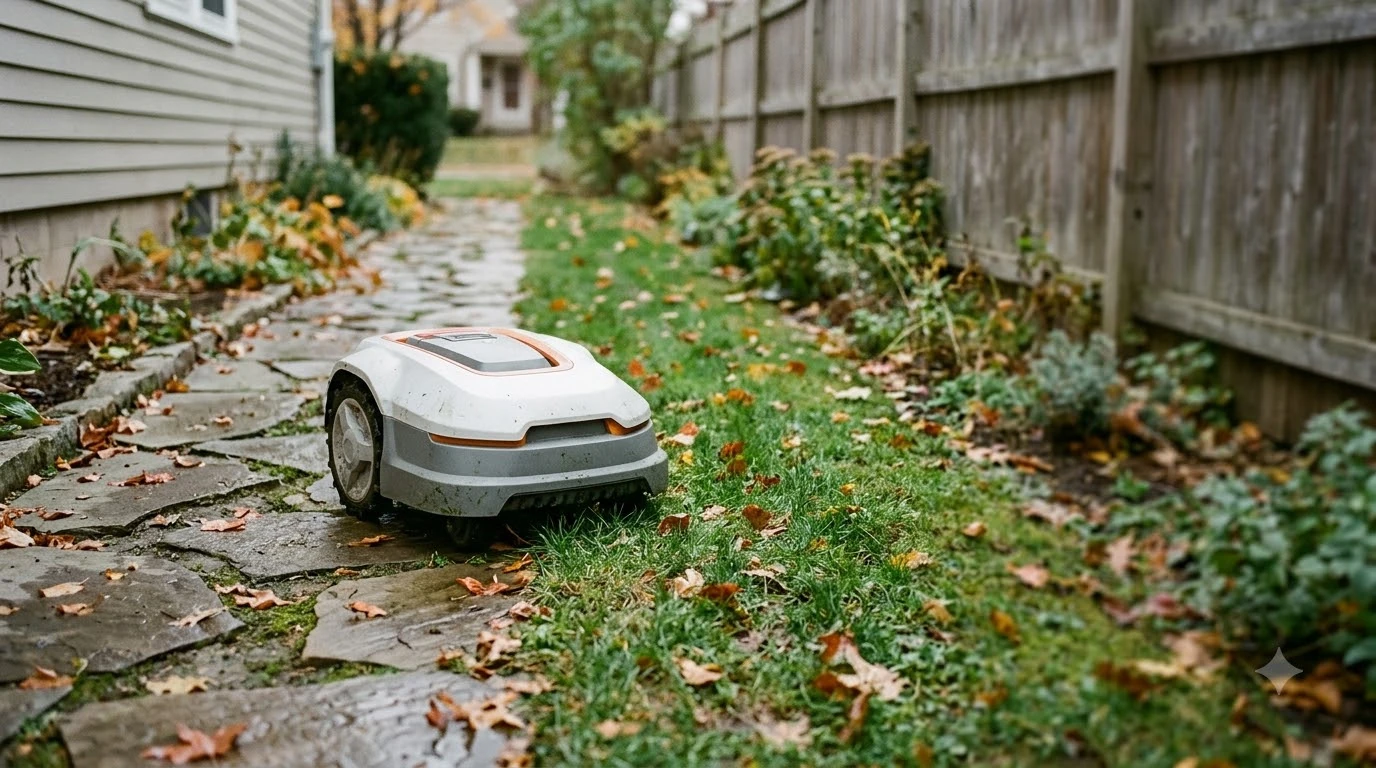

Best mowing strip pavers for robot mower edges are flat, level-set stones about 10 to 24 cm wide, laid in two staggered rows. The Robomow guidance we read describes this stone size and layout as the one that lets a centred blade reach the edge. Pick pavers by shape and fit before you pick a brand.
The short answer
- Width: about 10 to 24 cm per stone, which Robomow names as the range that lets a centred blade reach the edge.
- Height: set the pavers level with the lawn surface, not raised above it.
- Layout: two staggered rows, with joints the wire can run under or between.
- Avoid: loose gravel and bark mulch next to the lawn, which can jam blades and wear the path.
What a mowing strip does for a robot mower
A mowing strip is the band of pavers or stone that sits between the lawn and a hard edge such as a path, patio or bed border. It gives the mower a surface it can drive over, so the blade can reach the grass right up to the stone. Our reading is that the best mowing strip pavers for robot mower edges matter most where a hard edge sits above the grass, because that edge is harder for the mower to cut cleanly.
Robomow’s edge article puts the difference in numbers. A centred-blade mower, it says, leaves about 10 to 20 cm of uncut grass along walls, while edge-cutting models leave about 5 to 6 cm. A strip of paver gives a centred blade room to reach the edge, which is why the stone width matters more than the brand name on the box. If you would rather skip the strip, compare robot mowers that cut close to edges.
Paver width and layout decide how close the blade gets
For mowing strip pavers for robot mower edges, stones about 10 to 24 cm wide, laid in two staggered rows, are the setup Robomow describes for letting a centred blade reach the edge. Our reading is that staggering the joints avoids one straight seam running along the lawn edge, though the article does not say so directly. For plastic or metal borders instead of stone, see landscape edging for robot mower borders.
Wheel layout is the other check. Robomow notes that three-wheel models should not let the front wheel go past the boundary. Measure your mower’s wheel positions against the strip before you buy stone.
Heads up
Robomow’s advice is to keep the wire away from flower beds, water and walls, since a wire too close to an edge can make the mower slip. Do not assume a paver strip removes the need for a boundary wire.
Set the pavers level with the lawn
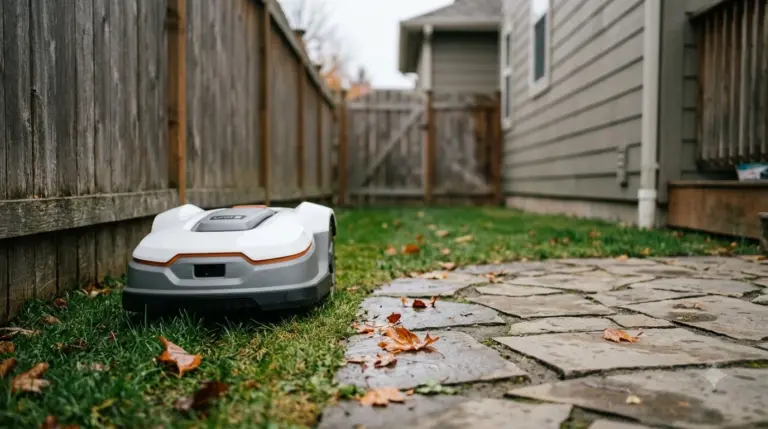
The best mowing strip pavers for robot mower edges only work if they sit at the same height as the grass. Robomow says the lawn edge and pavement should be level, with stones laid level with the ground surface. A stone that stands proud of the turf can tip the mower or stop the wheel from climbing cleanly.
If your path is already higher than the lawn, the same article offers a fix: backfill with soil so the robot can climb onto the stones. Our reading is that this works best with a low step and a firm base, and it should be checked after the first few runs, since soil settles over time.
Joints and wire placement around pavers
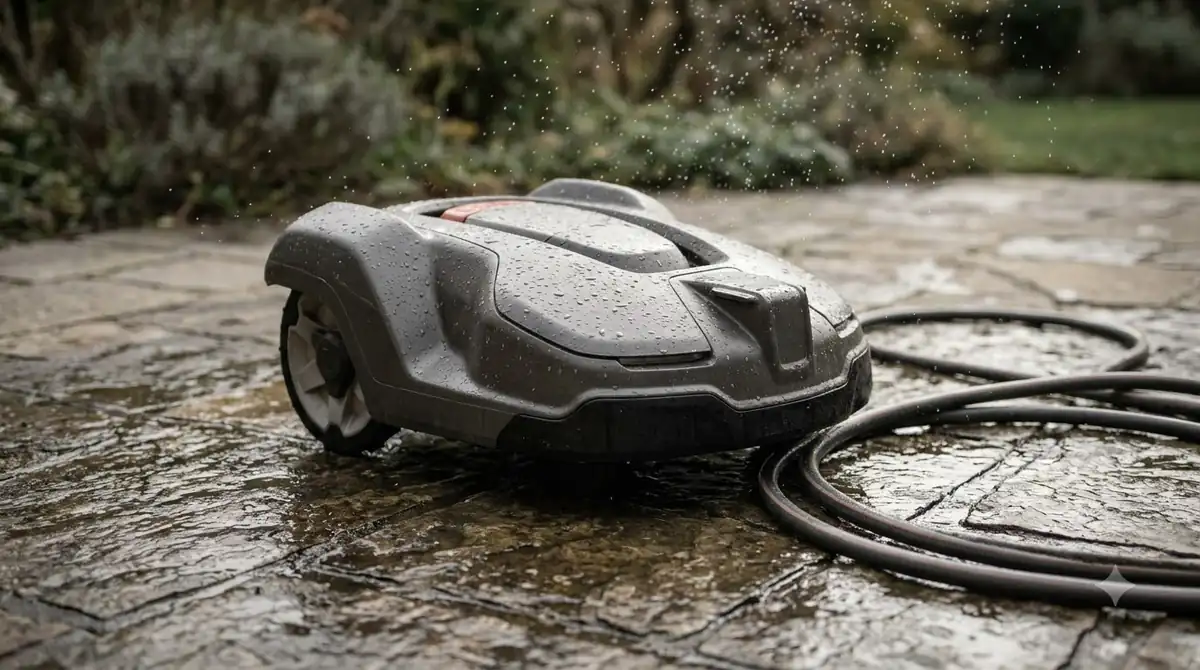
Where a passage runs between two stone areas, Robomow advises laying the boundary wire in the joints or under the cobblestones. That keeps the wire out of the way and makes the crossing point predictable for the mower. The boundary wire installation guide covers the full layout.
The same article gives a width rule for passages. A passage should be at least one metre wide, so signals from both sides do not interfere and the mower does not get stuck (see the minimum passage width for a robot mower). For a narrower gap, a tunnel circuit or a small loop on each side of the entrance lets the mower pass only when it approaches head-on.
Joint size matters too. Eufy’s guide, published by Anker, asks owners to check that the joints and cracks are “not large enough to catch a wheel”, and that the transition from grass to paving is “close to level”. For a gap that cannot be avoided, the same page suggests “two flush rows of solid pavers or a narrow bonded-gravel strip for the wheels” as a way to give the wheels a firm line to run on.
Wet stone is a grip issue. The Eufy page says wet paving can reduce wheel grip, so a paver strip that stays damp in shade may need a closer look after rain.
What to avoid next to the lawn
Not every hard edge suits a robot mower. Robomow says driving over gravel is possible but “not always advisable”, because loose stones can jam the blades and leave the robot stuck. Bark mulch is also a poor edge. Robomow says the blade chops the chips, which causes faster wear and can damage the path.
Flat paved areas are the safer surface. Robomow describes them as unproblematic, so for a mowing strip, solid flat pavers are a better choice than a loose-stone border. If you already have gravel next to the lawn, our reading is to fence it off with wire and leave a narrow, paved passage where the mower must cross. Our notes on gravel path crossings in a robot mower yard cover that case.
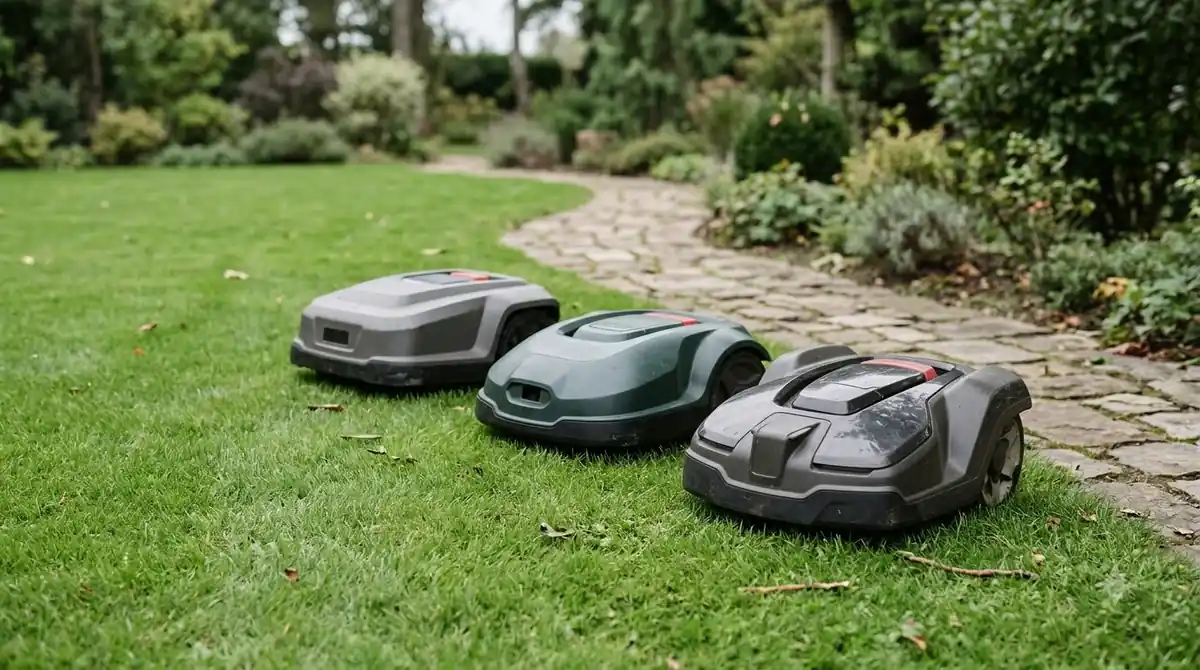
If the wire runs under the stones, depth matters. A Robomow article on boundary wire depth says the general range is “between 3 and 7 cm”, with about 4 to 5 cm described as optimal. It warns that wire laid too deep risks signal interference, and wire at only one or two centimetres may resurface during scarifying. Follow your model’s manual for the exact figure.
Ground-level paths do not need wire
A path that sits at ground level does not need to be enclosed by wire. The mower simply drives over it. The wire only matters where the lawn ends at a raised or uneven edge, or where you want the mower to stay on the grass. Our reading is that walking the lawn edge before you lay any wire is the simplest way to see which stretches need it.
Best mowing strip pavers for robot mower edges: what to check
Use this checklist before you buy stone for a mowing strip, based on the points above:
- Measure the stone. Aim for about 10 to 24 cm per stone, so a centred blade can reach the edge.
- Check the height. The top of the paver should sit level with the lawn, not above it.
- Check the layout. Plan two staggered rows and keep the front wheel inside the strip on three-wheel models.
- Plan the wire. Keep the wire away from beds, water and walls, and put it in the joints where a passage crosses the stone.
- Measure the passage. Make any passage at least one metre wide, or use a tunnel loop for a narrower gap.
- Avoid loose material. Do not use gravel or bark mulch as the edge the mower must cross.
Choosing the best mowing strip pavers for robot mower edges comes down to stone size, height and joints, not a brand name. Check your mower’s manual for its wheel layout and boundary distances before you lay anything.
Frequently asked questions
How wide should a mowing strip of pavers be for a robot mower?
Robomow describes stones about 10 to 24 cm wide, laid in two staggered rows, as the setup that lets a centred blade reach the edge. Check your model’s wheel footprint before you buy.
Should pavers sit above or level with the lawn?
Level. Robomow says the lawn edge and pavement should be level, with stones laid level with the ground surface. If the path is higher, backfilling with soil lets the robot climb onto the stones.
Can a robot mower drive over gravel next to the lawn?
It can, but Robomow says this is “not always advisable” because loose stones can jam the blades and leave the robot stuck. Fence gravel off with the boundary wire and keep a narrow paved passage.
Do I still need a boundary wire if I lay a paver strip?
Often yes. Robomow advises keeping the wire away from flower beds, water and walls, and says a path at ground level needs no wire because the mower drives over it. Check your model’s manual for the exact setup.
Sources
- How cleanly does a robotic mower cut the lawn edge (Robomow): uncut strip widths, edging stone widths and layout, wire placement and front-wheel rule.
- Can a robotic lawnmower cross paths? (Robomow): paved surfaces, gravel and bark mulch, level-with-ground advice, passage width and tunnel loops.
- How deep must the boundary wire be laid for robotic mowers? (Robomow): burial depth range and wire placement under paving.
- Robot lawn mower cross path (Eufy, Anker): joint size, grass-to-paving transition, gravel strip and wet paving grip.
 Up next8 min readGearBest Cordless String Trimmer for Robot Mower Edges: How to ChooseUpdated Nov 11, 2026
 8 min readGearBest Soil Moisture Sensor to Pair With Robot Mower: What Actually Controls MowingUpdated Nov 11, 2026
 8 min readGearBest Garage for Dreame Robot Mowers: 5 Checks Before You BuyUpdated Nov 11, 2026
 7 min readGearBest Lawn Aerator for Robot Mower Lawns: What to CheckUpdated Nov 11, 2026
 8 min readGearBest Weatherproof Enclosure for RTK Base Station: 6 Checks Before You BuyUpdated Nov 11, 2026
 8 min readGearBest Lawn Edger to Use With Robot Mower: 6 Points to CheckUpdated Nov 11, 2026