
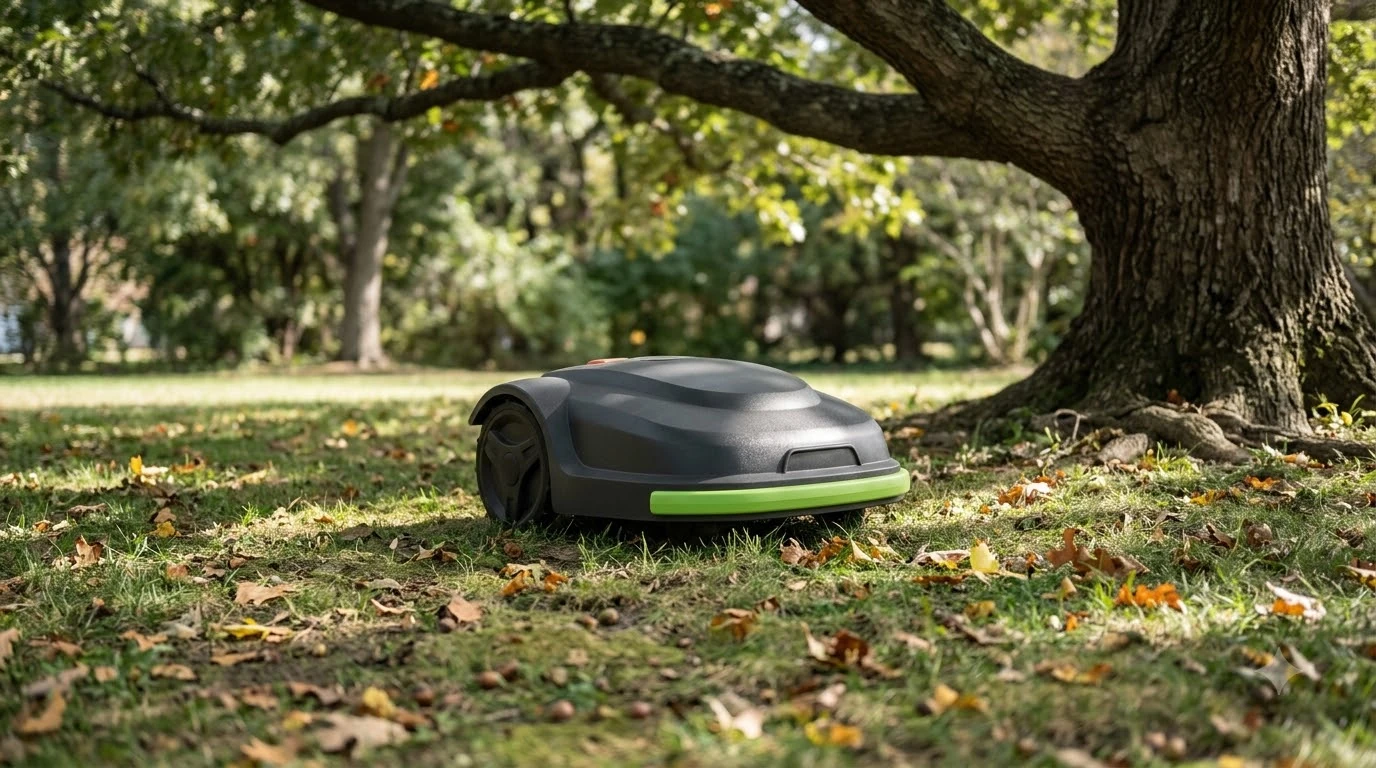

Best fertilizer for robot mowed lawn is usually a nitrogen-led lawn product with a slow-release share, sized to your grass species and season. Frequent robot cuts return fine clippings, so the lawn needs less nitrogen than a bagged lawn, but it still needs a feed. The label, not the brand name, tells you whether a bag fits your yard.
The short answer
- Look for nitrogen first. On the label, the first number on the bag is nitrogen, and it drives the color and growth you see.
- Prefer slow-release nitrogen. Virginia Tech says slowly available sources are less likely to leach, which matters on sandy soil.
- Match the rate to the grass. Cool-season and warm-season lawns have different seasonal limits and different feeding windows.
- Test the soil. Before you choose a bag, a soil test shows whether phosphorus, potassium or lime are also needed.
Best fertilizer for robot mowed lawn: why clippings change the choice
Clippings from a robot mower return nitrogen to the lawn. Penn State Extension reports a three-year study in which Kentucky bluegrass clippings held 46 to 59 percent of the nitrogen applied as fertilizer. That makes clippings a real nitrogen input, so a robot-mowed lawn usually needs a smaller fertilizer load than a lawn whose clippings are bagged. The same Penn State guidance says that when clippings are returned, you can reduce fertilizer use, and its basic turfgrass guide puts the reduction at up to one-third.
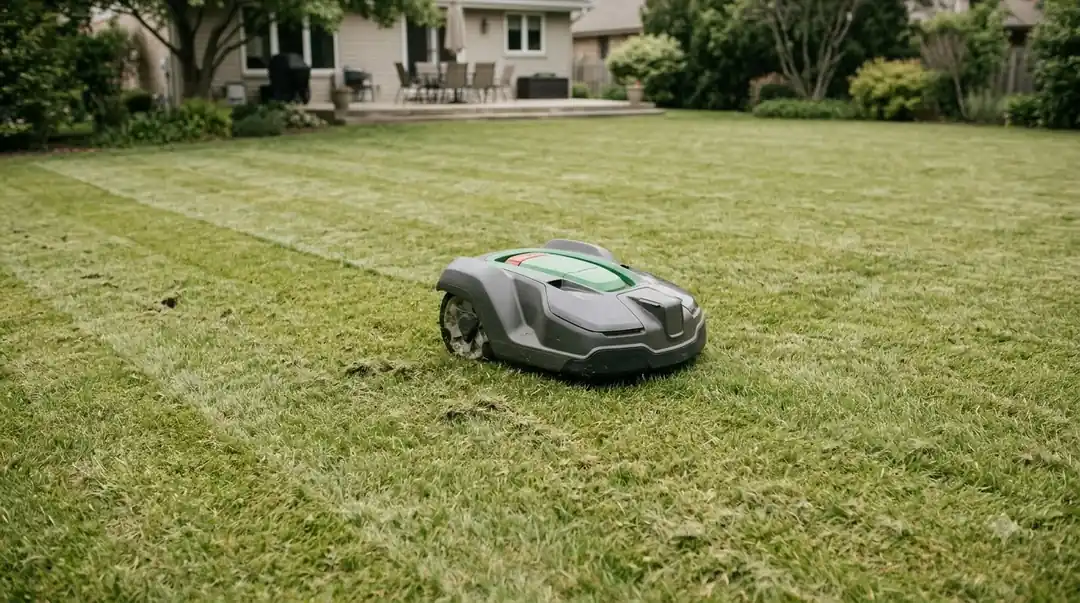
Clippings do not build thatch in the usual sense. Penn State states that because turf clippings are mostly leaf tissue that decomposes quickly, they do not contribute to thatch. Dry clippings typically carry about 2 to 5 percent nitrogen, according to Virginia Tech 430-402, which is why dry, fine clippings from frequent cuts are the easiest to recycle.
Our reading: clippings reduce the fertilizer you need, but they do not replace it. Think of the best fertilizer for robot mowed lawn as a lighter, well-timed feed, not no feed. For how robot mowers handle clippings, see do robot mowers mulch grass.
Read the N-P-K label first
Every lawn fertilizer label lists three numbers, always in the same order: nitrogen, phosphate and potash, each as a percentage of the bag by weight. Penn State gives a clear example. A 100-pound bag of 30-0-10 contains 30 pounds of nitrogen, no phosphate, and 10 pounds of potash. A 50-pound bag holds half those amounts.
Labels for phosphate and potash use oxide forms, so you may need to convert them. Penn State’s guide says to multiply the P2O5 percentage by 0.44 to get phosphorus, and the K2O percentage by 0.83 to get potassium. On the bag, the nitrogen number sets the main plan, while the other two numbers should match what your soil test says is missing.
Slow-release vs water-soluble nitrogen
When you compare bags, Virginia Tech’s comparison of the two main nitrogen sources applies. Slowly available sources can be applied at higher rates per application, and they are less susceptible to leaching, so they are preferred on sandy soil that drains quickly. Water-soluble sources act faster but can leach more readily and cause leaf burn, so the publication uses lower per-application rates for them.
| Feature | Slow-release nitrogen | Water-soluble nitrogen |
|---|---|---|
| Release speed | Slower, lasts longer | Faster, shorter response |
| Per-application rate | Can be applied at higher rates | Lower rates per application |
| Leaching risk | Lower, better on sandy soil | Higher |
| Leaf burn risk | Lower | Higher if over-applied |
Virginia Tech also notes a cap for water-soluble products on cool-season turf: no more than 0.7 pound of nitrogen per 1,000 square feet in any active growing month. Read the label for the product’s own rate, and do not add a second quick-release bag on top of a slow-release feed without a reason.
Match the rate to your grass
Seasonal nitrogen limits depend on the grass group. Virginia Tech’s upper limits are about 3.5 pounds of nitrogen per 1,000 square feet per season for cool-season lawns such as tall fescue, perennial ryegrass and Kentucky bluegrass, and up to 4 pounds for warm-season lawns such as bermudagrass and St. Augustinegrass. Zoysiagrass and centipedegrass fall lower, at 1.0 to 2.0 pounds in the same table.
| Grass group | Seasonal nitrogen upper limit (per 1,000 sq ft) |
|---|---|
| Cool-season (tall fescue, ryegrass, Kentucky bluegrass) | 2.0 to 3.5 lb |
| Fine-leaf fescue | 1.0 to 2.1 lb |
| Bermudagrass and St. Augustinegrass | 2.0 to 4.0 lb |
| Zoysiagrass and centipedegrass | 1.0 to 2.0 lb |
These are upper limits for the growing season, not targets, and the publication splits them across several applications. Your grass species decides which row applies, and the label rate decides how much product goes down each time.
Timing the feed around clipping return
Timing matters as much as the product, and a robot mower lawn care calendar can help you place the passes. Cool-season lawns in Virginia are best fertilized from mid-August through early November. Warm-season lawns perform best when fertilized between April 1 and August 15. Penn State’s basic guide describes the usual windows as mid-to-late spring, late summer and late fall, applied in several passes rather than one heavy dose.
- Cool-season lawn: the main feed sits in the late-summer to fall window.
- Warm-season lawn: the main feed sits in the April to mid-August window.
- Either type: feed when the grass is actively growing, not during dormancy.
Mowing height also changes how much clipping returns. Penn State’s table lists 2.5 to 3.5 inches for Kentucky bluegrass, perennial ryegrass and fine fescues, and 3.0 to 3.5 inches for tall fescue. A robot set in that range removes only a small amount of leaf each pass, which keeps the clippings fine.
Check the soil before you buy
Penn State advises testing soil every two or three years, ideally at about the same time of year each time. A soil test tells you whether phosphorus, potassium or lime are short, which no clipping plan fixes. Nitrogen is the one nutrient clippings help with most, so before you settle on the best fertilizer for robot mowed lawn, let the soil test guide the other numbers on the bag. If the soil is compacted, read about the best lawn aerator for robot mower lawns as well.
Our reading: if your last soil test is old, run a new one before buying a fertilizer with a high phosphorus or potassium number, since a lawn fertilizer should not add nutrients the soil already has. Many lawns do not need those nutrients added every year. For the wider picture, see whether robot mowers make lawns healthier.
What to check before you buy the best fertilizer for robot mowed lawn
Use this checklist before you pick a bag for a robot-mowed lawn. Each step narrows the choice to a bag that fits your yard.
- Identify your grass. Cool-season and warm-season grasses use different limits and different windows.
- Read the nitrogen number and the slow-release share. Prefer a slow-release share, especially on sandy soil.
- Check the rate on the label. Compare the seasonal total against the Virginia Tech upper limit for your grass group.
- Check the other two numbers against your soil test. Buy phosphorus or potassium only if the test shows a need.
- Plan two or three passes in the right window. Spread the season instead of one heavy application, which suits a robot-mowed lawn better than a single bag dumped in spring.
Frequently asked questions
Do I need a special fertilizer for a robot mowed lawn?
No special product is required, so the best fertilizer for robot mowed lawn is a standard product chosen on its label. Choose a nitrogen-led lawn fertilizer with a slow-release share and a rate that suits your grass species, because the robot mower does not change the nutrient needs of the grass.
Is slow-release fertilizer better than water-soluble?
On sandy soil, slow-release nitrogen is usually preferred because it is less likely to leach. Water-soluble products act faster but need lower rates per application to avoid leaf burn.
How many times a year should I fertilize?
Penn State describes several passes across the season, usually in mid-to-late spring, late summer and late fall. The exact number depends on your grass type and the seasonal limit on the label.
Can grass clippings replace fertilizer?
No. Penn State says returning clippings can reduce fertilizer use by up to one-third, but the lawn still needs a feed. Clippings recycle nutrients the grass has already taken up.
Sources
- Recycling Turfgrass Clippings (Penn State Extension): clippings nitrogen recovery of 46 to 59 percent and no thatch contribution.
- Turfgrass Fertilization: A Basic Guide for Professional Turfgrass Managers (Penn State Extension): N-P-K label reading, oxide conversion, soil test interval and application windows.
- Lawn Fertilization in Virginia, 430-011 (Virginia Tech Extension): seasonal nitrogen limits, slow-release vs water-soluble, timing windows.
- Mowing To Recycle Grass Clippings, 430-402 (Virginia Tech Extension): dry clippings nitrogen range.
 Up next9 min readGearBest RTK Antenna for Robot Mower: How to Choose the Right SetupUpdated Nov 11, 2026
 8 min readGearBest Grass Seed for Robot Mowed Lawn: Match Light and HeightUpdated Nov 11, 2026
 8 min readGearBest Cordless String Trimmer for Robot Mower Edges: How to ChooseUpdated Nov 11, 2026
 9 min readGearBest Soil Leveling Rake for Robot Mower Lawn: What to Look ForUpdated Nov 11, 2026
 9 min readGearBest Garden Hose Sprayer to Clean Robot Mower: What Brands AllowUpdated Nov 11, 2026
 7 min readGearBest Lawn Roller for a Bumpy Lawn Before a Robot MowerUpdated Nov 11, 2026