
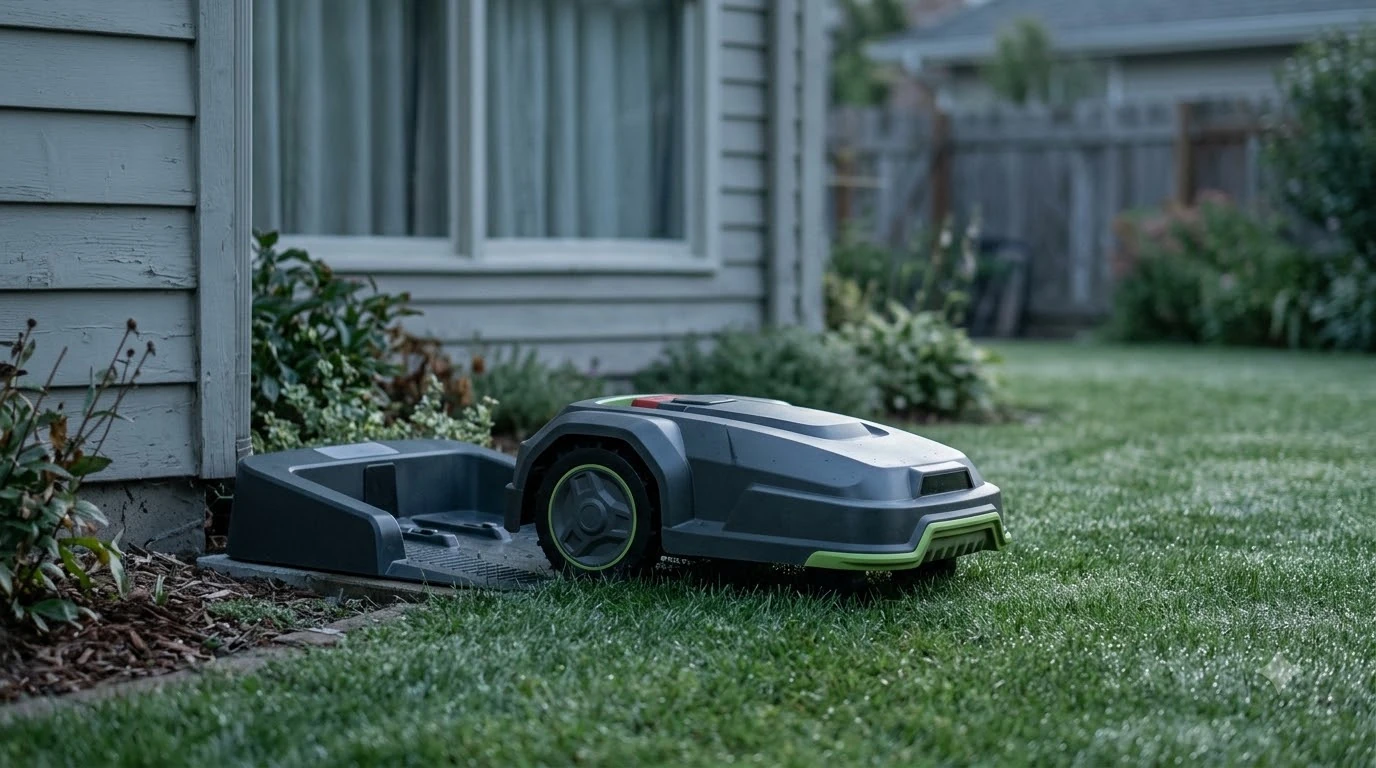

The best no base station robot lawn mower 2026 depends on how the mower finds its position. Three approaches skip a base station on your lawn: LiDAR, camera vision, and network RTK, which replaces the base with a correction service. Each has different limits for weather, light, and internet access, so your yard decides the fit.
The short answer
- LiDAR needs no base station. Ecovacs says LiDAR mowers need no extra base station or setup, while traditional RTK needs a base placed in an open area.
- Network RTK swaps the base for the internet. Mammotion says its service sends corrections over a 4G module or home Wi-Fi from a reference network.
- Accuracy figures are manufacturer claims. Mammotion states network RTK is typically within 1 to 2 centimeters, and we did not find an independent test that confirms it.
- Weather and light matter. Fog and heavy rain can scatter LiDAR beams, and some camera models work only in daylight.
What “no base station” means on a robot mower
A robot mower has to know where it is on the lawn to cut evenly and stay inside its zone. A traditional RTK setup (see how an RTK robot mower works) gets that accuracy from a base station placed in the yard. Ecovacs advises setting the base up in an open, unobstructed area, and notes that poor placement reduces positioning precision. Our guide on where to mount an RTK base station covers the placement side. Setup also needs calibration and extra installation time.
Plain satellite GPS is far coarser. Mammotion’s comparison puts standard GPS at approximately 2 to 5 meters. In our reading, that gap is why a correction source matters at all. All three approaches below still use satellite signals. What changes is how the correction arrives, or whether the mower falls back on onboard sensors when the signal is weak. That difference is the real test for any best no base station robot lawn mower 2026 shortlist.
The three main ways to navigate without a base station
LiDAR, camera vision, and network RTK each remove the physical base, but they locate the mower in different ways and fail in different conditions. The table summarizes what the manufacturer pages we read say about each one.
| Approach | How it helps position the mower | What the sources say it needs | Limits the sources name |
|---|---|---|---|
| LiDAR | Laser pulses map the lawn, obstacles, and boundaries | No extra base station or setup (Ecovacs) | Fog and heavy rain scatter the beams; sensors need cleaning (Anker, Ecovacs) |
| Camera vision | Camera checks for grass when satellite signal drops (Husqvarna) | Works alongside satellite navigation as a backup (Husqvarna) | Daytime-only on some models; no lux or weather thresholds given (Husqvarna) |
| Network RTK | Correction data from a reference network over 4G or Wi-Fi (Mammotion) | No physical base station or antenna (Mammotion) | Needs internet and a stable network signal (Mammotion) |
LiDAR: no base station, but weather and sensor care matter
LiDAR mowers send out thousands of tiny laser pulses and time how long each one takes to return, according to Anker. The mower builds a digital map of the lawn, detects obstacles, and keeps updating that map as it works. Because it does not depend on daylight to understand its surroundings, Anker says it can work in shade, at dusk, or at night.
Weather is the main trade-off. Ecovacs says fog and heavy rain “may scatter and absorb laser beams, impacting laser performance.” Anker adds that sensors may need cleaning after rain, mud, or dust, and that many models return to the charging station until conditions improve.
Heads up
Plan for sensor cleaning if your lawn gets muddy or dusty. Anker says LiDAR sensors still need to stay clean, so that upkeep is part of owning one.
Cost is the other trade-off. Ecovacs and Anker both say LiDAR is generally more expensive than RTK or basic vision systems. Neither source gives a price, so compare current listings directly before you decide.
Camera vision: a backup for signal gaps, with light limits
Camera-based navigation works mainly as a backup for short satellite dropouts. Camera mapping comes in more than one form, and our explainer on VSLAM navigation on a robot mower covers the map-building kind. Husqvarna says that when the satellite signal is temporarily lost, its Automower uses its camera to check its surroundings. It keeps mowing for a limited distance as long as it can see grass. If it finds no grass, it rotates to search, and if none is found in any direction, it stops and looks for a satellite signal.
Light matters too. Husqvarna lists the Aspire R6V, 308V, and 312V as daytime vision models, where the AI vision features stop working at night. The 405VE NERA, 410VE NERA, 430V NERA, and 450V NERA use an infrared camera for day and night operation. That same page gives no lux, fog, or rain thresholds, so check the spec sheet for those limits before you buy.
In our reading, a camera backup is built for short gaps. If your yard has long stretches under tree cover, check whether the maker documents a fallback for longer dropouts.
Network RTK: lighter setup, but it depends on the internet
Network RTK removes the physical base station and antenna, but the mower still needs a live connection to receive corrections. Mammotion explains that its mower connects to this server using an onboard 4G module or your home Wi-Fi, and that the server calculates correction data from reference stations across a region. The article describes no base station and no antenna for the service.

Mammotion says network RTK is typically accurate to within 1 to 2 centimeters, and it notes that a stable network signal is essential. That accuracy figure is the manufacturer’s claim. We did not find an independent test in the sources we read that confirms it.
Two practical points follow. First, the article is written for European buyers and describes coverage as most regions in Europe, with availability varying by country. Check that the service covers your location before you buy. Second, Mammotion says its 4G data is free for the entire product lifespan, with no hidden subscription costs. That is a vendor claim, so confirm the terms in writing.
In our reading, the big gap is fallback. The Mammotion article does not describe what happens when the network or the signal fails, so ask the seller how the mower behaves when the connection drops. If a mower already struggles to hold a fix, why a robot mower keeps losing its RTK signal lists what to check.
Which yard suits which approach
Yard layout matters more than any single feature when you compare the best no base station robot lawn mower 2026 options: large, open lawns favor RTK, while yards with trees and shade favor LiDAR, according to Anker. The table lists common situations and the approach that usually fits better, based on the sources and our reading. Shaded lawns get more detail in our guide to a robot mower under trees.
| Yard situation | Approach that usually fits better | Why |
|---|---|---|
| Large, open lawn with a strong satellite view | RTK, base or network | Anker says RTK suits large, open lawns with strong GPS reception |
| Trees, fences, or shade | LiDAR | Ecovacs says LiDAR is unaffected by shade or structures, and Anker says it suits shaded gardens better than RTK |
| Frequent fog, heavy rain, or dust | Check ratings and sensor care first | Ecovacs and Anker both list fog and heavy rain as LiDAR limits |
| Weak cellular or Wi-Fi at the lawn | LiDAR or camera vision | Network RTK needs a stable network signal, according to Mammotion |
| Long dropouts under heavy cover | Ask about fallback behavior | Husqvarna’s camera backup covers only a limited distance |
In our reading, a mower that combines satellite positioning with LiDAR or vision gives more fallbacks. The spec sheet should still say which sensor takes over, and when.
The best no base station robot lawn mower 2026: what to check before you buy
Before you buy the best no base station robot lawn mower 2026 for your yard, confirm how the mower finds its position without a base station, what it does when that signal drops, and what the service and weather terms are. Use this checklist alongside the manufacturer’s spec sheet and support pages.
- Positioning method. Confirm whether the mower uses LiDAR, camera vision, network RTK, or a mix, and which sensor takes over when satellite signal is weak.
- Fallback behavior. Ask what happens during a signal dropout. Husqvarna documents its camera fallback, while the Mammotion network RTK article does not describe one.
- Light conditions. Check whether the model works at night. Husqvarna separates daytime-only vision models from day-and-night infrared models.
- Weather limits. Look for stated fog, rain, and dust limits. Husqvarna gives none, and Ecovacs and Anker both describe fog and heavy rain as a LiDAR limit.
- Connectivity. For network RTK, confirm your location is covered and that the lawn has a reliable 4G or Wi-Fi signal.
- Service terms. Find out whether the correction service is free, time-limited, or paid, and get the terms in writing.
- Sensor upkeep. If the model uses LiDAR, plan for regular cleaning, especially after rain, mud, or dust.

Frequently asked questions
Does a robot lawn mower need a base station to work?
No, not always. Ecovacs says LiDAR mowers need no extra base station or setup, and Mammotion says its network RTK service works without a physical base station. Traditional RTK still depends on a base placed in an open, unobstructed area, so the best no base station robot lawn mower 2026 for your yard is the one whose substitute method fits your lawn.
Is network RTK as accurate as a base station?
Mammotion says network RTK is typically within 1 to 2 centimeters. That is a manufacturer claim, and we did not find an independent test that confirms it, so look for third-party results before you rely on the number.
Does LiDAR work at night?
Yes, according to Anker, because LiDAR does not depend on daylight to understand its surroundings. Fog, strong rain, or water on the sensor can still make navigation less accurate, so keep the sensor clean and check the weather limits.
What happens when the satellite signal drops?
It depends on the model. Husqvarna says its camera-equipped Automower keeps mowing for a limited distance when it can see grass, then searches for grass and a satellite signal. Mammotion’s network RTK article does not describe a fallback, so ask the seller for that behavior in writing.
Sources
- LiDAR vs RTK robot lawn mowers (Ecovacs): base station placement, LiDAR without a base station, weather limits, and cost comparison.
- LiDAR robot lawn mower guide (Anker): how LiDAR works, weather and sensor cleaning, and yard fit compared with RTK.
- What is network RTK (Mammotion): correction delivery, accuracy claim, and service terms.
- How Automower AI vision technology works (Husqvarna): camera fallback during satellite signal loss and day and night models.
 Up next7 min readBest Robot MowersWhich No Base Station Robot Mower Is the Most Accurate?Updated Nov 18, 2026
 8 min readBest Robot MowersBest Robot Mower With No Subscription Fee: What to Check Before You BuyUpdated Nov 11, 2026
 8 min readBest Robot MowersBest LiDAR Robot Lawn Mower With No RTK Antenna: What to CheckUpdated Nov 11, 2026
 8 min readBest Robot MowersBest Robot Lawn Mower for 1 Acre: What to Check Before You BuyUpdated Nov 13, 2026
 7 min readBest Robot MowersBest Robot Lawn Mower for Ohio Lawns: What to Check Before You BuyUpdated Nov 11, 2026
 7 min readBest Robot MowersBest Robot Lawn Mower for Georgia Lawns: What to Check Before You BuyUpdated Nov 13, 2026