
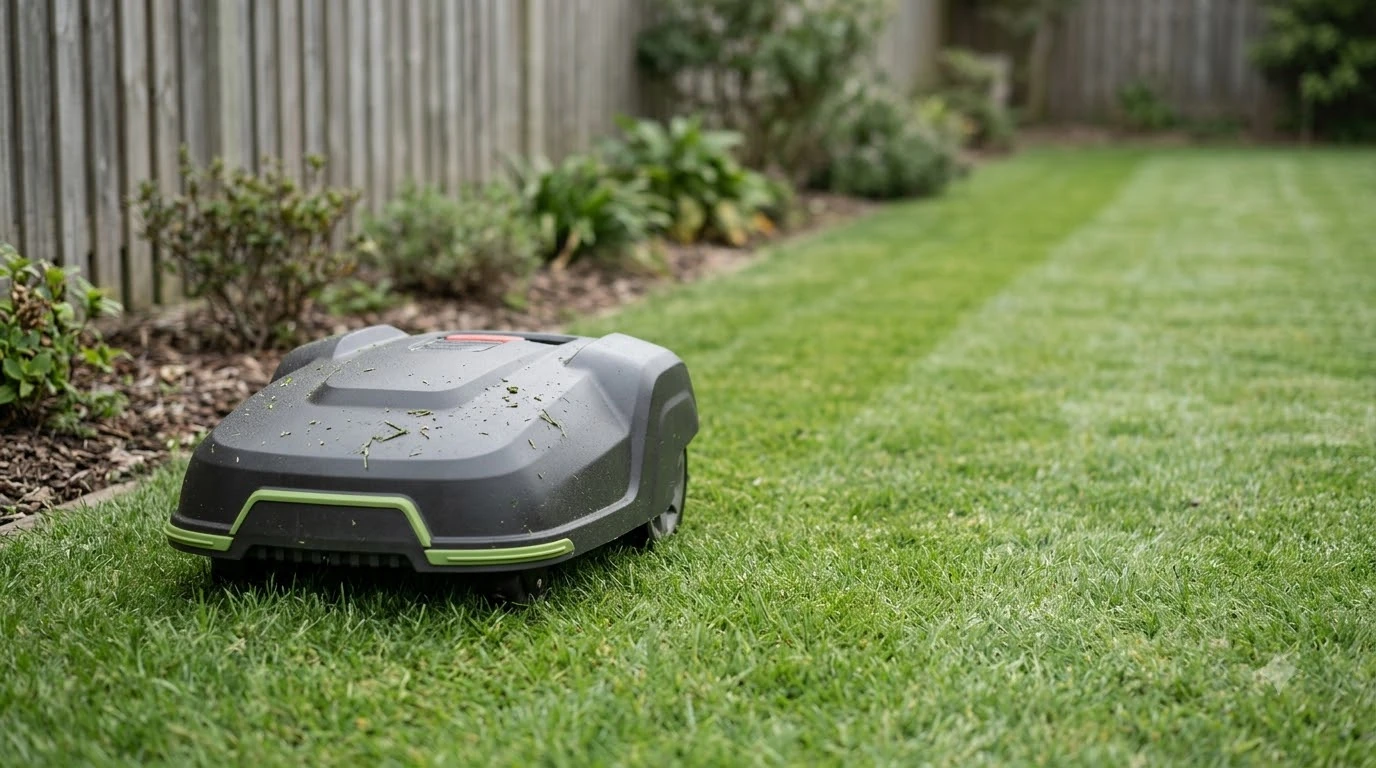

The best robot lawn mower for Georgia lawns is the one whose cutting height, slope limit and rain rating match your yard. Georgia lawns are mostly warm-season grass, so the mower’s height range and terrain limits matter more than any brand name, as of November 2026. This guide lists the numbers to compare and what the sources say about them.
Robot mowers cut often and in small amounts, which suits fast-growing warm-season grass. The sections below show what to compare on the spec sheet before you buy.
The short answer
- Match the grass: identify your lawn type first, because cutting ranges differ by grass.
- Match the height range: the mower’s lowest and highest settings must cover your grass’s range.
- Run often: short, frequent cuts remove only a little leaf each time, which fits the one-third rule.
- Check rain: UGA Extension says robotic mowers can run in light rain, but that source does not cover heavy rain.
- Check slope in the manual: the rating for your yard, not the headline number, decides the fit.
Which grasses Georgia lawns usually have
Bermudagrass, zoysiagrass, St. Augustinegrass and centipedegrass are warm-season lawn grasses, and each has its own cutting range. Clemson HGIC’s mowing guide lists typical heights for all four, and those figures are the reference used in this guide.
UGA Extension publishes Georgia-specific grass guidance, but its pages could not be retrieved for this guide. Treat the figures below as regional references, and confirm them with your county extension office before you set a mower.
Cutting height ranges to match your grass
Common bermudagrass is usually cut at 1 to 2 inches, and St. Augustinegrass at 2.5 to 4 inches, according to Clemson HGIC.
| Grass | Clemson HGIC typical height | NC State Extension range |
|---|---|---|
| Common bermudagrass | 1 to 2 inches | 0.75 to 2 inches (listed with zoysia) |
| Hybrid bermudagrass | 0.5 to 1.5 inches | Not listed separately |
| Zoysiagrass | 1 to 2 inches | 0.75 to 2 inches |
| Centipedegrass | 1.5 to 2 inches | 1 to 1.5 inches |
| St. Augustinegrass | 2.5 to 4 inches | 2 to 4 inches |
The sources do not match exactly, because they describe different cultivars and conditions. NC State Extension lists bermudagrass as acceptable from 5/8 to 2.5 inches, and says it performs best at 3/4 to 1 inch under a reel mower, so the lower end of the range is a reel mower question as much as a mower-setting one. Our reading is that the best robot lawn mower for Georgia lawns has a lowest setting that reaches the bottom of your grass’s range and a highest setting that reaches the top. For one grass in detail, see this guide on how often to mow Bermuda grass.
Why cutting height limits a robot mower
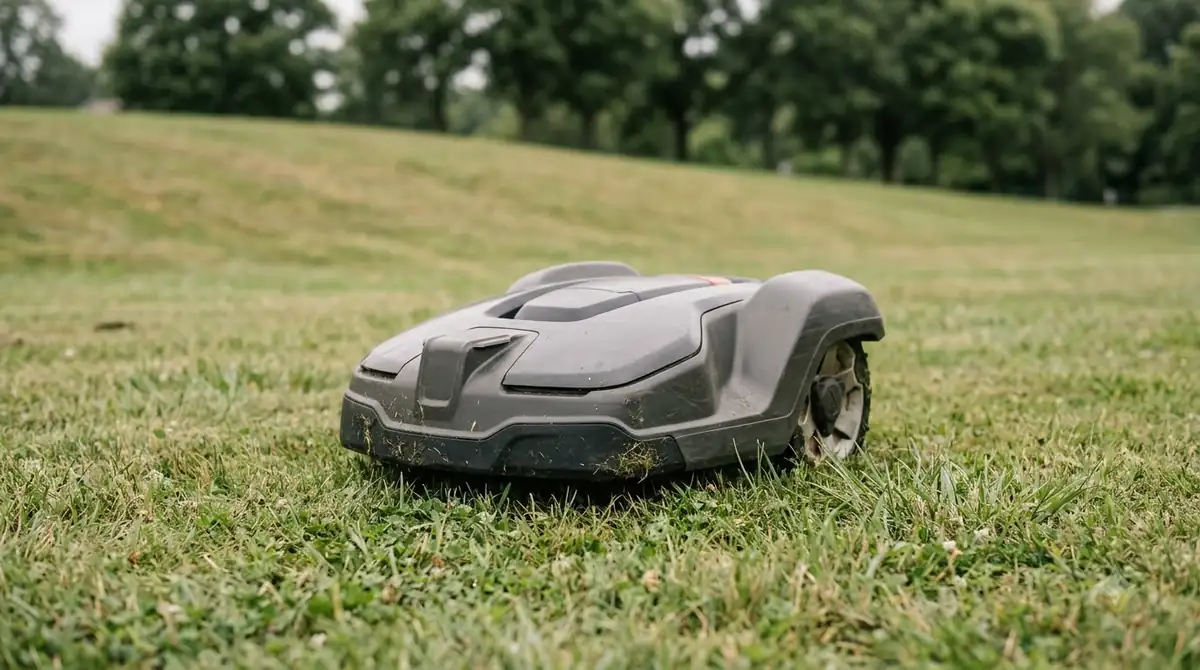
A robot mower can only cover your lawn when its height range overlaps your grass’s range, so the spec sheet decides the fit. In a 2026 UF/IFAS report on robot mowers, researchers tested a robot mower at a 2.4 inch cut on St. Augustinegrass, below the 3 to 4 inch average that the usual recommendation lists for warm-season grasses.
Two limits apply. That trial was run in Florida, not Georgia, and it does not show that every model can reach 2.4 inches. Check the lowest setting on the spec sheet before you assume a model can match a low cut. Our St. Augustine grass cutting height guide covers the same grass in more detail. Unruh also said the turf was spectacular and quite healthy compared with results from conventional mowers, which is a single-trial finding, not a general rule.
How often a robot mower should run
UF/IFAS describes conventional mowing as about every seven days, removing a third of the blade each time. Bryan Unruh of UF/IFAS reported that daily robotic mowing increased turf density and promoted healthier turf in that trial. The comparison shows why the schedule matters as much as the mower’s specs when you judge a robot model for a warm-season lawn.
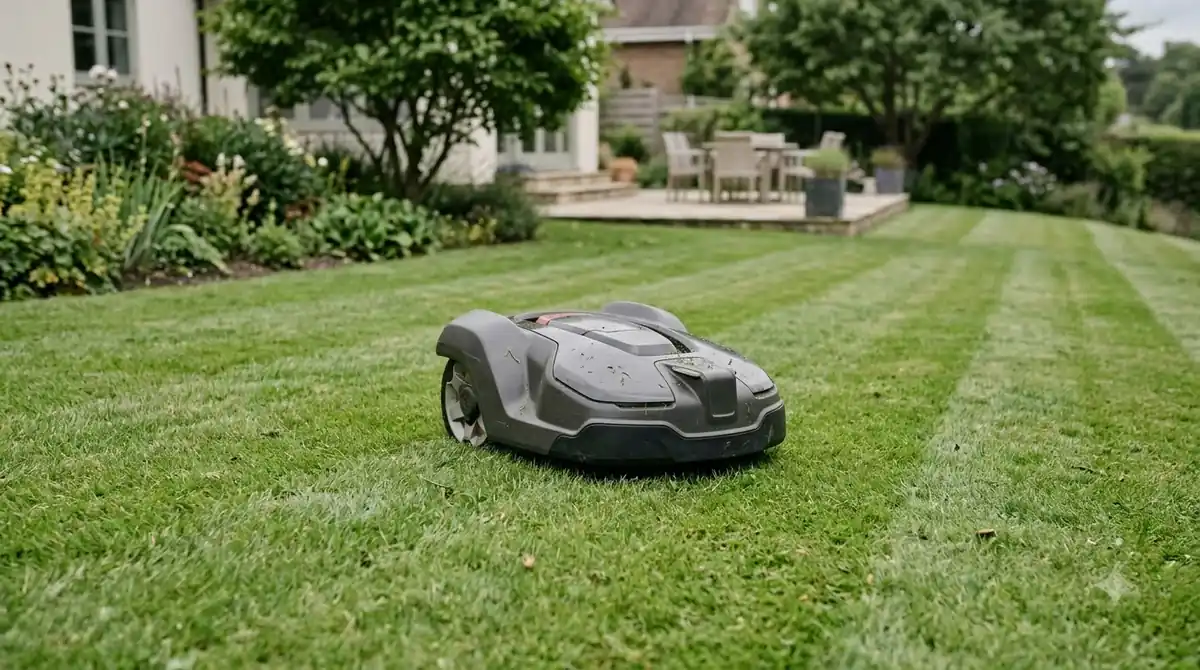
UGA Extension specialist Clint Waltz made the same point about frequency: because the mower takes off very little leaf tissue each time, there is less stress on the plant. Frequency matters as much as height when you compare the best robot lawn mower for Georgia lawns. Our reading is that the schedule should follow grass growth, with more runs in peak season and fewer when growth slows.
Rain, heat and the Georgia season
In a UGA Today interview from September 2023, the article says robotic mowers can operate in a light rain. For more on wet-weather limits, read whether robot lawn mowers can mow in the rain. The same interview says detail work such as string trimming around the drive still has to be done by hand.
Clemson HGIC advises raising mowing height slightly during high heat or lack of rain, and keeping it raised until the stress ends. That advice comes from its zoysiagrass calendar, so check the calendar that matches your grass type. Heat and dry spells are a good reason to pick a model whose height you can adjust easily, so the best robot lawn mower for Georgia lawns keeps its setting range useful all season.
Lot size, slope and boundary limits
Slope and boundary ratings are set per model, so the figure in the manual for your yard decides whether a mower fits. Manufacturers state slope in different ways, so compare the unit and check whether the rating applies to the work area or to the boundary. A rating that looks high on a headline may only apply to flat sections, so measure your steepest area and compare it with the wording in the manual, not the marketing. This explainer on how robot mower slope ratings work shows how to read those figures.
Lot size is a separate question for anyone shopping for the best robot lawn mower for Georgia lawns. Compare the coverage area the maker states with your lawn after you subtract beds, pools and other obstacles.

Checklist for the best robot lawn mower for Georgia lawns
Before you buy, confirm the cutting height range, slope rating, rain behavior and coverage area against your own yard. Use the height table above as the first filter, because a mower that cannot reach your grass’s range will cut too high no matter how well it performs elsewhere.
- Cutting height: the lowest and highest settings, compared with your grass’s range in the table above.
- Slope: the rating and whether it applies to the work area or the boundary.
- Rain: the rating in the manual, and whether the mower pauses during heavy rain.
- Coverage: the stated area, compared with your lawn after beds and obstacles.
- Documents: the manual and spec sheet for the exact model you plan to buy.
Frequently asked questions
Is there one best robot lawn mower for Georgia lawns?
No single model suits every yard. Grass type, the mower’s cutting height range, slope and lawn area all change the fit, so the right choice is the model whose specs cover your conditions.
Can a robot mower cut St. Augustinegrass at 2.5 inches?
Clemson HGIC lists 2.5 to 4 inches as typical for St. Augustinegrass, and a UF/IFAS trial cut it at 2.4 inches. Whether a given model reaches 2.5 inches depends on its lowest setting, so check the spec sheet before buying.
Do robot mowers work in the rain?
UGA Extension says robotic mowers can operate in light rain. The source does not address heavy rain, so check the manual’s rain rating and whether the mower pauses during storms.
How often should a robot mower run?
UF/IFAS describes conventional mowing as about every seven days, removing a third of the blade. Robot mowers cut in short, frequent runs, which UGA Extension links to less stress on the plant. Set the schedule by grass growth.
Sources
- UGA Today: Extension specialist discusses advantages of robotic mowers (UGA Extension): light rain operation, less stress from frequent short cuts, trimming still by hand.
- UF/IFAS News: robotic mowers (UF/IFAS): 2.4 inch trial on St. Augustinegrass, usual 3 to 4 inch recommendation, one-third rule.
- Mowing Lawns (Clemson HGIC): typical cutting heights by grass type.
- Zoysiagrass Maintenance Calendar (Clemson HGIC): raise height during high heat or lack of rain.
- Lawns, Extension Gardener Handbook (NC State Extension): mowing height ranges in Table 9-1.
 Up next8 min readBest Robot MowersBest Robot Lawn Mower for 1 Acre: What to Check Before You BuyUpdated Nov 13, 2026
 10 min readBest Robot MowersBest No Base Station Robot Lawn Mower 2026: What to Check Before You BuyUpdated Nov 13, 2026
 9 min readBest Robot MowersBest Robot Lawn Mower for the Midwest Lawns: What to Check Before You BuyUpdated Nov 13, 2026
 7 min readBest Robot MowersBest Robot Lawn Mower for Ohio Lawns: What to Check Before You BuyUpdated Nov 11, 2026
 8 min readBest Robot MowersBest LiDAR Robot Lawn Mower 2026: What to Check Before You BuyUpdated Nov 13, 2026
 9 min readBest Robot MowersBest Satellite Navigation Robot Lawn Mower 2026: What to Check Before You BuyUpdated Nov 11, 2026