
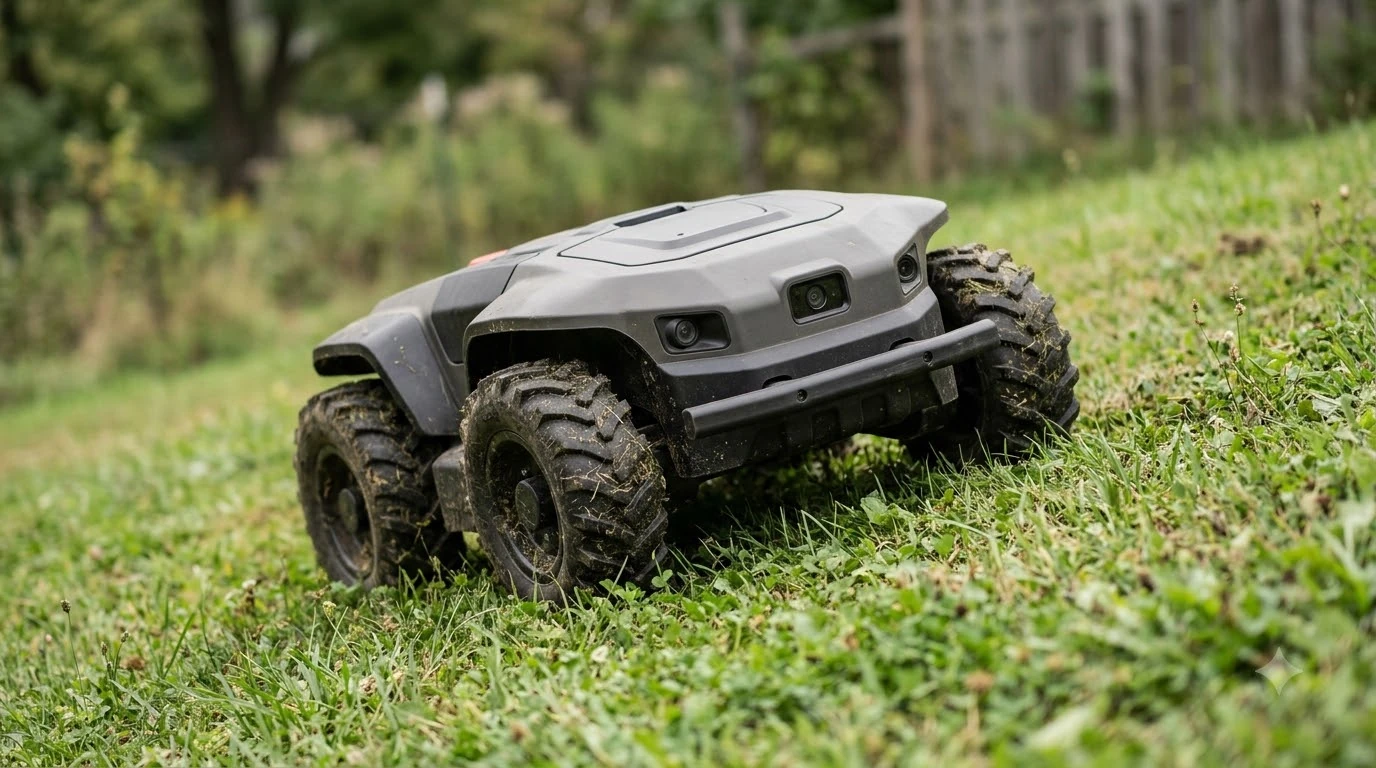

A robot lawn mower for 70 percent slope is a narrow category, limited to all-wheel-drive models such as the Husqvarna 435X AWD. Most robot mowers are rated between 25 and 50 percent, and the top figure applies to the work area inside the boundary wire. The edge of the lawn is usually rated lower, so check both numbers before you buy. Husqvarna’s support pages and Eufy’s guide list these figures as of November 2026.
The short answer
- 70 percent is about 35 degrees. Our calculation: the arctangent of 0.70 is 35.0 degrees.
- Which models: for a robot lawn mower for 70 percent slope, Husqvarna rates its 435X AWD and 435X AWD NERA at 70 percent in the work area, with a 50 percent limit at the boundary wire.
- Other brands: Eufy’s AU guide places its AWD tier at up to 70 percent, its mid-range at up to 35 percent, and its advanced residential at up to 40 percent.
- Check first: measure your steepest section, compare it with both limits, and keep a margin below the rating.
What 70 percent means in degrees
Robot mower specs are mostly written in percent, while some blogs quote degrees. The two are different numbers. Percent is the vertical rise divided by the horizontal run, multiplied by 100 (our robot mower slope rating explainer covers the basics). Degrees measure the angle itself. Husqvarna’s installation guide gives the formula as slope (%) = vertical height divided by horizontal distance, multiplied by 100. Its worked example is a 15 cm rise over 100 cm of run, which is 15 percent.
Iowa State University Extension also writes slope as a ratio. It notes that 1:12 equals 8.33 percent, which is one foot of rise for every 12 feet of run. The table below is our calculation from the standard arctangent formula, not a manufacturer figure.
| Slope (percent) | Angle (degrees, our calculation) |
|---|---|
| 25% | 14.0 |
| 40% | 21.8 |
| 50% | 26.6 |
| 70% | 35.0 |
The unit matters when you compare brands. Eufy’s guide pairs 40 percent with 18 degrees in one section. Standard trigonometry does not support that pairing, because 18 degrees is about 32 percent. Our reading is that you should confirm the unit on each spec sheet before comparing two models.
Robot lawn mower for 70 percent slope: which models qualify
Only the top all-wheel-drive tier reaches 70 percent in the sources we read. Husqvarna’s table shows a clear step between its model families, and the boundary figure drops at every step.
| Husqvarna model family | Work-area limit | Boundary-wire limit |
|---|---|---|
| 105 | 25% | 15% |
| 305, 310, 315 (standard) | 40% | 15% |
| 320 NERA, 430X NERA, 450X NERA | 50% | 25% |
| 435X AWD, 435X AWD NERA | 70% | 50% |
Eufy groups mowers in tiers instead: basic models at 10 to 25 percent (5.7 to 14 degrees), mid-range at up to 35 percent (19.7 degrees), advanced residential at up to 40 percent, and advanced all-wheel-drive models at up to 70 percent (35 degrees). Both sources describe 70 percent as a maximum rating, not a figure every model in a brand reaches. Some retailer listings show higher numbers, such as 80 percent. We did not confirm those against a manufacturer manual, so we leave them out.
Why the boundary limit is lower
The boundary limit is the figure that governs the edge of the lawn, and on the 435X AWD it is 50 percent rather than 70. Husqvarna’s guide says that areas with slopes that are too steep must be excluded from the installation. Those areas can be isolated with boundary wire islands or with stay-out zones, depending on the model and the installation type.

Husqvarna also sets clearance rules for AWD models. On slopes up to 50 percent, keep 1.5 m (5 ft) between the boundary wire and any obstacles. On slopes from 50 to 70 percent, keep obstacles off the slope itself and keep 1.5 m (5 ft) between the bottom of the slope and the boundary wire. The same guide asks for at least 50 cm (1.6 ft) of level ground between a flat area and a steep slope.
Why the rated limit is not a daily target
Eufy describes a mower’s maximum slope as an absolute limit rather than a target for daily mowing, and that matters most for a robot lawn mower for 70 percent slope, where the top of the range is only reached by a few models. Wet grass adds a second risk, covered in more detail in our guide to a robot mower on wet grass. According to Eufy, damp turf reduces tire grip, which can cause the unit to slide sideways or slip downhill, even when the slope is inside the rated range.
- Grip: wet grass reduces traction, so the rated figure is a ceiling that good conditions allow, not a guarantee for every day of the year.
- Battery: Eufy notes that steeper inclines can noticeably reduce runtime per charge, so a yard with long climbs leaves less battery for the rest of the lawn.
- Margin: choosing a mower rated well above your steepest section leaves room for wet days and for a battery that is not fully charged.
How to check your slope before buying
Our guide on how to measure your yard’s slope goes deeper, but a phone and a tape measure are enough for a rough check before you shortlist any robot lawn mower for 70 percent slope. Our reading is that a rough check is good enough to rule a model in or out, but you still need the exact boundary layout from the manufacturer’s installation guide.
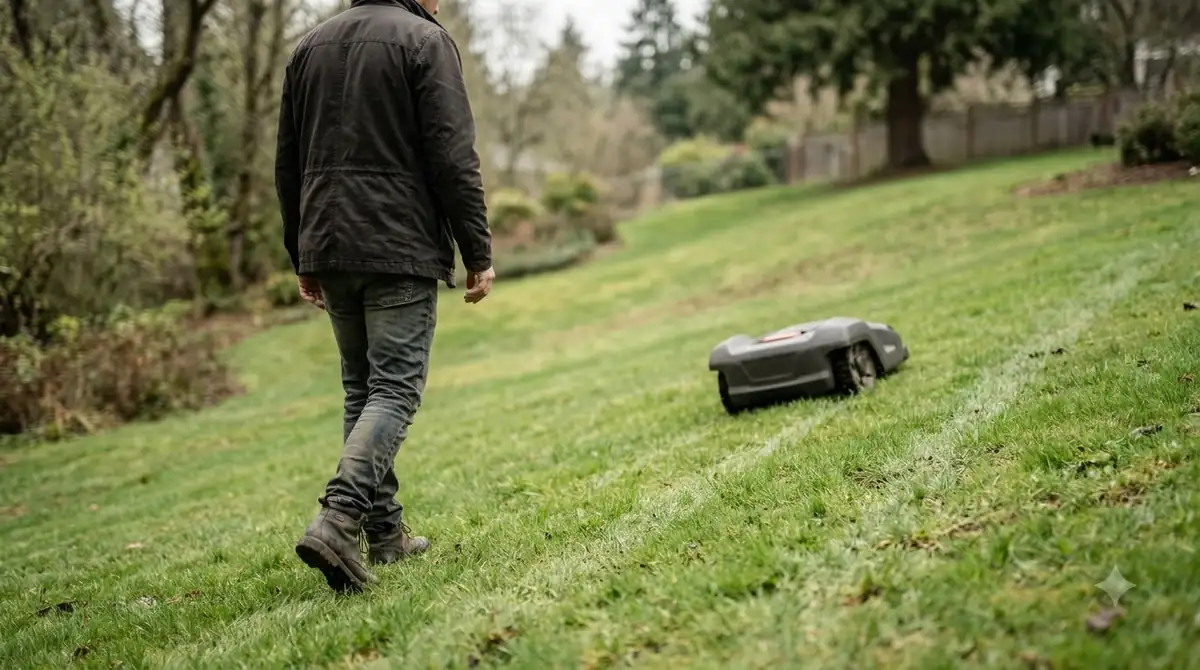
- Find the steepest section. Walk the lawn and note where the mower would have to climb the most.
- Measure rise and run. Eufy suggests a smartphone incline app, or a spirit level with a tape measure placed on the steepest section.
- Convert to percent. Divide the rise by the run and multiply by 100. Husqvarna’s example of 15 cm over 100 cm gives 15 percent. If your steepest section lands nearer 45 percent, read about a robot lawn mower for 45 percent slope instead.
- Compare with both limits. The work-area limit applies to the interior of the lawn, and the boundary limit applies at the edge where the wire runs.
- Leave a margin. We recommend choosing a model whose rated figure clearly exceeds your measured steepest slope.
When steep ground is a poor fit for any mower
Iowa State University Extension treats slopes of 20 percent (1:5) or more as steep for landscaping, and says that slopes of about 30 percent (1:3) or more are too steep to mow for turf. That guidance is written for hand mowing and planting, so it is a landscape rule of thumb rather than a robot specification. The same extension guide advises securing sod strips with 2 to 3 stakes or staples on slopes steeper than 10 percent. Our reading is that a mower rating tells you whether a robot lawn mower for 70 percent slope can climb it, not whether the grass on that slope will stay healthy.
What to check before you buy
Use this checklist before you compare a robot lawn mower for 70 percent slope with a lower-rated model.
- Both the work-area and boundary-wire figures, written in the same unit.
- Whether the spec sheet uses percent or degrees, and whether the figure is a maximum.
- Whether the model is AWD, since only the AWD tier reaches 70 percent in the sources we read.
- The manual’s rules for excluding steep areas and for placing the boundary wire.
- The manufacturer’s notes on wet grass and battery runtime on hills.
Frequently asked questions
Can a robot lawn mower really climb a 70 percent slope?
Some AWD models are rated to 70 percent in the work area. Husqvarna’s 435X AWD is one example, and its boundary-wire limit is 50 percent.
Is 70 percent the same as 70 degrees?
No. 70 percent is about 35 degrees. The two units describe the same slope in different ways, so always check which unit a spec sheet uses.
Why is the boundary limit lower than the work-area limit?
Husqvarna lists a lower limit for the boundary than for the work area, and it says too-steep areas must be excluded from the installation. Check the boundary figure for the edge of your lawn.
Does wet grass change the slope rating?
The rating itself does not change, but Eufy says damp turf reduces tire grip. A mower can slide or slip downhill even when the slope is inside its rated range.
Sources
- Husqvarna support: optimising an Automower installation for steep slopes (manufacturer): model slope table, AWD clearance rules, slope formula.
- Eufy: robot lawn mower slope limits (manufacturer blog): tier ranges, absolute limit, wet grass and battery notes.
- Iowa State University Extension: gardening on slopes and hillsides (university extension): ratio conversion, steep thresholds, sod staking.
 Up next8 min readBy YardRobot Lawn Mower for 50 Percent Slope: What the Rating MeansUpdated Nov 11, 2026
 9 min readBy YardRobot Lawn Mower for a 30 Percent Slope: What to Check Before You BuyUpdated Nov 11, 2026
 7 min readBy YardRobot Lawn Mower for a 25 Percent Slope: What to Check Before You BuyUpdated Nov 11, 2026
 8 min readBy YardRobot Lawn Mower for a 35 Percent Slope: What to Check Before You BuyUpdated Nov 11, 2026
 9 min readBy YardRobot Lawn Mower for 80 Percent Slope: What the Claims ShowUpdated Nov 12, 2026
 10 min readBy YardRobot Lawn Mower for 45 Percent Slope: What to Check Before You BuyUpdated Nov 11, 2026