
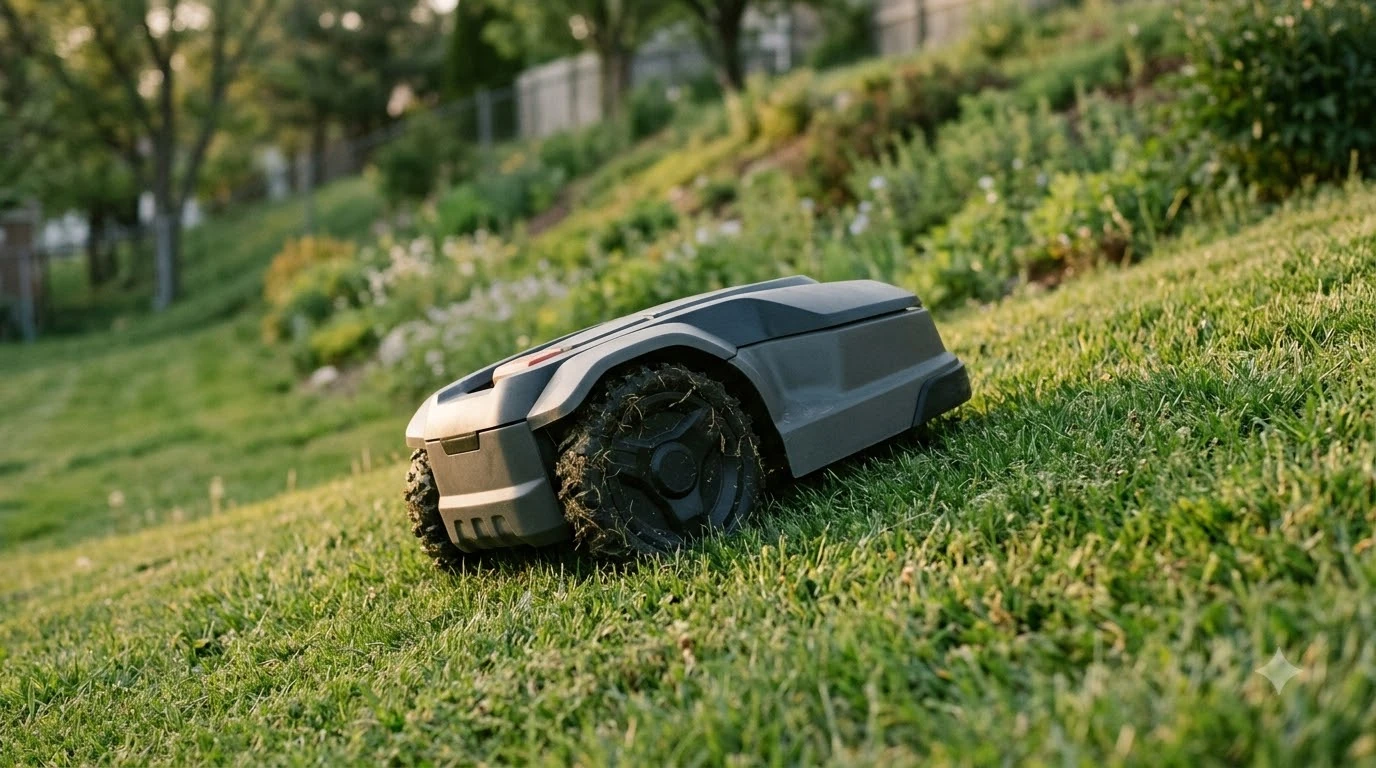

A robot lawn mower for 30 percent slope is one whose rated limit sits clearly above 30 percent in the area it actually mows. A 30 percent grade equals about 16.7 degrees, a moderate incline that many models can climb, but only if the rating applies to your yard.
Spec sheets often list two numbers, one for the work area and one for the boundary wire, so check both before you buy.
The short answer
- Rating. Look for a work-area rating above 30 percent, with margin for wet days.
- Boundary. Confirm the boundary rating too, since it is often much lower.
- Measurement. Measure rise over run on your steepest strip, not the average.
- Margin. Treat the rating as a limit, not a daily target.
What a robot lawn mower for 30 percent slope has to handle
A 30 percent slope rises 30 feet for every 100 feet measured flat, which works out to about 16.7 degrees. Percent is a ratio of rise to run, so the same figure applies whatever unit you measure in. Iowa State University Extension describes slope the same way, showing that a 1:12 ratio equals 8.33 percent, one foot of rise over twelve feet of run.
Iowa State’s guidance is written for people pushing a mower, where slopes around 30 percent or steeper are considered too steep to mow. A robot mower’s rating describes what the machine can climb, not what is comfortable or practical for your lawn. For a robot lawn mower for 30 percent slope, read the rating as a ceiling for the machine and treat your own yard as the real test.
Eufy groups its robots into rough tiers, with basic mowers rated 10 to 25 percent, mid-range models up to 35 percent, advanced residential models up to 40 percent, and all-wheel drive models up to 70 percent. On that scale a 30 percent slope sits above the basic tier and inside the mid-range, so mid-range and higher models, including AWD robot lawn mowers, are the ones to compare.
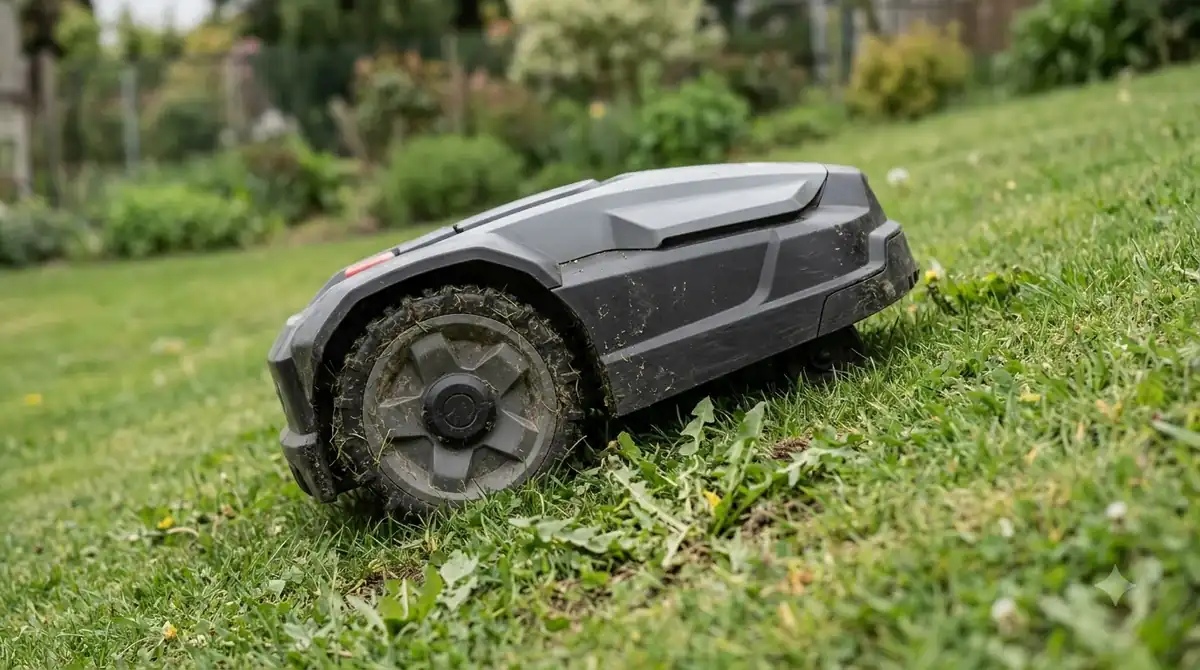
Work area vs boundary: check both numbers
Many Husqvarna models list a higher rating for the work area than for the boundary wire, so a 30 percent yard can pass in the middle and fail at the edge. The figures below come from Husqvarna’s installation support page, as of November 2026.
| Husqvarna model group | Work area limit | Limit at boundary |
|---|---|---|
| 305, 310, 315 | 40 percent | 15 percent |
| 320, 430X NERA, 450X NERA | 50 percent | 25 percent |
| 435X AWD | 70 percent | 50 percent |
The same guidance says areas steeper than the model limit must be excluded from the installation. If the outer edge of your lawn is steeper than the boundary limit, the advice is to move the boundary inward onto flat ground. Plan that before you buy, because a 30 percent slope along the outer edge can rule out a robot lawn mower for 30 percent slope that looks suitable on paper.
Where a slope borders a public road, the same page calls for a barrier of at least 15 cm (6 in) along the outer edge. That detail is easy to miss when the lawn itself looks fine.
If a steep patch cannot be avoided, Husqvarna describes isolating it with boundary wire islands or stay-out zones, so the mower never enters the area. That keeps the rest of a 30 percent lawn usable without forcing the machine onto ground it cannot hold.
Percent and degrees side by side
Percent converts to degrees with the arctangent function, so a robot lawn mower for 30 percent slope faces a grade of about 16.7 degrees. The table uses our calculation from that formula, so you can compare the units directly.
| Slope (percent) | Angle (degrees) |
|---|---|
| 25 percent | 14.0 |
| 30 percent | 16.7 |
| 35 percent | 19.3 |
| 40 percent | 21.8 |
| 50 percent | 26.6 |
Some listings mix the two units, and a 30 degree slope is about 58 percent, nearly double. Use the percent figure from the spec sheet, and convert it yourself if you need degrees. Keep the unit in every note you make, because a mixed-up number can change which model looks suitable.
Where a 20 percent slope fits next to 30 percent
A 20 percent slope rises 1 foot for every 5 feet measured flat, which is about 11.3 degrees. A 30 percent grade is about 5.4 degrees steeper than that, by our calculation, and the gap decides whether a basic model is enough. Putting the two side by side shows where a robot lawn mower for 30 percent slope has to step up.
| Measure | 20 percent | 30 percent |
|---|---|---|
| Rise per 100 feet of run | 20 ft | 30 ft |
| Ratio (run per 1 ft of rise) | 1:5 | about 1:3.3 |
| Degrees | 11.3 | 16.7 |
| Eufy rating tier | Basic band (10 to 25 percent), near the top | Above basic, inside mid-range (up to 35 percent) |
| Husqvarna boundary limits above | Over the 15 percent limit of the 305, 310 and 315, under the 25 percent limit of the 320, 430X NERA and 450X NERA | Over both |
The tier column is one vendor’s grouping, not an industry standard, and the boundary row is our comparison of the grades with the Husqvarna figures in the table above. The practical point is that a 20 percent edge can already exceed the boundary limit of the smaller Automower groups, so the work-area rating is not the only number to check even on a gentler lawn.
Wet turf affects both grades, since damp grass reduces tire grip even inside the rating. Our reading is that a 20 percent section is easier to manage than a 30 percent one only if you mow the steepest strip when the grass is dry. Do not treat the lower grade as permission to run a basic model at the top of its rating every day.
Measure the steepest strip before you buy
Measure rise over run along the steepest path the mower must cross, not the average slope of the whole lawn. A single steep strip is enough to rule out a robot lawn mower for 30 percent slope for the whole yard. Mark the spot with a stake or flag so you can return to it with the tape and the level on the same day.
- Pick the steepest strip. Walk the route a mower would take across the slope, including the outer edge.
- Measure the run. Stretch a tape or string level along the ground for a set distance, such as 100 units.
- Measure the rise. Use a spirit level on a straight board, or a smartphone incline app, and read the height at the far end.
- Divide and multiply. Divide rise by run and multiply by 100 to get percent, then compare it with both ratings.
Eufy’s guidance on slope limits also recommends a smartphone incline app or a spirit level with a tape measure, because sloping yards look flatter than they really are.
Wet grass, grip and the margin you should leave
A robot lawn mower for 30 percent slope has a rated maximum that is a limit, so leave margin below it, because wet turf reduces grip even within the rating. Eufy’s guidance states that the rated maximum is an absolute limit rather than a target for daily mowing.
Iowa State University Extension also notes that soil at the base of a slope is often wetter than soil higher up. That is the spot where a mower is most likely to lose traction, so the bottom of the slope deserves the closest look.
- Running at the top of the rating strains the motor and drains the battery faster.
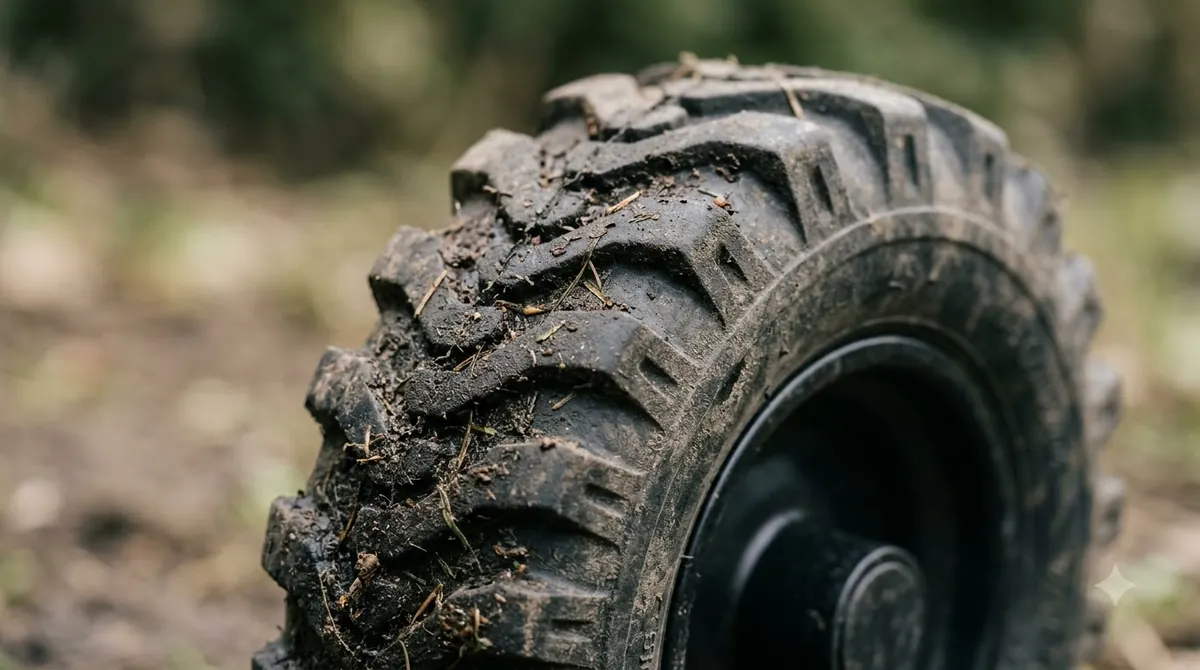
- Damp grass reduces tire grip, and a mower can slide even inside its rating (see why robot mower wheels slip on grass).
- Steeper inclines shorten runtime per charge, so a large sloped yard may need more charging stops, as in a hilly 1 acre lawn.
- Husqvarna advises laying the guide wire diagonally across the slope, which it links to traction and less grass wear.
Our reading is that a work-area rating of about 40 percent gives a robot lawn mower for 30 percent slope more room for wet days and uneven turf. This is our reading, not a manufacturer rule, so confirm the figures for the exact model you are considering.
Common mistakes with a 30 percent rating
The most common mistake with a robot lawn mower for 30 percent slope is reading the work-area rating as the limit for the whole lawn, including the boundary. Tilt protection is a separate feature, explained in what a tilt sensor does on a robot mower. The other errors are easy to avoid once you know them.
- Using the work-area figure for the outer edge of the lawn.
- Mixing percent with degrees, so a 30 degree slope is mistaken for 30 percent.
- Measuring the average slope instead of the steepest strip.
- Forgetting the 15 cm barrier along a public road when the edge is steep.
Frequently asked questions
Is a robot lawn mower for 30 percent slope too steep?
Not by itself. A 30 percent slope is about 16.7 degrees, and Husqvarna lists standard Automower models for slopes of 25 to 50 percent depending on the model. Whether it is too steep depends on the rating that applies to your work area and boundary.
How many degrees is 30 percent?
30 percent is about 16.7 degrees, calculated as the arctangent of 0.30. Percent and degrees are not interchangeable, so 30 degrees would be about 58 percent.
Should I buy a mower rated at exactly 30 percent?
Usually not, because a robot lawn mower for 30 percent slope should be rated as a limit rather than a daily target. Eufy’s guidance notes that running at the top incline strains the motor and drains the battery faster. Choosing a rating above your steepest measured point is our reading.
Does the rating apply to the boundary wire too?
Not always. For a robot lawn mower for 30 percent slope, Husqvarna’s per-model figures list separate limits for the work area and the boundary, and the boundary limit is often lower. Check both figures on the spec sheet before you buy.
How does a 30 percent slope compare with 20 percent?
A 20 percent slope is about 11.3 degrees, or 1 foot of rise per 5 feet of run, and sits inside the basic band that Eufy lists at 10 to 25 percent. A 30 percent slope is about 16.7 degrees and falls above that band, so mid-range or higher models are the ones to compare.
A robot lawn mower for 30 percent slope suits a yard when your steepest measured strip sits comfortably under the work-area rating and the outer edge sits on flat ground. If the edge is steep, the boundary limit becomes the number that decides the purchase, so check it first.
Sources
- Husqvarna installation guidance for steep slopes (manufacturer): model limits, boundary rules, barrier and guide wire advice.
- Iowa State University Extension, gardening on slopes (university): ratio conversion and steepness guidance.
- Eufy, robot lawn mower slope limits (manufacturer blog): rating tiers, limit versus target, wet grass, battery and measuring.
 Up next7 min readBy YardRobot Lawn Mower for a 25 Percent Slope: What to Check Before You BuyUpdated Nov 11, 2026
 8 min readBy YardRobot Lawn Mower for a 35 Percent Slope: What to Check Before You BuyUpdated Nov 11, 2026
 10 min readBy YardRobot Lawn Mower for 45 Percent Slope: What to Check Before You BuyUpdated Nov 11, 2026
 7 min readBy YardBest Robot Mower for Perennial Ryegrass: What to Check Before You BuyUpdated Nov 11, 2026
 9 min readBy YardBest AWD Robot Mower for Hilly Backyard: 6 Things to Check Before You BuyUpdated Nov 13, 2026
 8 min readBy YardBest Robot Mower for a Townhouse Yard: Layout Checks Before You BuyUpdated Nov 13, 2026