
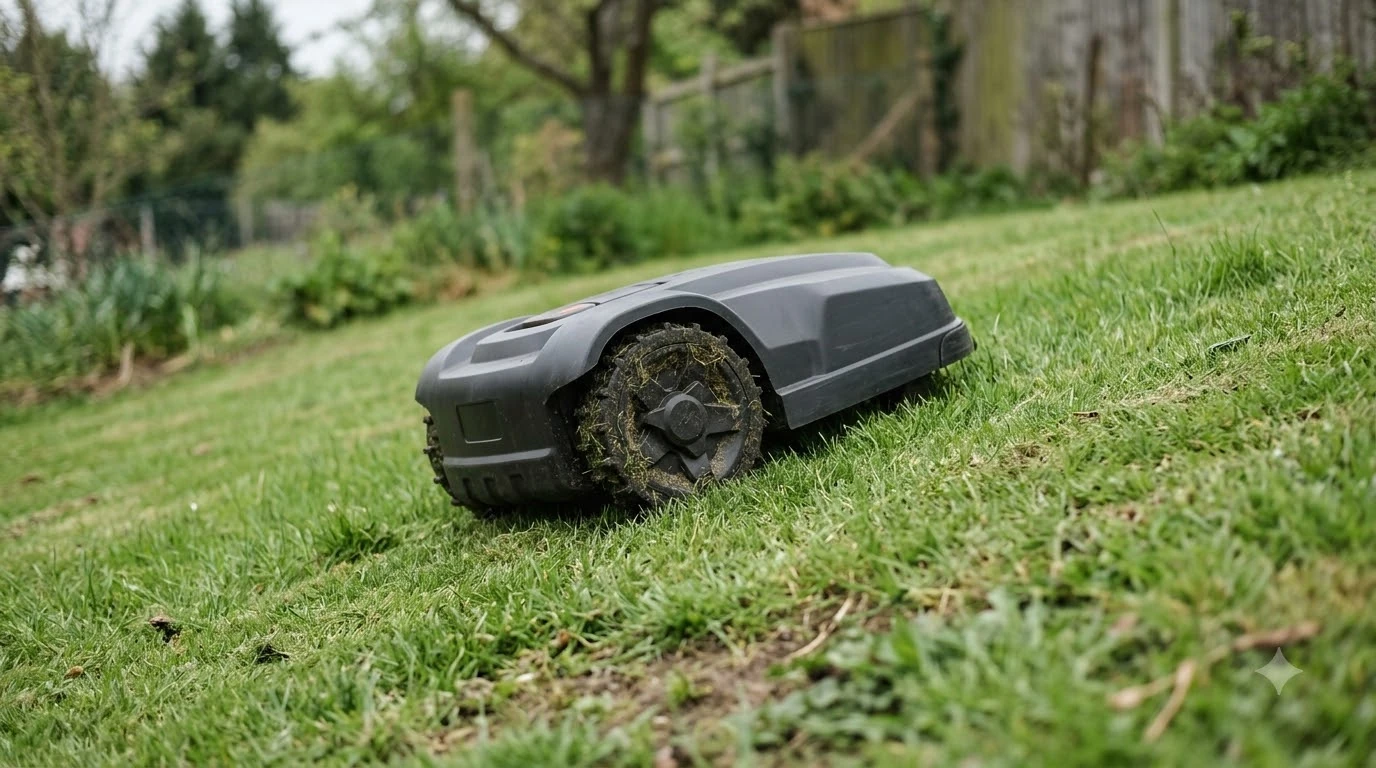

The best AWD robot mower for hilly backyard use is the one whose rated slope limit clears your steepest section with room to spare, because no single model suits every yard. AWD drives all four wheels, which can help on steep, damp grass, but it does not raise a model’s rated limit. Figures below are as of Nov 2026 and come from manufacturer pages.
Start by measuring the steepest strip of the yard, not the average slope. Then compare that figure with the limit each manufacturer publishes, and check the lower limit that applies near the boundary wire, where a mower is most likely to meet a steep drop.
The short answer
- Measure first: slope percent is rise divided by run, times 100, so 15 cm over 100 cm is 15%.
- Read two limits: Husqvarna lists a work-area limit and a lower limit by the boundary wire for many models.
- AWD’s role: all four wheels are driven, and manufacturers say this helps on wet, uneven ground, though most wet-grass figures are vendor claims.
- Layout counts too: obstacles, guide-wire direction and stay-out zones change how a hilly lawn performs with any drive type.
How to measure your steepest section
Measure the steepest strip with a tape and a level before you compare any spec sheet. Husqvarna’s steep-slope guide gives the formula as vertical height divided by horizontal distance, times 100. Its example is a 15 cm (6 in) rise over 100 cm (40 in) of run, which is a 15% slope. Take the reading along the line the mower would actually climb, not across the middle of the lawn, because the steepest strip is where the limit is tested. Only once you have that number can you judge which is the best AWD robot mower for hilly backyard conditions like yours. Our guide on how to measure yard slope walks through the same steps.
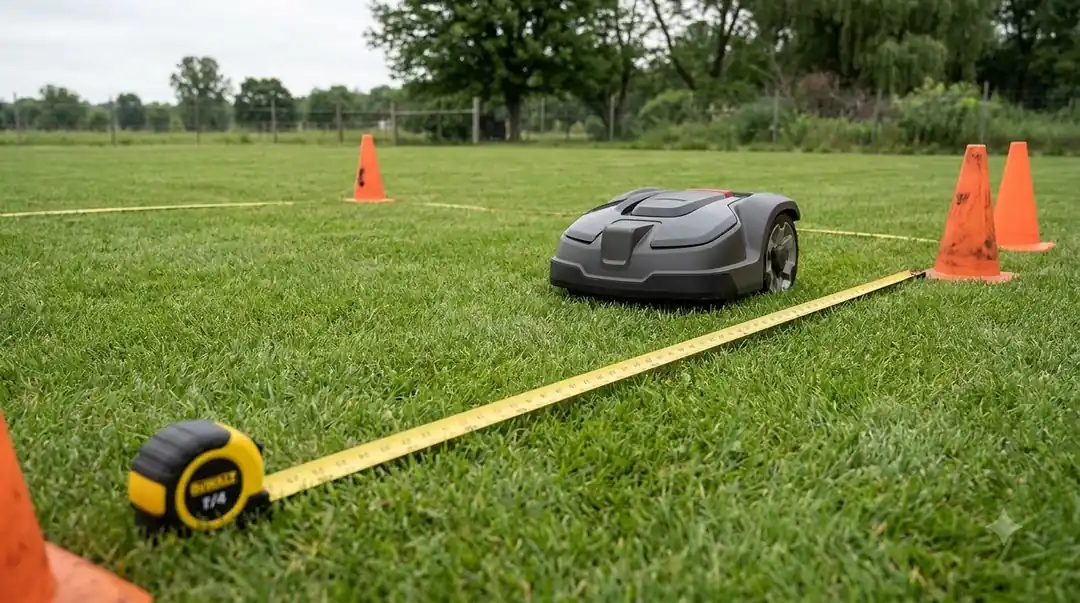
Percent and degrees are different scales (our robot mower slope rating explainer shows how the two relate). Husqvarna lists its standard models at 25 to 50%, which it gives as 14 to 26 degrees depending on the model. Sunseeker lists one of its models at 45% (24 degrees), which is another reminder that the two units are not interchangeable. Use the unit printed on each spec sheet, and convert only for a rough check.
Read the slope spec as two numbers
Many Husqvarna models list one limit for the work area and a lower one by the boundary wire, so the edge of a hilly yard sets the real ceiling. The published examples below show the gap. Model names differ by product line, so confirm the exact model in its manual before you buy.
| Husqvarna model group | Work-area limit | Limit by boundary wire |
|---|---|---|
| 305, 310 | 40% | 15% |
| 320 NERA, 430X NERA, 450X NERA | 50% | 25% |
| 435X AWD, 435X AWD NERA | 70% | 50% |
For a hilly backyard, the lower number is the one to compare with the steep edge of the lawn. Husqvarna’s steep-slope installation guide also advises keeping 1.5 m (5 ft) between the bottom of a 50 to 70% slope and the boundary wire on AWD models, with at least 50 cm (1.6 ft) of level ground between flat and steep areas.

What AWD changes on hilly, damp grass
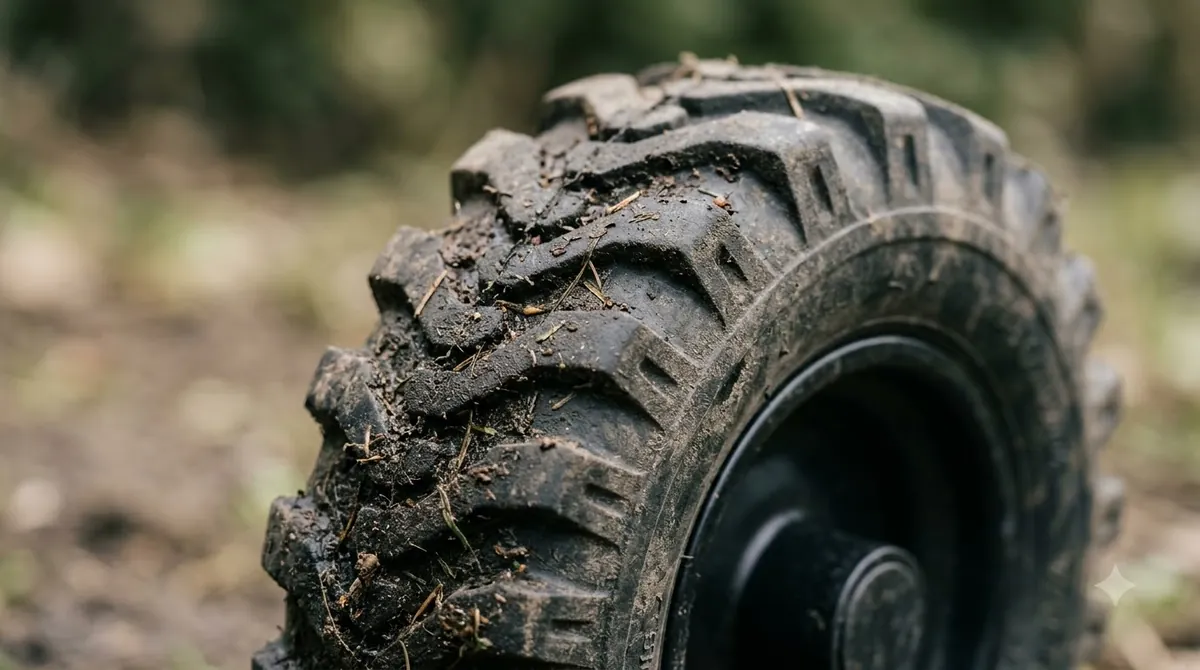
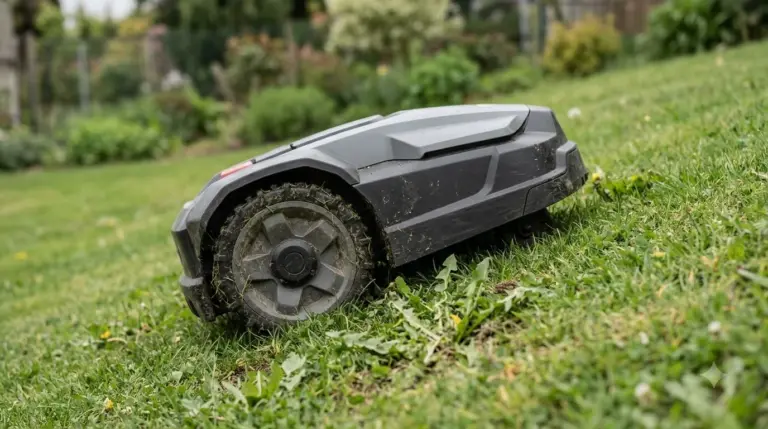
AWD (explained in our guide to what AWD means on a robot mower) gives all four wheels a driven role, which manufacturers say matters most on wet or soft ground. Husqvarna warns that the slipping risk rises on steep slopes, especially in wet conditions, and that obstacles such as trees or rockeries make the mower turn more, which adds to the slip. That warning applies to every model, AWD included. For more on this, see our guide to a robot mower on wet grass.
Mammotion’s 2WD vs 4WD comparison, dated May 25, 2026, says a 2WD mower can slip on soft, wet or muddy ground, while an AWD model handles wet grass with minimal slipping. Sunseeker says power to all four wheels ensures consistent grip on steep slopes and wet grass. Both companies sell AWD mowers, and neither names a test method or surface, so read these as vendor claims rather than measured results.
Our reading is that AWD is the layout most likely to justify its cost on a hilly lawn that stays damp in shade, which is where the best AWD robot mower for hilly backyard use earns its premium. A model rated only just above your steepest strip can still slip when the grass is wet, so keep a clear margin below the rated number rather than planning to run at the limit.
Layout decides how well a hilly yard works
On any drive type, the lawn setup changes traction, so plan the layout before you choose a model. These are Husqvarna’s rules for its own products, and your model’s manual may give different distances.
- Mow straight up the slope. Husqvarna recommends setting mowing patterns straight up the slope where possible, for better traction and less grass wear.
- Lay the guide wire across the slope. For physical wire installs, Husqvarna advises a guide wire diagonal to the slope. For AWD models it allows a straight or diagonal line from the bottom of the slope to the top.
- Keep obstacles off the steep sections. On 50 to 70% slopes, Husqvarna says to avoid obstacles on the slope itself, since they force extra turning.
- Fence off what is too steep. Areas steeper than the model’s limit should be excluded from the installation or closed off with a stay-out zone. Where a slope borders a public road, Husqvarna advises a barrier of at least 15 cm (6 in) along the outer edge.
Wheel care matters too. Husqvarna notes that grass clogging the wheels makes slopes harder to manage, and suggests clearing them with a soft brush or a hose. Many models offer an optional Terrain Kit with heavy rear wheels and wheel brushes for better grip on sloping lawns. Check whether the kit is offered for your exact model before you count on it, and see our notes on robot mower traction spikes for slopes for other grip add-ons.
Size, runtime and upkeep
AWD usually costs more, uses more energy and has more to maintain. Sunseeker says AWD uses more power because several motors run at once, and that it can shorten runtime per charge on flat lawns. Mammotion says AWD has more motors and components, which it says increases maintenance needs compared with a 2WD model. Neither source gives a runtime figure, so check the battery and runtime numbers in each model’s own spec sheet.
Prices change often and vary by model and region. None of the sources used here gives a fixed price, so compare current listings for the exact model rather than relying on any figure in this article. Our reading is that a hilly yard means more uphill mowing, so when you compare the best AWD robot mower for hilly backyard shortlists, ask whether each model’s runtime claim holds up on your slope.
Best AWD robot mower for hilly backyard: what to check before you buy
Use this checklist before you choose a model. Each item comes from the spec sheet or manual, not from a comparison table.
- Steepest measured strip, in percent. Record the length of the steep strip too, since a short bump and a long climb are different problems.
- The boundary-wire limit for that exact model. Take it from the manual or support page rather than a blog table.
- The gap between your strip and the rating. Note how far the rated number sits above your steepest section.
- Wet-grass evidence. Note whether it comes from the manufacturer or an independent source, and whether it names a test method.
- Obstacles and stay-out zones. Mark trees, rockeries and any slope that borders a road or drop.
- Maintenance and warranty. Check the parts, service and warranty terms for AWD before you buy.
Who AWD suits, and who may not need it
AWD suits a yard whose steepest strip sits close to a rated limit, or one that stays wet on the slope. A flat or gently rolling lawn that measures well inside a 2WD model’s rating may not need the extra drive. Our reading is that the best AWD robot mower for hilly backyard use is the one with the most margin, not simply the one with the highest drive label.
AWD does not change the manufacturer’s maximum, so a section steeper than any model’s rating still needs to be excluded or fenced off. If your steepest strip is beyond every model you can buy, the practical fix is changing the lawn, not the drive type.
Frequently asked questions
What is the best AWD robot mower for hilly backyard use?
There is no single best model. The best AWD robot mower for hilly backyard use is the one whose boundary-wire limit clears your steepest measured strip with margin, and whose manual covers the layout you need. Compare spec sheets, not drive labels.
Is AWD always better on a hilly backyard?
Not always. Manufacturers say AWD grips better on wet grass, but it costs more and uses more energy. If your steepest strip is well inside a 2WD model’s rating and the grass stays mostly dry, 2WD may be enough.
Does AWD raise the slope a mower can handle?
No. The published limit is the ceiling. Husqvarna’s 435X AWD is rated at 70% in the work area and 50% by the boundary wire, so the boundary figure is the one to compare with a steep edge of the yard.
Is a percent slope the same as degrees?
No. Husqvarna lists its standard models at 25 to 50%, or 14 to 26 degrees, and Sunseeker lists 45% as 24 degrees. Read the unit on the spec sheet and convert only for a rough check.
What if my steepest slope is above every rating?
Exclude that area from the mowing zone or fence it off with a stay-out zone, as Husqvarna’s guidance describes. Then check whether the rest of the lawn stays within a model’s rated limit with margin.
Sources
- How to optimise an Automower installation for steep slopes (Husqvarna, manufacturer): slope limits by model, slope formula, AWD layout distances, traction and wheel advice.
- 2WD vs. 4WD Robot Mower (Mammotion blog, vendor, dated 2026-05-25): wet-grass traction and maintenance claims.
- FWD vs RWD vs AWD Robot Mowers (Sunseeker blog, vendor): wet-grass grip, energy use and model slope examples.
 Up next9 min readBy YardBest Robot Mower for Centipede Grass: 6 Checks Before BuyingUpdated Nov 13, 2026
 7 min readBy YardBest Robot Mower for Perennial Ryegrass: What to Check Before You BuyUpdated Nov 11, 2026
 9 min readBy YardRobot Lawn Mower for a 30 Percent Slope: What to Check Before You BuyUpdated Nov 11, 2026
 8 min readBy YardBest Robot Mower for a Townhouse Yard: Layout Checks Before You BuyUpdated Nov 13, 2026
 8 min readBy YardRobot Mower for Soggy Lawn: What to Check Before You BuyUpdated Nov 11, 2026
 7 min readBy YardRobot Lawn Mower for a 25 Percent Slope: What to Check Before You BuyUpdated Nov 11, 2026