
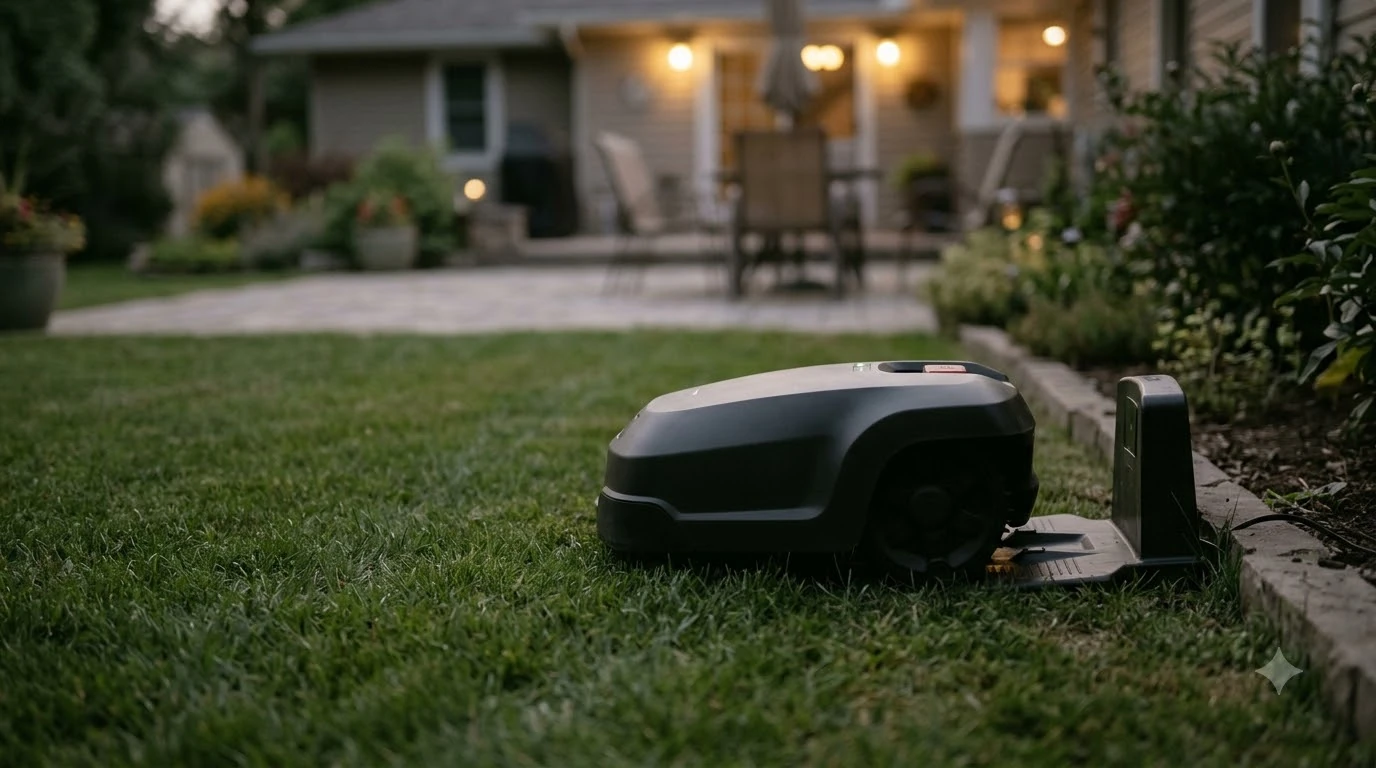

Where to put a robot mower charging station: on flat, shaded ground near the middle of the lawn, with about 3 m (10 ft) of clear space in front and an outdoor outlet within easy reach. The exact clearance depends on the wire system: boundary-wire models need less room than wire-free EPOS systems. Check your mower manual before you fix the base in place.
The short answer
- Central and level: the mower reaches every zone in a short trip, and the base sits flat.
- Clear space: at least 3 m (10 ft) in front for boundary-wire models, and 6 m (20 ft) for EPOS wire-free models.
- Sheltered: shade or a mower house, away from metal, sprinklers, and tight corners.
- Powered: an outdoor outlet nearby, with a short low-voltage cable and no extension cords.
What a charging station needs before you pick a spot
Four conditions matter more than anything else: level ground, a nearby outdoor outlet, protection from direct sun, and open space in front of the base. Husqvarna’s placement guide for its Automower range lists these as the starting checklist, and Robomow gives similar rules for its own models.
Knowing where to put a robot mower charging station is easier if you walk the lawn with the wire layout in mind. Before you stake anything, do that walk. A spot that looks ideal on a sketch can fail once the perimeter wire has to leave the base and loop back to it.
Where to put a robot mower charging station on the lawn
Husqvarna recommends placing the station in a central location of the mowing area, so the mower can reach every part of the lawn in a short trip. In our reading, a central spot also keeps the wire loop shorter and easier to lay out.
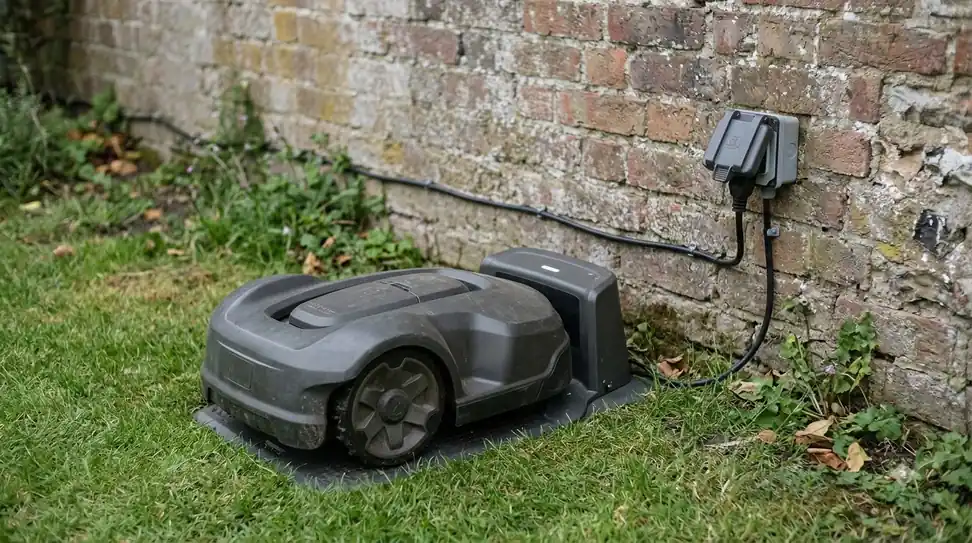
Level ground matters for two reasons. The base plate has to sit flat, and the mower needs to line up squarely to dock. Husqvarna asks for a level surface, and Robomow asks for the flattest ground you can find. Neither source gives a slope limit in degrees or percent, so judge the spot by eye and test the dock with the mower before you fix it.
In our reading, keep the base out of the main walking path too. Foot traffic near the base can move the wire and the charging contacts, and it makes the approach path harder to keep clear.
How much clear space the station needs
Clearance is where most placement mistakes happen, and the numbers depend on the wire system. The table below lists the minimums in Husqvarna’s guide. Robomow gives a rougher figure of about 3 m, which matches the boundary-wire minimum.
| Direction from the station | Boundary-wire installation | EPOS wire-free installation |
|---|---|---|
| In front | At least 3 m (10 ft) | At least 6 m (20 ft) |
| To each side of the center | At least 150 cm (60 in) | Not stated in the guide, check the manual |
| Behind | At least 60 cm (2 ft) | Not stated in the guide, check the manual |
Robomow also says the wire leaving the station should run about 3 m straight ahead before it turns. The wire must form a closed loop back to the station, and it must never cross itself.
Keep metal, sprinklers, and tight corners away
Husqvarna warns that metal objects near the station and wires can disturb the signal. Its examples include reinforcement bars, metal edging, and coils of low-voltage cable, so store spare cable away from the base.
Robomow advises against tucking the station into an angled corner. The signal can confuse the mower while it searches for the dock, so a spot with open ground in front works better than a nook.
Sprinklers are another risk. Robomow says to avoid placing the station near a lawn sprinkler, because water can damage the internal electronics (see using a robot mower with sprinklers). Neither source gives a minimum distance, so keep a clear margin and check the spray pattern before you choose the spot.
Power the station from a nearby outlet with a short cable
Husqvarna asks you to place the station near a power outlet. Robomow adds that the outlet should be an outdoor, weatherproof socket, and that the low-voltage cable should be kept short with no extensions. Neither source gives a maximum cable length, so the shortest practical route is the safest choice. For the electrical side of the base, see charging station power requirements.
Keep the power supply out of enclosed boxes, as Husqvarna advises. Robomow applies the same sun and water protection to the transformer as to the station itself.
If the nearest outlet is far from the spot you want, our reading is to pick a spot closer to the power rather than run a long cable. Have a licensed electrician add an outlet if none is close enough.
Protect it from sun, rain, and weak Wi-Fi
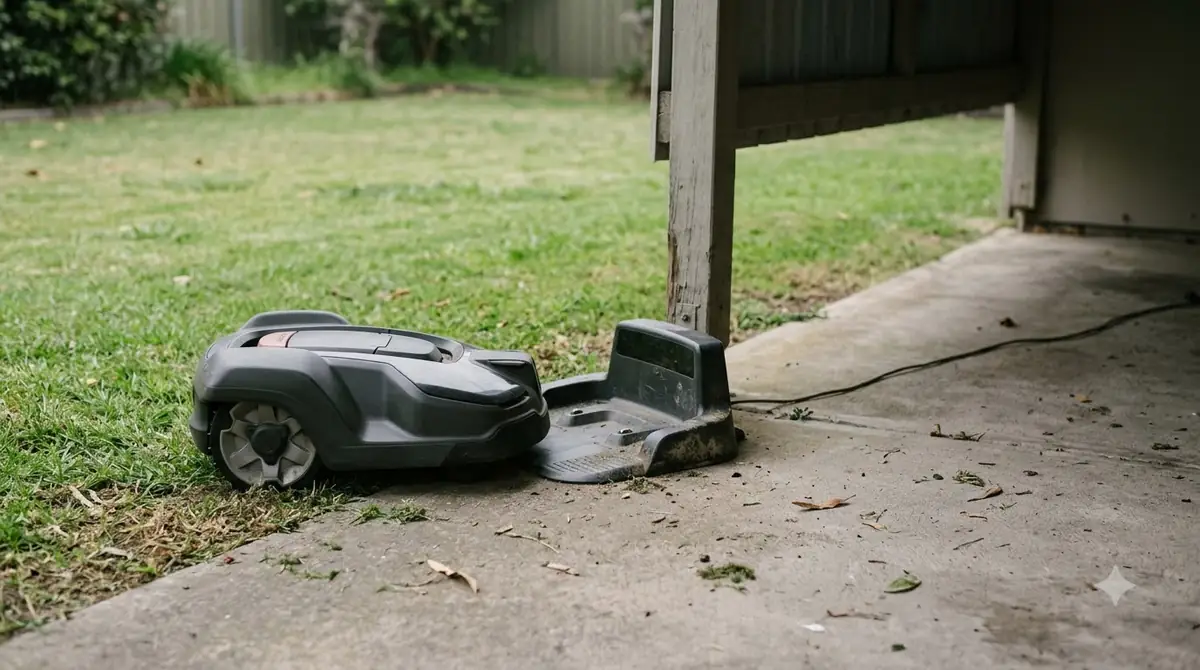
Husqvarna recommends protecting the station from the sun, either with shade or with its Automower House. The House also protects the mower from long-term rain and sun. The guide warns that other shelters may work but are not tested or verified by Husqvarna, and they could interfere with mower functions. Any cover needs open sides, ventilation, and clearance on all sides, so the mower can enter, align, and reverse into the dock. If you are wondering whether the mower can stay outside all year, see leaving a robot mower outside.
Robomow says constant heat speeds battery aging, so shelter from full sunlight is worth the effort. It does not give a shade measurement, so check how much sun the spot gets during the hottest part of the day.
Wi-Fi matters on some models too. Husqvarna says that models connecting to its cloud only over Wi-Fi need the station within range of your home network, or firmware updates cannot download. Test the signal at the station before you commit to the spot, and see whether a Wi-Fi extender helps if the signal is weak. For EPOS models, a roof is acceptable only if the area in front of the station keeps a clear view of the sky.
Placing the station on a split or sloped lawn
On a split lawn, where to put a robot mower charging station depends on the slope. When two parts of the lawn are separated by a steep slope, Husqvarna recommends putting the charging station in the lower section. Neither source gives a slope limit, so test the mower on the actual slope before you decide.
If the base sits on a separate island in the lawn, Husqvarna’s guide says to connect the guide wire to that island. Robomow’s guidance is simpler: keep about 3 m of straight wire ahead of the station, then let the wire turn.
Heads up
Do not secure the charging station to the ground until you have installed all the wires and verified that the installation works. Husqvarna gives this warning, and Robomow makes the same point.
Install the base in the right order
- Lay the perimeter wire first. Run it as a closed loop back to the station, and make sure it never crosses itself.
- Test before you stake. Run the mower from the dock, check that it finds the station, and check that it docks cleanly (how robot mowers return to the charging station explains the approach).
- Pin the base plate last. Attach it to the ground only after the wire is confirmed, so the station can still shift slightly if needed.
- Choose how to hold the wire. Above-ground wire is held with lawn hooks. Underground wire takes much longer to install, but it is protected from weather and damage, according to Robomow.
Common placement mistakes
| Mistake | Why it hurts | Fix |
|---|---|---|
| Tucking the base into a corner | The signal can confuse the mower during its search (Robomow) | Choose a spot with open ground in front |
| Metal edging or reinforcement bars nearby | Metal can disturb the signal (Husqvarna) | Move the base or the metal, and keep spare cable away |
| A sprinkler spraying the base | Water can damage the internal electronics (Robomow) | Adjust the sprinkler or move the base |
| Fixing the base before testing | Wire faults are harder to fix once the base is staked (our reading) | Test the dock first, then stake it |
Use this table as a last check before you settle where to put a robot mower charging station. In our reading, stand at the chosen spot, look at the open ground in front, and picture the mower’s route back to the dock. If that route crosses a sprinkler arc, a shed corner, or a metal gate, move the base before you lay any wire.
Frequently asked questions
Can I move the charging station later?
Yes, as long as the base is not staked yet. Once the base and wire are fixed, moving the station means re-laying the wire and testing the dock again. This is our reading.
Does a robot mower charging station need shade?
Husqvarna recommends protection from the sun, either shade or its Automower House. Robomow says constant heat speeds battery aging, so shelter from full sunlight is worth the effort.
How far from the house should a robot mower charging station be?
Neither source gives a distance from the house. Keep the spot within reach of a short low-voltage cable, and check the clearances first.
Can I put the station under a tree?
Shade helps, but overhanging branches can drop debris and block the sky view that EPOS models need at the docking point. This is our reading of Husqvarna’s sky-view note.
Sources
- Automower charging station: optimal placement and mower house guide (Husqvarna): clearances, central location, shade, metal, and Wi-Fi advice.
- How to install the charging station of the robotic lawnmower (Robomow): space in front, wire run, angled corners, sprinklers, outlet and cable advice.
 Up next8 min readBy YardWhere to Place RTK Antenna in a Yard With TreesUpdated Nov 11, 2026
 8 min readBy YardHow Narrow Can a Robot Mower Passage Be? Simple 2026 RulesUpdated Nov 11, 2026
 8 min readBy YardOne Third Rule for Mowing Grass: How It Works and Why It MattersUpdated Nov 11, 2026
 8 min readBy YardRobot Mower and Moles or Gophers: What Actually WorksUpdated Nov 11, 2026
 8 min readBy YardShould You Bury or Peg Robot Mower Boundary Wire?Updated Nov 11, 2026
 8 min readBy YardRobot Mower Under Trees: What Changes and What to DoUpdated Nov 11, 2026