
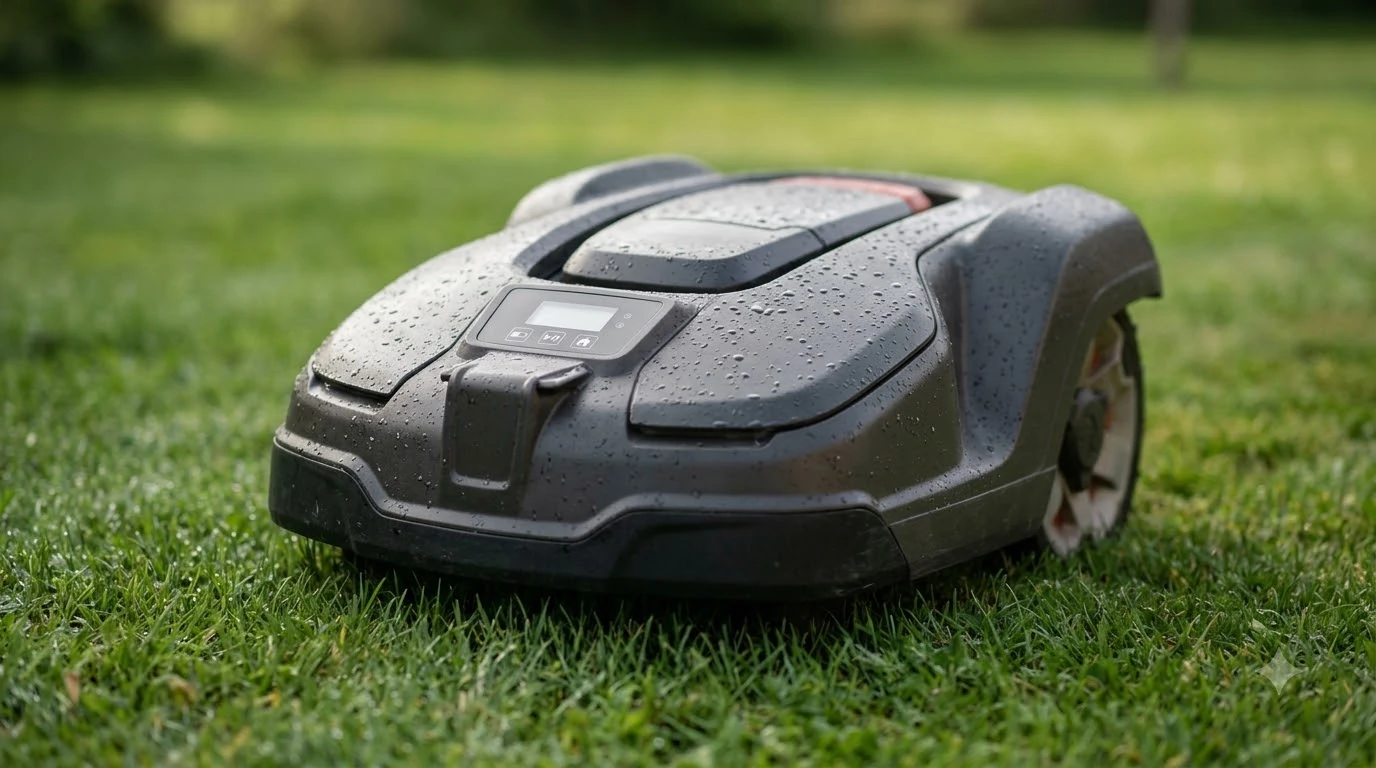

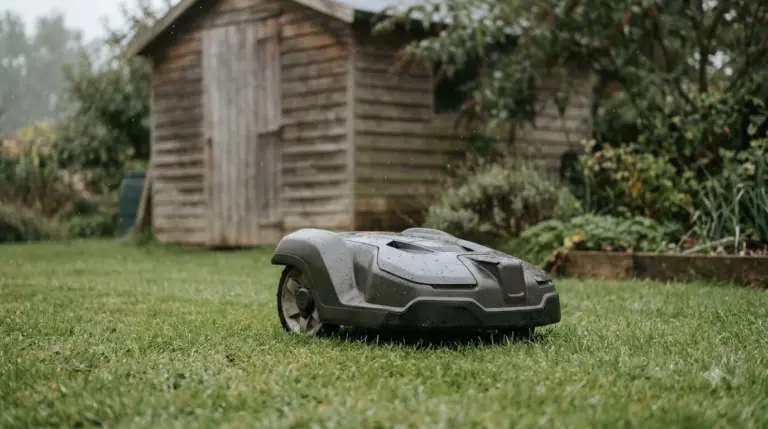
What IP rating should a robot mower have? Our reading is that at least IPX4 is the sensible minimum if it will work on a lawn that gets wet. IPX4 means the housing can take water splashing from any direction with no harmful effect. Higher ratings such as IPX5 and IPX6 test stronger water jets, so they suit yards where you rinse the mower or where rain is frequent. The rating is a lab limit on the enclosure, not a promise that the mower will work well on wet grass.
The short answer
- Entry level: IPX4 covers splashing from any direction. The Husqvarna Automower 535 AWD spec page we read lists IPX4.
- Stronger: IPX5 and IPX6 test water jets from a nozzle at set pressures. Ecovacs lists its GOAT mower as IPX6.
- Not covered: the standard test uses fresh water, so salt water, oils, and solvents are not included.
- Still needed: the rating does not solve wet grass, camera fogging, or scheduling, so pair it with a rain sensor and a sensible mowing schedule.
What the two digits in an IP code mean
An IP rating is a two-digit code defined by the IEC 60529 standard. The first digit describes protection against solid objects and dust, and the second digit describes protection against water. For robot mowers, the water digit is the one that matters most outdoors.
The second digit runs from 0 (not protected) to 8 (continuous immersion beyond 1 m, with the depth set by the manufacturer). The first digit runs from 0 to 6. An X in either position means the manufacturer did not provide data for that criterion, so a rating such as IPX4 says nothing about dust.
The IEC standard also states that standard IP testing uses fresh water. Protection against other fluids such as salt water, oils, or solvents is not guaranteed by the code, and the test does not address chemicals or condensation.
What IP rating should a robot mower have for your lawn
Choosing a rating starts with the water exposure you expect. The two manufacturer pages we read list IPX4 (Husqvarna) and IPX6 (Ecovacs), so the table covers the range from IPX4 to IPX6. It shows what each test involves, based on the IEC definitions.
| Rating | Test | What it means for a mower |
|---|---|---|
| IPX4 | Water splashing from any direction, tested with an oscillating tube or spray nozzle | Rain and splashes from sprinklers. Not a rinse-down rating. |
| IPX5 | 6.3 mm nozzle, 12.5 L/min at 30 kPa, from 3 m, for at least 3 minutes | Low-pressure jets, such as a garden hose at a distance. |
| IPX6 | 12.5 mm nozzle, 100 L/min at 100 kPa, from 3 m, for at least 3 minutes | Powerful jets. Heavier water exposure than IPX5, but still not immersion. |
The difference between the ratings is the water volume and pressure. IPX6 is a much harder test than IPX4, because it uses far more water at higher pressure. A higher number does not mean the mower can be submerged.
Why a rating does not mean the mower works in rain
An IP rating describes whether the housing survives a test, not whether the mower should run in wet conditions. The testing standard notes that some water ingress is common and still allowed as long as the enclosure keeps working, and the manufacturer usually decides what counts as acceptable.
The Ecovacs GOAT FAQ shows the practical limits of a good rating, and our guide on whether robot mowers can mow in the rain covers the weather side in more detail. It says the GOAT is IPX6-rated and able to withstand rain, but it also warns that wet grass can make the blades become blocked. It adds that rain on the camera interferes with visual localization and obstacle avoidance. The same FAQ recommends turning on the rain sensor so the mower starts again only after the lawn has dried.
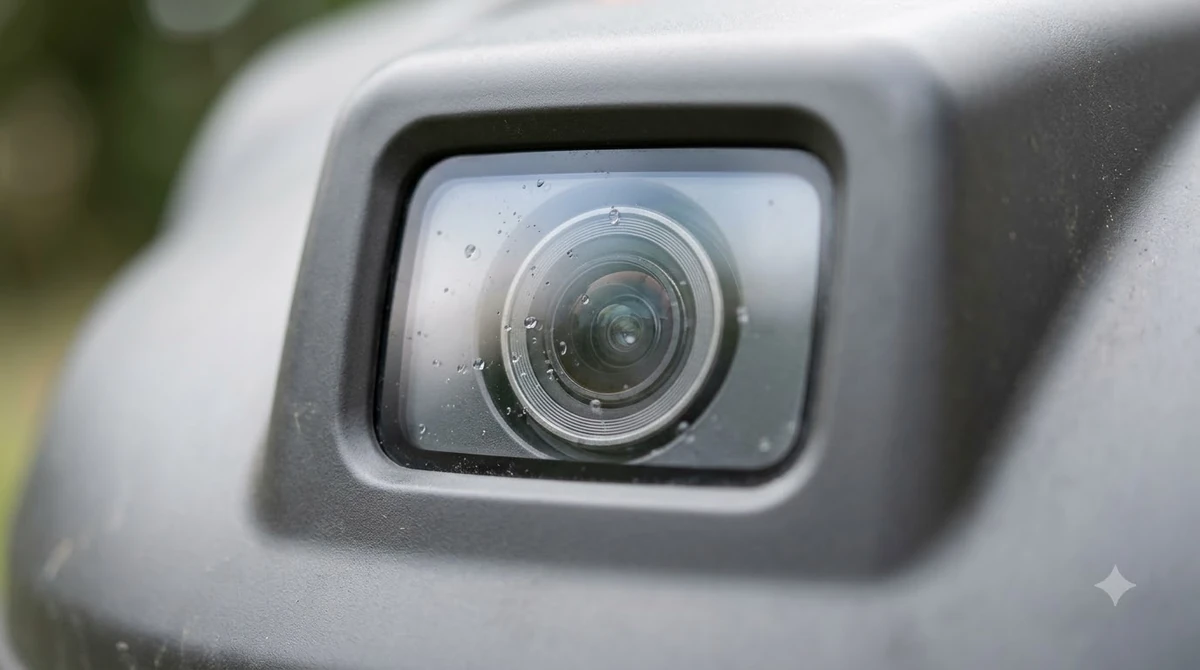
So when you ask what IP rating should a robot mower have, the answer depends on the job: the rating protects the hardware, while the mowing problems come from wet grass, a fogged camera, and mud on the wheels. A mower with a high rating can still give poor cuts or sensor errors after a storm, so the rating should be one factor among several.
What the rating does not cover
Three gaps are worth checking before you rely on any IP code. First, the test uses fresh water, so a mower used near the coast or on a lawn treated with fertilizer or other chemicals may need more than the rating suggests. The standard does not cover those liquids, and the manufacturer should be asked directly.
Second, the rating printed in a spec table applies to the product it describes. The spec pages we read did not say whether the charging station carries the same rating, so check the dock and the boundary-wire connectors separately rather than assuming they match the mower. Our guide to waterproof boundary-wire connectors covers the connector side.
Third, the IEC code does not address condensation, which can form inside a housing when temperatures swing. The IEC pages we read did not say whether the rating covers condensation, so this is a question to put to the manufacturer.
IPX7 and IPX8 on robot mowers
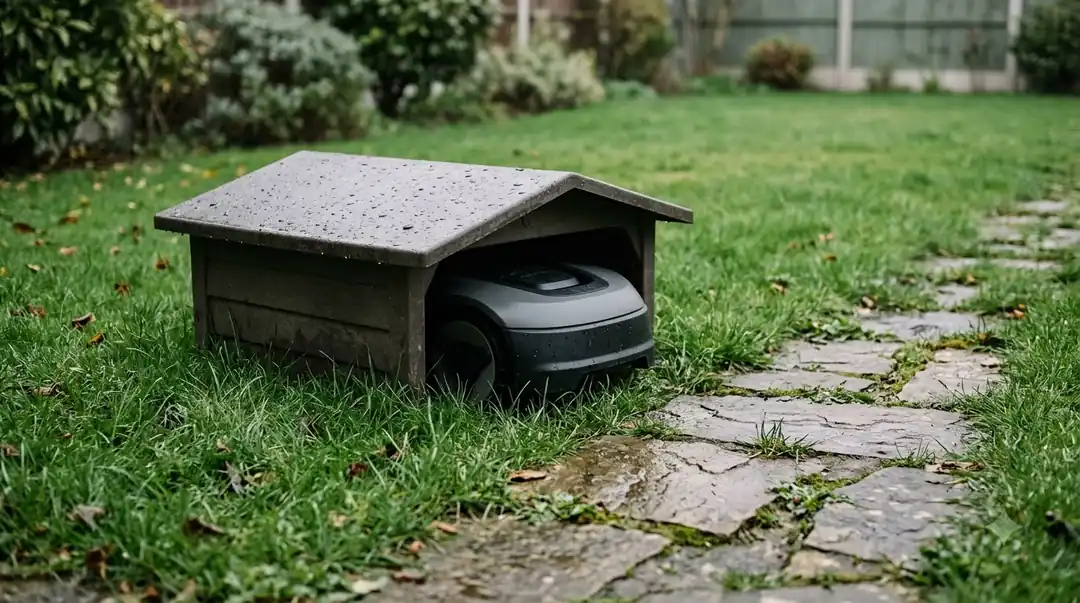
IPX7 and IPX8 are immersion ratings, and they are rare on robot mowers. IPX7 means the enclosure survives immersion up to 1 m for 30 minutes under defined conditions. IPX8 means continuous immersion at a depth the manufacturer specifies, usually deeper than 1 m.
Our reading is that for a normal home lawn the question of what IP rating should a robot mower have stops at the IPX4 to IPX6 range, because an immersion rating is not needed. A rating such as IPX7 tells you the housing can handle standing water, but it does not tell you the mower should be left in a puddle.
How to read the rating on a spec sheet
If you are deciding what IP rating should a robot mower have, start by finding the code on the spec sheet. Manufacturers list the rating in different places. On the Husqvarna Automower 535 AWD spec page we read, it appears as “Protection Index (IP Code)” with the value IPX4. Look for the code itself rather than a marketing phrase such as “weatherproof” or “all-weather”.
When you find the code, check the exact value. IPX4 and IPX6 are different products with different test conditions, and “waterproof” on a product page does not name a rating. If the page gives only a phrase like “rain resistant” and no IP code, ask the manufacturer for the number before you buy.
What to check before you buy
The rating is one line in a longer checklist. When you work out what IP rating should a robot mower have for your yard, these steps are more useful than comparing a single number across brands (our reading).
- Find the exact IP code. Confirm the full two-digit value on the manufacturer’s spec page, not on a reseller summary.
- Match it to your climate. A lawn that sees frequent rain or sprinklers benefits from IPX4 or higher. Hose rinsing points toward IPX5 or IPX6.
- Check the sensor options. A rain sensor or rain-delay setting, as Ecovacs recommends, matters more on wet days than the rating alone, and our list of robot mowers with a rain sensor shows what to look for.
- Ask about salt, chemicals, and the dock. The IP test uses fresh water, so ask the maker about coastal air, fertilizer, and whether the charging station is rated the same way.
- Read the warranty terms. Check what the warranty says about water damage and wet use, and keep the manual’s guidance on it.
Frequently asked questions
What IP rating should a robot mower have for rain?
For most rain, IPX4 is the minimum to look for. It covers splashing from any direction, so it is designed for water hitting the housing from rain or sprinklers. It does not say the mower is meant to run in heavy rain. Our reading is that IPX4 suits occasional wet weather, while heavy or repeated rain calls for the manufacturer’s guidance and a rain sensor.
Can I hose down a robot mower?
IPX5 and IPX6 test the housing against water jets, so a rating in that range is more relevant to rinsing than IPX4. The test uses fresh water at set pressures and distances, not every hose setting. Follow the manufacturer’s cleaning instructions, which may ask you to avoid direct jets near seals and the charging contacts.
Is IPX6 waterproof?
IPX6 is protection against powerful jets, not immersion. A waterproof claim without a number is not useful. IPX7 is the immersion rating with a defined depth and time, and IPX8 is deeper immersion set by the manufacturer.
Does an IP rating cover wet grass?
No. The rating describes the housing, while wet grass affects cutting and traction. The Ecovacs GOAT FAQ notes that wet grass can block the blades, so a rated mower can still struggle on a soaked lawn. Waiting for the lawn to dry is the practical answer, and a guide on how wet grass affects a robot mower explains the cutting and traction problems.
Sources
- IP Code (Wikipedia, summarizing IEC 60529): second-digit definitions for IPX4 to IPX8, test volumes and pressures, X meaning no data, and the fresh-water test note.
- IEC 60529 and EN 60529 testing (DLS EMC): digit ranges, the point that some ingress can be acceptable, and that the manufacturer usually decides.
- Can the GOAT be used in the rain? (Ecovacs support): IPX6 rating, wet-grass blade blocking, camera interference in rain, and the rain sensor advice.
- Automower 535 AWD (Husqvarna): the “Protection Index (IP Code)” listed as IPX4 in the specifications.
 Up next8 min readLearnDo Robot Mowers Have Blade Stop Sensors? What Lift and Tilt Sensors DoUpdated Nov 11, 2026
 6 min readLearnDo Robot Mowers Have a Subscription?Updated Nov 13, 2026
 9 min readLearnShould a Robot Mower Run After Aeration?Updated Nov 12, 2026
 9 min readLearnRTK vs LiDAR: Which Should You Choose for Your Robot Mower?Updated Nov 11, 2026
 7 min readLearnWhat Height Should a Robot Mower Cut Grass?Updated Nov 10, 2026
 9 min readLearnShould You Fertilize a Lawn Mowed by a Robot Mower?Updated Nov 11, 2026