


Do robot mowers have blade stop sensors? Yes, many do: a lift sensor and a tilt sensor usually cut the blade when the machine leaves the ground or tips over. The blades do not always stop at the same instant, though. One manufacturer manual allows the blades up to two seconds to come to rest, so the blades should be fully stopped before anyone reaches under the deck.
The short answer
- Yes on many models. Husqvarna’s material says that when its mower is lifted, “the blades automatically and immediately shut off.”
- The blades can keep turning briefly. The Robomow RKS user guide says the blades “continue to rotate for up to two (2) seconds” after a safety sensor or the STOP control is triggered.
- Sensors reduce risk but do not remove it. A 2021 study of 18 mower models found that some safety features failed to detect a hedgehog.
- Check the manual. Look for lift and tilt sensors, a STOP control, a disabling key, and a stated blade stop time.
Do robot mowers have blade stop sensors for lift and tilt?
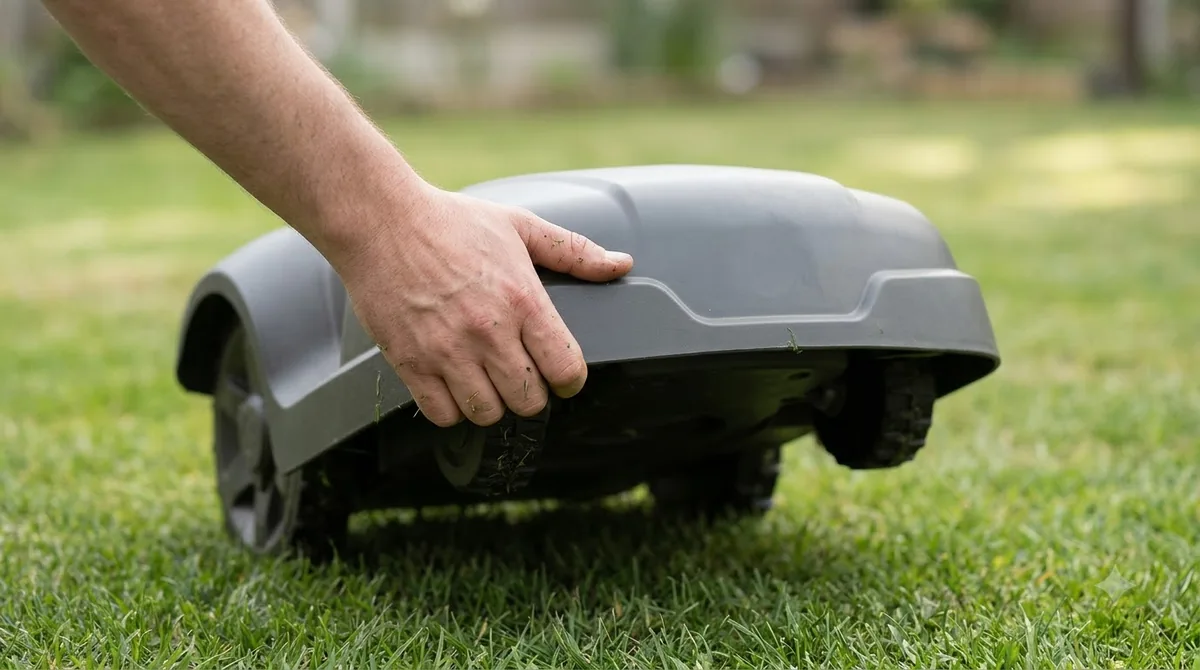
A lift sensor reacts when the mower leaves the ground, and a tilt sensor reacts when the machine is raised or tipped over. Both are designed to cut power to the cutting blade without waiting for a person to press a button. Husqvarna describes its own set of sensors in plain terms: when the mower is lifted or tipped over, the blades shut off automatically.
Anker, which sells robot mowers under the Eufy name, describes the same behavior in its safety article and adds that “on most modern models” the blade stop is automatic, while petrol and electric push mowers usually need a manual stop. That comparison comes from a marketing page with no test data, so treat it as the vendor’s view rather than an independent measure.
The sensors matter most when someone handles the mower during a service check, and a pair of cut-resistant gloves for changing robot mower blades is sensible gear for that job. Robomow’s manual tells owners to stop the machine and remove the disabling key before lifting it, and it says that removing the key disables the blades and the drive motors. That is a separate layer of protection from the automatic sensor. Owners should use both: the key for any hands-on work, and the sensor as a backup for accidental lifts.
Why the blades keep turning for a moment
Do robot mowers have blade stop sensors that stop a spinning blade instantly? Not in every case. The Robomow RKS 800 and 1500 user guide states that “the blades continue to rotate for up to two (2) seconds once a safety sensor has been triggered or the red STOP control has been pressed.” The same manual says the blades “should come to a complete stop within two (2) seconds of pressing the red STOP control,” and that if you do not hear them stop in that window, the mower must be serviced by an authorised dealer before further use.
Two seconds is a short time, but a blade turning at speed can still injure a hand or foot. The manual therefore gives a direct instruction: allow the blades to stop rotating completely before lifting or tilting the mower or approaching the blades. If you are about to work on the blades, see how to change robot mower blades for the full routine. Our reading is that a stop time written in the manual is a better guide than a general claim such as “instant stop,” because it gives you a number to test against once the mower is installed. Do not rely on the sound of the blades alone to decide they have stopped.
Heads up
The two-second figure comes from one manufacturer’s manual for the RKS line. Other brands may publish different figures or none at all, so read the manual for the exact model you are considering.
What the sensors do not guarantee
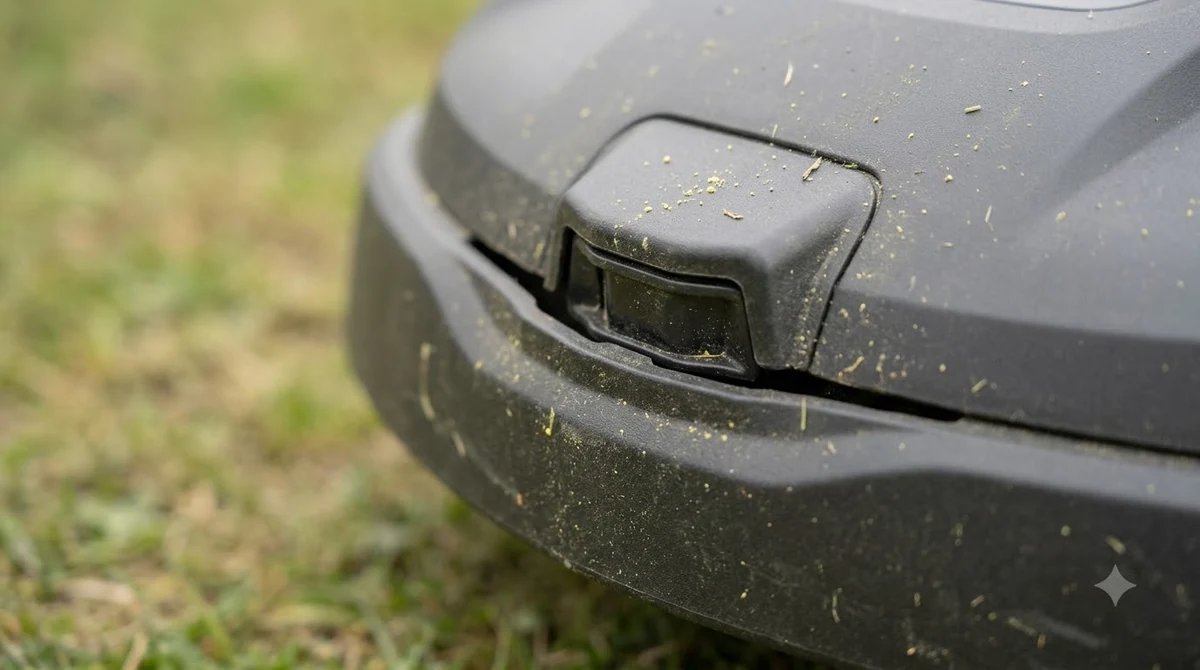
The sensors respond to the machine itself being lifted or tipped. They do not guarantee protection for small animals, objects on the ground, or anything hidden in tall grass. Robomow’s manual warns that rough terrain or hidden objects could cause an accident, and notes that tall grass can hide obstacles. It also tells owners to remove stones, sticks, wire, and toys before running the mower, because the blade can throw them.
The clearest independent evidence on this point is a 2021 study in the journal Animals by Rasmussen and colleagues. The authors tested 18 robot mower models using 70 hedgehog carcasses, running 216 tests in daylight, with each mower tested 12 times. They concluded that “we cannot be confident that any of the robotic lawn mowers tested were entirely safe to hedgehogs.” They also wrote that they “could not test” the lift detection sensitivity of the mowers, which means the study cannot tell you how fast any one sensor reacts. In some cases the safety features stopped the blades within seconds of contact, while in others the machine failed to detect the animal at all.
The study had limits that matter for a homeowner. It used dead animals, so it could not measure how a live hedgehog responds, whether it moves away, or curls up. It is a snapshot of one set of mowers, not a ranking. Still, it shows that a lift or tilt sensor should not be treated as a complete safeguard for wildlife in the yard. For the night-time side of the question, see whether robot mowers are safe at night for wildlife.
Keeping children and pets away
Do robot mowers have blade stop sensors that make supervision unnecessary? No, because most of the risk comes from people and animals close to a running mower. Our guide to robot mower safety around kids and pets goes further. Robomow’s guide says to keep bystanders at least 15 feet (5 metres) from the mower during operation, and to keep children and pets inside while it runs. It also says children should not play on the lawn while the mower is operating, and that mowing should not go ahead when children or others are around.
For a home with young children, our reading is that the simplest rule is a schedule: run the mower when the yard is empty, check the lawn for kids’ toys and garden tools before each run, and make sure the STOP control is easy for an adult to reach. If you cannot guarantee the yard is clear, the more cautious approach is to stop the mower and keep it off until the area is empty.
What to check in a manual or spec sheet
Do robot mowers have blade stop sensors on the model you are considering? Before you buy, look for four things in the documentation. First, confirm that the model lists both a lift sensor and a tilt sensor, and read how each one is described. Second, find the STOP control and check how it works and where it sits on the body. Third, look for a disabling key that stops the blades and drive motors during service. Fourth, find the stated blade stop time, and note whether the manual says what to do if the blades do not stop in that time.
Many buyers also ask about standards. Anker’s article names BS EN 50636-2-107 as “the UK and European safety standard for robotic lawn mowers,” and says it covers blade safety and automatic shut-off. We did not read the standard text itself, so use the name as a search term and check with the manufacturer whether a model is certified to it. A manufacturer that can point to the certification number is giving you more to verify than one that only uses the word “safe.”
Frequently asked questions
Do robot mowers have blade stop sensors on every model?
No. Husqvarna and Robomow both describe lift or tilt sensors that stop the blades, but the feature varies by model and brand. Check the manual for the specific model rather than assuming it is standard.
How long do the blades keep spinning after the sensor trips?
The Robomow RKS user guide gives up to two seconds after a safety sensor is triggered or the STOP control is pressed. Other manufacturers may publish different figures, so use the number in the manual for your model.
Can a blade stop sensor protect a hedgehog in the yard?
Not reliably. A 2021 study of 18 mower models said the authors could not be confident any of the mowers tested were entirely safe to hedgehogs, and some safety features failed to detect the animal. Sensors reduce risk, but they are not a guarantee.
Should I still use the disabling key if the mower has blade sensors?
Yes. Robomow’s manual says to remove the disabling key before lifting the mower, clearing a blockage, or servicing it, because removing the key disables the blades and drive motors. Treat the sensor as a backup, not the main safety step.
Sources
- Robomow RKS 800 and RKS 1500 user guide (manufacturer): blade stop time, STOP control, disabling key, bystander distance, and blade-contact warnings.
- How Does a Robotic Lawn Mower Work? (Husqvarna): lift and tilt blade shut-off.
- Rasmussen et al., Wildlife Conservation at a Garden Level: The Effect of Robotic Lawn Mowers on European Hedgehogs, Animals (2021): test design, results, and limits.
- Are robot lawn mowers safe? (Anker, formerly Eufy; marketing page): the BS EN 50636-2-107 standard name. No test data on the page.
 Up next9 min readLearnDo Robot Mowers Stop for Animals?Updated Nov 11, 2026
 9 min readLearnHow to Make a Robot Mower Last Longer: Battery, Blade, and Winter CareUpdated Nov 11, 2026
 8 min readLearnHow to Update Robot Mower Firmware: 5 Safe StepsUpdated Nov 11, 2026
 8 min readLearnCan a Robot Mower Mow Over Sticks? What the Sources SayUpdated Nov 11, 2026
 8 min readLearnIs It Legal to Run a Robot Mower at Night?Updated Nov 11, 2026
 9 min readLearnDo Robot Mowers Really Work? Yes, on the Right LawnUpdated Nov 11, 2026