
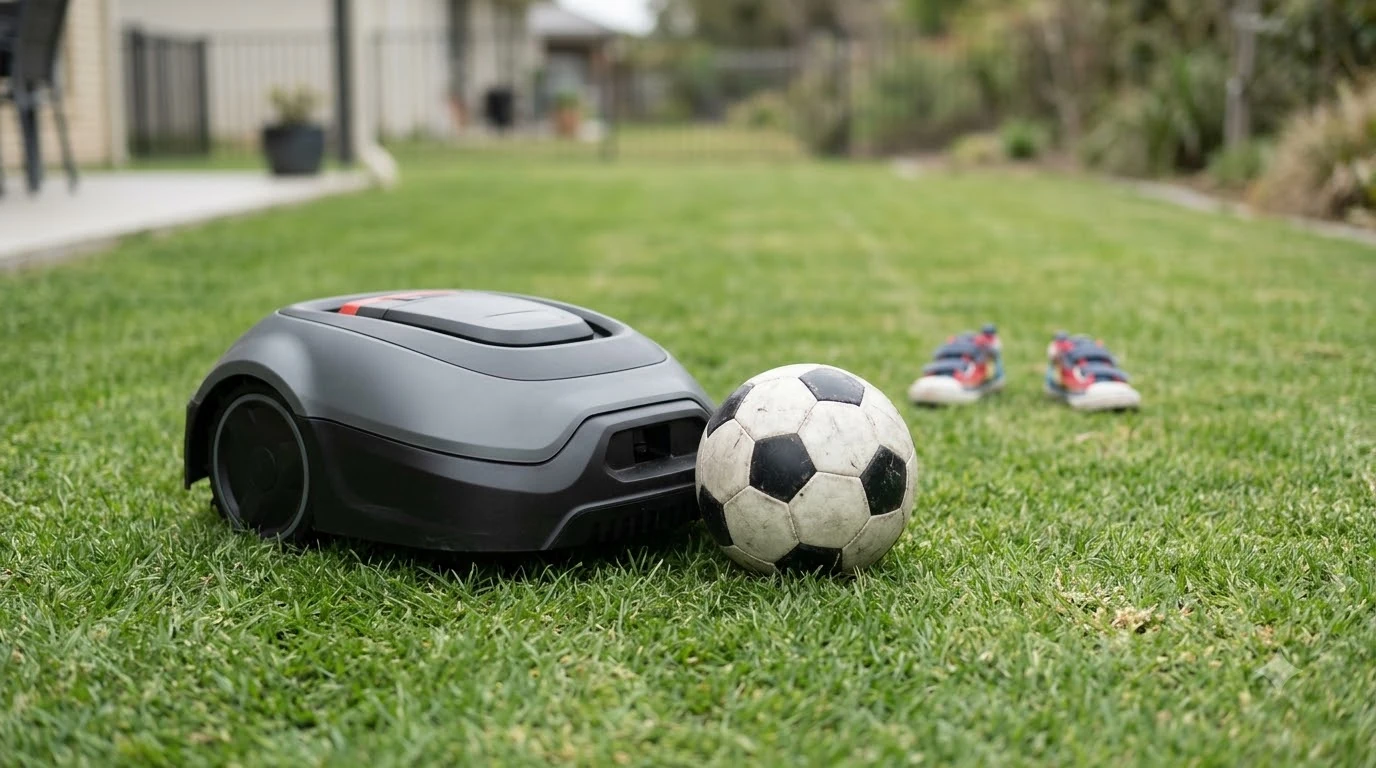

How does a robot mower handle kids toys? It can detect many toys left on a lawn, but it does not reliably avoid every one. Husqvarna’s support material classes toys as low-risk objects that the mower approaches more closely before turning. Sensors are a backup, not a guarantee, and the toys that cause trouble are usually the ones hidden in tall grass, lying flat, or very small.
The short answer
- Detection: Camera, radar and ultrasonic systems can spot toys before contact on many models, but detection depends on the model and the conditions.
- Where it fails: Toys hidden in high grass, lying flat or very small can be missed, and a hidden toy can snag the mower.
- Damage: A mower left to run unattended can damage toys, hoses and sprinklers left on the grass.
- Best routine: Clear the lawn before each run, schedule mowing when children are indoors, and set a stay-out zone around play areas.
How does a robot mower sort toys compared with people and hoses?
Toys are not treated the same as every other object. Husqvarna’s AI vision guidance divides what the mower sees into risk classes. Toys, garden furniture and flowerpots are classed as lower risk, so the mower gets closer to them before it turns. That means the mower can come close to a toy before it turns.
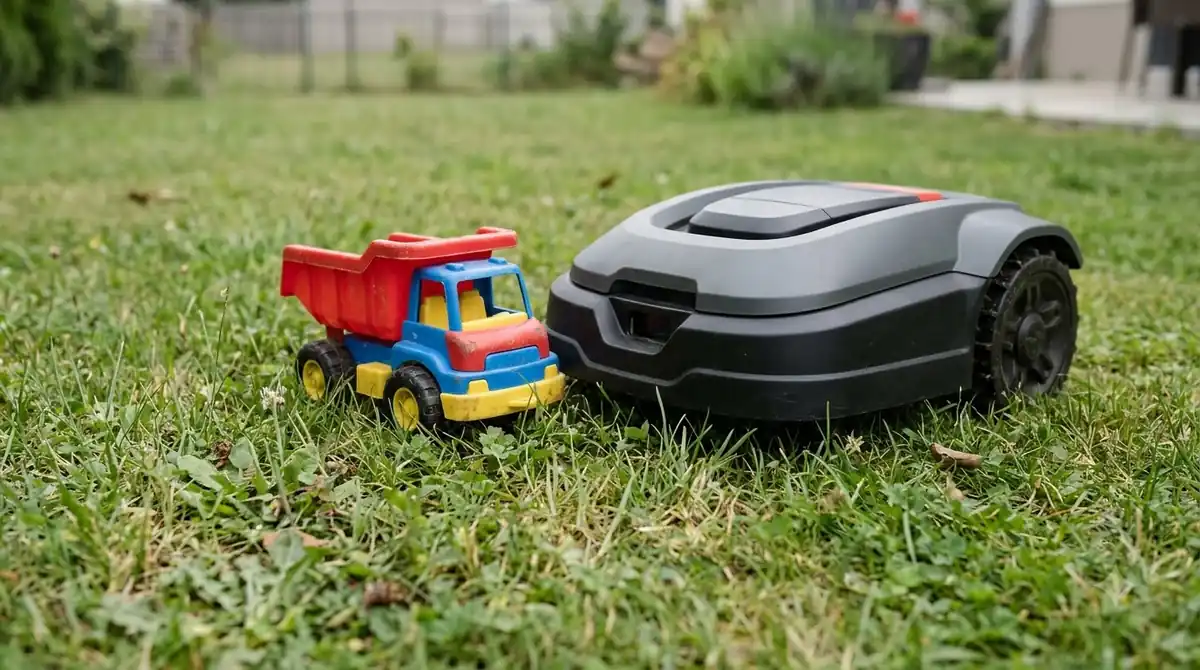
People, animals and items such as water hoses sit in a higher class. Husqvarna says the mower keeps a larger safety distance from these, which is why a hose is a more serious case than a plastic toy. In our reading, the practical lesson is that a toy is handled as a nuisance object by design, not as a hazard the mower is built to protect against.
These classes apply to Husqvarna’s vision models. Other brands may use different logic, so the answer to how does a robot mower handle kids toys can differ from one brand to another.
How does a robot mower handle kids toys in tall grass?
Most failures come from toys the sensors cannot see clearly. Husqvarna’s guidance lists several cases where detection is weaker: small objects in tall grass, objects lying flat or very close to the ground, and tall grass or flowers that can be mistaken for objects. The same guidance warns that objects hidden in high grass may snag the mower. Its example is trampoline legs (our guide to how a robot mower handles a trampoline covers that case), but a toy hidden in the same way can cause the same problem.
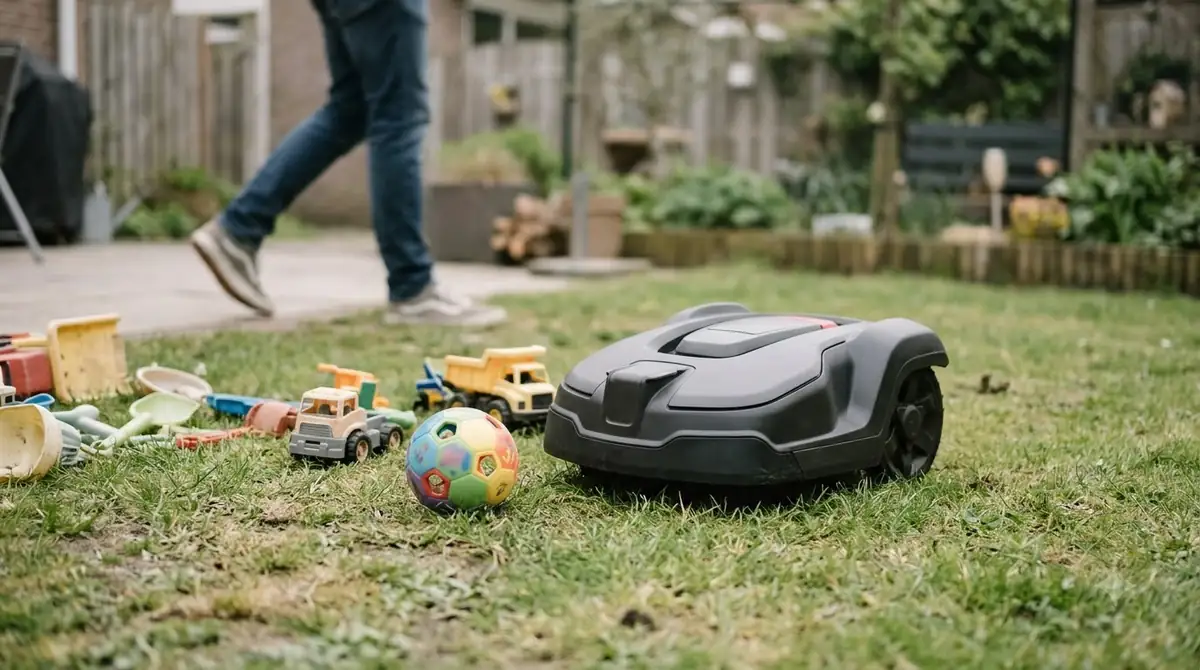
- Hidden in tall grass: the sensor may not see the toy until contact, and the mower can get stuck while trying to cut around it.
- Lying flat: a flat plastic toy or a ball sitting low can be harder to classify than an upright object.
- Very small: small items may pass below the detection range or be missed in clutter.
Husqvarna is direct about the limit. It says object avoidance “is not a safety feature” and that “there is no guarantee that objects will not be run over.” PCWorld makes the same practical point from an independent review angle: a robot mower can do real damage to hoses, sprinklers and toys left out on the grass. Sprinklers have their own guide on sprinkler heads and robot mowers.
Which sensor type handles toys best?
The sensor type is the main factor in how a robot mower handles kids toys in practice. No sensor type is perfect for toys. Each one finds objects in a different way, and each has a different weak spot. The table below summarizes what the sources describe. It is a reading of manufacturer and reviewer descriptions, not a test of the products.
| Sensor type | How it finds a toy | Limitation the sources describe |
|---|---|---|
| Bump sensor | The mower taps the object and works around it | Contact happens first, so a toy can be pushed or hit before the mower reacts |
| Ultrasonic or radar | Detects objects before contact | Husqvarna switches avoidance off within 60 cm (2 ft) of the virtual boundary and within 90 cm (3 ft) of a boundary wire |
| AI vision camera | Classifies objects in real time, including toys | Some models are day-only; Husqvarna says AI vision features do not work at night on those models |
| Infrared (NERA models) | Detects and avoids objects at night | Specific to certain Husqvarna NERA models |
Lift and tilt sensors also matter in a toy-filled yard. A lift sensor signals that the mower has caught on something, and a tilt sensor detects an unsafe angle. Neither one is a toy detector, but both help the mower stop when it climbs onto an object.
Wire-based mowers follow a different model. PCWorld notes that boundary-wire mowers keep the mower inside the perimeter and do not primarily avoid obstacles, so a toy inside the lawn is a bigger issue for them.
How do you set up a yard so toys are not a problem?
For a family yard, the practical answer to how does a robot mower handle kids toys is a routine rather than a feature. The most reliable step is to clear the lawn before each run. Eufy’s safety guidance recommends clearing loose items from the lawn beforehand and scheduling mowing when children and pets are indoors. A quick visual sweep before every mow catches new toys that sensors might miss.
- Sweep the lawn first. Pick up balls, small toys, hoses and loose items each time before the mower starts.
- Trim the edges and hidden spots. Husqvarna suggests trimming edges, burying or protecting objects, or creating a stay-out zone for objects hidden in high grass.
- Set stay-out zones for permanent play gear. For garden furniture or children’s trampolines, Husqvarna recommends creating a stay-out zone in the app, since these are fixed objects. Our walkthrough on setting up no-go zones covers the general steps.
- Schedule mowing for when the yard is empty. Eufy says the safest rule is to run the mower only when the lawn is empty.
Swing sets and playhouses raise the same question, which we cover in how a robot mower handles a playset. Our reading is that a stay-out zone is a setup step, not a sensor feature. It works the same way whatever the sensors detect, which makes it a stronger safeguard for a play area than relying on detection alone.
What to check on a spec sheet or manual before you buy
Before you rely on a mower in a yard with toys, read the manual to see how it deals with them. The questions below come from the manufacturer and reviewer sources in this article. They do not rank any product.
- Sensor type: bump only, radar or ultrasonic, camera, or a combination. Each one behaves differently with toys.
- Day or night operation: some camera models are day-only, and infrared models are a separate case. Check which mode your model uses.
- Stay-out zones: confirm that the app lets you draw no-go areas around play gear.
- Lift and stop behavior: confirm that the blades stop when the mower is lifted, and how the mower restarts. Husqvarna’s lift sensor restarts the blades about 20 seconds after the mower is put back in its normal position.
- Stop controls: a clearly visible STOP button and a PIN or safety key are useful checks, according to Eufy’s safety guidance.
- Noise: Digital Trends notes that many robot mowers are quieter than traditional ones and can sneak up on pets or children, so do not count on sound as a warning. For the wider safety picture, see our guide on whether robot mowers are dangerous.
Frequently asked questions
How does a robot mower handle kids toys left in tall grass?
It can miss them. A toy hidden in tall grass, lying flat, or too small for the sensors may go undetected. Husqvarna says object avoidance is not a safety feature and cannot guarantee that objects will not be run over.
Will a robot mower damage a toy or a hose?
PCWorld notes that robot mowers can do real damage to hoses, sprinklers and toys left out on the grass, so clearing those items before mowing is the simplest protection.
How does a robot mower handle kids toys at night?
It depends on the model. Husqvarna lists day-only vision on certain AI vision models and infrared day-and-night operation on its NERA models. Check the manual for your model.
Is a stay-out zone better than relying on sensors?
For permanent objects such as trampolines or garden furniture, Husqvarna recommends a stay-out zone. It is a setup step, so it does not depend on what the sensors detect.
Sources
- Object detection and avoidance with AI vision technology (Husqvarna): low-risk and priority-hazard object classes, hidden objects in tall grass, stay-out zones.
- How Automower AI vision technology works (Husqvarna): local image processing, day-only models, limitations.
- Object avoidance with radar or ultrasonic sensors (Husqvarna): switch-off distances near boundaries, small and flat objects.
- How do Husqvarna Automower sensors work (Husqvarna): lift, tilt and collision sensors, blade restart time.
- How robot lawn mowers cut grass without whacking off your toes (PCWorld, Ed Oswald, June 26, 2024): damage to toys and hoses, sensor types.
- Digital Trends robot mower safety article (Digital Trends): blade stop on obstacle, quiet operation.
- Robot lawn mower safety for kids and pets (Eufy, manufacturer content): clearing loose items, scheduling, STOP button and PIN checks.
 Up next8 min readBy YardHow Does a Robot Mower Handle a Fire Pit?Updated Nov 11, 2026
 9 min readBy YardHow Does a Robot Mower Handle Solar Lights?Updated Nov 11, 2026
 8 min readBy YardHow Does a Robot Mower Handle Raised Garden Beds?Updated Nov 11, 2026
 9 min readBy YardHow Does a Robot Mower Handle Lawn Ornaments?Updated Nov 11, 2026
 7 min readBy YardHow Does a Robot Mower Handle Fallen Branches?Updated Nov 11, 2026
 9 min readBy YardHow Does a Robot Mower Handle Garden Furniture?Updated Nov 11, 2026