
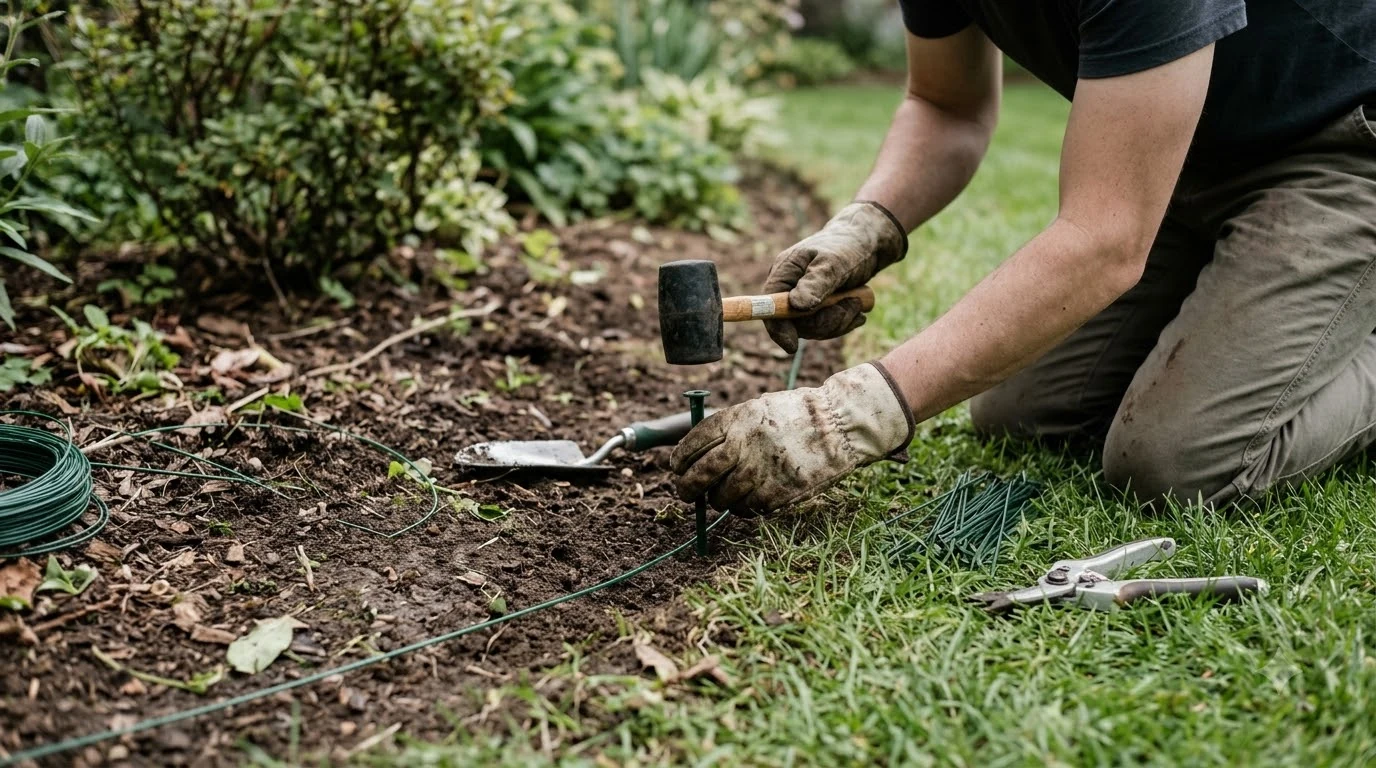

How does a robot mower handle a fire pit? It treats the pit as a solid object it can bump into, and none of the manufacturer pages we read says it senses heat. Fence the pit off and wait for the ashes to cool before the mower runs nearby.
The mower’s sensors help it avoid collisions, but they do not protect the lawn from warm ashes or embers. Most of the safety work falls on the owner, so the setup around the pit matters as much as the mower.
The short answer
- Sensors: a fire pit is a fixed object, so bump and detection sensors can react to it, but the manufacturer pages we read describe object detection, not temperature sensing.
- Fencing: a boundary wire island or a FlexiFence zone keeps the mower out of the pit area.
- Cooling: fire departments recommend at least four days of cooling in the burn spot, with one week as the minimum before ashes are moved.
- Ash container: a tightly covered metal container at least 10 feet from buildings and combustibles, never plastic.
How does a robot mower handle a fire pit with its sensors?
A fire pit is a solid object on the lawn, so a robot mower’s obstacle sensors can react to it. PCWorld describes bump sensors as the simplest form of detection, which reacts only after contact, while ultrasonic and infrared sensing can detect an object before the mower touches it.
The sources we read describe these sensors as object detectors. None of the Husqvarna material we reviewed says the sensors measure temperature or detect embers. Our reading is that a warm pit and a cold pit look the same to the mower, so heat is not a factor it is built to handle.
Detection also has gaps that matter around a pit. Husqvarna says its object avoidance may miss small objects and objects lying flat or very close to the ground, and tall grass can be mistaken for an object. A low ring of stones or a flat pit base may therefore not register as an obstacle at all.
Fence the fire pit with a boundary wire island
A boundary wire island is the most direct way to keep a mower out of a fire pit area. Husqvarna recommends islands for areas the mower should not enter, such as flower beds or rockeries, and in our reading a fire pit fits the same case. Our guide to boundary wire around obstacles covers the wider method.
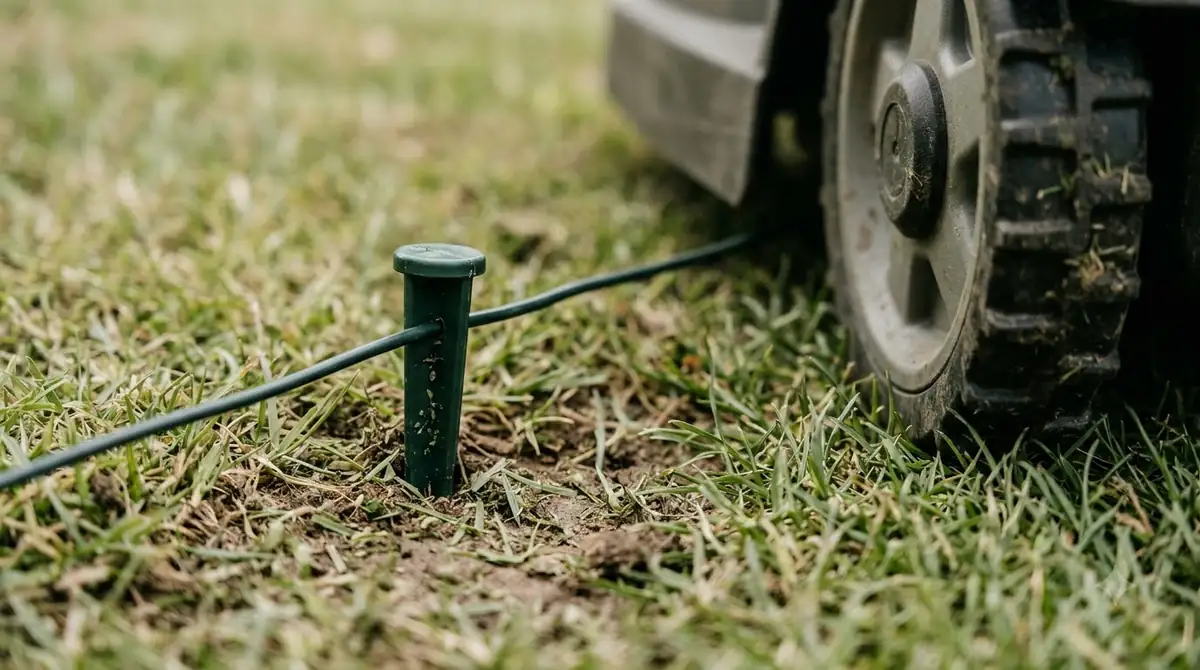
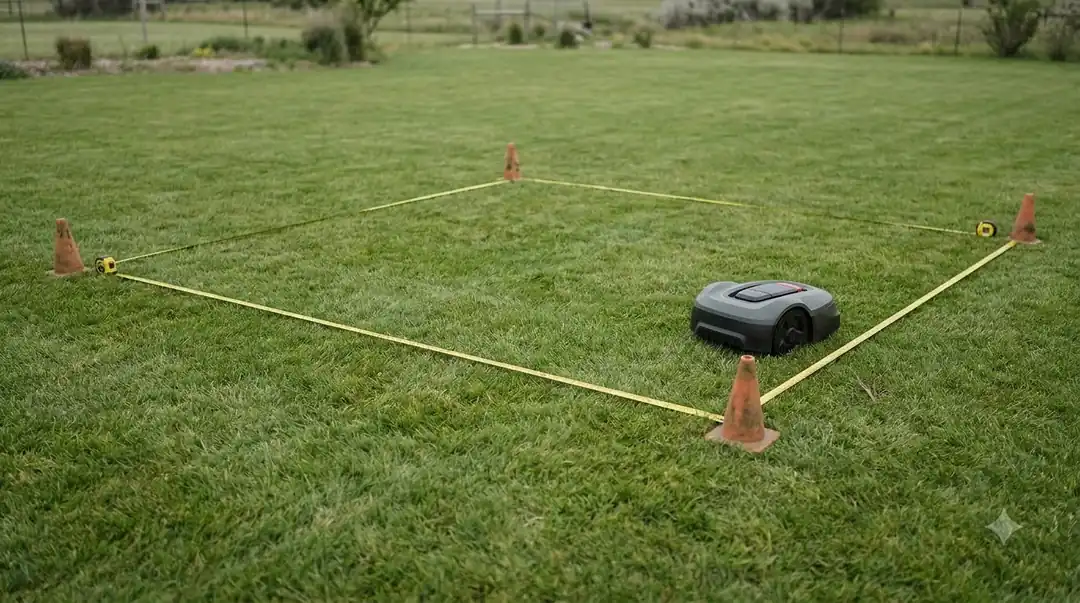
- Measure the clearance. Mark a loop around the pit with enough room for the mower to turn outside it. Include any ash or log storage spot you do not want the mower to visit.
- Lay the wire. Route the wire around the marked loop and secure it with pegs; for general installation basics see installing robot mower boundary wire. Husqvarna warns that the wire must not cross itself.
- Check the result. If the wire crosses, Husqvarna says the mower will not recognize the island and will stop. Run a short test cycle and watch where the mower turns.
Our reading is that the loop should leave a clear route between the lawn and the charging station. Other bulky garden items raise a similar question, covered in how a robot mower handles garden furniture. A wire island that cuts off the way back to the dock would stop the mower from doing its job, so plan the loop before you bury the wire.
Set up a FlexiFence zone instead
FlexiFence is a battery-powered unit. Husqvarna describes it as a zone the robotic lawn mower cannot enter or cut grass in. The trade-off is that the zone depends on its battery.
| Option | How it is set up | Key limit |
|---|---|---|
| Boundary wire island | Wire loop around the pit, pegged into the lawn | The wire must not cross itself; a crossing stops the mower |
| FlexiFence zone | Battery unit that creates the zone in the work area | Must stay charged; installed in the work area, not across a guide wire |
Husqvarna’s FlexiFence guidance sets out the battery rules. The product does not operate while it charges, it does not operate when the battery is empty, and if it is not used for a long time, the battery should be charged to at least 60% every three months. If the mower starts before FlexiFence is charged, the mower can cut in the zone. That makes a charge check part of your routine, not a one-time setup step.
Husqvarna’s FlexiFence article covers installation in full, including the rule about guide wires.
Let the ashes cool before the mower runs nearby
Fire departments give cooling times that are much longer than most people expect. The City of Boise Fire Department recommends allowing ashes to cool in the area of the fire for four days, and it says to dump ashes only after at least one week. Crystal Lake Fire Protection District gives the same pattern: at least four days in the burn location, with a week as the minimum before moving ashes.
Both agencies warn that ashes can hold heat for days after a fire looks out. Boise notes that coal and ashes can remain hot enough to reignite and start a fire for many days. Crystal Lake advises treating all ashes as hot, even when they seem cool.
So how does a robot mower handle a fire pit after an evening fire? It comes down to timing: the pit area should stay off the mower’s schedule until the ashes have cooled for days, not hours. Our reading is that a mower running over a warm pit base or near spilled embers is a risk the sensors will not reduce.
Keep the ash container off the mowing route
Ash goes into a tightly covered metal container, and that container should sit well away from the lawn the mower uses. Boise asks for a metal container at least 10 feet from the home, other buildings and combustible materials. Crystal Lake asks for a metal or earthenware container with an air-tight, non-flammable lid, set on a non-combustible surface at least 10 feet from combustibles.
Heads up
Never empty hot ash into a plastic trash can, a cardboard box or a paper bag. Boise says never to empty hot ash into plastic or paper, and Crystal Lake asks for a non-combustible surface under the container.
- Container spot: on a non-combustible surface, away from the mower’s route and its dock path.
- Lid: tightly closed, with nothing combustible stored inside.
- Distance: at least 10 feet from buildings and combustibles.
What to check before you rely on the mower near a fire pit
How does a robot mower handle a fire pit in your own yard? That depends on setup, and the mower’s sensors are only one layer of the plan. Before you rely on any setup, check the points below in your manual and in your own yard. For the wider safety picture, see our guide on how dangerous robot mowers can be.
- Sensor list: which obstacle sensors the model uses, and whether it detects objects before contact.
- Avoidance limits: how flat, low and small objects are handled, and how tall grass affects detection.
- Zone method: whether a wire island or a battery zone fits the pit layout.
- Zone battery: whether the FlexiFence battery is charged, if you use one. A pool or similar hazard area has its own guide in how a robot mower handles a swimming pool.
- Cooling plan: a fixed rule for when the pit area is safe to mow near.
Frequently asked questions
How does a robot mower handle a fire pit when it is still hot?
The mower can react to the pit as an object, but the sources we read describe object sensing, not heat sensing. Fence the pit with a boundary island or FlexiFence so the mower stays out of the area altogether.
Can a robot mower mow around ashes that are still warm?
It is not a good idea. Crystal Lake Fire Protection District advises treating all ashes as hot even when they seem cool, and Boise notes that coals can stay hot enough to reignite for many days.
Is a FlexiFence zone enough to protect the pit?
It helps only while the battery is charged. Husqvarna says FlexiFence does not operate when its battery is empty, and the mower can cut in the zone if it starts before FlexiFence is charged.
How long should ashes cool before they are moved?
Boise recommends four days of cooling in the area of the fire and dumping only after at least one week. Crystal Lake uses the same pattern, with at least four days in the burn location and a week as the minimum before moving them.
Sources
- Install and use Automower FlexiFence in boundary wire installations (Husqvarna): zone behavior, battery rules, guide wire placement.
- How to create islands in a boundary wire Automower installation (Husqvarna): island use for beds and rockeries, wire crossing rule.
- Object avoidance with radar or ultrasonic sensors in Automower robotic lawn mowers (Husqvarna): detection limits and the “not a safety feature” statement.
- How robot lawn mowers cut grass without whacking off your toes (PCWorld): bump, ultrasonic and lift sensor overview.
- Hot Ash Can Program (City of Boise Fire): cooling time, metal container, 10-foot clearance.
- Fireplace and ash disposal safety (Crystal Lake Fire Protection District): minimum cooling time, lidded metal container, hot-coal warning.
 Up next8 min readBy YardHow Does a Robot Mower Handle Kids Toys?Updated Nov 11, 2026
 9 min readBy YardHow Does a Robot Mower Handle Solar Lights?Updated Nov 11, 2026
 8 min readBy YardHow Does a Robot Mower Handle Raised Garden Beds?Updated Nov 11, 2026
 9 min readBy YardHow Does a Robot Mower Handle Lawn Ornaments?Updated Nov 11, 2026
 7 min readBy YardHow Does a Robot Mower Handle Fallen Branches?Updated Nov 11, 2026
 9 min readBy YardHow Does a Robot Mower Handle Garden Furniture?Updated Nov 11, 2026