
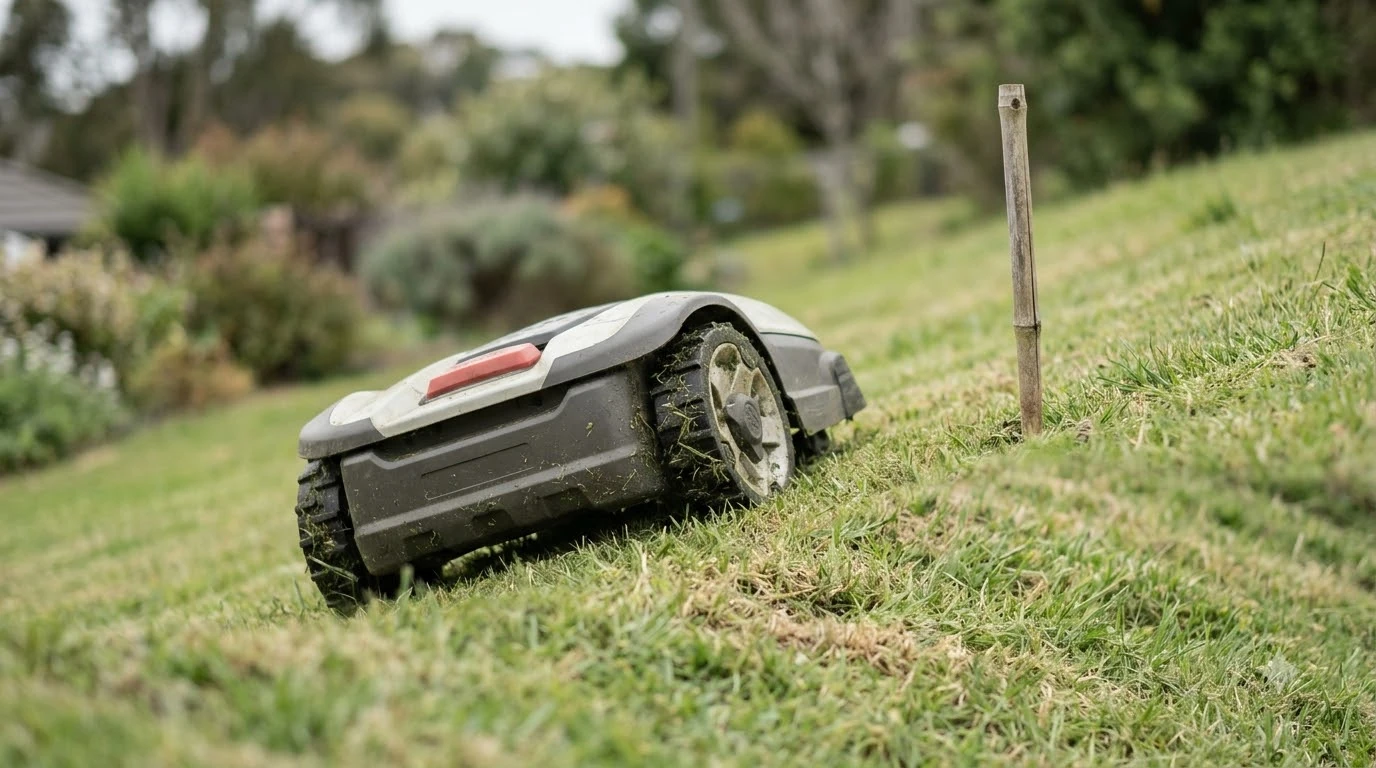

What is the best robot lawn mower for a 1/2 acre with slopes? It is the one whose slope rating clears your steepest section and whose coverage rating sits well above your real mowing area. No single model wins for every yard. Start with two numbers from your lot, then compare machines against them.
The short answer
- Slope first. Find the steepest section you need to mow. The Dreame buying guide says two-wheel drive models can be ruled out if any section runs steeper than about 35 percent.
- Size up. Makers suggest a coverage rating at least 20 to 30 percent above your mowable area, and 30 to 50 percent above for a 2,000 m2 (about 0.5 acre) lawn.
- Pick navigation by yard shape. Boundary wire, RTK, vision and LiDAR each trade setup effort against accuracy under trees and near buildings.
Measure the mowable area of your half acre
A half acre is 21,780 square feet (see a half acre in square feet for the conversion), but the mower only cuts the grass. Beds, patios, driveways and trees take space out of that number before a robot starts, so the figure to plan with is the mowable area.
Clemson HGIC describes the offset method for irregular lawns. Find the longest line across the lawn and label its ends A and B. Mark offset lines at right angles to that line, spaced so they divide it into equal parts. Measure the length at each offset line, add those lengths, and multiply by the distance between the offset lines. The publication notes that the closer the offset lines are, the more accurate the estimate. Clemson HGIC, measuring the area of a home lawn.
Our reading: write the mowable square footage on paper before you look at any spec sheet. A mower sized to the total lot will often fall short once the beds are subtracted.
Slope units: percent and degrees are not interchangeable
Makers and retailers quote slope in percent, in degrees, or in a ratio, and the three can be confused. Iowa State Extension uses ratios and percent together. A slope of 1:5 is 20 percent, and a slope of 1:12 is about 8 percent. Extension also treats 20 percent (1:5) or steeper as steep ground that needs special planning.
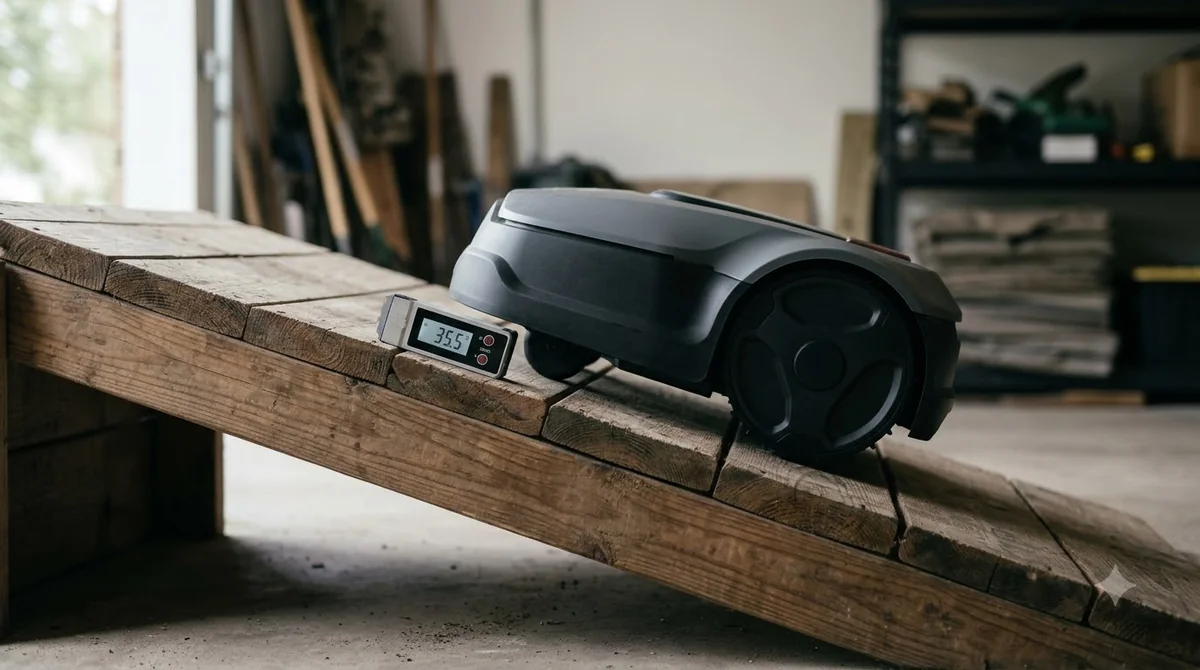
Our reading: percent is rise divided by run, times 100. A 45-degree angle is 100 percent, which is far steeper than most people expect. Do not compare a percent rating with a degree rating without converting one of them first. If you have not measured yet, start with measuring slope in your own yard.
The same extension page says slopes of about 30 percent (1:3) or more are too steep to mow with turfgrass, and that mowing on an incline is inconvenient and possibly dangerous. That guidance is written for conventional mowing, but it shows where a rider or walk-behind starts to struggle, and it gives you a sense of what a robot mower is being asked to do. Iowa State Extension, gardening on slopes and hillsides.
Why the slope rating matters more than the acreage
The answer to what is the best robot lawn mower for a 1/2 acre with slopes starts with the slope rating, because acreage tells you how much grass there is, while slope tells you whether the mower can keep moving across it. The Dreame guide says slopes increase motor load and drain the battery faster, which reduces effective coverage. A mower that handles the lawn on paper can still cover less ground once a hill is in the yard.
Ratings from makers do not all describe the same test. A retailer category page for steep-slope robot mowers lists maker-stated ratings from 42 percent to 80 percent, and some of its own product descriptions contradict the listed number for the same model. Treat any single listing as a starting point and confirm the slope rating on the maker’s spec sheet before you buy.
Our reading: a rating that just matches your steepest slope leaves no margin for wet grass or a worn battery. Look for a rating above your steepest section rather than equal to it, and read slope ratings explained for robot mowers if the figures on a spec sheet look inconsistent.
Coverage headroom for a half acre
Rated coverage is the figure makers print on the box (robot mower coverage ratings are covered in a separate guide), and it usually assumes an ideal lawn. The Dreame guide says a yard can lose 20 to 30 percent of rated coverage to trees and beds, to slopes, to complex boundaries, and to wet grass. In its example, a mower rated for half an acre realistically covers 0.35 to 0.4 acres in a typical suburban yard.
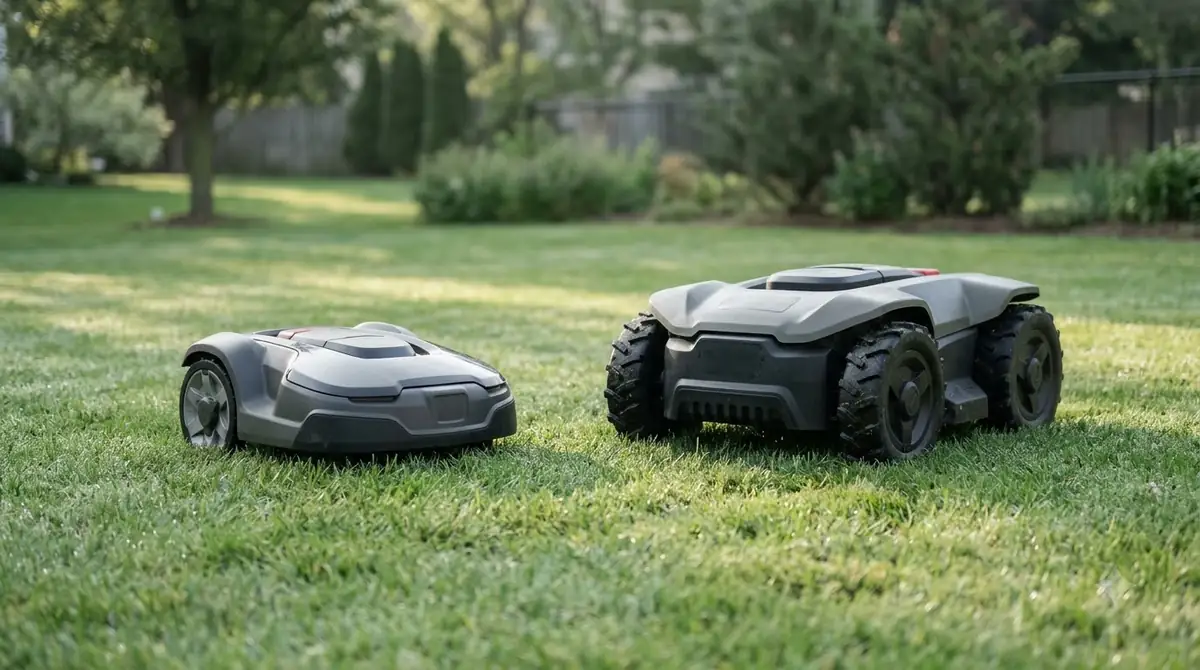
The same guide advises that the coverage rating should exceed the actual mowing area by at least 20 to 30 percent, and that a 0.4-acre yard should use a 0.7-acre model rather than a 0.5-acre one. For a half-acre lot with hills and trees, that points toward the upper end of the half-acre class rather than the minimum.
Our reading: when you ask what is the best robot lawn mower for a 1/2 acre with slopes and your mowable area after subtracting beds is close to 0.5 acre, plan for a model rated well above that figure. If the mowable area is closer to 0.3 acre, a smaller model with a strong slope rating may be the better fit.
When all-wheel drive matters on slopes
The Dreame guide draws the line at about 35 percent. Below that, it says two-wheel drive models can be fine. Above it, the same guide rules out two-wheel drive, so AWD is the model class to compare; what AWD means on a robot mower explains the difference.
Our reading: a half acre with a single gentle slope may not need AWD, but a lot with several sections above 35 percent should be compared only among AWD models. Check the wheel layout in the spec sheet, not only the marketing name.

Navigation on a sloped half acre: wire, RTK, vision or LiDAR
Navigation decides how the mower finds its way across a lot, and each type behaves differently on a slope with trees. The Dreame guide summarizes the trade-offs as follows.
| Navigation | What the maker says | Watch for |
|---|---|---|
| Boundary wire | Reliable on simple rectangular lawns and cheap to run | Setup takes 2 to 3 hours of digging, and layout changes mean re-burying the wire |
| RTK GPS | Centimeter-level accuracy in open sky | Loses accuracy under tree canopy and near tall buildings |
| Vision | Detects obstacles in real time | Less reliable in low light and along open boundaries |
| LiDAR | Works in any lighting, under canopy, across slopes and in multi-zone layouts | Does not depend on GPS or buried wire |
Our reading: a sloped half acre with mature trees tends to favor LiDAR or wire over RTK alone. An open lot with few trees is a better case for RTK.
What is the best robot lawn mower for a 1/2 acre with slopes? A pre-buy checklist
Before you compare models, write down the steepest section, the mowable area, whether trees or beds cut into the lawn, and whether you want to bury wire. Then check each model against those answers, not against a best-of ranking.
- Steepest slope. Measure the hardest section and note it in percent, not degrees, so you can compare with maker ratings.
- Slope rating. Confirm the maker’s rating on its own spec sheet and keep a margin above your steepest section.
- Mowable area. Subtract beds, patios and driveways from the half acre, then size up for the 20 to 30 percent coverage loss.
- Drive layout. Above about 35 percent, shortlist AWD models only.
- Navigation. Match wire, RTK, vision or LiDAR to how many trees and buildings the lot has.
Our reading: the answer to what is the best robot lawn mower for a 1/2 acre with slopes is the model that passes all five checks, not the one that tops a list. Compare at least three models against the same numbers before you decide.
Frequently asked questions
Is there one best robot lawn mower for a 1/2 acre with slopes?
No single model wins for every yard. The deciding limits are whether the slope rating clears your steepest section and whether the rated coverage, after the 20 to 30 percent loss from trees, beds and slopes, still covers your mowable area.
What slope rating do I need for a hilly half acre?
Choose a rating above your steepest section rather than equal to it. The Dreame guide says two-wheel drive can be ruled out above about 35 percent, so a hilly lot usually calls for AWD.
Is slope rating in percent or degrees?
Both are used, and they are not interchangeable. Percent is rise divided by run, times 100. A 45-degree angle equals 100 percent, so always convert before comparing a percent rating with a degree rating.
Do I need boundary wire on a sloped lot?
Not always. Wire is reliable on simple lawns but takes hours to bury, and it has to be re-buried when the layout changes. Wire-free options such as LiDAR or RTK are common alternatives, though RTK can lose accuracy under tree canopy.
Sources
- Robot Lawn Mower Buying Guide (Dreame): slope and AWD threshold, coverage buffer, coverage losses, navigation trade-offs.
- Gardening on Slopes and Hillsides (Iowa State University Extension): slope ratios, the 20 percent steep threshold, and mowing guidance.
- Measuring the Area of a Home Lawn (Clemson Home and Garden Information Center): offset method for irregular lawns.
- Robotic Lawn Mowers for Steep Slopes and Hills (retailer category page): range of maker-stated slope ratings, with conflicting listing text noted.
 Up next8 min readBest Robot MowersBest Robot Lawn Mower for 1/2 Acre: How to Choose by Lawn SizeUpdated Nov 11, 2026
 7 min readBest Robot MowersWhat Size Robot Mower Do You Need for 2 Acres?Updated Nov 11, 2026
 9 min readBest Robot MowersBest Robot Lawn Mower for 2 Acres: What to Check Before You BuyUpdated Nov 11, 2026
 8 min readBest Robot MowersWhat Size Robot Mower Do I Need for 1.5 Acres?Updated Nov 11, 2026
 8 min readBest Robot MowersWhat Size Robot Mower Do I Need for 1/4 Acre?Updated Nov 11, 2026
 7 min readBest Robot MowersBest Wireless Robot Mower for 1/3 Acre Lawn: What to CheckUpdated Nov 11, 2026