
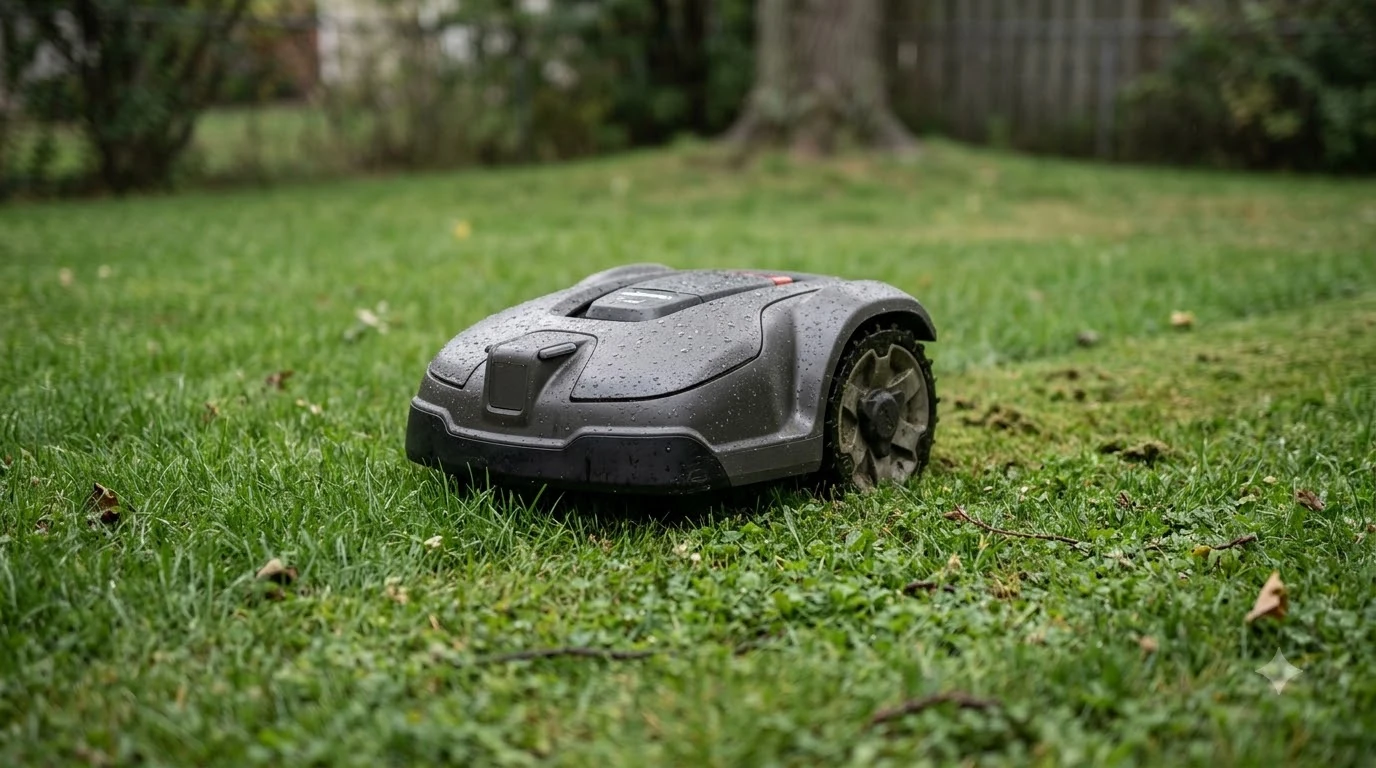

How long does the Anthbot M5 battery last? The Anthbot M5 LiDAR is rated for about 40 minutes of mowing on a full charge. The manufacturer gives a 60-minute charging time and a 2.5 Ah (45 Wh) battery. Once the battery runs low, the mower returns to its dock, charges, and carries on, so the useful question is less about one charge and more about how much lawn it covers in a day. These figures are as of November 2026.
The short answer
- Mowing per charge: 40 minutes, according to the manufacturer.
- Charging time: 60 minutes for a full charge.
- Battery: 2.5 Ah (45 Wh), located under the cover between the front wheels.
- Battery itself: robot mower packs are commonly rated at about 3 to 5 years of service, depending on use and storage, so the M5 pack should be judged by that longer timeline, not by the 40 minutes.
How long does the Anthbot M5 battery last on one charge?
The Anthbot M5 LiDAR is listed with a 2.5 Ah battery, which works out to 45 Wh. Two independent reviews of the model both repeat the manufacturer’s figures: 40 minutes of mowing time per charge and 60 minutes of charging time. The first figure describes the cutting time from a full pack, and the second describes how long the mower needs on the dock to reach full charge again. These are the numbers to compare when you ask how long the Anthbot M5 battery lasts against other mowers, because they show how the battery is sized for the job.
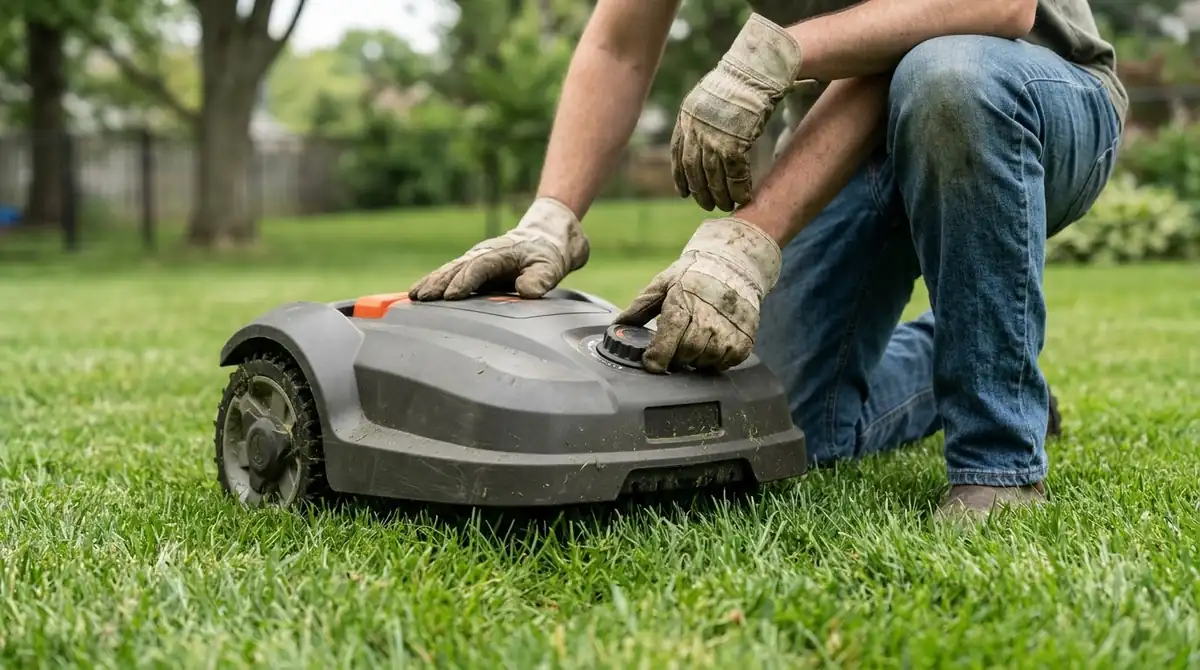
The battery sits under a cover between the front wheels. One review notes that the battery compartment can be reached by removing screws, which matters if you ever need to replace the pack. The manufacturer’s own runtime figure is the starting point for any estimate of how long the Anthbot M5 battery lasts in your yard, not a guarantee, since grass height, slope, and cutting height all change how much energy each minute of mowing uses.
What 40 minutes means for a real lawn
So how long does the Anthbot M5 battery last on a real lawn? It depends on the lawn, because the 500 m² figure in the M5 specifications is the recommended coverage area.
Forty minutes of cutting per charge does not map neatly onto that area, because the mower does not cut the same amount of grass in every minute. Turns, narrow passages, slopes, and long grass all slow it down. One reviewer tested the M5 on a 200 m² area and reported that the mower did not finish the area in one go; the test took about 150 minutes of pure mowing time once the charging pauses were removed. That is a reviewer’s result on one lawn, not our own test, and it should be read as one data point.
Our own arithmetic, using only the manufacturer figures, gives a simple picture. If the mower cuts for 40 minutes and then needs 60 minutes on the dock, a continuous run cycles through about 100 minutes, and roughly 40 percent of that time is spent cutting. A lawn that needs several hours of cutting time will therefore take a full day, not one charge. For a small lawn, one run may be enough; for a larger one, the schedule matters more than the 40-minute number.
How the Anthbot M5 battery recharges during a job
The M5 does not stop and wait for you when the battery gets low. According to the review that covers the in-box contents and the dock behaviour, the mower returns to its charging station, charges, and then continues mowing.
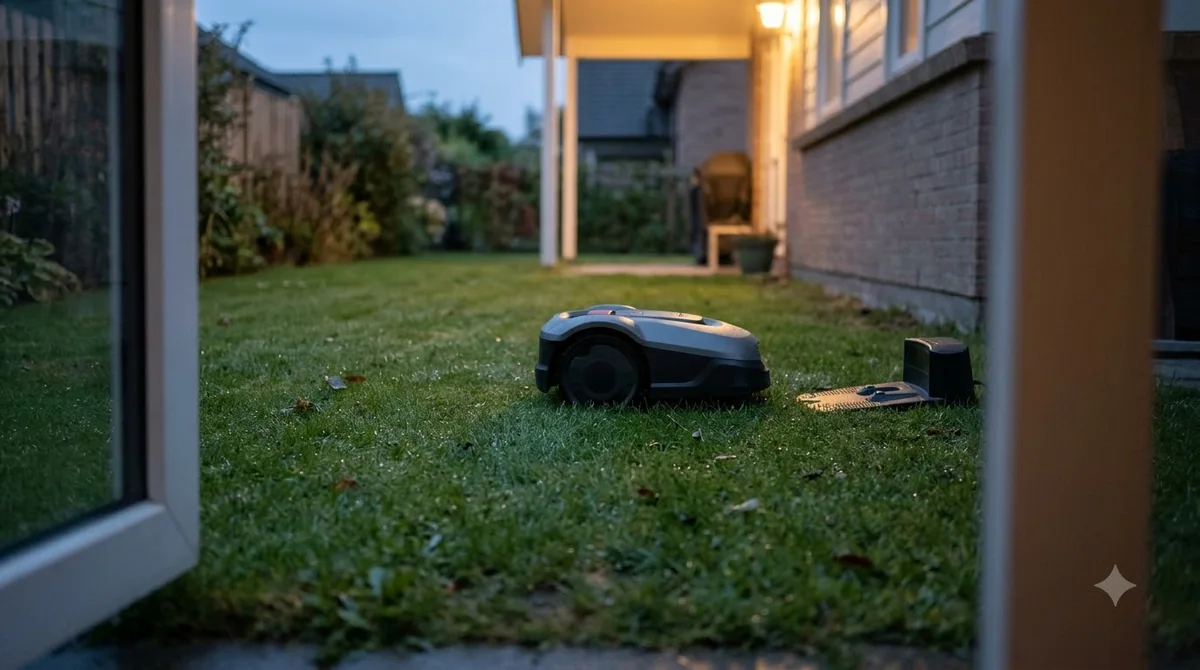
This matters for two reasons. First, the mower can cover more ground in a day than its 40-minute rating suggests, as long as the dock is reachable and the lawn is mapped. Second, a slow charge or a dock that is hard to reach extends the time the job takes, even when the battery itself is healthy. Placing the dock on level ground with a clear approach and a short run to the lawn helps keep each return trip predictable.
Heads up
The 40-minute and 60-minute figures come from the manufacturer and are repeated by reviewers. We did not measure them ourselves. Confirm them against the current user manual before you plan a schedule, because specifications for the same model can change between production runs.
How long the battery itself lasts
Runtime per charge and battery lifespan are different questions. Runtime tells you how much you get from one full pack. Lifespan tells you how many years the pack will hold a useful charge. For robot mowers in general, the published ranges are broadly consistent.
Ecovacs says robot lawn mowers normally last 3 to 5 years, depending on usage and battery type, and that a large lawn mowed every day wears the battery faster. Robomow lists average lithium-ion life at about 4 years, LiFePO4 at about 5 years, and NiMH at about 6 years. Husqvarna gives a range of around 2 to 4 years and makes the same point about daily use on a large lawn. Our robot mower lifespan guide compares these ranges in more detail.
If you are asking how long does the Anthbot M5 battery last in years, these figures are not specific to the M5 LiDAR. No manufacturer or reviewer we found publishes a cycle rating or a lifespan for this exact battery, so the honest answer is that the M5 pack should fall within the general range for lithium-ion mower batteries, but the actual number depends on your lawn and your habits.
What shortens robot mower battery life
Four habits show up most often in manufacturer guidance, and they shape how long the Anthbot M5 battery lasts in your yard too; see robot mower battery life for the general picture. Heat is the first: excessive heat can overheat a lithium-ion battery and shorten its life. Cold is the second, since extreme cold makes the battery lose power faster. Running the mower on a large lawn every day is the third, because a full cutting schedule means more charge cycles. The fourth is leaving the pack deeply discharged, which is why storage advice focuses on keeping a partial charge.
Our reading is that a shaded dock and a sensible cutting schedule do more for battery life than any single setting. If the mower can finish its area in a few runs per week instead of running at full capacity every day, the pack sees fewer deep cycles over its life.
Winter storage and simple checks
If the mower will sit through winter, the battery needs attention. Robomow advises storing the mower horizontally (our robot mower winter storage guide has the full steps), charging the battery to about 80 percent before winterization, and not letting it discharge fully. Ecovacs lists the warning signs of an aging battery: the mower recharges more often, or it takes longer to charge. If you notice either, the pack is wearing and the mower may need a new battery sooner than expected; upgrading a robot mower battery explains the options.
A simple check is to time one full cutting run and compare it with the 40-minute rating after a season of use. A large drop suggests the pack is aging. Keep a note of the date and the approximate lawn area each time you check, so you can see the trend rather than relying on a single reading. How long does the Anthbot M5 battery last in your yard is best answered by that trend, and by Anthbot M5 problems and complaints if the runtime drops early.
What to check before you buy or replace
If you already own the M5 and the battery is losing charge, ask whether the pack is a replaceable part. The review describes a removable battery compartment reached by removing screws, so the pack is designed to be swapped. Before ordering a replacement, check the battery rating on the label or in the manual and compare it with the 2.5 Ah (45 Wh) figure, so you buy the correct pack. Ask the seller or the manufacturer about the warranty period for the battery, because we could not confirm the M5 battery warranty term from a source we read.
If you are still choosing a mower, the 40-minute rating is one input among several. The size of your lawn, the slope, the cutting height, and how often you want the mower to run all matter more than any single runtime figure, and robot mower run time per day shows how to plan it. For a larger yard, compare the coverage rating and the charging time together, because a short run with a fast charge can cover more area than a long run with a slow one.
Frequently asked questions
How long does the Anthbot M5 LiDAR battery last on one charge?
The manufacturer rates the M5 LiDAR at about 40 minutes of mowing per full charge. Reviewers repeat that figure. Real cutting time depends on lawn size, slope, and grass height.
How long does the Anthbot M5 take to charge?
The manufacturer gives 60 minutes for a full charge. Charging starts when the mower returns to its dock.
How many years will the M5 battery last?
No source we read gives a lifespan for this exact battery. Robot mower batteries in general are commonly rated at about 3 to 5 years, with daily use on a large lawn shortening that.
Can I replace the Anthbot M5 battery myself?
One review describes a removable battery compartment reached by removing screws. Check the manual for the correct battery specification, and confirm the warranty terms with the seller before you replace it.
Sources
- Anthbot M5 LiDAR review (independent review): 2.5 Ah (45 Wh), 40 minutes mowing per charge, 60 minutes charging, dock return behaviour, removable battery compartment.
- Anthbot M5 LiDAR specifications and review (German review site): 2.5 Ah battery location, manufacturer figures of 40 minutes and 60 minutes, reviewer’s 200 m² run.
- How long do robot lawn mowers last (Ecovacs): 3 to 5 years, daily use on a large lawn, signs of an aging battery.
- How long does the battery of a robotic lawnmower last (Robomow): lithium-ion, LiFePO4 and NiMH lifespans, winter storage, one-year warranty.
- Battery life of a robot lawn mower (Husqvarna): range of about 2 to 4 years and the effect of daily use on a large lawn.
 Up next7 min readLearnHow long does the Ecovacs GOAT O1000 battery last?Updated Nov 11, 2026
 7 min readLearnHow Long Does the Dreame A1 Pro Battery Last?Updated Nov 12, 2026
 7 min readLearnHow Long Does the eufy E15 Battery Last?Updated Nov 12, 2026
 8 min readLearnHow Long Does the Worx Landroid Vision Battery Last?Updated Nov 12, 2026
 7 min readLearnHow Long Does the Segway Navimow i110N Battery LastUpdated Nov 11, 2026
 8 min readLearnHow Long Does the Husqvarna Automower 430X Battery Last?Updated Nov 12, 2026