
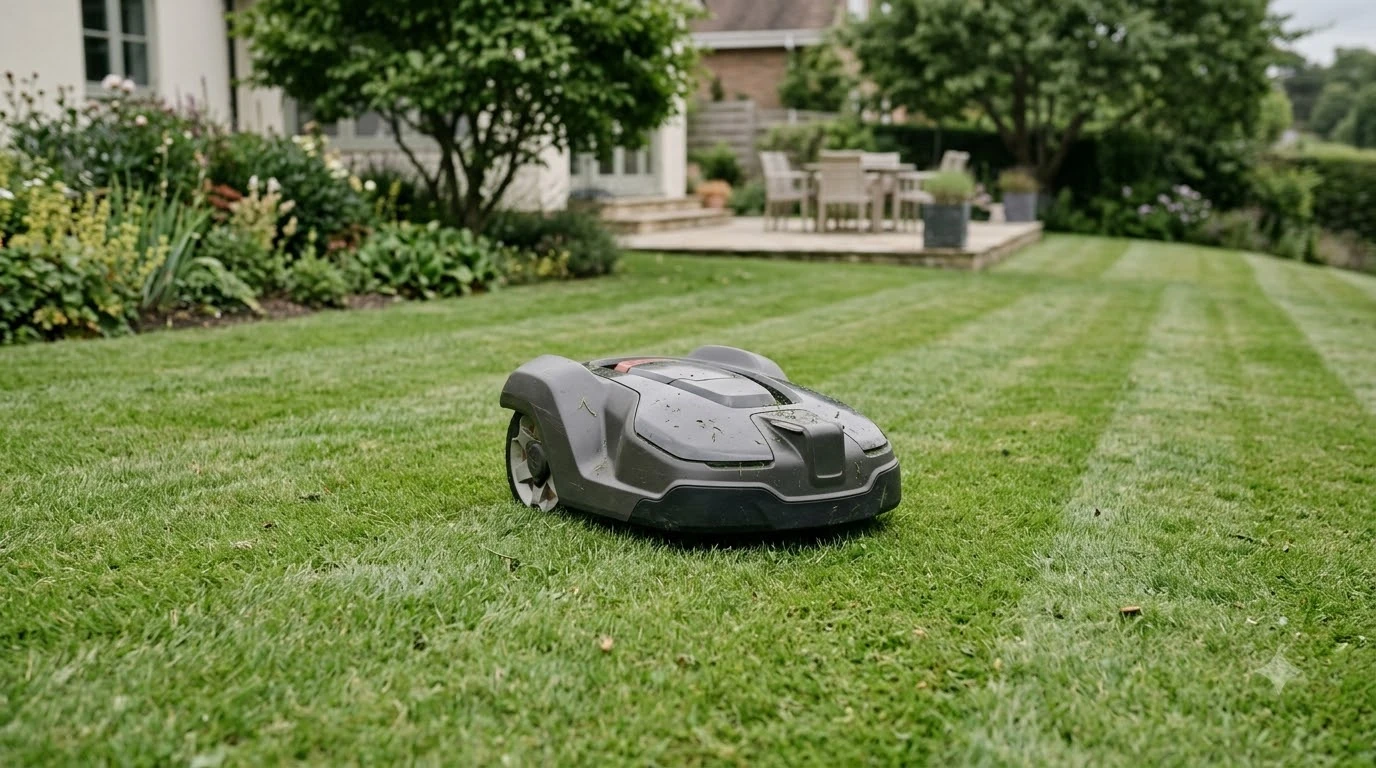

Can a robot mower work around a bird bath? Yes, if you set the bath up as an island in the boundary wire rather than rely on the mower to find its own way around it. A pedestal bird bath is a solid, freestanding object with a base that cannot be driven over, and the mower needs clear space around it. The details that matter are the wire clearance, how the wire loops around the base, and whether the model has object sensors that are reliable at the spot where the bath sits.
The short answer
- Treat it as an island. Manufacturers recommend wiring freestanding objects so the mower loops around them, not through them.
- Keep the wire clear of the base. Worx specifies a 26 cm (about 10 in) clearance on its island setup. Lawnmowers.com suggests 25 to 30 cm from soft edges and at least 30 cm from walls and tree trunks. For a solid pedestal, we recommend the larger figure.
- Do not rely on sensors alone. Whether a robot mower can work around a bird bath safely also depends on the model’s detection range and the light conditions, so the physical boundary is the safer plan.
Why a bird bath counts as an obstacle
Can a robot mower work around a bird bath? It comes down to the setup. A robot mower works inside the area its boundary defines. Anything inside that area that it cannot drive over has to be handled by the setup, not by luck. Husqvarna’s trapped-mower guidance names outdoor furniture as a common cause of a mower getting stuck behind an obstacle, which shows how a solid object can interrupt the mowing pattern even on a simple lawn.
Object detection is a separate layer. Husqvarna’s object detection article for its camera-equipped NERA range divides objects into two groups. Humans, animals and water hoses are treated as priority hazards, and the mower keeps a larger safety distance from them. Toys, garden furniture and flowerpots are described as lower risk, and the mower approaches them more closely before changing direction. The page does not list bird baths, so placing one in the lower-risk group is our reading by analogy, not a confirmed rule for any model.
The same page says the camera-based behaviour depends on the model. For the Aspire R6V, 308V and 312V, Husqvarna says the mower changes direction to avoid an object in daylight regardless of its type, but at night it operates without vision support. A bird bath therefore should not be left to detection alone, especially if the mower runs in the evening. For a wider look at sensor types, see how robot mowers avoid obstacles.
Can a robot mower work around a bird bath? Use an island
The island method is the standard way manufacturers handle a freestanding object in the middle of a lawn. Husqvarna’s island guidance recommends islands for areas such as flower beds and rockeries that the mower should stay away from, and the same logic applies to a pedestal base that the mower should not hit. Its steps are to run the wire from the boundary to the object, go around it without crossing, and close the loop by bringing the return run back side by side with the outward run. Husqvarna’s island page is a useful reference for the sequence.
Worx’s Landroid Classic guide gives the clearance number that most readers need. It says to surround the area while maintaining a 26 cm distance until the island is enclosed, then lay the wire so the mower stays out of the island and return along the same path, keeping the two strands side by side and never crossing them. Worx also advises keeping islands smaller than 6 m by 6 m (about 19 ft by 19 ft), so a single bird bath is well inside that limit. The Worx island page gives the full steps.
Anker’s perimeter wire guide points in the same direction. It advises keeping boundary wire about 30 to 35 cm from walls, fences, raised beds and other solid obstacles so the mower has room to turn without hitting hard surfaces, and it recommends an island for obstacles in the middle of the lawn, such as trees, ponds, flower beds or garden features. For other fixed objects, see how to lay boundary wire around trees and obstacles.
Clearance and placement rules that reduce problems
Clearance is the number most readers get wrong, because the wire is usually laid on the grass and the base of a bird bath is often wider at ground level than the pedestal above it. Measure the widest part of the base, add the clearance, and place the wire outside that boundary. The table below collects the figures from the sources we read so you can compare them side by side. So can a robot mower work around a bird bath without hitting it? Yes, once the wire clears the widest part of the base by the distance in your manual.
| Situation | Figure from the source | Source |
|---|---|---|
| Wire around an island (Worx Landroid Classic) | 26 cm (about 10 in) clearance while enclosing the area | Worx wiki |
| Wire from solid obstacles (walls, fences, raised beds) | About 30 to 35 cm | Anker |
| Wire from a wall, fence or tree trunk | At least 30 cm so the mower can turn without scraping | Lawnmowers.com guide |
| Wire from a soft edge (flower bed, gravel, mulch) | 25 to 30 cm | Lawnmowers.com guide |
| Island size | Under 6 m by 6 m | Worx wiki |
| Outbound and return wires | Side by side, about 1 cm apart, never crossing | Lawnmowers.com guide, Husqvarna |
Two further points are worth checking. First, the wire must not cross itself, because Husqvarna notes that the mower will not recognize the island and will stop if the wires cross. Second, if the bird bath sits on a slope or near a drop, the mower’s stability matters as much as the wire. The University of Florida’s IFAS extension notes that irrigation heads can disrupt operation, causing a mower to become unstable, stop, or be damaged, so a fountain, drip line or spray head near the bird bath deserves the same attention as the base itself.
Signs the mower is getting trapped near the bath
A mower that keeps getting stuck in the same spot is usually telling you the setup needs an island or a larger clearance. Husqvarna’s trapped-mower page lists three common causes: an obstacle such as outdoor furniture, narrow passages the mower struggles to navigate, and grass that is too long for the model. Its fixes are to move the mower to a clear area, remove the obstacle and restart, and, if the mower repeatedly gets trapped in one place, to create a stay-out zone or island around that spot. If it still collides, the isolated area should be enlarged.
Grass height is part of the same problem. Husqvarna’s table lists maximum grass heights by model, from 4 cm (1.6 in) for the Aspire R4 to 10 cm (3.9 in) for many other models, so check the figure for your exact model before deciding that the bird bath is the cause. Our reading is that a long strip of grass around a pedestal base often causes the same trapping symptoms as the obstacle itself, so trimming that strip is worth doing when you first set up the island.
When to rely on the manual and when to change the layout
So can a robot mower work around a bird bath on an open lawn? Yes, with little trouble, once the island is wired correctly and the grass around the base is kept short.
The University of Florida’s extension guide describes robot mowers as best suited to lawns with simple layouts and few obstacles, and it says they may struggle in complex landscapes with many obstacles. A single bird bath on an open lawn is a manageable case.
A bird bath inside a tight bed, a corner with a fence, or a narrow walkway is a different case, and the layout may need to change before the wire does. Moving the bath a short distance to a wider part of the lawn is often the cheapest fix, and it reduces the number of islands the setup has to carry. If your model supports no-go zones in its app, how to set up no-go zones on a robot mower explains the process.
Read your model’s manual for three details before you lay the wire: the object detection range and whether it works at night, the grass height limit, and the minimum passage width. Those settings decide whether a bird bath is a minor island or a real constraint. We recommend writing down the clearance you used, so that if the mower starts trapping later, you know whether the wire moved or the grass grew into the clearance.
Frequently asked questions
Can a robot mower work around a bird bath without hitting it?
It depends on the model and the setup. Camera-equipped models such as Husqvarna’s Aspire range change direction to avoid objects in daylight but operate without vision support at night. A wire-only setup relies on the boundary, so a freestanding base should be wired as an island.
How far should the boundary wire be from a bird bath?
Worx gives 26 cm (about 10 in) for an island while enclosing an area. Anker suggests about 30 to 35 cm from solid obstacles such as raised beds and fences. For a pedestal base, we recommend the larger figure because it leaves room for the mower to turn.
Should the bird bath be on the mower’s path?
Avoid it. Husqvarna lists narrow passages as a cause of trapping, and the University of Florida notes that robot mowers work best on simple layouts with few obstacles. Moving the bath to a wider section of lawn is usually the simplest fix.
Do I need an island if the mower has a bump sensor?
The sources we read do not say how a bump sensor handles a bird bath specifically. Manufacturers recommend islands for flower beds and rockeries, which are similar fixed objects, so an island is the more predictable choice. Check your model’s manual for its sensor behaviour before deciding.
Sources
- Husqvarna: how to create islands in an Automower installation (manufacturer): island method and the no-crossing rule.
- Worx: Landroid Classic, set up an island (manufacturer): 26 cm clearance and 6 m by 6 m island limit.
- Anker: robot lawn mower perimeter wire (manufacturer): 30 to 35 cm from solid obstacles, islands for mid-lawn objects.
- Lawnmowers.com: robotic mower boundary wire setup guide (retailer guide): hard and soft edge distances, 30 cm from walls and trunks, loop test.
- Husqvarna: object detection and avoidance with AI vision technology (manufacturer): priority and lower-risk object groups, night operation.
- Husqvarna: trapped Automower error message (manufacturer): causes of trapping and grass height limits by model.
- UF/IFAS EDIS: Autonomous or Robotic Mower Use on Florida Lawns (EP667) (university extension): layouts with few obstacles, irrigation head risk.
 Up next9 min readBy YardCan a Robot Mower Mow Around a Wildflower Patch? Setup Rules That WorkUpdated Nov 12, 2026
 9 min readBy YardHow to Lay Boundary Wire Around Trees and ObstaclesUpdated Nov 11, 2026
 8 min readBy YardCan a Robot Mower Work Around a Rain Garden?Updated Nov 12, 2026
 7 min readBy YardCan a Robot Mower Work Around a Wooden Deck?Updated Nov 12, 2026
 7 min readBy YardCan a Robot Mower Work Around a Hot Tub?Updated Nov 12, 2026
 9 min readBy YardCan a Robot Mower Work Around a Brick Walkway?Updated Nov 12, 2026